
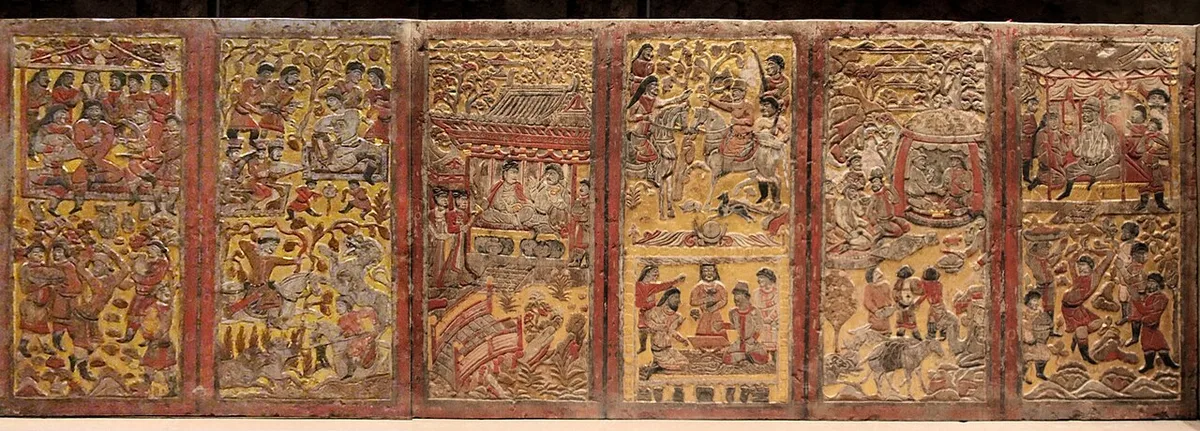
An Jia was a sabao, a head of the Sogdian community, under the Northern Zhou. He died in 579.[1] He came from Wuwei in Gansu and was culturally a Sogdian, which the reliefs of his couch show.[2] He was sabao of Tongzhou, one of the districts of Chang’an, and was later promoted to governor general.[2] His epitaph gives his father as a general and governor of Meizhou, a prefecture in Sichuan that the Wei did not control. The title is therefore probably fictitious, at best honorific.[2]
His tomb at Xi’an is one of four tombs of Central Asians found there and at Taiyuan since 1999. The others are those of Shi Jun, Kang Ye and Yu Hong.[3] The couch is of stone with painted reliefs. The epitaph puts the burial in 579.[3] In the tomb An Jia presents himself as a diplomat. The reliefs show trade with the nomads and Sogdians at work as envoys.[1]
Couch and burial
The tomb held a stone couch of the older sofa form, with three side panels. This form stayed in use in the Chang’an region of the Northern Zhou. It was not a house-shaped sarcophagus.[4] Over the entrance a tympanum carries a fire altar at its centre. The reliefs show a half-human, half-bird deity at a ritual and a purification by dogs before the soul crosses the Chinvat bridge.[5] The epitaph makes An Jia a sabao.[6]
How he was buried is not settled. The bones point to a secondary burial. They lay at the entrance of the tomb, and fire had scorched them.[7] His tomb lies in an area near Chang’an in which the Sogdian elite and other foreigners were buried in the sixth century. The tomb of a Brahman from Kashmir, Li Dan, was found there in 2005.[7]
The meeting with the ruler
One relief shows a nomad ruler who sits in a tent, with long hair down his back. The long hair marks him as a Göktürk.[8] A similar scene is on a couch in the Miho Museum.[8] In the meeting with the ruler, An Jia is joined by a man with a long sword at his belt. The man wears a crown that combines the wings of the winged crown with the crescents of the triple-crescent crown. His nationality has not been identified.[9]
References
Literature
- Etsuko Kageyama, The Winged Crown and the Triple-crescent Crown in the Sogdian Funerary Monuments from China: Their Relation to the Hephthalite Occupation of Central Asia (2007)
- Étienne de la Vaissière, Sogdian Traders: A History (2005)
- Shing Müller, Sogdier in China um 600 n. Chr. Archäologische Zeugnisse eines Lebens zwischen Assimilation und Identitätsbewahrung (2008)
What links here7
- Peoples
- Hephthalites · Sogdians
- Institutions and Titles
- Sabao
- Sources
- Tomb of Kang Ye · Tomb of Shi Jun · Tomb of Yu Hong
- Controversies
- Turkic-Sogdian Synthesis
Cite this article
Yavuz, Emre-E. “Tomb of An Jia.” Turkic Atlas, revised 7 November 2026. https://turkicatlas.org/sources/tomb-of-an-jia/
Last revised: 7 November 2026


