
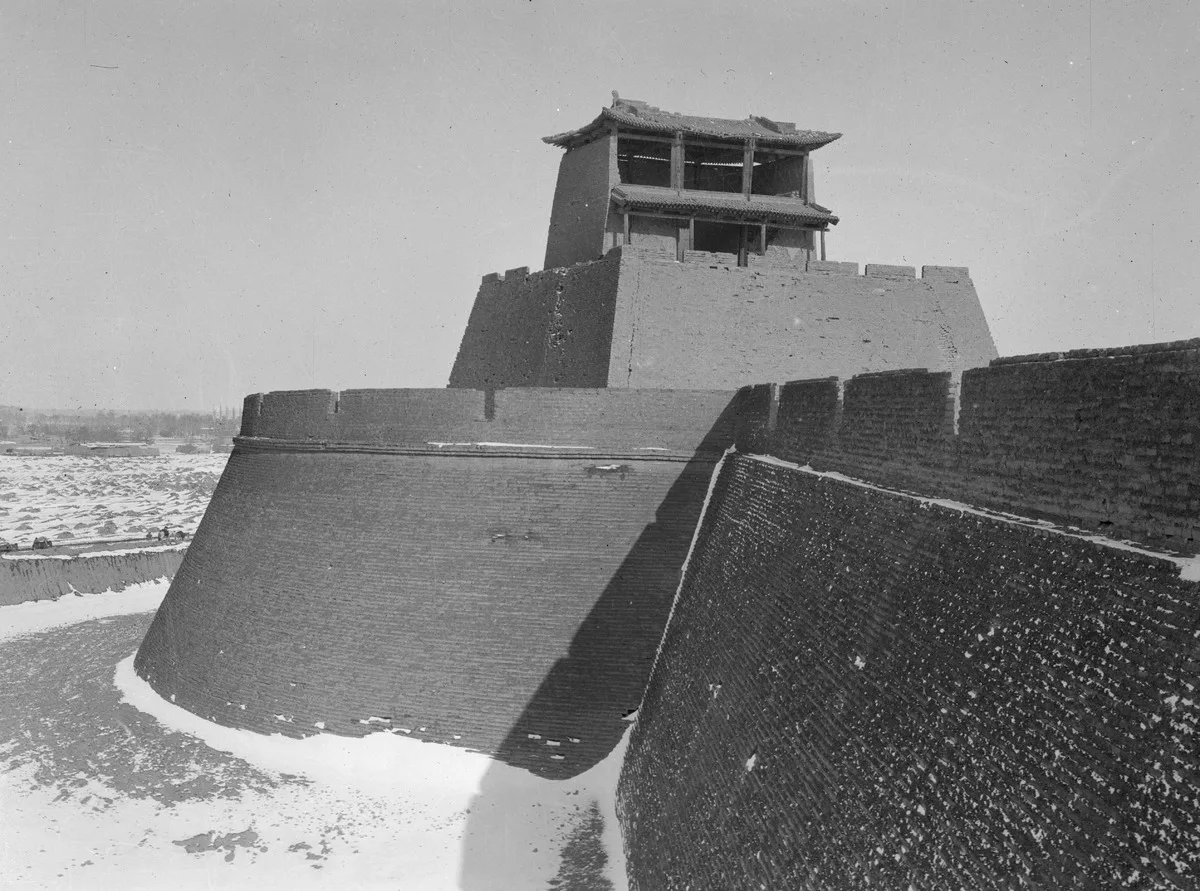
Wuwei, called Guzang in the older sources and the seat of Liangzhou, lay in the middle of the Gansu corridor.
The Han commandery
In the annals of Wudi in the Han Shu, Wuwei and Jiuquan were made commanderies together in 121 BC, from the land of the Hunye and Xiutu kings. Zhangye and Dunhuang followed in 111 BC, cut from the land of the first two.[1] The chapter on the Western Regions names Jiuquan alone as the first. It says that Wuwei, Zhangye and Dunhuang were set apart from it after settlers had been sent to fill the country.[2] The geographical treatise of the Han Shu is said to give 101 BC for Wuwei.[3] The Zizhi tongjian detaches Wuwei from Jiuquan later than 115 BC.[3] The place is the later Liangzhou.[4][5]
Sogdians and the Juqu
In 227 the heads of the Yuezhi and of the Sogdian communities of Liangzhou vied with each other to be the first to welcome an army from inner China. The “hu from Kangju” among them can only have been Sogdians.[6]
Ancient Letter II reports the agent Arsāch at Guzang safe and well. Letter V was sent from Guzang to the chief merchant Aspandhāt.[7] The Wei Shu records that the merchants of Sogdiana came in great numbers to Liangzhou to trade. All of them were captured when the Wei took Guzang in 439. The king of Sogdiana later sent to ransom them.[8] The Sui Shu ties the Göktürk ruling house to the same event. When Emperor Taiwu of the Wei destroyed the Juqu, the house of the Northern Liang, the Ashina fled with five hundred families to the Rouran.[9] The Juqu held Guzang until 439. Under the Zhou and the Sui a member of the An family lived at Wuwei as sabao, head of the Sogdian community.[10]
References
- ^ Han Shu, juan 6
- ^ Han Shu, juan 96
- ^ a b Chavannes 1913, v–vi
- ^ Chavannes 1913, v
- ^ Herrmann 1910, p. 118
- ^ de la Vaissière 2005a, p. 60
- ^ Sogdian Ancient Letters
- ^ de la Vaissière 2005a, p. 69
- ^ Sui Shu (Book of Sui), juan 84
- ^ de la Vaissière 2005a, p. 62
Sources
- Sogdian Ancient Letters
- Sui Shu (Book of Sui), juan 84
- Han Shu, juan 6, 96 (after Shiji)
Literature
- Étienne de la Vaissière, Sogdian Traders: A History (2005)
- Édouard Chavannes, Les documents chinois découverts par Aurel Stein dans les sables du Turkestan oriental (1913)
- Albert Herrmann, Die alten Seidenstrassen zwischen China und Syrien. Beiträge zur alten Geographie Asiens, Bd. 1 (1910)
What links here15
- Persons
- Emperor Wu of Han · Hunye King · Pei Ju · Que Dadu Shad
- Battles & Events
- Assembly at Mount Yanzhi (609) · Battle of Zhoupan (582) · Göktürk–Wei Campaign against Tuyuhun (556) · Northern Xiongnu Market at Wuwei (AD 84) · The Bargain with Mukan (562–563) · The Flight of the Ashina (439)
- Institutions and Titles
- Sabao · Trade Routes of the Steppe
- Sources
- Tomb of An Jia
Cite this article
Yavuz, Emre-E. “Wuwei.” Turkic Atlas, revised 7 November 2026. https://turkicatlas.org/places/wuwei/
Last revised: 7 November 2026

