
Anluochen, 菴羅辰, was the son of Anagui. He carried the Rouran house into exile and was the last of it to rule.[1] The Zhou Shu gives him a single clause. After the defeat north of Huaihuang in 552, Anagui killed himself, and “his son Anluochen fled to the Qi”.[1] The Bei Shi repeats the clause. It is therefore not a second witness.[2] What happened to Anluochen afterwards is recorded in the annals of the Qi, which are cited here from the text itself.[3]
The flight to the Qi (552)
The Qi annals date the collapse to the second month of 552 and name the men who came over. Anagui was defeated by the Göktürks and killed himself. His heir Anluochen came south with his followers, together with Anagui’s cousin Dengzhu, the ilteber, and Dengzhu’s son Kuti.[3] The remnant that stayed in the steppe set up Dengzhu’s second son, Tiefa, as their ruler.[3] The Northern Qi took the newcomers in. Within a short time it made them its instrument.
The Qi used them at once. In the second month of 553 it sent Tiefa’s father Dengzhu back north, together with Dengzhu’s son Kuti. Within a few months the Rouran throne changed hands three times. The Khitan killed Tiefa. The people set up Dengzhu. Dengzhu was killed by his own chief Afuti. The people then set up Kuti.[3]
Khan under the Qi (553)
In the twelfth month of 553 the Göktürks attacked the Rouran again. The whole people fled south.[3] Emperor Wenxuan marched north from Jinyang to meet the Göktürks and take the fugitives in.[3] He deposed Kuti and set up Anluochen, Anagui’s son, as ruler. He settled him on the Mayi river and gave him grain and silk.[3] The emperor then pursued the Göktürks as far as Shuozhou. There, according to the annals, the Göktürks asked to submit. The emperor allowed it and turned back. This was the Qi march to Shuozhou.[3]
That last statement of the annals is the Qi court’s own account of its campaign. No Göktürk or Zhou source confirms it.
Revolt and end (554–555)
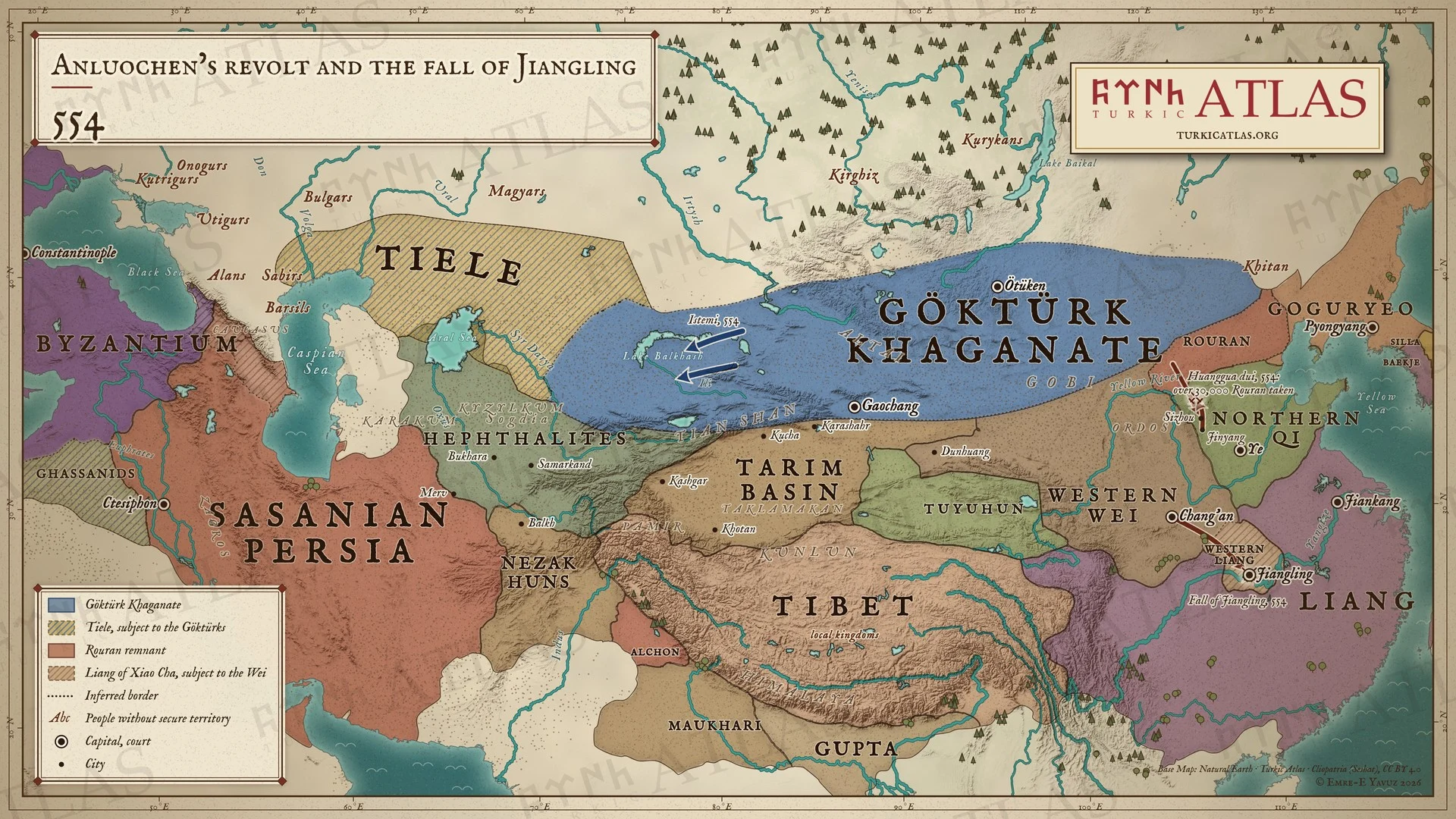
In the third month of 554 Anluochen revolted. The emperor took the field himself and beat him badly. Anluochen and his son fled north.[3] In the fourth month the Rouran raided Sizhou. The emperor pursued them to the Huanggua ridge in Hengzhou. There a Rouran division of tens of thousands surrounded him, and he had a thousand horse with him. He broke out and drove them twenty li over their own dead.[3] Anluochen’s wife and children were taken, along with more than thirty thousand people.[3]
The Qi went on destroying what was left. In the summer of 555 the emperor set out from the White Road with five thousand light horse. He caught the Rouran at Huaishuo and again at Woye. He took more than twenty thousand people and hundreds of thousands of cattle and sheep.[3] The annals do not say what became of Anluochen himself.
Assessment
In the two years after Anagui’s death, the Chinese took in the Rouran house, once linked by marriage to kings, and used it against the Göktürks. When it turned against them, they destroyed it. Anluochen is the name associated with this outcome.
References
Sources
- Zhou Shu (Book of Zhou), juan 50
- Bei Shi (History of the Northern Dynasties), juan 99 (after Wei Shu, Zhou Shu and Sui Shu)
- Bei Qi Shu (Book of Northern Qi), juan 4 (after Bei Shi)
Literature
- Emre-E. Yavuz, The Gokturk Empire: 2nd Edition (2025)
- Peter B. Golden, An Introduction to the History of the Turkic Peoples (1992)
What links here14
- Persons
- Anagui · Dengzhu · Gao Huan · Issik Khan
- States
- Eastern Wei · Northern Qi · Rouran Khaganate · Western Wei
- Battles & Events
- Battle of Mount Mulai (553) · The Qi March to Shuozhou (553)
- Places
- Mayi
- Lineages
- Yujiulü
Cite this article
Yavuz, Emre-E. “Anluochen.” Turkic Atlas, revised 8 November 2026. https://turkicatlas.org/persons/anlouchen/
Last revised: 8 November 2026

