

Istemi was a member of the Turkic Ashina clan and the younger brother of Bumin, the founder of the First Göktürk Khaganate. In 552, Bumin broke the rule of the Rouran. He died within the year.[1] Istemi took over the western half of the new realm and ruled it for twenty-three years. In those years he did more to enlarge the Göktürk state than any other ruler who held its title. The Altai Mountains lie between present-day Mongolia, China, Kazakhstan and Russia. In 553 Istemi led an army out of them into lands the Göktürks knew only by hearsay.
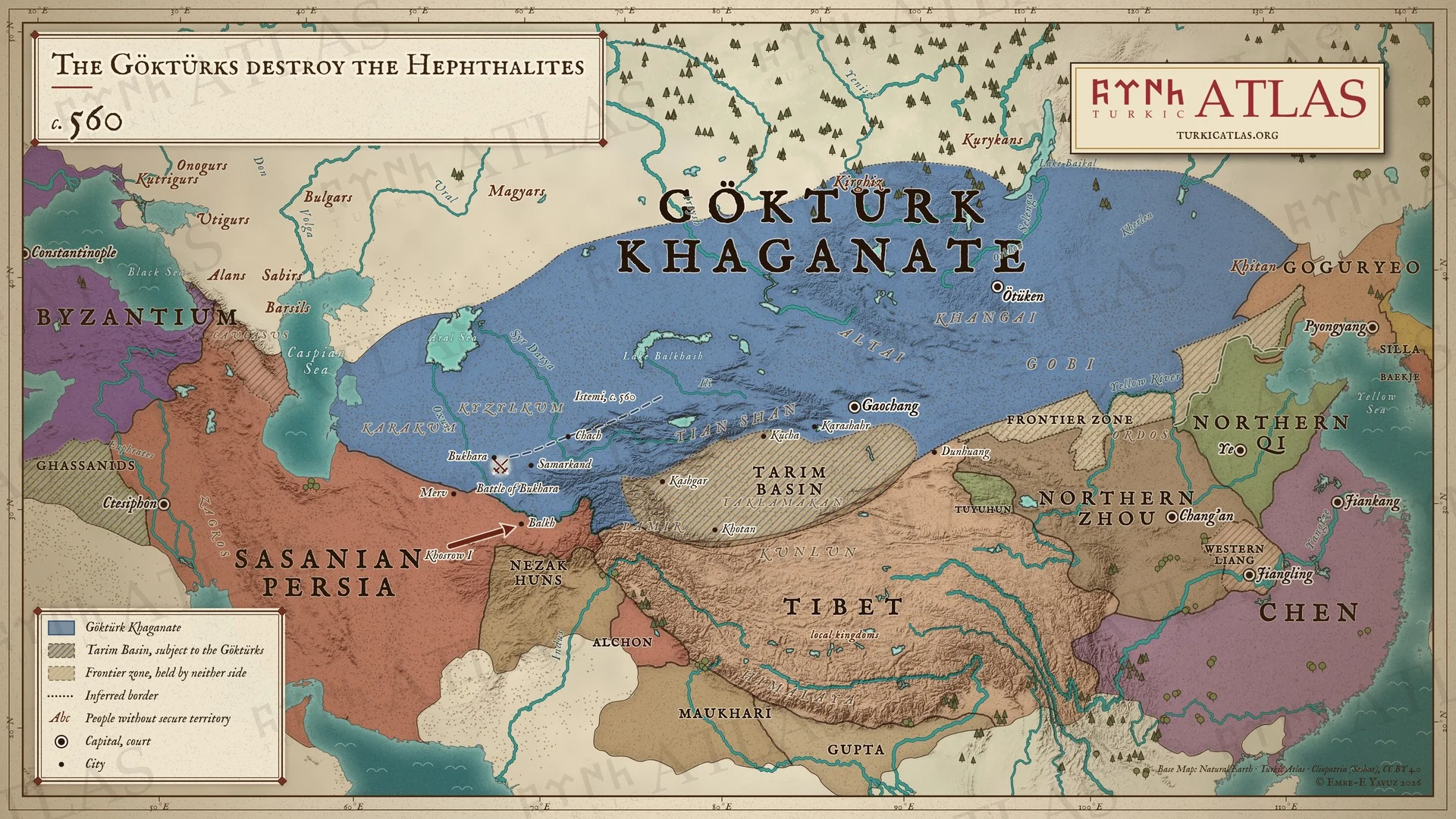
When he died in 576, the khaganate reached from the Khingan Mountains in Manchuria to the Volga and the northern Caucasus. Its frontier with Persia ran along the Oxus, the Amu Darya of today. Its horsemen had stood on the shore of the Caspian Sea. The Roman emperor in Constantinople had received his envoys. The trade of the Sogdian merchants on the Silk Road passed through Göktürk hands. Soon after his death, while his son still mourned him, the Göktürks sent an army against Bosporos in the Crimea.[2]
The sources for his life come from several sides. Only the stone inscriptions are Göktürk. The Chinese histories were written at the courts of northern China. The Zhou Shu and the Sui Shu, the histories of the dynasties of his own lifetime, do not name him at all.[3] The fullest contemporary account comes from the other end of the Silk Road. Menander Protector, a Byzantine historian of the late sixth century, preserved the reports of the Roman envoys who visited Istemi’s camp. The Romans saw him on his golden throne and called him the ruler of the Göktürks.[4]
The Göktürks themselves remembered him as a founder. The inscriptions carved for his brother’s descendants in the Orkhon valley two centuries later open with the two names side by side, Bumin Khan and Istemi Khan. They give the younger brother the same title as the elder.[5] According to some scholars, he held only the rank of yabgu, a deputy of the khan.[6]
Early life
Nothing is recorded of Istemi’s life before 552. The Xin Tang Shu, the later of the two histories of the Tang dynasty, traces the western Göktürks to Tuwu. Tuwu was a grandson of Nadulu and bore the title Great Yabgu. The history then puts the two brothers in order: the eldest son was Tumen Ili Khan, the second son was Istemi.[7] Tumen is the Chinese form of Bumin’s name. The order of birth is the whole of the evidence for Istemi’s age. Bumin was born between 510 and 515, and Istemi some years after him. The two were far enough apart in age for the sources to treat them very differently. They were close enough in age to have acted together through the 540s. Istemi was therefore about thirty-five when he marched west in 553.
Like his brother, Istemi grew up among the Ashina smiths of the Altai. They were a people bound to serve the Rouran. He probably learned to ride and to fight as every young man of the steppe did. He will have known the trade routes that ran west from the Altai, along which his later campaigns went.
The Zhou Shu, the history of the Northern Zhou dynasty, names Bumin alone as the leader of the War of Independence. What Istemi did between 546 and 552 is not recorded. As Bumin’s only brother, he probably held a command in that war. The army he was given in 553 suggests that he had already proved himself as a leader.
Then Bumin died. His son Issik became khan. The Tiele had submitted to Bumin in person. They considered that they had sworn loyalty to no one else. It has been argued that Istemi and Issik together averted a crisis of the state at the founder’s death.[8] In the spring of 553, Istemi appears in the record for the first time, at the head of his own campaign.
Western campaign (553–555)
Istemi gathered an army and marched west. With this march, the Göktürk advance along the Silk Road began. According to the Jiu Tang Shu, the older of the two Tang histories, Istemi followed the chanyu. He commanded the ten great chiefs and an army of a hundred thousand men. He went west to subdue the states of the Western Regions.[9] He made himself khan, and his people were called the Ten Clans. His line ruled them from generation to generation.[9] The same history explains the old title: a khagan is what the chanyu, the ruler of the Xiongnu, was in ancient times.[9] It does not say which ruler it means by the chanyu. Some identify him with Bumin.[10] The Ten Clans are the Ten Arrows of the western Göktürks.[10]
The older literature long repeated the figure of a hundred thousand.[11] Others consider the figure impossible for a force that had to move fast through unknown country. They put the army at thirty to fifty thousand, since Bumin had beaten the whole Tiele federation with fewer men.[12]
By the summer of 553, Istemi had reached the Seven Rivers, the Zhetysu in what is now south-eastern Kazakhstan. One reckoning dates his arrival at Lake Balkhash to 555.[13] The two years between would then be the time Istemi needed to visit every tribe and every small state of the western steppe. In that case, he brought each under the Ashina, by force where force was needed.[13] There he met the Tiele of the west. Beyond them lived peoples the Göktürks had heard of but never seen.
At the same time, the Göktürks took the Tarim Basin, the desert basin of present-day Xinjiang with its ring of oasis cities. The Rouran and the Hephthalites had divided the cities on the rim of the basin between them. The Göktürks reached these cities through the Dzungarian Gate. This is the eighty-kilometre corridor between the Dzungarian Alatau and the Tarbagatai mountains that leads from the Seven Rivers into the basin. The Göktürks held the Gate from then on. Mukan, Bumin’s son and the third khan, led the eastern wing, and Istemi led the western wing. The boundary between the two wings ran from the Altai down through Dzungaria to the Gate.
A wall painting in the Kizil caves near Kucha, an oasis city on the northern rim of the Tarim, has been dated to 552.[14] The painting shows the local rulers of the city leading armed newcomers in heavy armour and face masks into a building.[14] The newcomers may be Ashina nobles taking possession of the city.[14] The Göktürks did not govern the cities themselves. They took the tribute and the trade and left the local rulers in place, as they would do with every settled people they conquered.[15] They may have kept to a half-nomadic life and left only tax collectors in the oasis states.[16] A different explanation traces this indifference to the internal affairs of their subjects to the religion of the Göktürks.
With the Tarim and the Seven Rivers, the khaganate now bordered on the Hephthalites, the White Huns. The Hephthalites were then at the height of their power, from the Aral Sea to India. Between the two lay Sogdiana, the land of the Sogdian merchants between the Amu Darya and the Syr Darya, in present-day Uzbekistan and Tajikistan.
Bukhara and the fall of the Hephthalites
Sogdiana was a country of merchant cities without an army of their own. Each city had its own king. All of them stood under Hephthalite overlordship and kept Hephthalite garrisons. The largest garrison lay at Bukhara. The records of the city of Bukhara are said to tell how seven Sogdian kings met there. They sent to Istemi, whose power now reached the Jaxartes, the Syr Darya of today, and asked him to drive out the Hephthalites.[17] Whether the Sogdians really felt oppressed by the Hephthalites is not clear. The request is unsurprising in this setting, since every Sogdian city paid the Hephthalites taxes and kept a Hephthalite garrison.[18]
Istemi came. In 557 or 560, according to the two reckonings, the Göktürks crossed the Jaxartes without difficulty and took the town of Otrar on the way.[19] Otrar has been equated with Keŋü Tarman. The Kül Tegin inscription names Keŋü Tarman as the western limit to which the Second Göktürk Khaganate later settled its people.[19] Then the Göktürks appeared before Bukhara.[20] The Hephthalite ruler Ghadfar had called up help from Balkh, the old capital of Bactria in what is now northern Afghanistan.[21] The fighting is said to have lasted seven days and seven nights. On the eighth day the Göktürks broke in, horse and foot together, and found the citadel empty. The Hephthalite commanders had fled, Faganish to Bactria and Ghadfar to the Persians.[21] The sources do not say how a steppe army took a walled city, or with what siege engines. The Göktürks probably had help from inside the walls, from the Sogdians who had called them in.
Then the Persian army appeared on the Oxus, led by the great king himself, and halted. Only now did the Sogdians learn what Istemi and Khosrow I, the Sasanian king of Persia, had agreed in secret.[22] They had agreed on a war against the Hephthalites from two sides and a division of the spoils along the river. Everything north and east of the Oxus was to go to the Göktürks, and everything west of it to Persia.[23] Where the two kings came to terms, and through whom, is not recorded.
Tabari, the Persian-born historian who wrote in Arabic in Baghdad around 900, puts the bond first. Before Khosrow marched against the Hephthalites, he had become the khagan’s kinsman by marriage. He told the khagan of his plan and asked him to march against the Hephthalites as well.[24] The Sui Shu gives the destruction of the Hephthalites to the eastern khan Mukan. It names no Persian ally.[25] The Zhou Shu, too, has Mukan break the Hephthalites in the west.[1] Some scholars think Mukan was credited with the victory only nominally. The campaign was probably led by Istemi, who held the west.[26] Tabari gives it to the khagan Sinjibu, “the boldest and mightiest of all the Turks”. Sinjibu had the most numerous troops.[27] He killed Warz, the Hephthalite king, with the greater part of his army. He took their wealth and conquered their land, except for the parts that had fallen to Khosrow.[27] Sinjibu may be Istemi himself.[28][29] Theophanes of Byzantium, a Greek historian of the same years, says that the Göktürks beat the Hephthalites in battle. They took from them the markets and harbours of the Seres, the silk people of the far east, which the Persians had held before the Hephthalites.[30] The pact has been dated to the end of the war and the border to 560.[31]
Istemi did not pursue the remnant of the Hephthalites. He offered them terms. The survivors in Bactria had crowned Faganish king, and he was now caught between the Persians and the Göktürks. The terms required him to place himself under the Göktürk banner, as the Sogdians had done. He did so.[32] The Hephthalites kept their lesser royal titles. They had only to acknowledge the authority of the Ashina. Their experienced warriors joined Istemi’s army.[32] The offer may have been a bluff, since no pursuit had been planned. Istemi’s readiness to take in the Huns rather than punish them would then be a sign of kinship between the two peoples.[33] For a commander so far from home, the Hephthalite horsemen were probably worth more as soldiers than as enemies.
Oxus frontier with Persia
The border did not settle at once. One day in 560, Khosrow’s agents are said to have reported that a Göktürk force had crossed the desert and appeared in Gurgan, inside Persia, on the south-eastern shore of the Caspian Sea.[34] Khosrow marched there in person with a large army. He found Istemi waiting for him, hundreds of kilometres inside Persian territory, professing no intention of war.[34] Khosrow kept his composure and gave gifts. The settlement came out of this meeting.[34] Istemi handed over his Hephthalite vassal Faganish to the Persian capital. Part of the Hephthalites became clients of the Sasanians. The border was fixed along the Oxus from the Aral Sea southward, and a daughter of Istemi went to Khosrow as a wife.[31]
Tabari tells it differently. In his account the khagan Sinjibu won over the Abkhaz, the Bangar and the Balangar, peoples of the Caucasus. He came with a hundred and ten thousand warriors near the land of Sul and demanded money.[35] Khosrow had fortified the gate of Sul and the passes. He paid no heed, and the khagan went home with nothing achieved.[36]
The daughter was probably called Kayan. Hormizd IV, Khosrow’s son and successor, was most probably her son.[37] The Armenian history ascribed to Sebeos, written in the seventh century, calls Hormizd’s mother Kayēn, daughter of the great Khakʿan, king of the Tʿetals.[38] Tabari calls her the daughter of the khagan and the khatun.[39] Aṯ-Ṯaʿālibī, an Arabic writer of the early eleventh century, tells in his history of the Persian kings how the khagan offered Khosrow his daughter, in the hope that the king would have children by her. The khagan sent her to Khosrow in procession “with countless riches of all that the Turks possessed”.[40] In the same history, two of Khosrow’s old ministers call Hormizd “the son of the Turkish woman”.[41] None of these writers names the khagan. A grandson of Istemi on the Persian throne therefore remains a hypothesis.
In Iranian myth, the Oxus was the boundary between Iran and Turan, between the settled world and the world of the nomads. From 560 it was the boundary between Persia and the Göktürks. From this beginning, the name Turan came in time to mean the homeland of the Turkic peoples.[37] Istemi is said to have taken up residence at Bukhara, in the citadel. He sent most of his army back to the steppe.[42] Another suggestion has him set his eldest son over the Göktürk half of the Hephthalite lands as shad, with the seat at Bukhara. This son is identified with the Arsilas of Menander and the Shir-i Kishvar of the tale of Abrui.[43] The Sogdian cities, Samarkand among them, passed under Göktürk protection.[44] Istemi paid for the repair of the irrigation canals that decades of war between Huns and Persians had ruined.[45] The repair probably served Istemi as well, since a prosperous Sogdiana paid more tribute. A small district south-east of Bukhara fell to neither side. It would later bring the two sides into conflict.[44]
Silk embassies to Persia (568)
The peace lasted eight years. Then the Sogdian merchant guilds asked Istemi for leave to send an embassy to Ctesiphon, the Persian capital on the Tigris. They wanted to ask Khosrow for the right to trade across his empire.[45] In Menander the Sogdians, once subjects of the Hephthalites and now of the Göktürks, ask their king for an embassy to the Persians, so that they may sell raw silk to the Medes, as Menander calls the Persians.[46] The Sogdians had smuggled silkworm eggs from China to Constantinople through the young khaganate in the 550s. They knew exactly what the Persian monopoly on the westward silk trade was worth.[47] Theophanes of Byzantium tells the story of the eggs differently. Under Justinian, a Persian brought them from the land of the Seres to Constantinople in a hollow cane. Justin later showed the Göktürks how silk was bred and worked, to their astonishment.[30]
Istemi agreed reluctantly and sent a delegation of Sogdians. Khosrow received the gifts and bought all the merchandise at a fair price. Then he had it burned in the open street, so that the merchants and his own people would see that he acted from Persian interest and not from spite.[48] Menander names Maniakh as the leader of this first embassy.[49] He attributes the purchase and the fire to the advice of the Hephthalite Katulph. In his account the silk is burned before the envoys’ eyes.[50]
Istemi sent a second delegation, this time of Göktürks. Khosrow’s counsellors told him that Scythians, as the Greeks and Persians called the peoples of the steppe, were not to be trusted. He had part of the delegation poisoned at a banquet. He put it about that the northerners had died of the heat. A few were spared, presumably so that they could report to their master.[51] In Menander, all but three or four of the envoys died of poison mixed into their food, and the survivors suspected the truth.[50] Menander calls Istemi a shrewd and intelligent man who understood perfectly well what had been done to his envoys.[52] From this, he says, the enmity between the Persians and the Göktürks began.[52]
The episode can also be seen from the other side of the steppe. The silk the Sogdians wanted to sell in Persia was the silk that the Northern Zhou and the Northern Qi, the two rival states of northern China, were paying the Göktürks at exactly that time. Each paid a hundred thousand pieces a year. The Sogdians of the empire proposed to the Göktürk princes a way to double the profit of this Chinese tribute: they would carry the unused surplus west. The whole western growth of the Sogdian trade network would then have come out of the Göktürk silk. Khosrow’s bonfire may instead have been frontier policy rather than a blockade. The Sasanians controlled trade by permits at their frontier towns. They also had a merchant class of their own to protect. After the common victory over the Hephthalites, the Persian court chose to check the Göktürks by every means. It began with a lofty refusal to use the most symbolic fruit of their expansion, while avoiding the open provocation of confiscating the goods.
From the quarrel over the silk, Istemi learned that Persia was closed to Sogdian goods and Göktürk envoys alike. A Sogdian named Maniakh opened another route. Maniakh was a merchant of standing and a friend of the yabgu. His son was being raised at Istemi’s court. He had helped Istemi build his connections in the Sogdian cities.[53] Menander calls him the head of the Sogdians.[52] Maniakh proposed to lead an embassy himself, not to Persia but around it. He would take the dangerous northern road across the Volga, through the lands of the Onogurs and the Bulgars, to Constantinople.[53] In Menander, he advised Istemi to court the Romans instead and sell the silk to them, since they used more of it than any other people. He offered to go himself with Göktürk envoys. His road led over mountains that reached almost to the clouds, through plains and woods, over marshes and rivers, and at last across the Caucasus.[52] The Romans and the Persians had been enemies for six hundred years. On that ground, Istemi agreed to Maniakh’s plan.[54]
Embassy to Constantinople
Menander dates the embassy’s arrival in Constantinople, the Roman capital on the Bosporus, to the beginning of the fourth year of Justin’s reign.[46] That year began in November 568. Maniakh may have reached Constantinople in the summer of 568, at least eight years after Bukhara.[55] The emperor Justin II received him warmly.[55] Maniakh brought a gift of silk and a letter in Istemi’s name. Menander says that the letter was written in Scythian letters. The emperor had it read to him through an interpreter.[52] The script may be the Old Turkic runes.[55]
The emperor questioned the envoys closely. Menander preserved the questions.[52] Had they taken the whole power of the Hephthalites? Entirely. Did the Hephthalites live in villages or in cities? In cities. Then, said the emperor, you have become masters of all those cities. Indeed. As for the Avars, were they the Göktürks’ subjects? Some still obeyed. Those who had fled numbered about twenty thousand.[56] The envoys then named every people under their rule and proposed an alliance, offensive and defensive. They offered to crush any enemy who pressed on Roman territory. They swore with raised hands, calling a curse on themselves and on Istemi if they lied.[57] The Göktürks and the Romans, Menander says, became friends.[57]
Scholars draw three motives for the alliance with Rome from the exchange.[58] They were the trade, the quarrel with Persia, and the Avars. The Avars were the twenty thousand fugitives from the collapse of the Rouran. The Göktürks had been chasing them across the steppe, and Constantinople had just promised them protection.[58] An alliance would oblige the emperor to drop them. It would also oblige the Göktürks to help him if the Avars attacked, which the Göktürks would have been glad to do. These scholars call the alliance realpolitik and the Göktürks pragmatists in any case.[58] Theophanes of Byzantium records the Avar clause from the Roman side. The Göktürks beyond the Tanais, the river Don, whom the Persians called Kermichiones, sent envoys and gifts to Justin. They asked him not to receive the Avars.[59] Later the Avars asked for land in Pannonia, on the middle Danube, and for peace. Justin refused them because of his word to the Göktürks.[59]
Menander preserves Istemi’s own words about the Avars. Istemi spoke them when he learned of their flight and of the damage they had done to Göktürk possessions as they went. The Avars were not birds, he said, to escape the Göktürk swords through the air, nor fish, to vanish under the waves of the sea. They wandered on the face of the earth. When the Hephthalite war was over he would fall on them, and they would not escape his forces.[60] With that boast, Menander says, Istemi pressed on with the war against the Hephthalites.[60] The Byzantine historian Theophylact Simocatta preserves a Göktürk letter to the emperor Maurice. In it a khagan conquers the Hephthalites and then, with Stembischagan as his ally, enslaves the Avars.[61]
Roman embassy of Zemarchos
Justin sent Zemarchos back with Maniakh. Zemarchos was a Cilician from southern Anatolia and then commander of the cities of the East. The return embassy left Constantinople at the beginning of August 569, at the end of Justin’s fourth year.[57] An older count puts the departure in August 568.[62] When the Romans reached Sogdiana, Göktürk traders came at once to offer them iron. The offer may have been a demonstration that the Göktürks had mines in plenty and knew how to work them.[62] Menander’s own words are more guarded. He thought the offer was meant to show that they had iron mines, and he adds that iron was said to be hard to come by among them.[63] Others see in the scene the smiths of the Altai a generation on, and the trade in iron that had paid for Bumin’s war.[62]
Istemi received the embassy on a mountain that Menander calls Ektag and translates as Golden Mountain.[64] The word should rather mean White Mountain. It is not settled whether this was the Altai, the golden mountain of the Göktürks and the yabgu’s own seat, or a height in the Tian Shan.[65] One author places the camp on a mountain north of Kucha, in the Tian Shan.[66] Zemarchos found Istemi in a tent, on a golden throne on two wheels that a single horse could draw.[67] He delivered the emperor’s message.[64] Menander preserved it.[64]
Ruler of so many peoples! Our great emperor sends you this message through me. May good fortune attend you always; may you be drunk with success, you who are our friend and wish the Roman state well. May you always overcome your enemies. May envy, which can destroy the laws of friendship, stay far from us. The tribes of the Göktürks and the subjects of the Göktürks are my friends. Think the same of us.[68]
In Menander’s Greek, the emperor wishes that Istemi’s fortune be always favourable and good, since Istemi takes pleasure in the Romans and is friendly to them. He also wishes that Istemi defeat his enemies and take their spoil.[64]
Istemi answered in kind and treated the Romans almost as brothers. The pact was sealed with drink.[68] They feasted for the rest of the day in the same tent, which was hung with silks worked in colours. They drank a wine that was not pressed from grapes, since the country grows no vines.[4] What it was is not known. Kumis, beer, mead and rice wine have all been proposed.[65] Most likely it was kumis, the fermented mare’s milk of the steppe. Istemi received the Romans twice more, in other tents, each hung with silk and gold.[68] In the second tent, which was set with figures of various forms, he sat on a bed of solid gold. In the third, wooden pillars were sheathed in gold and a golden bed rested on four golden peacocks. In front of it stood wagons laden with silver dishes, baskets and silver figures of animals, in no way inferior to Roman work.[69][70] Some find it striking that a Roman diplomat should have said this of a people the old cliché called uncivilised nomads.
Then Istemi took Zemarchos to war. He invited Zemarchos and twenty of his people to ride with him on an expedition into Persian country. It was a raid for plunder rather than a conquest. At Talas, the present-day Taraz in southern Kazakhstan, a Persian envoy was in attendance.[71] In Menander, Zemarchos went with twenty servants and companions. The other Romans were sent back to wait in the country of the Kholiatai.[69] Istemi gave Zemarchos himself a slave woman, a captive of war from the people Menander calls Kherkhir.[69] They may be the Kirghiz.[72]
At the meal, Istemi seated the Roman above the Persian and accused Persia of wrongs. The Persian interrupted him mid-sentence with accusations of his own. This breach of manners confirmed the yabgu in his decision to attack.[71] In Menander, the Persian envoy disregarded the custom of silence at meals. He answered the charges so hotly that those present marvelled at his anger. Istemi then made ready for the campaign against Persia.[73] Maniakh had died in the meantime, of causes not recorded. Istemi sent Zemarchos home with Maniakh’s son, who already bore a title from the yabgu. He also sent a tarkhan named Tagma to carry the Göktürk oath to the emperor.[71] Menander gives the order of rank. Tagma, whose title was Tarkhan, led the new embassy. Maniakh’s son, still a very young man, had inherited his father’s rank and came next after him.[74]
On the way, in the Kuban country north of the Caucasus, between the mountains and the Volga delta, four thousand Persians lay in wait. They meant to seize Zemarchos, carry him to Ctesiphon and undo the alliance at the last minute.[75] The Alans, loyal to the Göktürks, and an unnamed Hunnic people under Göktürk authority saw the embassy through. It reached Constantinople.[75] In Menander, the warning came from the Ugurs, whose chief upheld Istemi’s power in that country. Four thousand Persians lay in ambush at the river Kophen. The Ugur chief gave the embassy water-skins for the desert.[76] In Alania, the ruler Sarodios warned that the Persians lay in wait in Suania, on the road through the Mindimianoi. He advised the road through Darene. Zemarchos sent ten porters laden with silk down the Mindimian road as a decoy. He himself went by Darene to Apsilia and the Black Sea, took ship to the Phasis and Trapezus, and rode the public post to the emperor.[77] Theophylact counts among the Roman grievances at the outbreak of the war with Persia that the Persians had tried to bribe the Alans to kill the very first Göktürk embassy on its way through their country.[78]
John of Ephesus, a church historian of the same years who wrote in Syriac, tells the embassy as the envoys reported it on their return.[79] In his account, it set out in Justin’s seventh year and travelled for a year before it reached the Göktürks.[80] The king who received it was one of several, for the Göktürks had eight other chiefs farther inland.[80] He wept when he saw the Romans. For two hours he did not speak.[81] Then he explained. His people had a tradition from of old that when Roman envoys entered their land, the whole world would pass away and all its kingdoms come to an end.[82] He took the gifts of gold, silver, pearls and robes. He called them the gifts of a great king.[82] Persian envoys were at his court. He asked the Romans whether it was true, as the Persians said, that the Roman emperor was the Persian king’s slave and paid him tribute.[82] Zemarchos answered with Trajan, whose statue in Persian land the Persians still feared to ride past. The Persians were called in. They admitted it, and the king sent them away in anger.[83] John adds that Khosrow had the statue overthrown. Khosrow suspected Rome of stirring these peoples against him, all the more because the king of the Göktürks had honoured the Roman envoys so highly.[84] John does not name the king. Menander’s account of the same embassy makes him Istemi.
Later embassies and the war with Persia
In Menander, the Göktürks were the strongest reason why Justin went to war with Persia. They had invaded the land of the Medes and laid it waste. They sent to Justin to urge him to join them in destroying the common enemy.[85] John of Ephesus gives the embassies to the Göktürks as the second cause of the war, after the surrender of the Persarmenians to Rome.[86] After Khosrow had taken Dara, the Roman frontier fortress in upper Mesopotamia, he sent two thousand captive Christian girls, dressed as brides, as a present to barbarians within his realm whose service he wished to buy. The manuscript has lost their name. Its editor restores it as “Turks” from John’s chapter on Zemarchos.[87] The girls drowned themselves in a river on the way.[88]
One count has five more Roman embassies go to Istemi’s court before 576, every one ambushed by Persian irregulars on the road.[75] Menander names the envoys with whom Göktürks had come to Constantinople: Anankastes, Eutychios, Valentinos, who had gone twice, Herodian and Paul the Cilician. He gives neither their dates nor their order.[89] In the years 575 and 576, some hundred and six Göktürks who had come at various times with those embassies were living in Constantinople.[89] Most of them were probably traders rather than a standing legation.[62] In Menander, the alliance broke soon after Istemi’s death, when the Göktürks took Bosporos and turned to open war with Rome.[2] According to some scholars, it survived the quarrel.[90] Istemi’s descendant Tong Yabgu renewed it in 627, when he met the emperor Heraclius under the walls of Tiflis, today’s Tbilisi. The whole western reach of these years, from the Volga to the Crimea, is the Göktürk expansion into Europe.
Death
The Roman envoy Valentinos left Constantinople in the second year of Tiberius as Caesar, between December 575 and December 576, to announce Tiberius’ elevation to the Göktürk rulers.[91] He came to the camp of Istemi’s son Turxanthos and found him in the greatest sorrow: “my father, Silziboulos, is recently dead”.[92] The date of 576 rests on this passage. The manner of his death is not recorded. Istemi was then in his late fifties, after twenty-three years at the head of the west.
Turxanthos told the Romans to follow the Göktürk custom for the dead and slash their faces with daggers. Valentinos and his companions cut their own cheeks.[92] The Sui Shu describes the same rite. The kinsmen sacrifice cattle and horses and go round the tent of the dead seven times, wailing. They cut their faces with knives until blood and tears run together.[25] On one of the days of mourning, four bound Hunnic captives were brought out with the dead man’s horses and bidden to go to Istemi and tell him how great …; the fragment breaks off there.[93] Menander gives the Göktürk word for the rites of the dead as dogia.[2] The inscription of 732 names the mourners at the funeral of the two founders: from the sunrise the Bökli and the Čölgil, and the Chinese, the Tibetans, the Avars, the Romans, the Kırgız, the Three Kurıkan, the Thirty Tatar, the Kıtañ and the Tatabı.[94] The words for the Avars and the Romans can be divided differently.[95] Then par is Persia, a name explained from Middle Iranian pahr, and apa urum is Great Rome, meaning Byzantium, so that the list holds no Avars.[95]
His son Tardush succeeded him as yabgu. The Xin Tang Shu names the filiation and gives the son both his titles, Datou Khan and Bujia Khan.[7] In Menander, Turxanthos sent Valentinos on to his brother Tardu, who lived on a mountain called Ektel.[2] The western seat moved from the Altai to Suyab on the Chu river, in present-day Kyrgyzstan.[96] Before the century was out, Tardush would break the one rule his father had kept: he would intervene in the affairs of the khan, east of the Altai.[97]
Names and rank
- 𐰃𐰾𐱅𐰢𐰃Sır YabguOld TurkicKül Tegin inscription
- 室點蜜ChineseXin Tangshu 215
- 瑟帝米ChineseXin Tangshu 215
- 室點密ChineseJiu Tangshu 194
- ΣιλζίβουλοςGreekMenander Protector
- ΣιζάβουλοςGreekMenander Protector
- ΣτεμβισχάδανGreekTheophylact Simocatta
- SinǧibūArabicTabari
- Istemi KhaganEnglish
The Göktürk chapters of the Zhou Shu and the Sui Shu do not name him at all.[3] The Xin Tang Shu does name him, at the head of its chapter on the western Göktürks: the second son was 室點蜜, also called 瑟帝米.[7] The Jiu Tang Shu, the older of the two Tang histories, writes 室點密 and calls him 室點密可汗, Istemi Khan.[9] That form, with the homophone 密, is the one usually printed in the modern literature. The runiform inscription of 732 spells the name as the second name of the founding pair.[94] The name is read Istemi in most editions and Ištemi by one scholar, who bases this on the Chinese form Shidianmi.[98] Menander writes Silziboulos in the sentence fragments and in the account of the mourning for his death. He writes Sizaboulos in the embassy fragments. The form Dizaboulos, which older editions and older literature print there, is not read in the critical text.[99][29] Modern scholarship understands the form as a Greek rendering of his title, Sir Yabgu, rather than of his name. The equation is generally accepted, though no source states it. Menander himself calls him the king of the Göktürks and their leader, and once the Chagan.[100] Two later names may be his: the khagan Sinjibu of Tabari and the Stembischagan of Theophylact Simocatta.[101] A third name is Qara Jurin, the Turkish lord with the nickname Biyaghu who in the History of Bukhara sends his son against the tyrant Abrui. Biyaghu may be yabghu and the lord Istemi, as the article on the tale sets out.[29] The name Istemi, like his brother’s, is not obviously Turkic. The question belongs with the names of the Ashina house as a whole.
Denis Sinor rejects the equation of Silziboulos with Istemi.[102] By his account, no adequate explanation of the Greek name has been given. The identification rests on nothing more than Istemi’s command in the west at the time of Maniakh’s mission. The difference in sound between the two names cannot be bridged.[103] He takes Maniakh’s statement that Silziboulos held the highest power among the four rulers for a diplomatic exaggeration. He takes Silziboulos himself for a minor chief, one of eight, whose dignity passed to his son Turxanthos.[103] The Chinese histories, he adds, give Istemi no second son besides Tardush. Tardush was already khan in the west in 576 and would certainly have come to the funeral of his father.[104] If Turxanthos and Tardu were brothers, as the Greek word is usually rendered, Sinor allows, the equation would follow.[105]
Against this stands what the sources show. Silziboulos is not known from Maniakh’s claim alone. Zemarchos saw him on a golden throne in tents hung with silk and gold. Zemarchos rode out with him towards the Persian frontier. On the way home he met an Ugur chief who ruled by his authority.[106] The Tang histories lead the western line from Tuwu through Istemi to Tardush.[7] Menander shows one ruler of the first rank at the Göktürk court in these years. The Tang histories show one in the west. Neither names a second. The dates settle nothing against the equation. The Chinese histories name no year for Istemi’s death and none for Tardush’s accession. Their silence about a funeral in 576 therefore proves nothing. The year 576 for Istemi’s death rests on the passage about Silziboulos alone. Their silence about a second son is no bar either. The Xin Tang Shu names the son who became khan. It does not say that he was the only one. Menander does not say whether Tardu came to the burial. He says that Turxanthos, when the rites were done, sent Valentinos on to him on the mountain Ektel.[2] That Tardu must have come is a supposition. The difference in sound is measured against a Greek form for which, in Sinor’s own words, no adequate explanation exists.[107] If Silziboulos renders the title Sir Yabgu, no likeness to the name Istemi is to be expected. Turxanthos and Tardu were brothers, and by Sinor’s own concession the equation then follows. None of Sinor’s reasons rests on a statement of a source: each is a silence, a supposition or a comparison of sounds. Against them stand Menander’s account of the court of Silziboulos and the single lord of the west in the Tang histories. The equation therefore stands, though no source states it.
The sources give him a higher rank than some modern scholars do. The Kül Tegin inscription calls him khan.[94] The Jiu Tang Shu says that he made himself khan.[9] Menander’s envoys told the emperor Justin II that the Göktürks had four principalities, but that power over the whole people lay with Istemi alone.[52] Some scholars style him yabgu. They treat the western command as an office under the eastern court.[6] Istemi then bore the title Sır Yabgu, an elevated yabgu: above a tribal chief, below a khan, and the second man in the state after Bumin.[6] The inscriptions are explained in the same way. They gave him the khaganal title afterwards, because the descendants of both brothers wished to legitimate the autonomy the western ruler had in fact enjoyed.[68] Others see two khagans from the foundation of the realm onwards: one ruling from north-eastern Mongolia and a co-khagan in the west.[16] From 553 Istemi acted on his own authority. No khan in Ötüken, the seat of the khans in the Mongolian steppe, ever tried to stop him.
Assessment
In twenty-three years, Istemi doubled the territory of the Göktürks and bound Central Asia, the Caucasus and a corner of eastern Europe to the Ashina. He destroyed the Hephthalites in concert with Persia and then took the Hephthalites in. He made a pact with Khosrow and gave him a daughter. When the pact proved worthless, he lost no time in allying with Rome against him. Much of Central Asia is still called Turkestan, the land of the Turks. Istemi laid the foundation of it, a fact that has scarcely been acknowledged.[108] Under the Göktürks, the agriculture, crafts and trade of Sogdiana revived after decades of war. Istemi’s legacy was economic and cultural as well as political.[97] Some rank him the greatest of all the Göktürk conquerors.[109]
The Tang histories trace the western house back to him. In the Jiu Tang Shu, his line rules the Ten Clans from generation to generation. Ashina Mishe, whom a Tang envoy made khan in 632, descends from him in the fifth generation.[9] The Xin Tang Shu counts Ashina Helu, too, among his descendants in the fifth generation.[7] The Göktürks’ own judgement is older and shorter. The inscription of 732 names two founders, not one, and gives them one title between them.[94] It says that the two led armies against the four quarters of the world. They settled their people eastward as far as the Kadırkan forest and westward as far as the Iron Gate.[94] A century and a half after his death, the descendants of his brother still carved his name beside the founder’s.[94]
References
- ^ a b Zhou Shu (Book of Zhou), juan 50
- ^ a b c d e f Menander Protector; Blockley 1985, p. 179
- ^ a b Zhou Shu (Book of Zhou), juan 50; Sui Shu (Book of Sui), juan 84
- ^ a b Menander Protector; Blockley 1985, p. 119–121
- ^ Kül Tegin inscription; Orkun 1994, p. 28–29
- ^ a b c Yavuz 2025, p. 249
- ^ a b c d e f g Xin Tangshu (New Book of Tang), juan 215
- ^ Yavuz 2025, p. 261
- ^ a b c d e f Jiu Tangshu (Old Book of Tang), juan 194
- ^ a b Chavannes 1903, p. 219
- ^ Yavuz 2025, p. 260
- ^ Yavuz 2025, p. 260–261
- ^ a b Yavuz 2025, p. 261–262
- ^ a b c Yavuz 2025, p. 265–266
- ^ Yavuz 2025, p. 266
- ^ a b von Gabain 2025, p. 109
- ^ Yavuz 2025, p. 269–270
- ^ Yavuz 2025, p. 270
- ^ a b Yavuz 2025, p. 270–271
- ^ Yavuz 2025, p. 271
- ^ a b Yavuz 2025, p. 272
- ^ Yavuz 2025, p. 272–273
- ^ Yavuz 2025, p. 273
- ^ Tabari; Nöldeke 1879, p. 167
- ^ a b Sui Shu (Book of Sui), juan 84
- ^ Sinor 1990, p. 298
- ^ a b Tabari; Nöldeke 1879, p. 158–159
- ^ Chavannes 1903, p. 226–229
- ^ a b c Markwart 1938, p. 147
- ^ a b Theophanes of Byzantium; Müller 1851, p. 270–271
- ^ a b Yavuz 2025, p. 278–279
- ^ a b Yavuz 2025, p. 275
- ^ Yavuz 2025, p. 275–276
- ^ a b c Yavuz 2025, p. 278
- ^ Tabari; Nöldeke 1879, p. 159–160
- ^ Tabari; Nöldeke 1879, p. 160
- ^ a b Yavuz 2025, p. 279
- ^ Sebeos, ch. 10; Howard-Johnston 1999, p. 14
- ^ Tabari; Nöldeke 1879, p. 252
- ^ aṯ-Ṯaʿālibī; Zotenberg 1900, p. 611
- ^ aṯ-Ṯaʿālibī; Zotenberg 1900, p. 639–640
- ^ Yavuz 2025, p. 273–274
- ^ Markwart 1938, p. 148–150
- ^ a b Yavuz 2025, p. 274
- ^ a b Yavuz 2025, p. 280
- ^ a b Menander Protector; Blockley 1985, p. 111
- ^ Yavuz 2025, p. 281
- ^ Yavuz 2025, p. 282
- ^ Menander Protector; Blockley 1985, p. 111–113
- ^ a b Menander Protector; Blockley 1985, p. 113
- ^ Yavuz 2025, p. 283
- ^ a b c d e f g Menander Protector; Blockley 1985, p. 115
- ^ a b Yavuz 2025, p. 284
- ^ Yavuz 2025, p. 284–285
- ^ a b c Yavuz 2025, p. 285
- ^ Menander Protector; Blockley 1985, p. 115–117
- ^ a b c Menander Protector; Blockley 1985, p. 117
- ^ a b c Yavuz 2025, p. 289
- ^ a b Theophanes of Byzantium; Müller 1851, p. 270
- ^ a b Menander Protector; Blockley 1985, p. 47
- ^ Theophylact Simocatta; Whitby 1986, p. 188
- ^ a b c d Yavuz 2025, p. 290
- ^ Menander Protector; Blockley 1985, p. 117–119
- ^ a b c d Menander Protector; Blockley 1985, p. 119
- ^ a b Blockley 1985, p. 264
- ^ Ögel 2000, p. 271
- ^ Ögel 2000, p. 271–273
- ^ a b c d Yavuz 2025, p. 291
- ^ a b c Menander Protector; Blockley 1985, p. 121
- ^ Ögel 2000, p. 272–273
- ^ a b c Yavuz 2025, p. 292
- ^ Blockley 1985, p. 265
- ^ Menander Protector; Blockley 1985, p. 121–123
- ^ Menander Protector; Blockley 1985, p. 123
- ^ a b c Yavuz 2025, p. 293
- ^ Menander Protector; Blockley 1985, p. 125
- ^ Menander Protector; Dindorf 1871, p. 55–56
- ^ Theophylact Simocatta; Whitby 1986, p. 86
- ^ John of Ephesus; Smith 1860, p. 428
- ^ a b John of Ephesus; Smith 1860, p. 425
- ^ John of Ephesus; Smith 1860, p. 425–426
- ^ a b c John of Ephesus; Smith 1860, p. 426
- ^ John of Ephesus; Smith 1860, p. 426–427
- ^ John of Ephesus; Smith 1860, p. 427–428
- ^ Menander Protector; Blockley 1985, p. 147
- ^ John of Ephesus; Smith 1860, p. 424–425
- ^ John of Ephesus; Smith 1860, p. 387–388
- ^ John of Ephesus; Smith 1860, p. 389–390
- ^ a b Menander Protector; Blockley 1985, p. 171
- ^ Yavuz 2025, p. 321
- ^ Menander Protector; Blockley 1985, p. 171–173
- ^ a b Menander Protector; Blockley 1985, p. 177
- ^ Menander Protector; Blockley 1985, p. 177–179
- ^ a b c d e f Kül Tegin inscription
- ^ a b Ercilasun 1990, p. 36–37
- ^ Yavuz 2025, p. 313
- ^ a b Yavuz 2025, p. 294
- ^ Ercilasun 1990, p. 35
- ^ Menander Protector; Blockley 1985, p. 46,112,172
- ^ Menander Protector; Blockley 1985, p. 47, 111, 119
- ^ Chavannes 1903, p. 226–229, 249
- ^ Sinor 1990, p. 303–305
- ^ a b Sinor 1990, p. 303,305
- ^ Sinor 1990, p. 305
- ^ Sinor 1990, p. 304–305
- ^ Menander Protector; Blockley 1985, p. 119–125
- ^ Sinor 1990, p. 303
- ^ Yavuz 2025, p. 293–294
- ^ Yavuz 2025, p. 259
Sources
- Zhou Shu (Book of Zhou), juan 50
- Sui Shu (Book of Sui), juan 84
- Jiu Tangshu (Old Book of Tang), juan 194
- Xin Tangshu (New Book of Tang), juan 215 (after Jiu Tangshu)
- Kül Tegin inscription
- Menander Protector
- Theophylact Simocatta
- John of Ephesus
- Theophanes of Byzantium
- Tabari
- Sebeos, ch. 10
- aṯ-Ṯaʿālibī
Literature
- Emre-E. Yavuz, The Gokturk Empire: 2nd Edition (2025)
- Étienne de la Vaissière, Sogdian Traders: A History (2005)
- Josef Markwart, Wehrot und Arang. Untersuchungen zur mythischen und geschichtlichen Landeskunde von Ostiran (1938)
- R. C. Blockley, The History of Menander the Guardsman: Introductory Essay, Text, Translation, and Historiographical Notes (1985)
- Ludwig Dindorf (ed.), Historici Graeci minores, Bd. II: Menander Protector et Agathias (1871)
- Karl Müller (ed.), Fragmenta Historicorum Graecorum, Bd. IV (darin: Menandri Protectoris fragmenta, griechisch mit lateinischer Übersetzung) (1851)
- Michael Whitby, Mary Whitby (trans.), The History of Theophylact Simocatta (1986)
- Theodor Nöldeke, Geschichte der Perser und Araber zur Zeit der Sasaniden. Aus der arabischen Chronik des Tabari übersetzt und mit ausführlichen Erläuterungen und Ergänzungen versehn (1879)
- Hermann Zotenberg (ed., trans.), Histoire des rois des Perses par Abou Mansour ʿAbd al-Malik ibn Mohammad ibn Ismaʿil al-Thaʿalibi (1900)
- R. W. Thomson (trans.), James Howard-Johnston (commentary), The Armenian History attributed to Sebeos (1999)
- R. Payne Smith (trans.), The Third Part of the Ecclesiastical History of John, Bishop of Ephesus (1860)
- Édouard Chavannes, Documents sur les Tou-Kiue (Turcs) occidentaux (1903)
- Annemarie von Gabain, Eski Türk Edebiyatı (2025)
- Denis Sinor (ed.), The Cambridge History of Early Inner Asia (1990)
- Hüseyin Namık Orkun, Eski Türk Yazıtları (1994)
- Bahaeddin Ögel, Türk Kültür Tarihine Giriş I: Türklerde köy ve şehir hayatı (2000)
- Ahmet Bican Ercilasun, Köl Tigin Yazıtı Bir Nutuk Metni midir? (1990)
What links here108
- Persons
- Arsilas · Ashina Helu · Askel · Bagha Shad · Bahram Chobin · Bilge Khan · Bochan · Bumin Khan · Hormizd IV · Issik Khan · Justin II · Katulph · Kayen · Khosrow I · Maniakh · Mukan Khan · Nadulu Shad · Shegui Khan · Tagma Tarkhan · Tardush · Taspar Khan · Türk-shad · Tuwu · Valentinos · Zemarchos
- Conflicts
- Göktürk Expansion along the Silk Road · Göktürk Expansion into Europe · Göktürk–Persian war, 588–589 · Kapgan's western war, 709–713 · The Göktürk–Hephthalite war, 555–563 · The Göktürk–Rouran Wars · The Göktürk–Sasanian Trade Conflict · The Turkic War of Independence
- Battles & Events
- Abrui and Shir-i Kishvar · Battle of Bukhara · Embassy of Valentinos (576) · Flight of the Avars (557) · Funeral of Istemi (576) · Göktürk Succession Crisis (581) · Istemi's campaign against Persia, 569 · Maniakh's embassy to Constantinople, 568 · Siege of Bosporos, 576 · The embassies to Ctesiphon, 568 · The embassy of Zemarchos, 569 · The Göktürk–Byzantine alliance · The khan's letter to Maurice
- Places
- Balanjar · Derbent · Dzungaria · Ektag · Gate of Sul · Gurgan · Ikar · Oxus · Sanmi Mountain · Sogdiana · Tarim Basin · Volga
- Peoples
- Hephthalites · History of the Turkic peoples · Kurykan · Ogurs · Sogdians · The Great Empires of the Steppe · Tiele · Turkic Tribes in Europe
- Lineages
- Ashina
- Institutions and Titles
- Baghatur · Buyruk · Diplomacy of the Steppe Empires · Envoys and Embassies · Göktürk Ironworking · Khan (Khagan) · The Göktürk Oath · Töre · Toy · Trade Routes of the Steppe · Wagons of the Steppe Peoples · Wood and Woodworking · Yabgu
- Religions
- Ancestor Cult · Burial and the balbal · Dochia · Following in Death · Göktürk Face-Cutting · Tengrism
- Foods
- Grape Wine in Central Asia · Kumys · Millet Beer
- Customs & Pastimes
- Seating at the Feast · The Göktürk Feast
Cite this article
Yavuz, Emre-E. “Istemi.” Turkic Atlas, revised 8 November 2026. https://turkicatlas.org/persons/istemi/
Last revised: 8 November 2026

