
- 400
- 500
- 600
- 700
- 800
- 900
- Rouran 400–554
- First Göktürk 552–630
- Tang rule 630–682
- Second Göktürk 682–744
- Uyghur 744–840
- Kirghiz 840–924
- Huns 370–469
- Western Göktürk 552–659
- Türgesh 699–766
- Karluk 766–800
- Khazar 650–969
The Western Wei was the state that controlled Guanzhong and the north-west of China from 535 to 557. It was the western of the two courts into which the Northern Wei broke.[1] Its emperors were princes of the Wei imperial house, the Tuoba.[2] Yuwen Tai controlled its government. He was a commander from the northern garrison of Wuchuan, and the Zhou Shu calls him Taizu, the founding ancestor.[3] The capital was Chang’an.[3]
For the Göktürks the Western Wei was the first Chinese court that treated them as a power in their own right.[4] Yuwen Tai sent an envoy to Bumin in 545. In 551 he gave him a Wei princess.[4] Later he handed the last Rouran fugitives to the envoys of Mukan. He also sent a general to fight beside Mukan against the Tuyuhun.[4] The Zhou Shu dates the rise of Bumin by the reign years of the Wei emperors.[4]
The state lasted twenty-two years and was at war for most of them.[5] It fought the richer Eastern Wei and its successor, the Northern Qi, for the country between the Yellow River bend and Luoyang. In its last years it took Hanzhong, Sichuan and the middle Yangtze from the Liang.[5] Its army was led by eight Pillars of State and twelve Great Generals.[6] From their houses came the Northern Zhou, which replaced the Western Wei in 557. The Sui and the Tang followed in the next two generations, and they too came from these houses.
Name
- 魏ChineseZhou Shu 50
- 西魏ChineseBei Qi Shu 4
The Chinese histories call the state Wei, 魏, the name of the empire it continued.[4] The Zhou Shu gives the rival court at Ye the name Eastern Wei, 東魏, from the month in which it was set up in 534.[3] The Bei Shi uses the pair when it tells how the Eastern and Western Wei competed to win the Rouran khan by marriage.[7] The Bei Qi Shu, the history of the eastern dynasty, calls the court at Chang’an the Western Wei, 西魏, in its annals of 554 and 556.[8] Within the state, the years were counted by the era Datong from 535 to 551. After that they were counted by the reign years of the last two emperors.[2]
Origins (524–535)
The Western Wei grew out of the revolt of the northern garrisons, the Six Garrisons on the steppe frontier of the Northern Wei. At the end of the Zhengguang era, in the 520s, Poliuhan Baling of the Woye garrison rose in revolt. Many people far and near followed him.[3] Yuwen Tai’s father, Yuwen Gong, gathered the men of his home district of Wuchuan and killed one of the rebel leaders. He later fell in battle against the government troops.[3] Yuwen Tai himself served in turn under three leaders. The first was the rebel Ge Rong. The second was the general Erzhu Rong, who crushed Ge Rong. The third was Heba Yue. When the court sent Heba Yue against the rising of Moqi Chounu, Yuwen Tai followed him into Guanzhong.[3]
The Zhou Shu traces the family back to the mythical emperor Shennong and gives it a Xianbei past.[3] In its account, an ancestor named Ge Wutu led twelve tribes. A later chief found three jade seals while hunting. They bore the words Seal of the Emperor.[3] According to the text, the Xianbei called heaven yu and a ruler wen. The family took the name Yuwen from these words.[3]
In the second month of 534 Heba Yue was murdered by his fellow commander Houmochen Yue.[3] The leaderless army sent for Yuwen Tai, then governor of Xiazhou.[3] He rode to Pingliang with a light escort and took command.[3] In the fourth month he marched into the Long mountains. He broke Houmochen Yue’s army and had him run down and killed.[3] At Shanggui he found Houmochen Yue’s treasury piled high and gave all of it to his soldiers.[3]
The emperor Xiaowu was then at odds with Gao Huan, the general who dominated the court at Luoyang.[3] In a proclamation of that year Yuwen Tai called Gao Huan a rebel subject and summoned the provinces against him.[3] In the seventh month of 534, as Gao Huan’s army approached, the emperor left Luoyang with a light escort and went west through the passes.[3] Yuwen Tai met him at the Dongyang post station and installed him at Chang’an.[3] There, in the words of the Zhou Shu, they cleared away the weeds and set up a court. Yuwen Tai took every decision of army and state.[3] In the tenth month Gao Huan raised another prince, Yuan Shanjian, and moved his court to Ye. The Zhou Shu adds that this was the Eastern Wei.[3]
Xiaowu died in the intercalary twelfth month of the same year, which fell early in 535.[3] The Zhou Shu records the death without comment.[3] The Bei Shi says that he died after drinking poisoned wine.[2] Yuwen Tai and the ministers raised Yuan Baoju, a grandson of the emperor Xiaowen. He took the throne west of the city in the first month of 535 and began the era Datong.[2] The division of the Wei is therefore dated to 534, when the second court was set up, or to 535, when the western court had its own emperor.[1]
Emperors
Three emperors of the Tuoba house reigned at Chang’an, all of them under Yuwen Tai’s control:[2]
- Emperor Wen (Yuan Baoju), 535–551
- The deposed emperor (Yuan Qin), 551–554
- Emperor Gong (Yuan Kuo), 554–557
Emperor Wen was strong-willed.[2] As Grand Commandant at Luoyang he had once offered wine to Gao Longzhi, a partisan of Gao Huan who treated the ministers with contempt. Gao Longzhi refused it. The prince struck him and cursed him as a garrison soldier.[2] While he was on the throne, the Bei Shi says, the power lay with the house of Zhou, that is, with Yuwen Tai.[2] He died in the third month of 551 at the age of forty-five and was buried at Yongling.[2]
His son Yuan Qin succeeded him. He was married to a daughter of Yuwen Tai.[9] In 553 the minister Yuan Lie plotted against Yuwen Tai and was executed.[5] The emperor spoke against it. Early in 554 Yuwen Tai and the ministers deposed him.[5] At a banquet a few months later the court historian Liu Qiu stood up with his tablets.[5] He reminded the court that the late emperor had entrusted his son to Yuwen Tai.[5] Whose fault was it that the son had been deposed, he asked, if not the Duke of Anding’s?[5] Yuwen Tai had a proclamation drawn up in which he took the blame on himself.[5] The deposed emperor died soon after. His empress, Yuwen Tai’s own daughter, came to harm for her loyalty to the house of Wei.[9]
The last emperor was Yuan Kuo, a younger son of Emperor Wen. He reigned from 554 until he gave up the throne to Yuwen Tai’s son early in 557.[2] The new dynasty made him Duke of Song. He died shortly afterwards.[2]
War with the Eastern Wei (535–550)
The western court began the wars for northern China with less of everything. The Eastern Wei controlled the plain of the Yellow River and the old heartland of the Wei. The west controlled Guanzhong, the valleys of Gansu and a frontier on the Ordos. In 536 a famine struck Guanzhong. According to the Bei Shi, people ate one another, and seven or eight in ten died.[2] It was the first year of the cold interval. Tree rings of the Altai and the Alps date this interval from 536 to about 660.[10] The annals give the famine no cause.[2] When Yuwen Tai faced the main eastern army in the autumn of 537, he had fewer than ten thousand fighting men.[5]
The first test came in the first month of 537.[5] Gao Huan built three pontoon bridges over the Yellow River at Puban. He sent Dou Tai, the commander of his vanguard, towards the Tong pass.[5] Yuwen Tai took the bridges for a feint.[5] He rode back to Chang’an with six thousand horsemen. He let it be said that he meant to fall back to the west.[5] The next day he took leave of the emperor and slipped out of the city. Two days later, at dawn, he was at Xiaoguan.[5] Dou Tai drew up against a hillside before his line was formed.[5] Dou Tai’s army was broken. He was beheaded, and more than ten thousand of his men were taken.[5]
In the autumn Yuwen Tai took Hongnong on the road to Luoyang and captured eight thousand of its defenders.[5] Gao Huan answered with a hundred thousand men. He crossed the Yellow River and advanced on Huazhou.[5] Yuwen Tai’s generals wanted to wait until he came further west.[5] Yuwen Tai attacked.[5] On the advice of Li Bi he took up position in the bend of the Wei river at Shayuan, with the water at his back. His men lay with their spears in the reeds until the drum sounded.[5] In the late afternoon the eastern army came up in no order and crowded against his left. The drum sounded. Li Bi’s armoured horsemen struck the eastern column from the flank and cut it in two.[5] Six thousand were killed and twenty thousand surrendered on the field.[5] In the pursuit the Wei took seventy thousand prisoners in all. They kept twenty thousand armoured men and sent the rest home.[5] On the battlefield every soldier of the army planted a tree to commemorate the victory.[5]
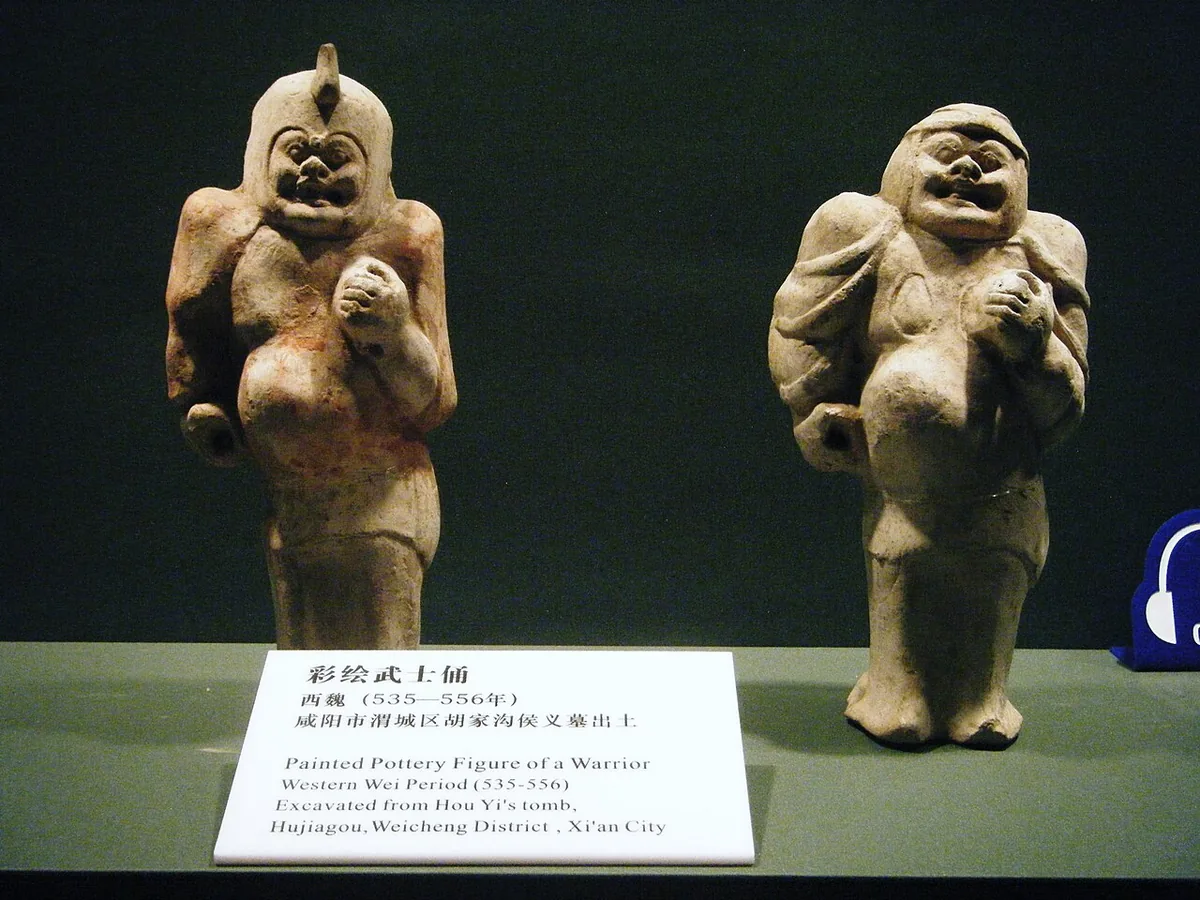
In 538 the eastern army besieged Dugu Xin in Luoyang. Yuwen Tai and the emperor marched to relieve him.[5] The battle between the river bridge and the Mang hills took place in the eighth month. It lasted from dawn into the afternoon, in a fog so thick that the wings could not see one another.[5] A stray arrow hit Yuwen Tai’s horse, and it bolted. An officer, Li Mu, gave him his own.[5] The eastern general Gao Aocao was killed. Even so, both wings of the Wei broke and withdrew, and Luoyang was lost.[5] Many of the men captured at Shayuan had been freed and taken into the army. At the river bridge they fought for Yuwen Tai to the death.[5] Others had been left behind in Guanzhong. They rose under Zhao Qingque and held the inner city of Chang’an until Yuwen Tai returned and put them down.[5]
Gao Huan came again in 542. He invaded the districts of Fen and Jiang and besieged Yubi. He turned back when Yuwen Tai marched.[5] In 543 an eastern governor, Gao Zhongmi, came over to the west with his province.[5] The battle that followed on the Mang hills began well for the Wei.[5] Gao Huan, pursued by Heba Sheng, escaped alone on horseback and only just.[5] The eastern army rallied. The left wing of the Wei gave way, and Yuwen Tai withdrew by night.[5] He asked to be demoted because his generals had failed. The emperor refused. The court recruited the leading families of Guanzhong and the Long region into the army on a large scale.[5]
In 546 Gao Huan laid siege to Yubi a second time.[5] Wei Xiaokuan held the fortress for sixty days.[5] Two or three in every ten of the besiegers died. Gao Huan, who had fallen ill, burned his camp and withdrew.[5] He died in the first month of 547.[5] Gao Huan’s commander south of the Yellow River, Hou Jing, offered six provinces to the west. He then turned to the Liang in the south. Yuwen Tai called back the troops he had sent him.[5] In 549 the eastern army took Yingchuan, which Wang Sizheng held for the west, by damming a river and flooding the country round the city.[5] In 550 Gao Huan’s son Gao Yang deposed the eastern emperor and founded the Qi.[5] Yuwen Tai marched east that autumn. Rain fell from autumn into winter, and the horses and donkeys of the army died. He turned back.[5] From then on, the Zhou Shu says, the country south of the Yellow River from Luoyang and north of it from Pingyang eastward belonged to the Qi.[5]
Rouran marriage (538–540)
The war in the east decided the policy in the north. The Bei Shi gives the reasoning of the court.[9] The capital had newly been set in Guanzhong, and the court was bent on campaigns to the east. The Rouran were raiding the border, and there was no leisure for a war in the north. The emperor therefore made a marriage to appease them.[9] Both Wei courts competed for Anagui, the Rouran khan.[7] The west married the daughter of an official to Anagui’s brother Tahan under the title of Princess Huazheng.[7] Emperor Wen took Anagui’s eldest daughter as his empress. He added gifts of gold and silk.[7] Anagui detained the envoy of the eastern court and sent no reply.[7]
The marriage cost the reigning empress her place.[9] Emperor Wen’s wife, the empress Yifu, came from a family whose ancestors had been chiefs of the Tuyuhun on the Qinghai lake.[9] She was deposed in 538.[2] She was moved out of the palace and made to take vows as a Buddhist nun.[9] Later she was sent to live with her son, the governor of Qinzhou.[9] According to the Bei Shi, the emperor did not forget her. He secretly told her to let her hair grow again.[9]
Anagui’s daughter came south with seven hundred carts, ten thousand horses and a thousand camels.[9] Among the Rouran the east was the side of honour. Her tents and mats all faced east.[9] At the Black Salt Lake the Wei escort under Prince Yuan Fu met her and asked her to face south, as a Chinese empress did.[9] She answered that she had not yet seen the lord of Wei and was still a Rouran woman. The Wei guard faced south, she said, and she would face east.[9] She reached Chang’an early in 538. She was made empress at the age of fourteen.[9]
The marriage did not hold the Rouran. In 540 they crossed the Yellow River in force. Their vanguard passed Xiazhou.[9] Yuwen Tai called the armies together at Shayuan to meet them.[5] At court it was said that the Rouran had come because of the deposed empress.[9] The emperor answered: how could an army of a million be raised for one woman?[9] Even so, he said, with such talk abroad he could not face his generals.[9] He sent a palace attendant with an order in his own hand. The former empress took her own life at the age of thirty-one.[9] She was buried in a niche cut into the cliff of Maiji.[9] The Rouran empress died the same year in childbirth, at sixteen. The court believed that the spirit of her predecessor had appeared to her.[9]
The eastern court used her death.[7] Gao Huan’s envoy told Anagui that Emperor Wen and Yuwen Tai had murdered the emperor Xiaowu and now his daughter.[7] The princess given to his brother, the envoy said, was a distant relative with a borrowed title.[7] When the Rouran had crossed the river, he added, Yuwen Tai had burned the grass so that their horses starved and could not advance.[7] Anagui turned east.[7] The eastern court married a princess to his son. In 546 Gao Huan himself took Anagui’s favourite daughter.[7] From then on, the Bei Shi says, the eastern frontier was quiet.[7] In the annals of the Eastern Wei, the Rouran appear among the bearers of tribute in every year but one from 540 to 550. The Tuyuhun appear in six of those years.[2]
For the Western Wei the north stayed hostile.[5] The Rouran raided Gaoping in 547 and reached as far as Fangcheng.[5] By the 540s the Rouran and the Tuyuhun both sent their embassies to the eastern court. The Western Wei faced all three.[2]
Göktürks (542–552)
The Göktürks enter the records of the western court as raiders.[11] The Zhou Shu records in the biography of Yuwen Ce, governor of Suizhou on the northern frontier, that the Göktürks came raiding every year, once the Yellow River had frozen. The people were moved into forts.[11] Yuwen Ce left them in their villages.[11] He had firewood piled at several hundred places along the roads. He sent his scouts far out.[11] In the twelfth month of 542 the Göktürks came in by Liangu, a few dozen li from the border.[11] The piles were lit all at once. The Göktürks took the fires for a great army. They fled in panic, trampled one another and left their livestock and baggage behind.[11] After that, the biography says, they did not dare to come again.[11] The biography names no Göktürk leader. The raid is therefore attributed to Bumin by inference.[11]
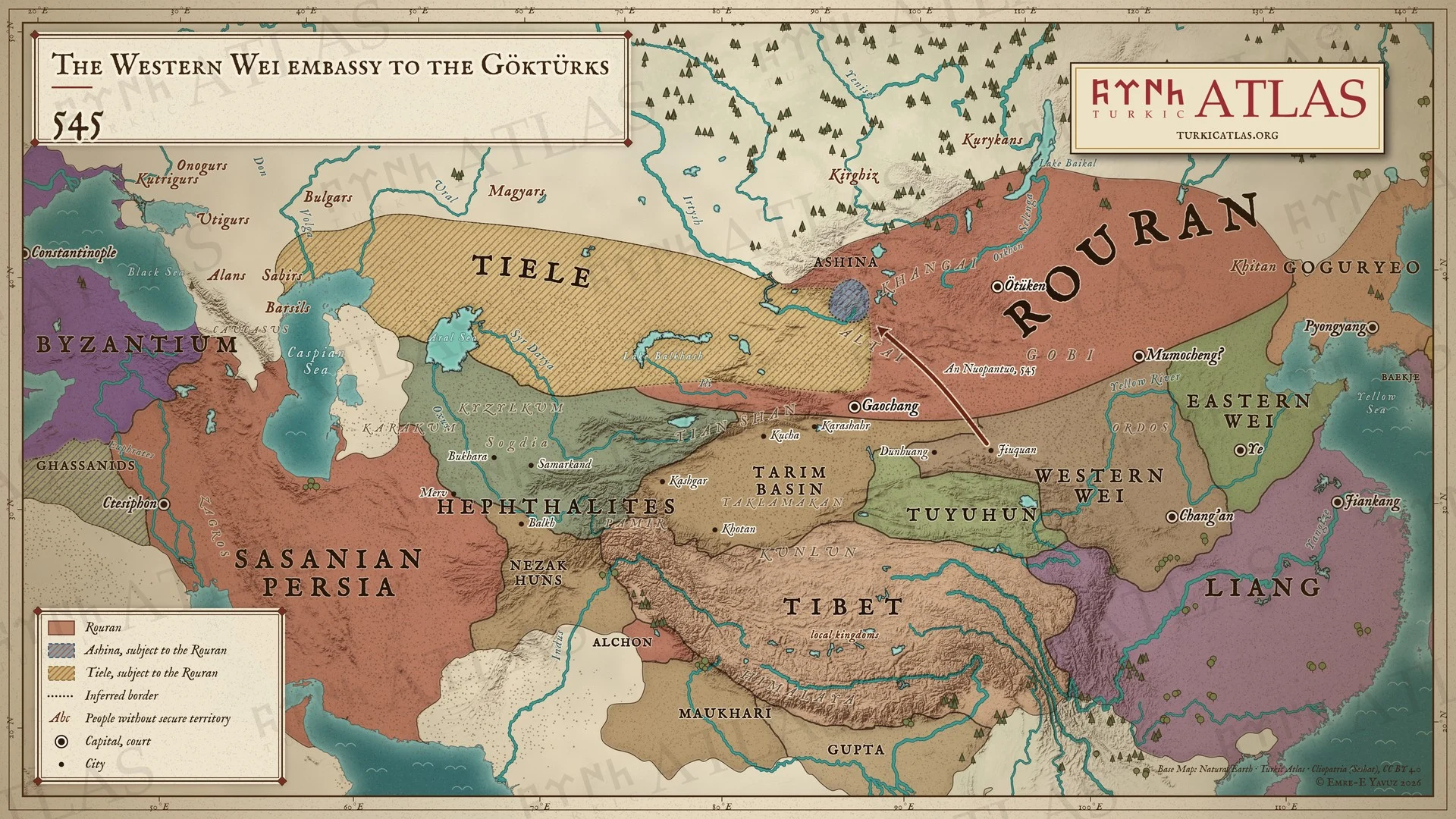
Three years later the court at Chang’an sought the Göktürks out. In 545 Bumin’s people had grown. They first came to the frontier to buy silk and floss, wishing for relations with China. Yuwen Tai sent An Nuopantuo, a Hu of Jiuquan, as his envoy.[4] Modern accounts read the name of An Nuopantuo as the Sogdian Anahitabanda, servant of Anahita.[12] The Göktürks congratulated one another. The envoy of a great state had come, they said, and their state would rise.[4] In 546 Bumin sent an embassy with the products of his country in return.[4] The embassy may have been the Wei’s answer to the raids: an offer of trade that forestalled plunder. By contrast, the Zhou Shu tells it as a Göktürk wish for trade that the Wei answered.[13]
In the same year Bumin fell on a rising of the Tiele against the Rouran. He took the surrender of more than fifty thousand tents.[4] Then he asked Anagui for a wife.[4] Anagui sent a man to revile him: you are my blacksmith slave, how dare you say such words?[4] Bumin killed the messenger and broke with the Rouran.[4] He asked the Wei instead. Yuwen Tai agreed.[4] In the sixth month of 551 the Wei princess Changle was married to Bumin.[4] When Emperor Wen died that year, Bumin sent an envoy to mourn him. He also sent a gift of two hundred horses.[4]
In the first month of the Chinese year 552, at the end of his war against the Rouran, Bumin destroyed them north of Huaihuang. Anagui killed himself.[4] The month ran from 11 February to 10 March. It was the second of two victories that winter. One dating puts the first, in Dzungaria, in January.[14] The Zhou Shu dates the victory by the Wei calendar, to the first year of the deposed emperor.[4] Bumin then took the title Illig Khan. He founded the khaganate.[4] Shi Ning’s biography in the same history says that the Göktürks killed Anagui.[15] No source records a Wei army at Bumin’s side in 552.[4]
The Wei had given Bumin standing rather than troops. A Chinese court had received him as a party in his own right while he was still the Rouran’s smith. It had given him a princess after a Rouran one was refused with an insult.[4] For the Wei the gain was a power on the far side of the Rouran at the moment when the Rouran had joined the east.
Rouran remnant (552–555)
The fall of Anagui did not end the Rouran on the Wei frontier. Groups that escaped the Göktürks rallied round Anagui’s sons and grandsons. They raided the country west of the Yellow River.[15] Shi Ning, governor of Liangzhou again from 552, intercepted them.[15] He captured two of Anagui’s descendants together with the chiefs of their tribes. In the fighting that followed he took several tens of thousands of prisoners.[15] In 554 a Rouran commander raided Guangwu.[5] The Zhou Shu has Zhao Gui pursue him and kill several thousand of his men.[5] The Bei Shi attributes the command to Li Bi.[2]
Meanwhile the Göktürks dealt with the Wei as a partner.[4] In the third month of 553 Bumin’s son and successor, Issik Khan, sent fifty thousand horses.[4] The horses of the Göktürks and the silk of the Chinese courts formed the two sides of an exchange. It lasted some thirty years.[16]
The last Rouran came to the Wei themselves.[7] The Göktürks broke the Rouran again and again. A remnant of more than a thousand households fled into Guanzhong.[7] Their ruler was Dengshuzi, an uncle of Anagui.[4] Mukan, who was now khan, asked for their deaths.[4] According to the Bei Shi, the Göktürks sent envoy after envoy to ask that all of them be killed.[7] The same text gives the reason.[7] The Göktürks trusted in their strength and in their friendship with the Western Wei. They feared that the survivors would find a great state to lean on.[7] Yuwen Tai put the request to his council and agreed.[7] Dengshuzi and some three thousand of his people were seized and handed to the Göktürk envoys. They were killed outside the Qingmen gate of Chang’an.[4] Youths and boys were spared and given as servants to the households of princes and dukes.[7]
The Zhou Shu gives the handover no year.[4] Its Göktürk chapter tells it after the horses of 553. Modern accounts often date it to that year. The Bei Shi’s Rouran chapter sets the flight into Guanzhong in the second year of Emperor Gong, 555.[7] Modern accounts follow the later date.[17]
The other part of the remnant, under Anagui’s son Anluochen, had fled to the Qi.[7] The Qi first set him up as their client. When he turned against them in 554, they broke his people.[7]
The compilers of the Zhou Shu did not defend the deed.[5] In their judgement on Yuwen Tai they set two acts side by side. One was the storming of Jiangling, which ended in the enslavement of a whole city. The other was the extermination of the Rouran who had come to submit.[5] Both, they wrote, sprang from expediency and ran against virtue. They suggested that this may have been why the Zhou did not last.[5]
Western frontier
West of the Yellow River the Western Wei controlled the corridor of Gansu as far as Dunhuang. In 546 the governor of Liangzhou, Yuwen Zhonghe, rebelled. At Guazhou a man named Zhang Bao killed the governor and joined him.[5] Dugu Xin took Liangzhou and moved six thousand households to Chang’an. At Guazhou an officer, Linghu Yan, killed Zhang Bao.[5] Guazhou was the province of Dunhuang. In 548 Yuwen Tai toured the western border with the crown prince.[5] He crossed the Long mountains. He had an inscription cut in the rock and rode along the northern Long Wall.[5]
The oasis states beyond Dunhuang turned to the new court.[4] In 542 the elder brother of the king of Shanshan came over to the Wei with his people.[4] The kings of Gaochang had served the Wei as vassals since the reign of Qu Jia. They now received their investiture from Chang’an.[4] In 548 an edict made the heir Xuanxi king. In 555 Mao, the Duke of Tiandi, succeeded.[4] The Hephthalites sent embassies with the products of their country in 546 and 553. The king of Persia sent one in 553.[4] Soon afterwards, the Zhou Shu adds, the Göktürks broke the Hephthalites. Their tribes scattered, and their tribute ceased.[4]
The strongest neighbour in the west was the Tuyuhun, a people of Xianbei origin on the Qinghai lake.[4] Their ruler Kualü was the first of his house to call himself khan. He had a walled capital fifteen li west of the lake, but he lived in a felt tent and moved in search of water and grazing.[4] Kualü sent horses, sheep and cattle to the Wei during the Datong years. Even so, his raids on the frontier did not stop.[4] In the fourth month of 553 Yuwen Tai led thirty thousand picked horsemen across the Long mountains and the Yellow River at Jincheng to Guzang.[5] Kualü took fright and sent tribute.[5] He was also sending envoys to the Qi.[4] Shi Ning caught one of these embassies on its way home at Chiquan, west of Liangzhou.[4] He took a Tuyuhun minister and a general, two hundred and forty Hu merchants, six hundred camels and mules, and silk and coloured cloth by the ten thousand bolts.[4] The Tuyuhun chapter of the Zhou Shu dates the capture to 553.[4] Shi Ning’s biography puts it a year later.[15]
Campaign with Mukan against the Tuyuhun (555–556)
Mukan Khan asked leave to march through Liangzhou to attack the Tuyuhun. Yuwen Tai ordered Shi Ning to go with him with his horsemen.[15] At Fanhe the Tuyuhun learned of their coming and fled into the southern mountains.[15] Mukan meant to divide his army, pursue them and meet again at Qinghai.[15] Shi Ning advised him otherwise.[15] Shudun and Hezhen, he said, were the Tuyuhun’s nests. If their roots were pulled out, the rest would scatter of itself.[15] Mukan agreed. He took the northern road to Hezhen, and Shi Ning went for Shudun.[15]
Shudun was the old Tuyuhun capital and held much treasure.[15] Its ruler had already fled to Hezhen. He had left a prince with a few thousand men to hold it.[15] Shi Ning attacked and fell back.[15] The defenders opened the gate to pursue him. His men turned and got in before it could be shut.[15] He captured the prince and gave all the captives and treasure to the Göktürks.[15] Mukan took Hezhen and captured the wife and children of the Tuyuhun ruler.[15]
The two armies met again at Qinghai.[15] Mukan took Shi Ning’s hand and praised his courage.[15] He gave him the horse he rode and had him mount it before his tent. He walked beside him on foot.[15] The Göktürks, the biography says, called Shi Ning a divinely wise man of the Middle Kingdom.[15] At parting Mukan gave him a hundred slaves, five hundred horses and ten thousand sheep.[15] When Shi Ning reached the court, Yuwen Tai was dead. He asked leave to report the victory at his tomb.[15]
The Tuyuhun chapter of the Zhou Shu dates the campaign to the second year of Emperor Gong, 555.[4] The Göktürk chapter sets it in a third year, which the modern editors read as 556. Shi Ning’s biography places it shortly before Yuwen Tai’s death late in 556.[4] It was the only campaign of the Western Wei fought jointly with the Göktürks. The spoils went to the khan.[15]
Conquests in the south (550–554)
The civil war in the Liang after Hou Jing’s rising opened the south to the Western Wei.[5] In 550 Yang Zhong defeated and captured the Liang general Liu Zhongli. The Liang governor of Yongzhou, Prince Xiao Cha, had already placed himself under the Wei.[5] In 552 a Wei army took Nanzheng in Hanzhong.[5] In 553 Yuchi Jiong marched into Sichuan and took Chengdu in the eighth month. The Zhou Shu says that the land south of the Jian pass was pacified.[5]
The Liang emperor Yuan at Jiangling then asked for the old frontier. He also made approaches to the Qi.[5] In the tenth month of 554 Yu Jin, Yuwen Hu, Yang Zhong and Wei Xiaokuan marched on Jiangling with fifty thousand men.[5] The city fell in the eleventh month. The emperor was captured and killed.[5] More than a hundred thousand of its people were carried off as slaves. Some two hundred households were spared.[5] Xiao Cha was installed at Jiangling as ruler of a Liang dependent on the Wei.[5] The Qi sent a relief army, which arrived after the city had fallen.[8]
Army and government
Yuwen Tai’s reforms began in 535 with twenty-four articles of new regulations. He had them drawn up because the constant campaigns had worn out the people and the officials.[5] Twelve further articles followed in 541.[5] In 544 the minister Su Chuo revised both sets into a code of five scrolls. From then on, governors and magistrates were chosen by this code.[5] The court cast wuzhu coins in 540 and again in 546. In 547 it dug the Bai canal to water the fields.[2] In 542 it first set up six armies.[2]
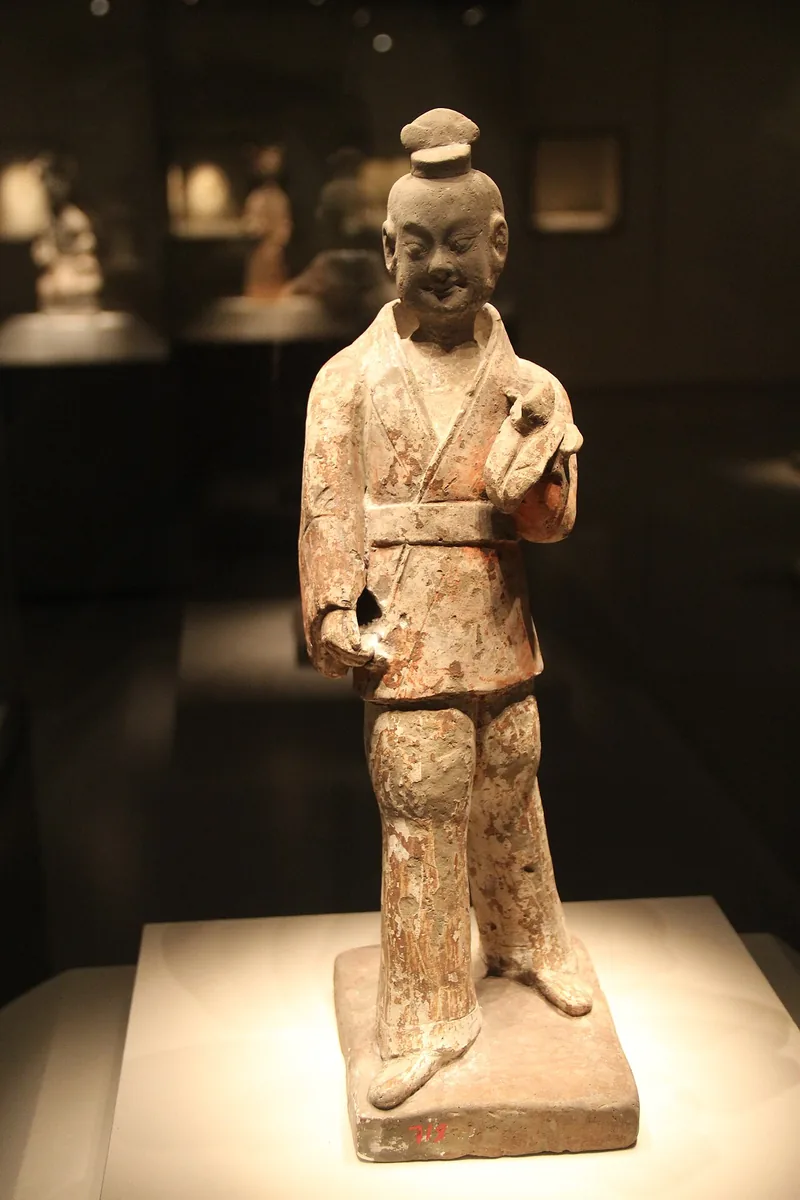
At the head of the army stood the Pillars of State, zhuguo da jiangjun. This rank had been created for Erzhu Rong and was revived for Yuwen Tai in 537.[6] By 550 eight men held it.[6] Yuwen Tai commanded all the armies.[6] Yuan Xin, a prince of the imperial house, held the rank without a command.[6] The other six were Li Hu, Li Bi, Dugu Xin, Zhao Gui, Yu Jin and Houmochen Chong.[6] Each of the six commanded two of the twelve Great Generals. Each Great General commanded two kaifu, and each kaifu stood at the head of an army. There were twenty-four armies in all.[6] The Zhou Shu adds that in its own day, when men spoke of the great families, they named the houses of the eight Pillars first.[6] Modern historians know this organisation as the fubing, the garrison soldiers. They trace the armies of the Sui and the early Tang to it.
The Western Wei also gave the Tuoba names back to its commanders.[2] In 549 an edict ordered the men of Dai whose surnames had been changed in the Taihe era to return to their old names.[2] The changes of the Taihe era, under the emperor Xiaowen, had turned the clan names of the Tuoba nobility into Chinese surnames. In 554 Yuwen Tai went further.[5] The Wei, the Zhou Shu says, had begun with thirty-six states and ninety-nine great clans, most of them since extinct.[5] Now the generals with the highest merit were made heirs of the thirty-six states and the next of the ninety-nine clans. The soldiers under their command took their commanders’ surnames.[5]
The offices followed in 554. The ranks of officials were recast as nine grades of command, and forty-six provinces, a hundred and six commanderies and two hundred and thirty counties received new names.[5] In the first month of 556 the six ministries of the Rites of Zhou replaced the offices inherited from the Han and the Wei.[5] Su Chuo and Lu Bian had been preparing the reform since the Datong years.[5] Yuwen Tai became Grand Preceptor and Grand Steward. Li Bi, Zhao Gui, Dugu Xin, Yu Jin and Houmochen Chong headed the other ministries.[5]
The Pillars’ houses outlasted the state they served.[6] The Zhou Shu notes that Dugu Xin’s daughters became empresses of three houses. The eldest was empress of the Zhou, the fourth of the Tang house and the seventh of the Sui.[6] Nothing like it, it says, had been seen since antiquity.[6] The grandson of Li Hu founded the Tang. Yang Zhong, one of the twelve Great Generals, was the father of the founder of the Sui.
Religion and art
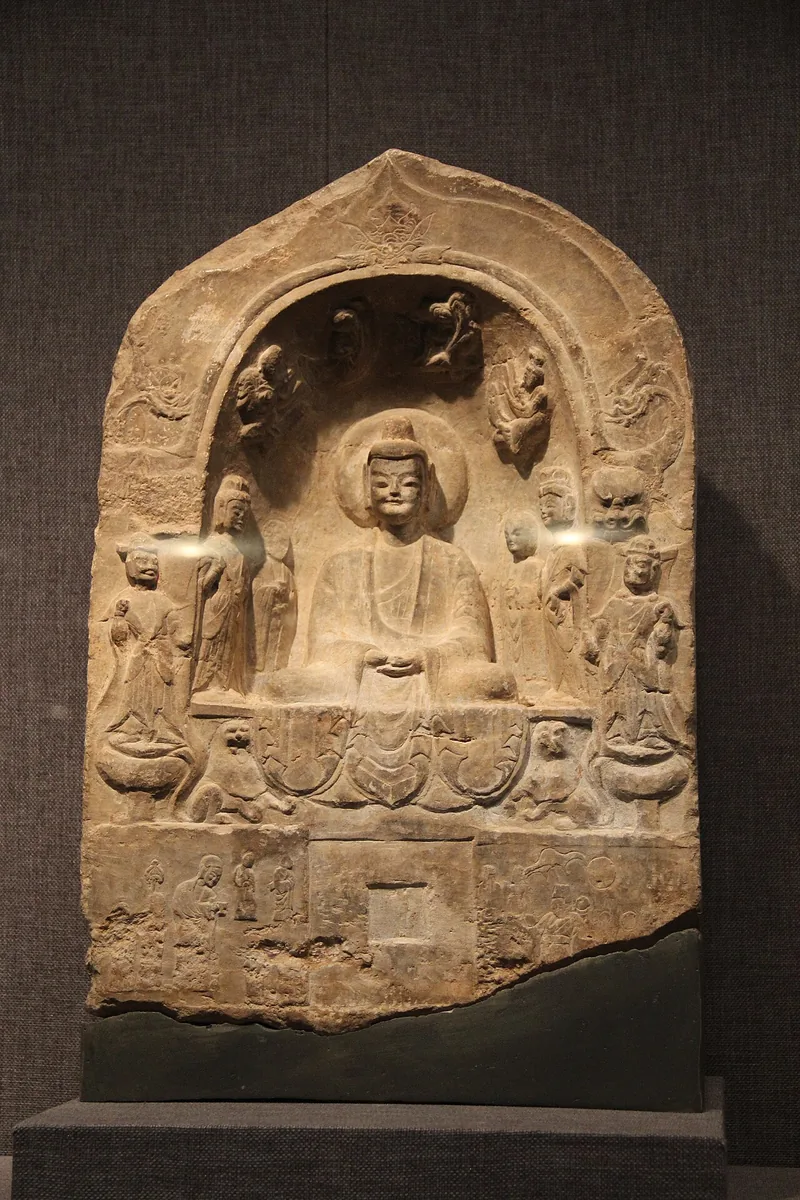
In the first month of 538 Emperor Wen worshipped Heaven in the Qinghui hall of the palace. The rite was kept up for the rest of his reign.[2] Buddhism reached into the palace.[9] Before her death the empress Yifu had monks called to make offerings. She had several dozen of her maids take vows, cutting their hair with her own hand.[9] Her tomb was a niche in the cliff of Maiji.[9] The cave temples of Maijishan near Tianshui keep sculpture of the period. One of the caves there is identified as her tomb. The last empress of the Western Wei, the wife of Emperor Gong, became a nun and died in a Buddhist monastery.[9]
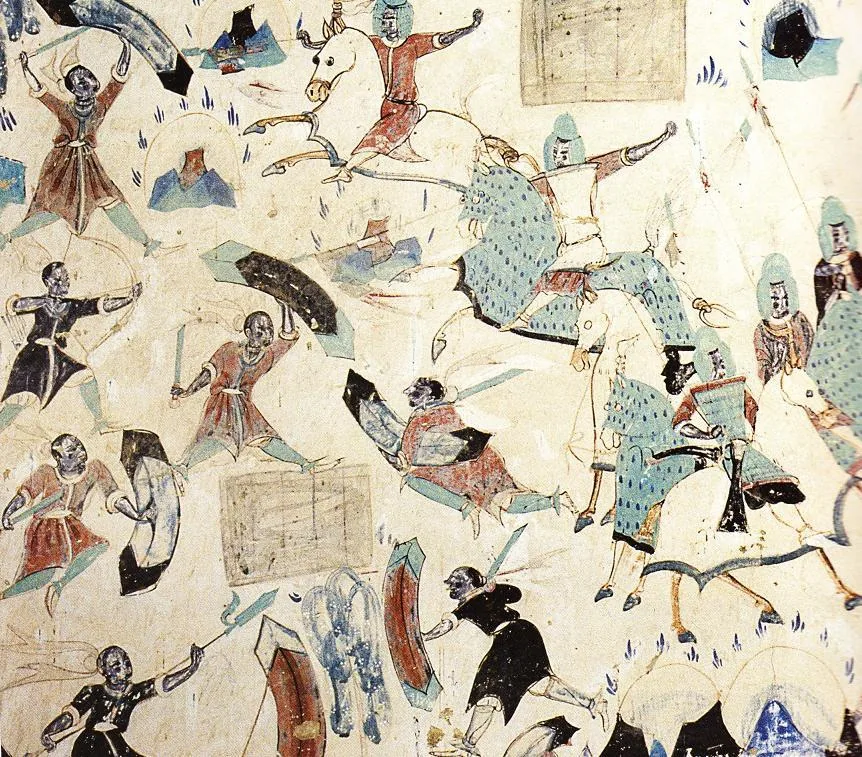
At the western end of the state, Cave 285 at Mogao near Dunhuang carries painted dedications of the fourth and fifth years of Datong, 538 and 539. It is the earliest dated cave of the site. Its walls show, among other scenes, the story of five hundred robbers who were blinded as punishment and converted by the Buddha. The soldiers who fight the robbers in the painting wear armoured coats and ride armoured horses.
End (556–557)
In the fourth month of 556 Yuwen Tai went north on a tour of inspection. In the seventh month he crossed the northern course of the Yellow River.[5] In the ninth month he fell ill and came back to Yunyang. He charged his nephew Yuwen Hu to support his heir.[5] He died at the Yunyang palace in the tenth month of 556, at the age of fifty-two. He was buried at Chengling.[5] He had been promised a daughter of Mukan. He died before the contract was settled.[4]
His son Yuwen Jue took over his offices.[18] In the twelfth month the emperor Gong enfeoffed him as Duke of Zhou. Thirteen days later he gave up the throne to him.[18] The edict of abdication said that Heaven had grown weary of the Wei.[18] The day fell early in 557. The next day, in the first month of the new year, Yuwen Jue took the title of Heavenly King. He founded the Northern Zhou.[18] The Bei Qi Shu records the abdication in the twelfth month from the Qi side.[8] The Zhou inherited the alliance with the Göktürks, the promise of a Göktürk bride and the war with the Qi.[4]
Assessment
The Western Wei began as the weaker half of a broken empire, with fewer men, poorer land and a famine in its second year.[5] It survived by winning the battles of 537, by holding Yubi and by building its army around the leading families of Guanzhong.[5] In the north it lost the Rouran to the eastern court in 540. Five years later it found the Göktürks. The alliance passed to the Zhou and became the Göktürk–Zhou alliance.[4] The houses of the Western Wei’s generals ruled China into the tenth century.
For the Göktürks the Western Wei was the first Chinese state to receive their envoys, to give them a princess and to fight beside them.[4] The history written for its successors, the Zhou Shu, is the source of most of what is known about Bumin.
Sources
The Western Wei has no dynastic history of its own. Its history is told in the Zhou Shu, written under the Tang for the dynasty that replaced it. The Zhou Shu treats Yuwen Tai as the founder of the Zhou and gives his annals in its first two chapters.[3] Its biographies, among them those of Yuwen Ce and Shi Ning, and its chapter on the foreign peoples tell the history of the frontier.[19] The Bei Shi adds annals of the three Western Wei emperors and biographies of their empresses.[2] It is a compilation that draws on the Zhou Shu and the other histories. Where it agrees with them, it is not a second witness.
The Wei Shu was written at the court of the Qi. Its Rouran chapter mentions the western court only once, in the emperor’s flight into the passes. It follows Anagui’s marriages into the eastern court alone.[20] The Bei Qi Shu records the Western Wei from across the frontier.[8] Each side wrote of the other as an enemy. Yuwen Tai’s proclamation of 534 in the Zhou Shu calls Gao Huan a rebel subject.[3] The Bei Shi preserves the charges that Gao Huan’s envoy brought against Yuwen Tai before the Rouran khan.[7]
Relations with other states
Red is war, blue alliance, gold trade. Where several held at once, the line shows what prevailed; alliance and trade can run side by side. Each line rests on an article. Point at a state to see its weightiest relation, select it to see its events. The slider shows what stood in a given year, and Play runs through the years.
Rouran Khaganate535 to 554
- War535 to 554Hegemony Wars in Northern China
First Göktürk Khaganate545 to 557
- Alliance545 to 557The Göktürk–Wei alliance
- Trade545Border Marketssilk at the frontier
- Embassy545Western Wei embassy of 545the mission of An Nuopantuo to Bumin
- Alliance552 to 557Hegemony Wars in Northern China
- Alliance556Göktürk–Wei Campaign against Tuyuhun (556)
Northern Qi550 to 557
- War550 to 557Hegemony Wars in Northern China
References
- ^ a b Golden 1992, p. 75
- ^ a b c d e f g h i j k l m n o p q r s t u v w Bei Shi (History of the Northern Dynasties), juan 5
- ^ a b c d e f g h i j k l m n o p q r s t u v w x Zhou Shu (Book of Zhou), juan 1
- ^ a b c d e f g h i j k l m n o p q r s t u v w x y z aa ab ac ad ae af ag ah ai aj ak al am an ao ap aq ar as Zhou Shu (Book of Zhou), juan 50
- ^ a b c d e f g h i j k l m n o p q r s t u v w x y z aa ab ac ad ae af ag ah ai aj ak al am an ao ap aq ar as at au av aw ax ay az ba bb bc bd be bf bg bh bi bj bk bl bm bn bo bp bq br bs bt bu bv bw bx by bz ca cb cc cd ce cf Zhou Shu (Book of Zhou), juan 2
- ^ a b c d e f g h i j k Zhou Shu (Book of Zhou), juan 16
- ^ a b c d e f g h i j k l m n o p q r s t u v w Bei Shi (History of the Northern Dynasties), juan 98
- ^ a b c d Bei Qi Shu (Book of Northern Qi), juan 4
- ^ a b c d e f g h i j k l m n o p q r s t u v w x y Bei Shi (History of the Northern Dynasties), juan 13
- ^ Büntgen 2016
- ^ a b c d e f g h Zhou Shu (Book of Zhou), juan 27
- ^ de la Vaissière 2005a, p. 205
- ^ Yavuz 2025, p. 218
- ^ Yavuz 2025, p. 225
- ^ a b c d e f g h i j k l m n o p q r s t u v w x Zhou Shu (Book of Zhou), juan 28
- ^ de la Vaissière 2005a, p. 210
- ^ Golden 1992, p. 79
- ^ a b c d Zhou Shu (Book of Zhou), juan 3
- ^ Zhou Shu (Book of Zhou)
- ^ Wei Shu, juan 103
Sources
- Zhou Shu (Book of Zhou), juan 1, 2, 3, 16, 27, 28, 50
- Bei Shi (History of the Northern Dynasties), juan 5, 13, 98 (after Wei Shu, Zhou Shu and Sui Shu)
- Wei Shu, juan 103
- Bei Qi Shu (Book of Northern Qi), juan 4 (after Bei Shi)
Literature
- Peter B. Golden, An Introduction to the History of the Turkic Peoples (1992)
- Emre-E. Yavuz, The Gokturk Empire: 2nd Edition (2025)
- Étienne de la Vaissière, Sogdian Traders: A History (2005)
- Ulf Büntgen; Vladimir S. Myglan; Fredrik Charpentier Ljungqvist; Michael McCormick; Nicola Di Cosmo et al., Cooling and societal change during the Late Antique Little Ice Age from 536 to around 660 AD (2016)
What links here30
- Persons
- Dengzhu · Empress Yujiulü · Gao Huan · Issik Khan · Mukan Khan · Princess Changle · Tahan · Yuwen Tai
- States
- Northern Qi · Northern Wei · Northern Zhou · Rouran Khaganate
- Conflicts
- Hegemony Wars in Northern China · The Göktürk–Rouran Wars · The Turkic War of Independence · The Zhou–Qi war, 557–577
- Battles & Events
- Battle of Mount Mulai (553) · Göktürk raid of 542 · Göktürk–Wei Campaign against Tuyuhun (556) · Mukan's Destruction of Dengshuzi (553–555) · Rise of Anagui Khan · The Göktürk–Wei alliance · The Qingmen Executions (555) · The Rouran Marriage Refusal (546) · Western Wei embassy of 545
- Peoples
- Xianbei
- Institutions and Titles
- Border Markets
- Customs & Pastimes
- The Chile Song
Cite this article
Yavuz, Emre-E. “Western Wei.” Turkic Atlas, revised 8 November 2026. https://turkicatlas.org/polities/western-wei/
Last revised: 8 November 2026




