
Chounu’s reign contains the two stories about the Rouran that everyone retells. One is the skull of a king, lacquered into a cup. The other is the shamaness who brought a boy down from heaven.[1] Both stories are in the Wei Shu. The same history also records the victory that the usual account gives to his brother.
Accession and embassies
Chounu succeeded his father Futu, who had been killed by the Gaoche in 508. He took the title Douluofubadoufa Khan, “manifesting control”, and proclaimed the era Jianchang.[1] In the ninth month of 511, he sent the Buddhist monk Hongxuan to the Wei court with a jewelled image.[1] In the winter of 514, the emperor Xuanwu appointed a general to go as envoy to Chounu. The emperor died before the man set out, and the matter lapsed.[1]
The monk is the earliest notice of Buddhism at a Rouran court. The penetration of the religion among the Rouran is dated to after 520, without counting this notice.[2] Turkic Atlas weighs the question under Buddhism.
Chounu was strong, vigorous and skilled in war.[1] In 515 he sent tribute by the irkin Weibijian. In 517 he sent it again, by Weibijian, Hexi Wuliuba and Gong Guli.[1] In the second month of 518, the emperor Xiaoming received Gong Guli and twenty others in the Xianyang hall. He had a decree read that reproved the Rouran for the incompleteness of their vassal rites.[1]
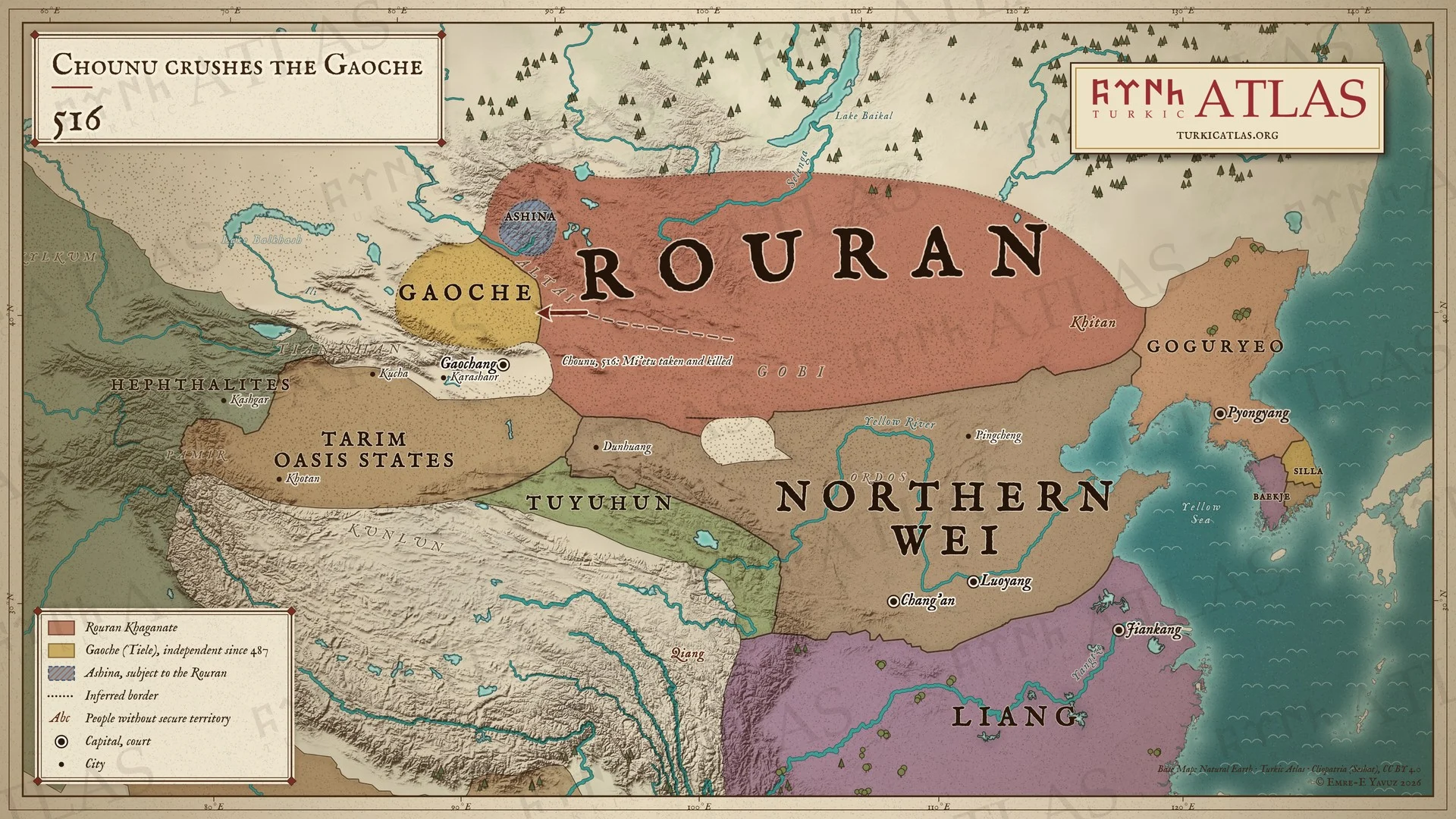
Victory over the Gaoche (516)
In 516 Chounu marched west and crushed the Gaoche. He captured their king Mi’etu and killed him. He absorbed all who had rebelled. The state grew strong.[1]
The Gaoche chapter describes how Mi’etu died.[1] Mi’etu was beaten and taken in the first years of Xiaoming. His two legs were tied to a sorry horse, and he was dragged to death. His skull was lacquered into a drinking vessel.[1] His people went over entirely to the Hephthalites.[1]
The usual account gives this western victory to Anagui, after 520, as the act that made the Tölös subjects again. The Wei Shu, by contrast, gives it to Chounu in 516. To Anagui it gives only a later, undated victory over Mi’etu’s brother Yifu.[3] According to the same history, Chounu brought the Tiele temporarily under control only in 516.[4]
Diwan the shamaness
One of Chounu’s sons, Zuhui, vanished. No search could find him.[1] Shidouhun Diwan was a woman of about twenty, the wife of Fushengmou of the Wuyin clan. She practised medicine and sorcery and claimed the powers of spirits. She had long had Chounu’s trust and free access to his tents.[1]
Diwan said that the boy was now in heaven and that she could call him down.[1] Chounu and his mother rejoiced.[1] In the autumn of the following year, they set up a tent in a great marsh. They fasted and purified themselves for seven days and prayed to heaven.[1] After one night, Zuhui was suddenly in the tent. He said he had been in heaven all the while.[1]
Mother and son embraced him, weeping and laughing. They called the whole people together and named Diwan the Holy Woman. They took her as khatun. They gave her husband rank and three thousand head of cattle, horses and sheep.[1] Diwan practised the black arts and was also beautiful. Chounu loved and trusted her and followed her word. She brought the government of the state into disorder.[1]
Years later, when Zuhui was older, his mother questioned him. He said that he had been in Diwan’s household the whole time and had never gone to heaven. Heaven was what Diwan had taught him to say.[1] Zuhui’s mother told Chounu. He answered that Diwan saw distant things in her mirror and must be believed, and that slander was not to be used. Diwan, afraid, slandered Zuhui to him. Chounu had the boy secretly killed.[1] The episode is the clearest record of shamanism among the Rouran.[2]
Death (520)
At the beginning of Zhengguang, in 520, Chounu’s mother sent the mohequfen Li Julie and others to strangle Diwan. Chounu was angry and wished to execute Julie and his fellows.[1] Then the Azhiluo, the Gaoche of the west, attacked. Chounu fought them, and his army was beaten. On his return, his mother and the great ministers killed him. They set up his younger brother Anagui.[1]
Modern accounts put the end more briefly. Four years after his victory, Afuzhiluo invaded his lands and defeated him. The unfortunate Chounu was murdered by his mother and courtiers.[4] A civil war followed the murder.
Assessment
For the Göktürks, the reign matters in one respect. It was the last time before 552 that the Rouran state was governed from within by fear, favour and a mother’s hand. The Ashina in the Altai, who had been subjects since 439, watched it. The whole sequence shows that the wars with the Wei weakened the Rouran from inside. A civil war and the Tölös rising of 508 followed. Chounu’s twelve years are that weakening as it looked from inside the khan’s tents.[3]
References
Sources
- Wei Shu, juan 103
Literature
- Peter B. Golden, An Introduction to the History of the Turkic Peoples (1992)
- Emre-E. Yavuz, The Gokturk Empire: 2nd Edition (2025)
- Kürşat Yıldırım, On the Culture of Rouran Khanate (2024)
What links here22
- Persons
- Afuzhiluo · Anagui · Diwan · Futu Khan · Hulü Khan · Poluomen Khan · Tulun Khan
- States
- Rouran Khaganate
- Conflicts
- Gaoche secession (487) · Rouran civil war (520–521) · Rouran Domination of the Turkic Peoples
- Battles & Events
- Rise of Anagui Khan
- Places
- Mumocheng
- Peoples
- History of the Turkic peoples · Rouran · Tiele
- Institutions and Titles
- Skull Cup · Women among the Turkic Peoples
- Religions
- Shamanism
- Sources
- Wei Shu
Cite this article
Yavuz, Emre-E. “Chounu Khan.” Turkic Atlas, revised 8 November 2026. https://turkicatlas.org/persons/chounu-khan/
Last revised: 8 November 2026

