
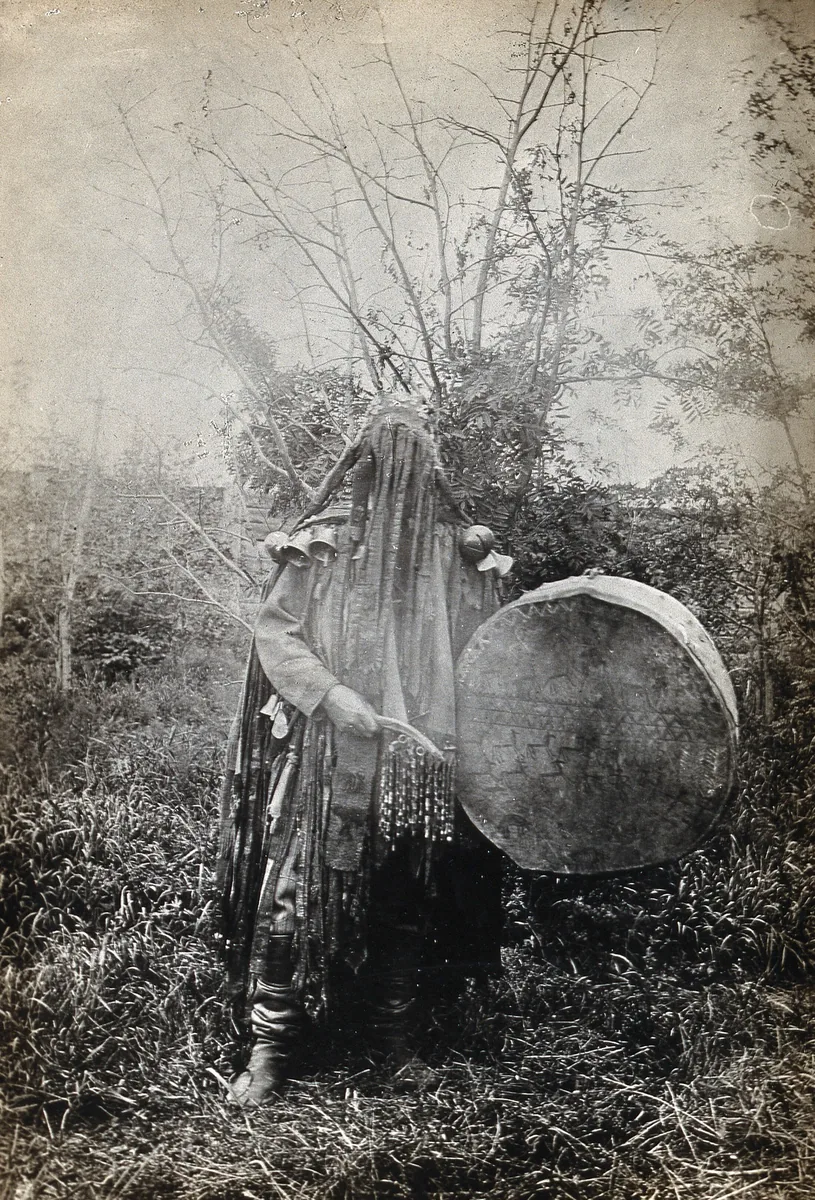
Shamanism is the name modern scholarship gives to the work of a ritual specialist who enters a trance and deals with the spirits on behalf of others. The specialist treats the sick, finds what is lost, foretells what the year will bring and drives off harmful powers.[1] The word is not Turkic. It comes from the Tungus. The Turkic peoples of the Altai call the specialist kam.[2]
Tengrism grew out of shamanism, and shamanism is the foundation on which the sky religion of the khaganates stands. The Turkic peoples passed from societies in which the shaman stood at the centre to societies that looked to Tengri. The belief of the Göktürk khans arose from that of their shamanist ancestors while becoming more developed, more complex and more hierarchical.[3]
Scholars disagree on how the two stand to each other. One treats shamanism as the old Turkic religion itself.[4] A second asks first what shamanism is: a religion, one part of a religion or a set of acts performed when they are needed. It finds the observers of the nineteenth century divided on the answer.[5]
The evidence lies in layers centuries apart. Chinese and Byzantine notices name the specialist and describe single rites. The inscriptions of the khans never name him. Turkic texts use the word kam from the eleventh century. Travellers and ethnographers describe drum, coat and journey in detail from the eighteenth century on. In the twentieth century the practice was suppressed in the Soviet Union. Since the 1990s it has been revived. Observers of the nineteenth century counted all the Tungus, Mongol and Turkic tribes of northern Asia among its former adherents.[6]
Before the written record
No text from the Bronze Age or the early Iron Age describes a shamanic rite on the steppe. What exists are images, graves and patterns of association. Scholars read them through the practice of recent centuries.
One account places the origin of shamanism, in part if not wholly, in the great forests of the north. It treats shamanism as a layer under the religions that the Turkic peoples adopted later.[7] A second finds a shamanic substratum in early Chinese civilisation and in the world of the Xiongnu alike, shown in the way colours go with directions. It traces the substratum to the early Bronze Age and even the Neolithic.[8] A third sets the rock carvings of Tuva beside the headdresses of Tuvan shamans of the twentieth century. It finds the likeness too striking to deny a link and regards masks and headdresses as images of shaman ancestors.[9] The drum is held to be older than the coat, because it has a common name in several Turkic, Mongol and Tungus languages and the coat has none.[10] None of this dates a rite. For the time before the first Chinese notices, the age of the practice is a matter of interpretation and not of record.
Finds of the first centuries AD and of the fifth century are interpreted in the same way. A looted Sarmatian grave at Ust-Labinskaja on the Kuban, with gilded bronze figures of a tree with birds, an ibex and a stag, has been called the grave of a shaman. Others see in it the grave of a man buried with objects made for the burial.[11] A gold diadem from a woman’s grave at Karagalyk in the northern Tian Shan, with winged figures riding on beasts, has been interpreted as the head-dress of a woman of the aristocracy who practised shamanism.[12] The crowns and the caps with bird wings in the graves of Silla in Korea are held to copy shamanic head-dress.[13] All three interpretations rest on the later records of Siberian peoples. None of them dates a rite.
The Xiongnu
The Han Shu has one episode in which a ritual specialist of the Xiongnu acts. Li Guangli was a Han general who had gone over to the Xiongnu. Wei Lü, a Han renegade, begrudged him the chanyu’s favour. When the chanyu’s mother fell ill, Wei Lü told a wu of the Hu, 胡巫, what to say. The former chanyu was angry, the wu declared, because before a campaign the Xiongnu used to vow at their sacrifice to offer up Li Guangli, and now they did not. The Xiongnu seized the general and sacrificed him. Rain and snow fell for months, the herds died, a plague struck and the grain did not ripen. The chanyu, afraid, built a shrine for the dead man.[14] The Han Shu gives no Xiongnu word for the specialist.[14]
The wu may have been a kam who stood high in the Xiongnu state. Another explanation is that the killing was the work of a foreign or Chinese wu who urged it on the court.[15] The Shiji says that in the fifth month the Xiongnu held a great assembly at Longcheng and sacrificed to their ancestors, to Heaven and Earth, and to ghosts and spirits.[16]
Huns, Gaoche and Rouran
Two high-ranking Huns of Attila’s time, Atakam and Eskam, carry kam in their names, and the word is the Turkic one for a shaman. On that evidence the Huns had shamans. The specialists seem to have stood in the upper stratum of Hun society. The same account warns against concluding from later steppe peoples what the Huns practised.[17] The princely graves of the Hunnic age add a bird of prey, almost the only animal figure on their weapons and harness. They also show a tree with a bird on a pair of temple pendants. Some see in this an eagle cult tied to the world tree and to shamans.[18]
The Wei Shu describes a rite of the Gaoche at a place struck by thunder. In the autumn after the strike they buried a ram, lit a fire and drew their knives. A female wu, 女巫, spoke prayers that the text compares with the purification rites of China. Then they rode round the place a hundred times.[19] The thunder rite shows a woman in the shamanic office.
Among the Rouran the same chapter tells of Diwan. Under Chounu, who reigned from 508 to 520, a woman of about twenty, the wife of a man of the Wuyin clan, practised as a physician and sorceress, 醫巫, and claimed the help of spirits.[19] When a son of the khan vanished she said that he was in heaven and that she could call him down. The khan and his mother pitched a tent in a great marsh, fasted for seven days and prayed to heaven. After one night the boy was in the tent. They proclaimed Diwan the Holy Woman, and Chounu took her as khatun. Years later the boy said that he had never been in heaven. He had lived in her house, and she had taught him what to say. Diwan slandered him, and Chounu had him killed in secret. In 520 the khan’s mother had Diwan strangled.[19]
Later retellings add the shamans of the Yueban, who in 155 are said to have called up rain and then snow to turn back a Xianbei army near Lake Balkhash. They also add parallels among the Avars and, in 1201, the Naiman.[20] Stories of this kind explain events that would otherwise seem inexplicable.[20]
The Göktürks
The Sui Shu says that the Göktürks revered spirits and trusted in wuxi, 敬鬼神,信巫覡. It adds that their customs were on the whole those of the Xiongnu.[21] The Zhou Shu tells of Nishidu, born of a wolf, who could summon wind and rain. He married two wives said to be the daughters of the spirit of summer and the spirit of winter.[22] The power over wind and rain has been seen as a trait of Turkic and Mongol shamans. It is tied to the belief in rain stones.[23]
The Zhou Shu records three rites. Each year the khan led the nobles to sacrifice at the cave of the ancestors. In the fifth month they gathered at a river and sacrificed to the spirit of heaven. A bare high mountain, which the Göktürks called 勃登凝黎, was the spirit of the earth. These rites belong to the cycle of sacrifice and the calendar.[22] The text does not say who performed them.[22] At the installation of a new khan, the nobles lifted him on a felt and turned him nine times with the sun. A silk cord was drawn round his neck until he was nearly senseless. Then he was asked how many years he would reign.[22] One account sees in the raising on the felt a rite with strong shamanic undertones.[24]
In 569 the Roman embassy of Zemarchos was purified before the khan received it, as Menander reports.[25] Men of the Göktürks whom the report calls averters of evil set the baggage down and burned incense leaves. They whispered words in their own language, rang bells and beat drums. In a frenzy they drove off the demons. Then they led Zemarchos himself through the flame, a rite of purification by fire.[25] It is the one description of a Göktürk rite by an eyewitness. Drum and bell are the instruments it names. A drum with iron rattles and bells is what the Altaian shaman held in the nineteenth century. The likeness shows a kind of instrument and not a descent.
A woman of the Ashide clan, the mother of An Lushan, is called a wu who practised divination. In the Tang accounts of her son she prayed to Yaluoshan, the god of war of the Göktürks, for a child.[26]
The khans’ own monuments never mention the kam. The inscriptions tell how the khans came to the throne by the command of Tengri and with their own Kut. No human officiant appears in the account.[27] No inscription of the khaganates names the specialist.[27][28] The silence may be intended. The khans tell at length of their own ascent to Heaven, and the texts would thereby show that the shaman holds no advantage over the khan, either on the journey through the universe or in knowledge of what is unseen.[29] The same account notes that the verb for the death of a khan is uça bar-, to go flying. It stands in the Turkic and Uyghur inscriptions only for very high persons, the khan and his brother Kül Tegin. Except for Kül Tegin, the speaker is always a son or a younger brother. The account connects the verb with a belief that the soul is bird-shaped and leaves the body in flight, and it takes one line to show that a ruler’s immortality lies with Heaven.[30] The Yenisei stones are less silent, though the evidence is thin. On them the word bel stands beside tengri. It is probably a spirit that shamans revered, and the Orkhon stones do not have it.[31] A trace of a shamans’ session has been found in the inscription of Uyuk-Arkhan, in which a speaker says that he came to his mother with the soul of a dead man and that he came down into the land. The same interpretation takes a line of an inscription from Uibat, “he went through the three storeys of the universe”, for the epitaph of a shaman. The word rendered “three storeys” can also mean “three times”, so this interpretation is not certain.[29]
Uyghurs and Kirghiz
In 765 an army of the Uyghurs came to the Tang frontier at Jingyang with two shamans in its train, although the Uyghur court had taken up Manichaeism two years earlier.[32] The Jiu Tang Shu has the Uyghur chiefs say that the shamans had foretold a safe journey on which they would not fight the Tang troops but would meet a great man and turn back. The great man was the Tang general Guo Ziyi. He took off his helmet and armour and rode out alone to meet them. The chiefs shared the Tang gift of silk with the shamans.[33] Days later, before the battle at Lingtai, the Uyghur shamans called up wind and snow, and the Tibetans froze and their bows and arrows were useless.[34]
The Xin Tang Shu says of the Kirghiz of the khaganate that they sacrificed to the spirits only of water and grass, kept no fixed time for the sacrifice and called their shamans 甘, gan.[35] The character renders the Turkic kam.[36][37] A later survey adds that Radloff recorded the form kan for the kam among the Khakas Kirghiz, and it gives a legend of the Uriankhai about a first shaman called Bö-khan.[38] The twelfth-century geography of Marvazī adds a Kirghiz commoner called faghīnūn, who was summoned on a fixed day each year. Singers and players gathered round him to drink and feast. When the company was well away, he fainted and fell as if in a fit. Then he foretold the coming year, plentiful or scarce crops, rain or drought, and the people believed him.[39]
The Uyghurs are the first Turkic people known to have taken up, as a people, a religion with a moral code in place of shamanism. For the eighth century and earlier nothing is known of a whole Turkic people accepting Buddhism or Christianity. In the shamans’ belief, killing a man could even be of use to the killer in the next world. In Manichaeism not only killing but also eating the flesh of animals is forbidden.[40]
The kam
The inscriptions of the khans do not use the word kam. The Turkic texts that do are of the eleventh century and later. The Kutadgu Bilig of 1069 has the word twice. It sets the physician against the kam, who heals by words and spells.[41] The Codex Cumanicus of 1303 glosses kam katun kisi as a woman conjurer and kamlik etermen as ‘I make a conjuration’.[41] The word is older than these texts if the names of the two Huns Atakam and Eskam contain it.
For the Göktürk period the kam is described as a healer who kept the rites at births, burials and feasts. The kam could be a man or a woman, and the core field was herbal medicine.[42] The kam held no political rank. The inscriptions never mention a kam in political affairs, unlike the Chinese notices of the Xiongnu and the Rouran and the reports of the Huns of Attila.[43] In the Göktürk account the sky makes the khan, and no priest crowns him.[27]
The ethnographic record
From the eighteenth century onward travellers and scholars described the shamans of Siberia. Pallas and Krasheninnikov gave particular attention to the shaman’s dress and drum.[44] In the nineteenth century Radloff worked among the Altaians of the Altai and recorded the rites of their kams. The reports are detailed. They are evidence for Siberia of their own time.
Altai
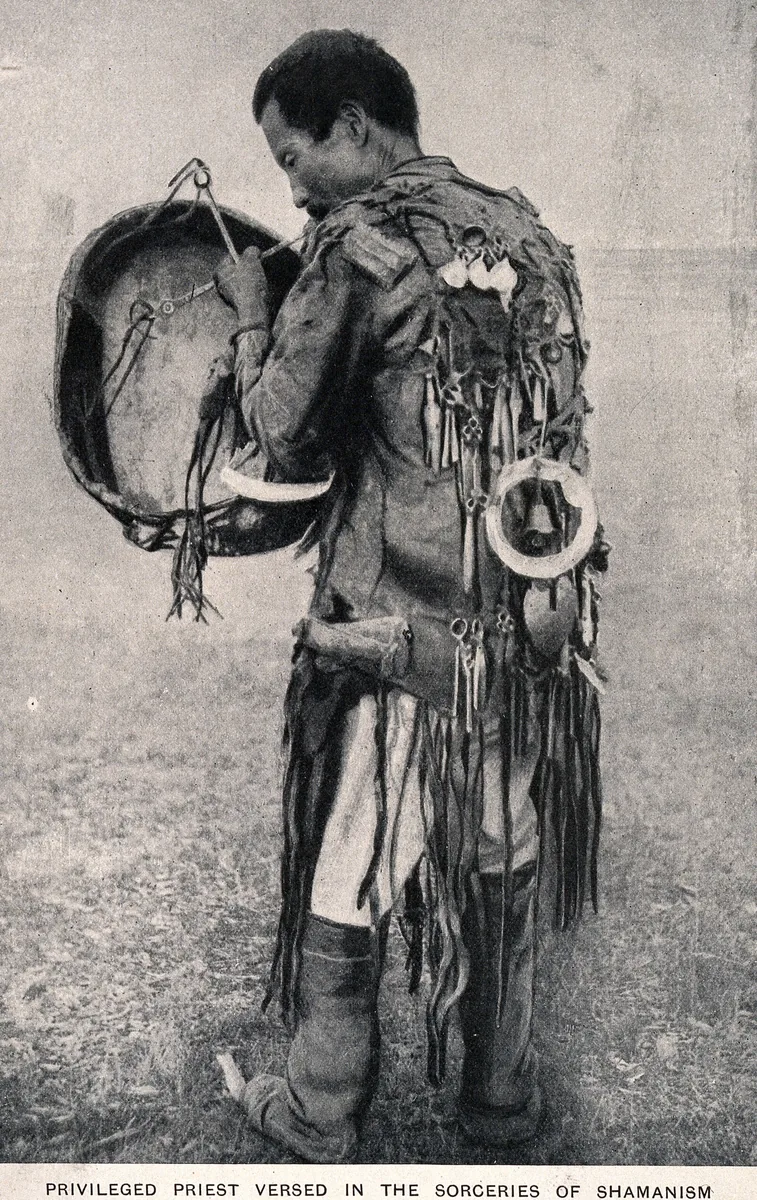
The Altaian kam wore at the rite an open coat with a bib of animal fur and a red cap with a feather of the black grouse. The kams of the Black Forest Tatars, the Shor and the Teleut had no special dress at all.[45] The coat did not matter to the rite. The drum did. Without it the conjuration had no power, although a kam could pray and prophesy without one.[46] The calling came as an illness.[47] The future kam was seized by fits and cries. When the power of the forefathers had passed into him, he had to shamanise. If he refused, he lost his wits, fell into raving madness or died within a short time.[45]
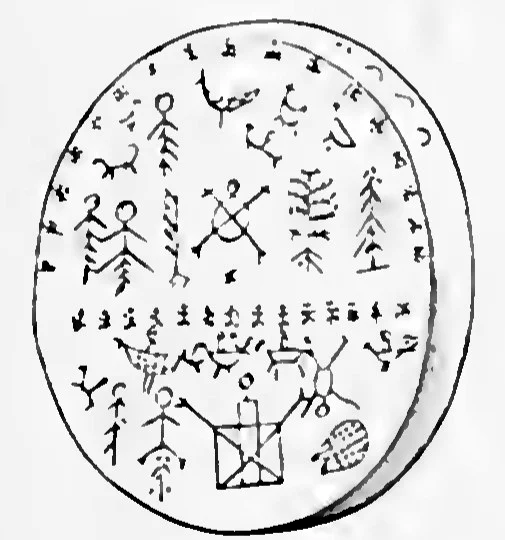
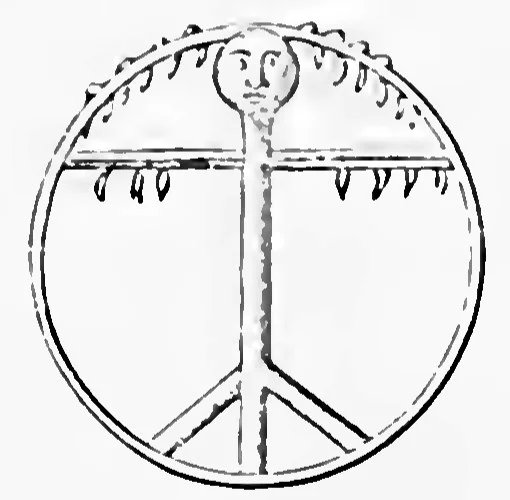
In the horse sacrifice the kam acted out the ascent. He stepped up the notches of a birch, the Tapty, and sat on a stool covered with a saddle cloth that stood for the soul of the sacrificed animal. At each step he beat the ground with the drum to show that he had burst through a layer of heaven. He ran round the birch and the fire and made the sound of thunder and lightning.[48] At the third heaven the animal began to tire. The kam called a goose and rode on it.[49] In the seventh heaven he bowed to the Sun and called her mother. The stronger the kam, the higher he went: to the eighth and ninth heavens and beyond, to the tenth, eleventh and twelfth. Few had the strength. At the top he called on Ülgen.[50]
The kam also went down. At one rite he imitated the beat of hooves on his drum to show that he was riding to the underworld of Erlik. The song of that journey crosses the Altai mountains, the red sands of the Chinese deserts, a yellow steppe, a pale steppe and an iron mountain that leans against the sky. It comes to a sea bridged only by a hair, to dogs that have to be appeased with gifts, and to Erlik, who greets the kam as an ill-smelling black beetle and is brought round with a cup of wine. The kam returns not on his horse but on a goose.[51] The Altaians knew diviners as well (omens and divination). They also knew the yadachi, who controlled the weather with a stone and had to give up all he owned to get it.[52]
Yakut
The Yakut shaman, the oyun, worked at night by a fire. A kamlanie that Gmelin saw took place in a yurt of birch bark. The shaman, a man with long black hair, put on a coat hung with iron and stockings embroidered for the rite. He sat with his face to the south-west and began to beat the drum and cry out. He leapt up, the beating quickened, and at last he fell fainting. Two chiefs seized him, because misfortune would come to the whole people if he fell to the ground while he raved. Then he prophesied. Afterwards he said that he remembered nothing.[53]
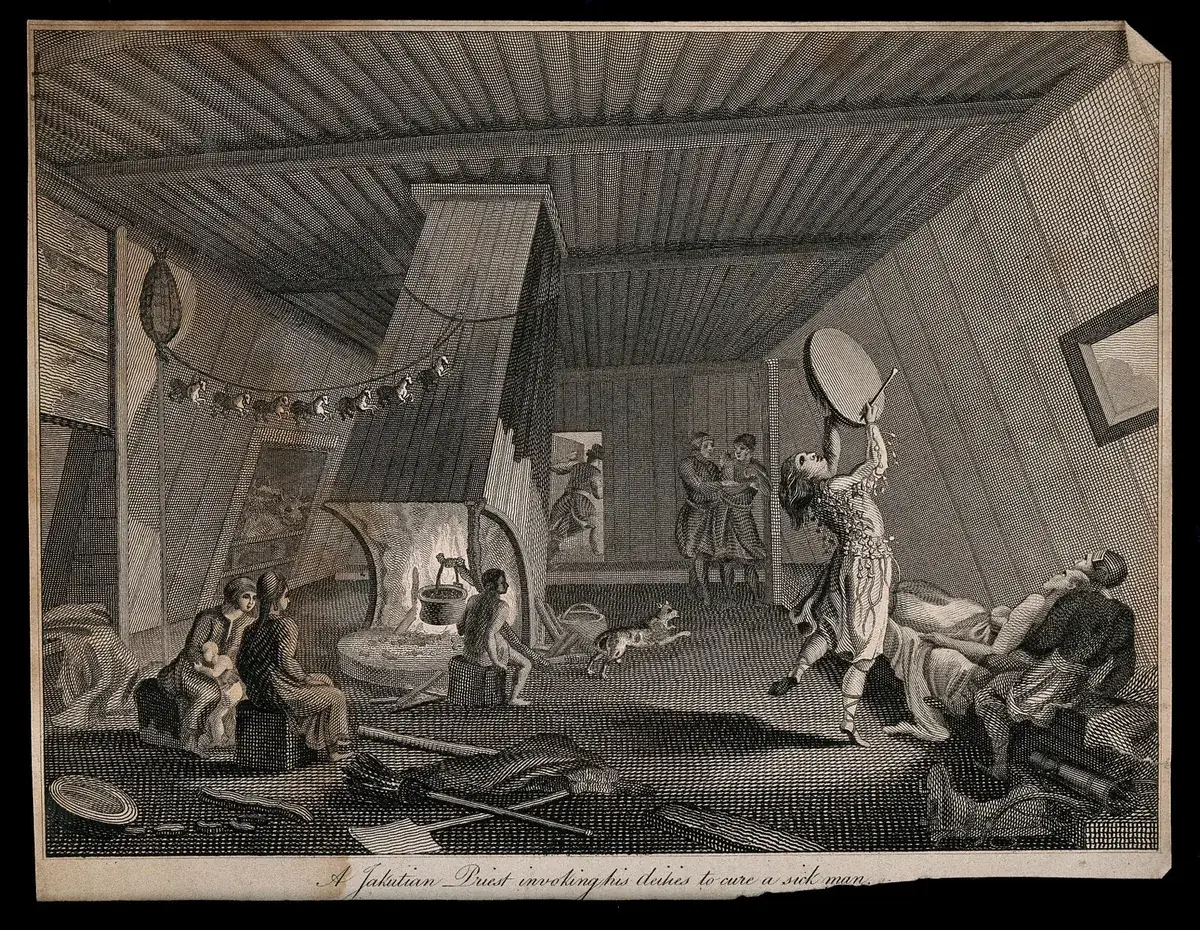
A good Yakut coat carried 35 to 40 pounds of iron, each plate and bell with its own name and meaning, and the Yakut called the coat the shaman’s horse. The hereditary smith who forged the iron had a half-magical place of his own. A proverb of the Kolyma district says that the smith and the shaman are of one nest.[54]
Khakas and Tuva
A shaman of the Minusinsk Tatars, the Khakas of the Minusinsk basin, is photographed with his face covered. The printed caption says that it is covered when he shamanises. A lama explained to a collector the picture on a drum of that region. Below were a rich birch round which the yearly sacrifices are held, two trees in the country of Ulu-khan, and the white and black frogs that serve him. Above were the aurora, the sun, two black birds that fly as messengers from the shaman to the shaytans, and the horses of Ulu-khan.[55]
In Tuva the staff came before the drum. A new shaman received first a staff of red-painted birch. He received the drum only after he had become a good shaman, when he could “mount the drum”. Some kept to the staff all their lives and were as powerful as those who had a drum.[56] A Tuvan scholar distinguishes shamans by the source of their power: shaman ancestors, the spirits of earth and water, the heavens or evil spirits. The shamans of heavenly descent, tengri boo, draw their power from the sky, a rainbow or lightning. Those of the earth and water spirits are held to keep the memory of the old Turkic respect for nature, which recalls the sacred Earth-and-Water of the inscriptions.[57] The shaman called his helper spirits with a whistling throat song. If they did not come, he imitated the voices of animals.[58] In 1958 an old shamaness agreed to shamanise for a film in a yurt with its roof lifted off. She lost all awareness of the camera, had fits of retching for three and a half minutes and then lay rigid.[59]
Kazakh baksa
Radloff found in the nineteenth century that Islam had for the most part rooted out shamanism among the Turkic peoples. Clear traces of the earlier religion remained among single nomad tribes, but he could report in detail only on the Kazakhs. The baksa differed from a pious Muslim in his hair and his cap. He used no drum. He played a two-stringed horsehair fiddle, the kobus, and swung a staff hung with bells and iron.[60] He fell into ecstasy, handled glowing iron and cried to the onlookers, “Do not look! The spirit bewitches your eyes.” Radloff took the feats for a conjurer’s tricks.[61] A Russian traveller of the 1870s confirmed the contrast. The Kirghiz baksy worked by day, without drum, special coat or dance, with a stringed instrument, and there were no women among them. By contrast, the Uriangkhai shaman worked by night with drum, dance and costume.[62] The Kazakh baqsy is described in modern writing as a folk healer who plays the qyl-qobyz fiddle to enter a trance, in which he talks to the spirits and calls on their help.[63]
Tungus and the Amur
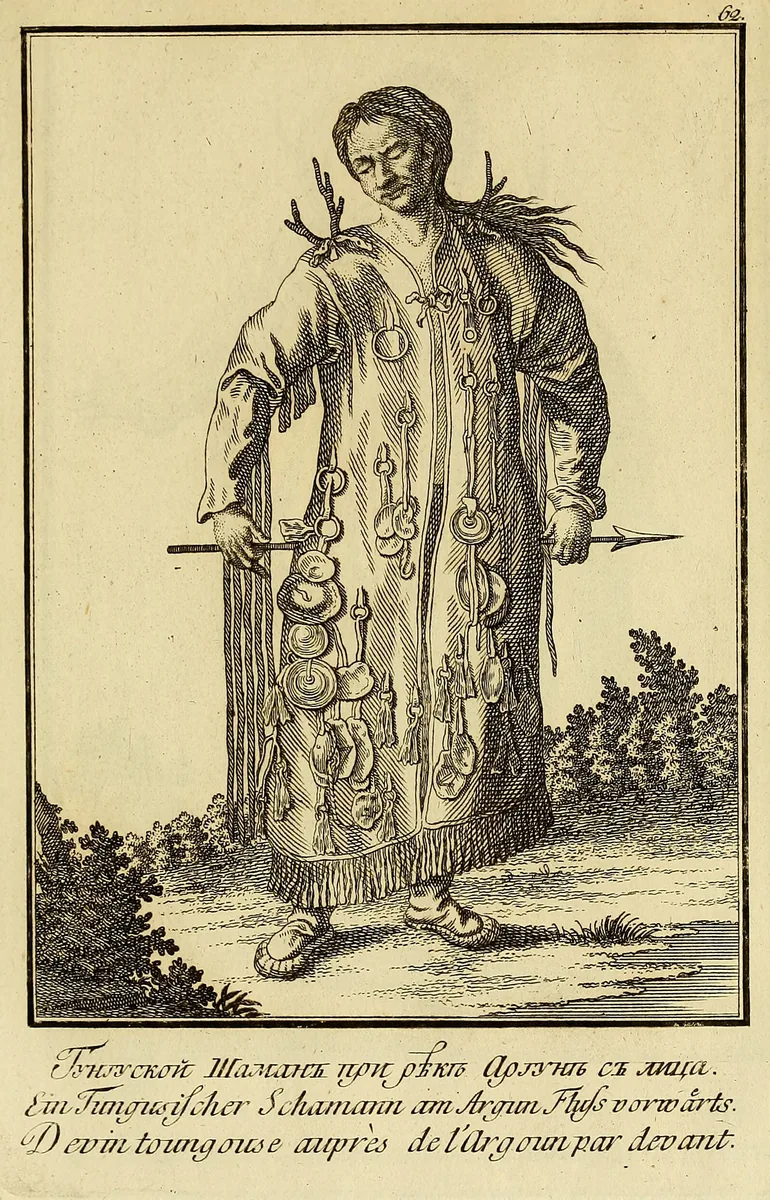
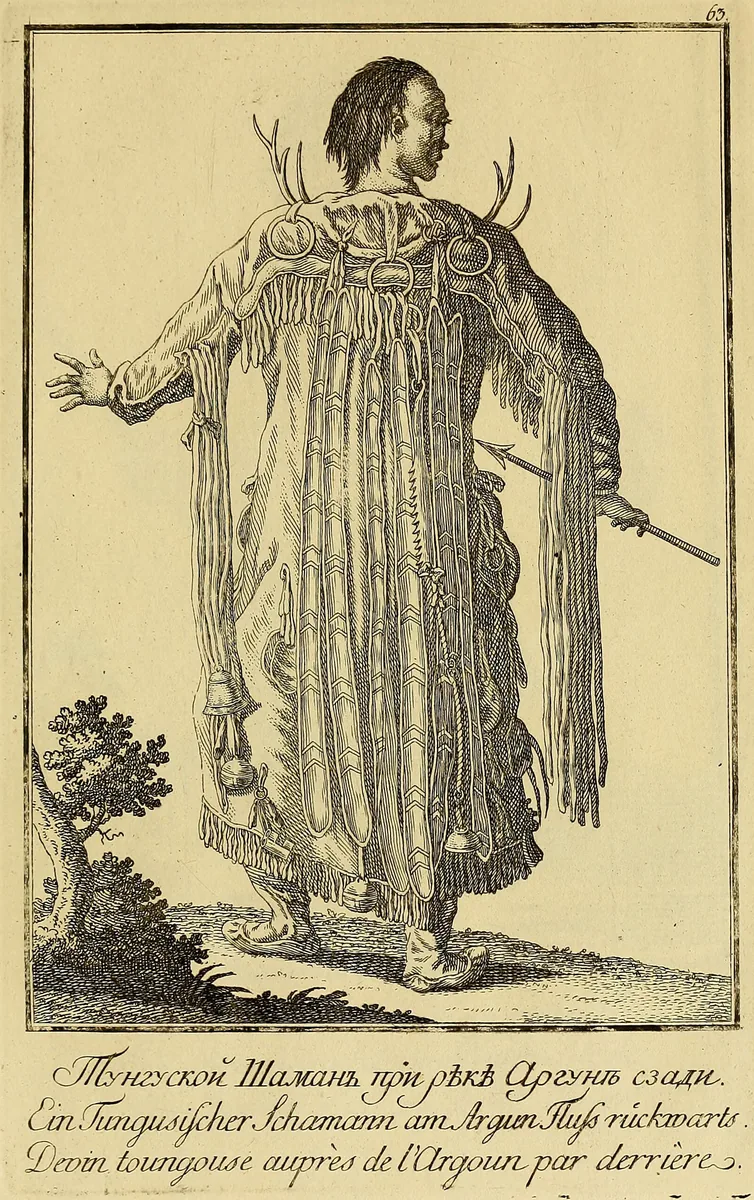
The Tungus are the people from whom the word shaman comes. The Tungus coat is hung on the back, the breast and the arms with iron pendants shaped like animals. They clatter at every movement.[64] Gmelin saw a Tungus shaman in an apron and stockings ornamented with iron. He wore no cap, because the old one had burned and the spirits had not granted him a new one.[65]
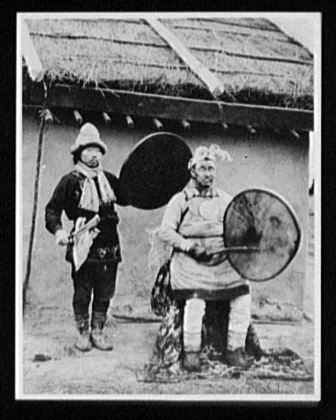
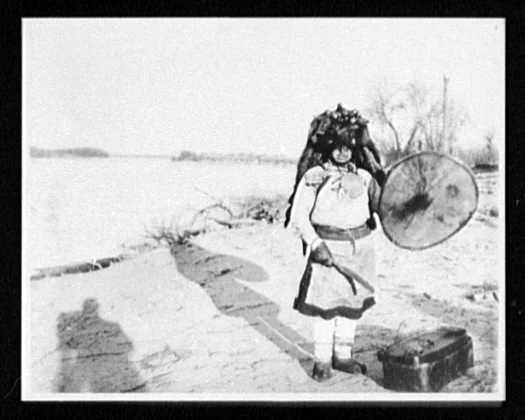
Photographs of the 1890s show Nanai shamans of the Amur, a Tungusic people, with their frame drums.
Under Islam and Buddhism
Islam and Buddhism did not end shamanism. The Islam of the Siberian Tatars and the Lamaism of the Buryats are mixed with shamanic practice, and Russian Orthodoxy forms a thin veneer over it among the Yakut.[66] Mullahs and lamas had to become shamans to a great extent.[67] Among the Turkic peoples the place of the kam is said to have passed to the eren and the evliya, the saints and holy men of Islam.[68]
The Soviet period and after
Two summaries, of 1892 and of 1924, call shamanism dying. They describe it as moribund among the Siberian peoples, bound to die with the beliefs in which it arose, and rapidly disappearing.[69] In Tuva the census of 1931 counted 725 active shamans, one for every twenty households.[9] Then came persecution. The Tuvan scholar Mongush Kenin-Lopsan recalled that his grandmother, a famous shamaness, was imprisoned in 1934, arrested again in the mid-forties and died in prison.[70] Tuvan scholars of the fifties and sixties did not work on shamanism or kept it secret. Drumming became a reason to fear. A paper of 1978 reported that shamanism in Tuva had lost its significance entirely.[71]
The revival followed the collapse of the Soviet Union. The Society of Tuva Shamans, Dungur, “the drum”, was formed on 21 October 1992 and then registered.[72] In 1993 the Foundation for Shamanic Studies declared Kenin-Lopsan a Living Treasure of Shamanism. The Tuvan government set up a scholarly centre for shamanism and a centre in Kyzyl where shamans can practise healing.[73] Tuva had more than 700 active shamans before 1937.[74] In 1996 Dungur had 37 members with cards and young shamans in every district.[74] On a morning in 1996 most of the ten or so people waiting at the Dungur building were not sick. They wanted to know the future or to join a purification.[75] The revived practice has been called an authentically late-twentieth-century phenomenon, shaped by circumstances unlike the traditional ones.[76] The movement that calls itself Tengrism belongs to the same decades and builds on the scholarship that made Tengrism.
Shamanism and Tengrism
In the account that makes shamanism the foundation of Tengrism, the Turkic peoples became Tengrist societies by building on shamanic ones. The inscriptions never show a kam crowning a khan. The khans of the Ashina made themselves rulers and had no need of a kam. This is understood as a sign of the development from shamanist to Tengrist steppe warriors.[77] The kam stayed among the people as healer and keeper of ritual, without political rank.[42]
Other views exist. One is that the Göktürk khans and their tribes were shamanists, while the shamanism of the recent Altaians and Yakuts cannot stand for the old Turkic religion whole, since the Turks who built great khaganates had a more developed world-view.[4] A second asks what shamanism is. Nineteenth-century observers took it for a primitive form of religion common to all aboriginal peoples. Others took it for one form of the northern Asian cult practised to avert evil spirits, or for the joint product of the whole of northern Asia.[78] The Yakut told the Russian government that shamanism was not their faith but an independent set of actions taken in certain cases.[67] A definition of 1924 calls it not a specific religion but a religious attitude based on the animistic view of nature, which in Siberia forms an essential part of a full religion of many gods and spirits.[79]
A national-historical interpretation goes further. It treats shamanism as a matter of magic and not as a Turkic system of belief, and it rejects totemism as the faith of the state.[80]
The layers touch at several points. The purification of strangers by fire that Menander describes has a counterpart in the burning cloth that Bashkirs and Kazakhs pass round the sick and in the Anatolian alazlama.[81] Control of the weather recurs. It appears with Nishidu, the Uyghur shamans of 765, the Altaian yadachi with his stone, and the Tuvan whistling song that laymen were forbidden to sing lest it bring wind, storm or snow.[82] Such a motif shows a likeness and not a descent.
The name of the sky occurs in the shamans’ own words. In Buryat accounts the tengri are the good spirits of the west who created men and gave them a shaman, the child of an eagle and a Buryat woman, to help against the evil spirits of the east.[83] In Tuva in the twentieth century a shaman who directed the sacrifice for a gravely sick person offered a grey horse to the lord of the sky and a chestnut horse to the spirit of the mountain.[9] The shamanism of the ethnographers comes from small communities without a state. The Göktürks of the inscriptions were an imperial court. Whether the one continues the other has not been shown.
Drum, costume and the three worlds
Where there is a shaman in Siberia there is a drum, which carries the shaman to the upper world and calls the spirits by its sounds.[44] The Altaian drum, the tüngür, is an oval wooden hoop three or four inches broad and about one arshin long, covered with tanned maral hide. Inside, along the long axis, stands a handle in the shape of a man with outstretched arms, the master of the drum, with a round head, button eyes and two slanting pieces of wood for legs. A wire forms his arms and carries iron rods and bells that rattle when the drum is swung, and strips of red and blue cloth sacred to the shaman’s forefathers hang from the handle.[46]
The skin carries red figures on the outside. The upper part is the sky, with the sun and the moon in the middle and stars above them. Below is the earth, with trees on both sides, a falling man, a rider on a horse, animals and birds. The shaman named the horses as sacrificial horses, the birds as geese and eagles, the rider as the shaman and the trees as the birches sacred to the gods.[46] Other drums divide the world into an upper and a lower part by a horizontal line.[84]
Yakut reports call the coat the shaman’s horse, and the Buryat shaman rides to the upper and lower worlds on two staves with a horse’s head. The drum too is said to be the horse on which he flies.[85][86] The sounds of the costume, bird calls, the rustle of a breeze and the voices of animals, make a soundscape on which the drum and the chant lie. It helps the shaman and the audience to enter the inner world and carries him on the journey.[58]
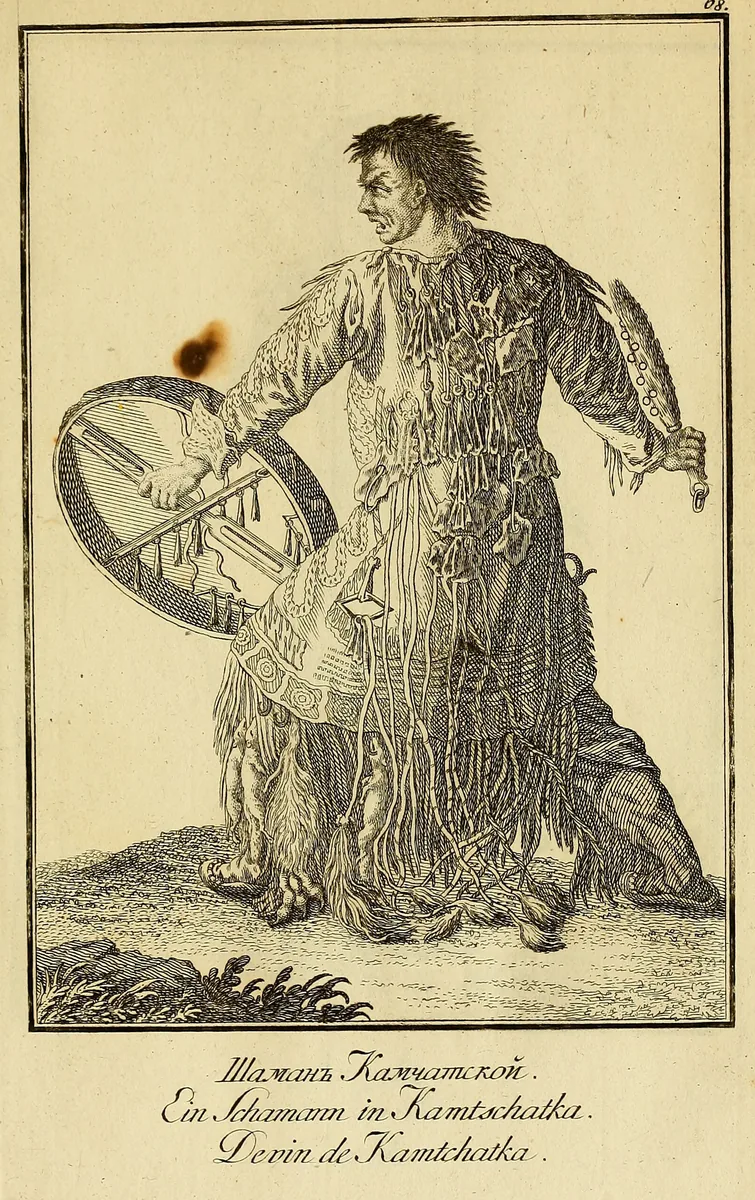
The reports of the Kamchadal do not all agree with the plate. Two eighteenth-century travellers held that the Kamchadal had no shamans in the narrow sense, no special shaman’s dress and no drum.[87] Equipment and dress differ from people to people, and the plate cannot stand for any one of them.
The cosmos of the Altaian rite is the cosmos of the tiered heavens. The shaman climbs through the layers of heaven and calls on Ülgen at the top, and on the journey to Erlik he crosses mountains, steppes, a sea and a gate guarded by dogs. This tiered world, with Ülgen above and Erlik below and the birch or pole as its axis, is known from the ethnography of the last three centuries and belongs to Turkic mythology as later writers built it.[88] The three worlds, the world tree and Erlik belong to that layer, and the Old Turkic texts know a lord of the dead under the name Erklig. The inscriptions name the blue sky above and the brown earth below, with the sons of men between them.[27]
Name
- kamqamOld TurkicDīvān Lughāt al-Turk
- kamlikKipchak
- šamanOther
- 巫覡ChineseSui Shu 84
- 胡巫ChineseHan Shu
- 甘ChineseXin Tangshu 217
- baqsyOther
The English word shaman comes from the Tungus, among whom it is the native name. The Manchu form is saman, and its basic sense is given as one who is excited, moved or raised. A rival derivation takes the word from the Sanskrit shramana, an ascetic and follower of the Buddha, which among the Mongols came to mean a magician, and it is the less accepted of the two.[2] The Buryats and Mongols call their shamans bo, the Yakuts oyun and the Samoyeds tadibei. The Altaians say kam and call the shaman’s dealings with the spirits kamlanie, a word in Russian dress.[89] The Mongols, Buryats, Yakuts, Altaians and Kirghiz share one word for the woman shaman in variant forms, udagan or utygan, while the word for the man differs in each language.[90]
The Chinese observers wrote 巫 and the compound 巫覡 of the specialists of the Göktürks, 胡巫 of the specialist of the Xiongnu court, 女巫 of the woman who prayed among the Gaoche and 巫師 of the two with the Uyghur army, and they wrote 甘 for the Kirghiz kam.[91] Menander calls the men who purified Zemarchos averters of evil.[25] No Göktürk text uses a word for the person, and the Turkic word that later centuries supply is kam. The Turkic specialist is therefore called a kam and not a shaman, and shamanism names a type of practice and not a word of the Göktürks.[92]
The ending -ism is a European addition. Russian observers of the nineteenth century first used the word of the phenomena of one region and its peoples and widened it only later to the phenomena of many peoples.[93] The Mongols who accepted Buddhism called their older religion the Black Faith, against the Yellow Faith of the lamas.[78]
Assessment
Steppe shamanism is recorded for two thousand years, and the record is of uneven weight. The Chinese and Byzantine notices show the specialist at work among the Xiongnu, the Gaoche, the Rouran, the Göktürks, the Uyghurs and the Kirghiz. They show sacrifice and prophecy, the purification of strangers and the calling up of snow and wind. The Turkic sources have the word kam from the eleventh century, and the ethnography of the last three centuries gives the drum, the coat, the journey and the tiered cosmos in detail that belongs to Siberia of those centuries.
Shamanism is the foundation of Tengrism, and the khans’ cult of the sky rose on it and left the kam out of the inscriptions.[42] In Tuva the practice has outlived its suppression and has taken on forms that the nineteenth century did not know.[76] What remains open is how far the practice recorded since the eighteenth century continues the practice of the khaganates.
References
- ^ Casanowicz 1924 (Annual Report 1924), p. 415,166,242; Czaplicka 1914, p. 415,166,242
- ^ a b Casanowicz 1924 (Annual Report 1924), p. 419
- ^ Yavuz 2025, p. 139,150–151
- ^ a b İnan 2017; first edition 1954, p. 1,6
- ^ Czaplicka 1914, p. 166,63; Mikhailovskii 1895, p. 166,63
- ^ Radloff 1893 (zweite Ausgabe), p. 1
- ^ Golden 1992, p. 1–2
- ^ Cosmo 2011, p. 47
- ^ a b c Hoppál 2003, p. 470
- ^ Czaplicka 1914, p. 211,526; Harva 1938, p. 211,526
- ^ Werner 1956, p. 71–72
- ^ Werner 1956, p. 77–78
- ^ Werner 1956, p. 75–76
- ^ a b Han Shu, juan 94
- ^ Erkoç 2026, p. 245–247
- ^ Shiji, juan 110
- ^ Maenchen-Helfen 1973, p. 269
- ^ Werner 1956, p. 72–74, 81
- ^ a b c Wei Shu, juan 103
- ^ a b Yavuz 2025, p. 138
- ^ Sui Shu (Book of Sui), juan 84
- ^ a b c d Zhou Shu (Book of Zhou), juan 50
- ^ Golden 1992, p. 119
- ^ Golden 1992, p. 147
- ^ a b c Menander Protector
- ^ Erkoç 2024, p. 193
- ^ a b c d Kül Tegin inscription
- ^ Barthold 2004, p. 17–18
- ^ a b Roux 1994, p. 53
- ^ Roux 1994, p. 214
- ^ Barthold 2004, p. 18
- ^ Sinor 1990, p. 330
- ^ Jiu Tangshu (Old Book of Tang), juan 195; Xin Tangshu (New Book of Tang), juan 217
- ^ Jiu Tangshu (Old Book of Tang), juan 195
- ^ Xin Tangshu (New Book of Tang), juan 217
- ^ İnan 2017; first edition 1954, p. 8
- ^ Hassan 1985, p. 238
- ^ Hassan 1985, p. 238–239
- ^ Marvazī (Ṭabāʾiʿ al-ḥayawān); Minorsky 1942, p. 30
- ^ Barthold 2004, p. 47–48
- ^ a b Radloff 1893 (zweite Ausgabe), p. 67
- ^ a b c Yavuz 2025, p. 150–151
- ^ Yavuz 2025, p. 387
- ^ a b Czaplicka 1914, p. 202
- ^ a b Radloff 1893 (zweite Ausgabe), p. 17
- ^ a b c Radloff 1893 (zweite Ausgabe), p. 18
- ^ Verbitskii 1893, scan 31
- ^ Radloff 1893 (zweite Ausgabe), p. 36–37
- ^ Radloff 1893 (zweite Ausgabe), p. 37–39
- ^ Radloff 1893 (zweite Ausgabe), p. 49
- ^ Czaplicka 1914, p. 240–242
- ^ Czaplicka 1914, p. 200
- ^ Mikhailovskii 1895, p. 65
- ^ Czaplicka 1914, p. 211,215,218
- ^ Czaplicka 1914, p. 221
- ^ Hoppál 2003, p. 466
- ^ Hoppál 2003, p. 472
- ^ a b Hoppál 2003, p. 475
- ^ Hoppál 2003, p. 468–469
- ^ Radloff 1893 (zweite Ausgabe), p. 59–60
- ^ Radloff 1893 (zweite Ausgabe), p. 60
- ^ Potanin 1881, p. 81–82
- ^ Rancier 2018, p. 215
- ^ Radloff 1893 (zweite Ausgabe), p. 17–18
- ^ Czaplicka 1914, p. 203–205
- ^ Casanowicz 1924 (Annual Report 1924), p. 416
- ^ a b Mikhailovskii 1895, p. 63
- ^ Alsan 2024, p. 1443
- ^ Mikhailovskii 1895, p. 63,415; Casanowicz 1924 (Annual Report 1924), p. 63,415
- ^ Hoppál 2003, p. 471
- ^ Hoppál 2003, p. 470,471,476
- ^ Hoppál 2003, p. 474,476
- ^ Hoppál 2003, p. 473–474
- ^ a b Hoppál 2003, p. 476
- ^ Hoppál 2003, p. 477–478
- ^ a b Hoppál 2003, p. 478
- ^ Yavuz 2025, p. 150
- ^ a b Czaplicka 1914, p. 166
- ^ Casanowicz 1924 (Annual Report 1924), p. 415
- ^ Kafesoğlu 1997, p. 297–303
- ^ Yavuz 2025, p. 145
- ^ Golden 1992, p. 119,200,475; Czaplicka 1914, p. 119,200,475; Hoppál 2003, p. 119,200,475
- ^ Mikhailovskii 1895, p. 64
- ^ Czaplicka 1914, p. 220–221
- ^ Czaplicka 1914, p. 218,224
- ^ Potanin 1881, p. 87–88
- ^ Czaplicka 1914, p. 171
- ^ Radloff 1893 (zweite Ausgabe), p. 49,240–242; Czaplicka 1914, p. 49,240–242
- ^ Mikhailovskii 1895, p. 63,419; Casanowicz 1924 (Annual Report 1924), p. 63,419
- ^ Czaplicka 1914, p. 198
- ^ Sui Shu (Book of Sui), juan 84; Han Shu, juan 94; Wei Shu, juan 103; Jiu Tangshu (Old Book of Tang), juan 195; Xin Tangshu (New Book of Tang), juan 217
- ^ Yavuz 2025, p. 146,150
- ^ Mikhailovskii 1895, p. 62
Sources
- Han Shu, juan 94 (after Shiji)
- Shiji, juan 110
- Wei Shu, juan 103
- Sui Shu (Book of Sui), juan 84
- Zhou Shu (Book of Zhou), juan 50
- Menander Protector
- Jiu Tangshu (Old Book of Tang), juan 195
- Xin Tangshu (New Book of Tang), juan 217 (after Jiu Tangshu)
- Marvazī (Ṭabāʾiʿ al-ḥayawān)
- Kül Tegin inscription
- Dīvān Lughāt al-Turk
Literature
- Wilhelm Radloff, Aus Sibirien. Lose Blätter aus meinem Tagebuche. Zweiter Band (1893 (zweite Ausgabe))
- Marie Antoinette Czaplicka, Aboriginal Siberia: A Study in Social Anthropology (1914)
- V. M. Mikhailovskii; Oliver Wardrop (trans.), Shamanism in Siberia and European Russia, Being the Second Part of "Shamanstvo" (1895)
- I. M. Casanowicz, Shamanism of the Natives of Siberia (1924 (Annual Report 1924))
- Uno Harva, Die religiösen Vorstellungen der altaischen Völker (1938)
- Abdülkadir İnan, Tarihte ve Bugün Şamanizm: Materyaller ve Araştırmalar (2017; first edition 1954)
- Mihály Hoppál, Tracing Shamans in Tuva (2003)
- Hayrettin İhsan Erkoç, Gök Türklerde Doğa Kültleri (2024)
- Hayrettin İhsan Erkoç, Asya Hunlarında Dinî İnançlar (Religious Beliefs of the Xiongnu) (2026)
- Şenay Sayın Alsan, Gök Tanrı İnancının Türk İnanç Sisteminde Yeri ve Mimariye Yansımaları (2024)
- Emre-E. Yavuz, The Gokturk Empire: 2nd Edition (2025)
- Peter B. Golden, An Introduction to the History of the Turkic Peoples (1992)
- Nicola Di Cosmo, Ethnogenesis, Coevolution and Political Morphology of the Earliest Steppe Empire: The Xiongnu Question Revisited (2011)
- Otto J. Maenchen-Helfen, The World of the Huns: Studies in Their History and Culture (1973)
- Razia Sultanova, Megan Rancier (ed.), Turkic Soundscapes: From Shamanic Voices to Hip-Hop (2018)
- V. Minorsky, Sharaf al-Zamān Ṭāhir Marvazī on China, the Turks and India (1942)
- Denis Sinor (ed.), The Cambridge History of Early Inner Asia (1990)
- Grigorii Nikolaevich Potanin, Очерки Северо-западной Монголии. Вып. 2. Материалы этнографические (Ocherki severo-zapadnoi Mongolii, Bd. 2) (1881)
- Vasilii Ivanovich Verbitskii, Алтайские инородцы (Altai Foreigners) (1893)
- Joachim Werner, Beiträge zur Archäologie des Attila-Reiches (1956)
- V. V. Barthold, Orta Asya Türk Tarihi Dersleri (Orta Asya Türk Tarihi Hakkında Dersler) (2004)
- Ümit Hassan, Eski Türk Toplumu Üzerine İncelemeler (1985)
- İbrahim Kafesoğlu, Türk Millî Kültürü (1997)
- Jean-Paul Roux, Türklerin ve Moğolların Eski Dini (1994)
What links here3
Cite this article
Yavuz, Emre-E. “Shamanism.” Turkic Atlas, revised 8 November 2026. https://turkicatlas.org/religions/shamanism/
Last revised: 8 November 2026

