
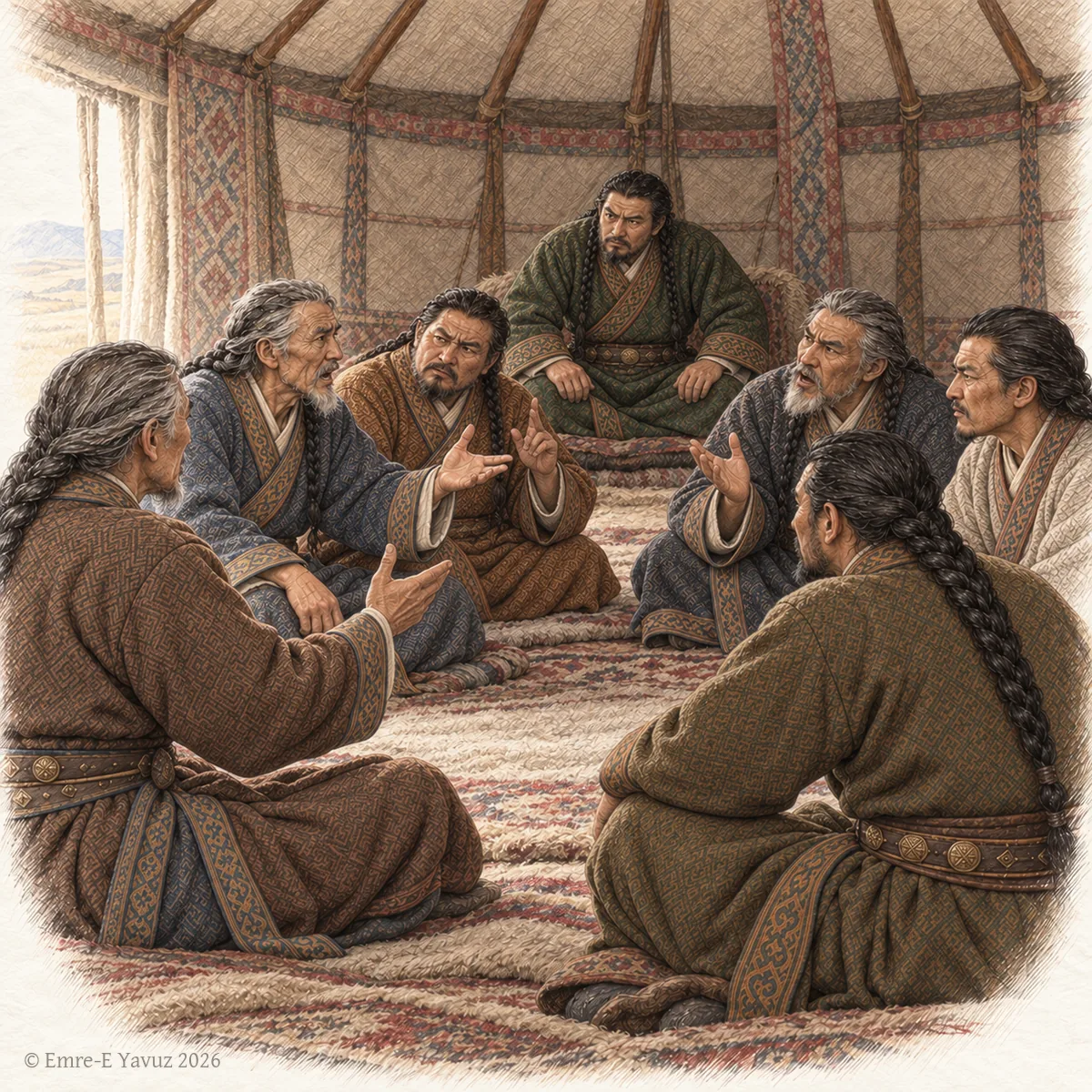
The yanhongda, 閻洪達, was an office of the western Göktürks.[1] The Sui Shu says that the western state had the offices of sifa and yanhongda to deliberate on the affairs of state. Its other offices, it says, were the same as in the eastern state.[2] The Bei Shi repeats the sentence word for word.[3]
The western state under Heshana
The sentence closes the Sui Shu’s description of the west under Heshana, whom the Chinese also call Chuluo Khan.[1] He had no fixed seat and stayed mostly in the old land of the Wusun.[1] Under him stood two lesser khans. One was north of Chach, to hold down the western peoples. The other was north of Kucha.[1] The council of sifa and yanhongda belonged to this court.[1]
In the Tang lists
The Jiu Tang Shu counts the yanhongda among the hereditary offices of the western Göktürks. It lists it after the yijin and the quli chuo, and before the xielifa, the tudun and the sijin.[4] The Tongdian gives the same list.[5] The Xin Tang Shu places the yanhongda among the great ministers of the Göktürks, between the sijin and the xielifa, in its list of the twenty-eight grades.[6]
The word
The Turkic word behind 閻洪達 is not known. An early attempt to match the titles of the Tang lists with Turkic words left the yanhongda among those too doubtful to identify.[7]
References
- ^ a b c d e Sui Shu (Book of Sui), juan 84
- ^ Sui Shu (Book of Sui), juan 84; Chavannes 1903, p. 15
- ^ Bei Shi (History of the Northern Dynasties), juan 99
- ^ Jiu Tangshu (Old Book of Tang), juan 194
- ^ Tongdian, juan 199
- ^ Xin Tangshu (New Book of Tang), juan 215
- ^ Thomsen 1896, p. 59
Sources
- Sui Shu (Book of Sui), juan 84
- Bei Shi (History of the Northern Dynasties), juan 99 (after Wei Shu, Zhou Shu and Sui Shu)
- Jiu Tangshu (Old Book of Tang), juan 194
- Tongdian, juan 199 (after Sui Shu and Zhou Shu)
- Xin Tangshu (New Book of Tang), juan 215 (after Jiu Tangshu)
Literature
- Vilhelm Thomsen, Inscriptions de l'Orkhon déchiffrées (1896)
- Édouard Chavannes, Documents sur les Tou-Kiue (Turcs) occidentaux (1903)
What links here2
- Institutions and Titles
- Sifa · The Twenty-Eight Ranks
Cite this article
Yavuz, Emre-E. “Yanhongda.” Turkic Atlas, revised 28 October 2026. https://turkicatlas.org/institutions/yanhongda/
Last revised: 28 October 2026

