
Kucha was the largest of the oasis kingdoms on the northern rim of the Tarim. It lay where the road along the foot of the Tian Shan is at its richest in water. It had its own dynasty, its own language and a Buddhist establishment.
The kingdom
The Sui Shu describes Kucha as an old state of the Han period. Its capital lay 170 li south of the White Mountain. The city was six li square and had several thousand men under arms.[1] The king’s surname was Bai, his courtesy name Suniezhi.[1] He tied a coloured ribbon round his head and let it hang down behind. He sat on a golden lion throne. The country grew rice, millet, beans and wheat. It produced copper, iron, lead, deerskins, woollen rugs, sal ammoniac, orpiment, benzoin, good horses and humped oxen.[1][2] The distances run 900 li to Yanqi in the east, 1,400 to Khotan in the south and 1,500 to Shule in the west. The Göktürk camp lay more than 600 li to the north-west.[1]
The Jiu Tang Shu adds that men and women cut their hair to the length of the neck. The king alone left his uncut. The people learned the script of the Hu and the script of the Brahmans, as well as reckoning, and held to Buddhism above all. The king wrapped his head in brocade and wore a brocade robe with a belt of gold and jewels. The country had good horses and humped oxen and plenty of grape wine. Rich houses stored it by the hundred shi.[3] An older report, from the campaign against Kucha in 384, has families store up to a thousand hu of wine in their houses. It also describes a people renowned for music, song and dance.[4][5]
Xuanzang passed through Kucha on his way to India. He found a country of more than a thousand li from east to west and some six hundred from north to south. The capital was seventeen or eighteen li round. The country grew millet, wheat, rice, grapes and pomegranates, pears, apples, peaches and apricots. It yielded gold, copper, iron, lead and tin. Its script followed the Indian one with some changes. Its music was better than that of the other countries. It paid in gold, silver and small copper coins. There were more than a hundred monasteries with over five thousand monks, who studied the Sarvastivada teaching of the Lesser Vehicle.[6] In the east of the country, before a temple, Xuanzang places a great pond of dragons. From this pond the country got its good horses.[6]
Kings and language
Sanskrit leaves from Qizil record the monks’ announcements of a king’s gift of food to the order. They name six kings of Kucha: Suvarnapuspa, Vasuyaśas, Artep, Tottika, a second Suvarnapuspa and Suvarnadeva.[7] Artep, Tottika and the second Suvarnapuspa, and perhaps Suvarnadeva, bear the title Kuciśvara Kucimahārāja, “lord of Kucha, great king”. Vasuyaśas is called only Kucimahārāja. Tottika is named with his queen Svayamprabhā.[8] The leaves are dated on palaeographic grounds to about 600, some of them older. They carry the form Kuci as the name of the country. This form comes from the local language.[9] In the language of Kucha the Sanskrit word for a novice monk, śrāmaṇera, became ṣanmire.[10]
The Jiu Tang Shu gives the Chinese side of the line. In the reign of the first Tang emperor, the lord of Kucha, Sufa Bujue, sent an envoy to court. He soon died, and his son Sufa Die took his place. In 630 Sufa Die sent horses. The country served the western Göktürks.[3] After his death his brother Helibushibi followed him.[3] Modern accounts read the Sanskrit leaves as naming the same pair as Suvarnapuspa and Suvarnadeva. They place Suvarnadeva on the throne between 618 and 630.[11] The Chinese give the royal family the surname Bai, “white”. The Sanskrit leaves do not confirm it.[1][12]
Xuanzang tells of an earlier king of Kucha, Goldflower, who harnessed dragons to his chariot. The descendants of the dragons turned violent. The king called in the Göktürks, and they killed everyone in the city, young and old. The city was a ruin.[6] Some scholars place the story at the older Suvarnapuspa. The Sanskrit leaves show that he lived long before Suvarnadeva. This view does not place the story at the king before Suvarnadeva.[13]
Wall paintings
The Buddhist caves near Kucha, at Qizil and elsewhere, carry wall paintings of the donors. The donors stand in a row along the foot of the walls. In the cave of the Sword-bearers they wear long coats with wide sleeves and breast flaps, soft wide trousers and stiff over-trousers. They carry long swords and daggers from metal rings on the belt, with handkerchiefs hanging beside them. They bring incense and flowers.[14] In a cave of the second group at Qizil a donor picture bears a Brahmi inscription in Sanskrit that names a mahārāja of Kucha, Anantavarman. It has no date.[15]
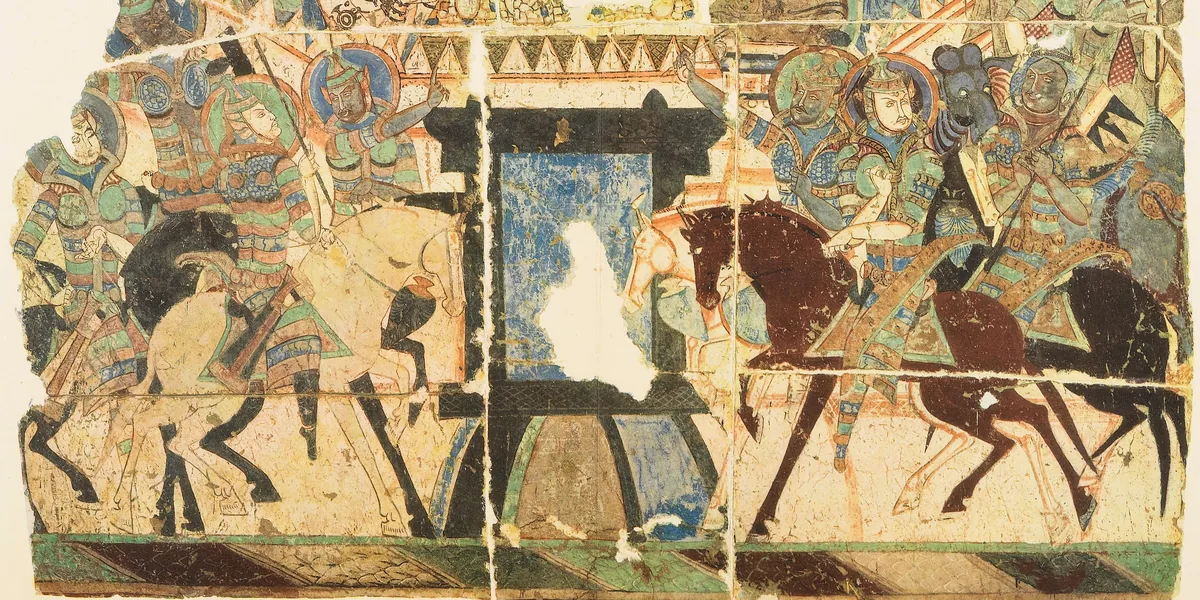
In the Cave of the Painters at Qizil a wall painting shows the distribution of the relics of the Buddha. The brahmin Drona stands with raised arms above the closed gate of a walled city, with the relics on cushions behind him. Riders in full armour approach the gate from both sides. Four of them are marked by haloes as the princes of the cities that claim a share. The armour has a high stiff collar that seems sewn from iron plates. The riders carry long two-handed swords with a small guard but no shields. Round plates protect their horses’ shoulders and thighs. Their helmet caps carry griffins, phoenixes, eagles, a wheel or a disc, each with long streamers. Their banners have three or four points, and one is a dragon banner. On almost all the lances hangs a lined leather holder for cups.[16] The armour does not follow Indian models. It is the armour of the country.[17] Others see in a Kizil painting of armoured newcomers received by the rulers of Kucha the Göktürk conquest of 552. The Tarim Basin article gives this reading.[18]
The seat of the western khans
The western Göktürks did not govern the Tarim from inside it. They governed it from the grass above it. The Chinese chapters use Kucha to fix where the grass was.
The Sui Shu opens its chapter on the western Göktürks with two statements. The Göktürks held off Ötüken in the east and crossed the Golden Mountain in the west. Kucha, the Tiele, Hami and the Hu states of the western regions all attached themselves to them.[19] The chapter adds that the western khan Heshana, then called Chuluo Khan, had no fixed residence. He set up two lesser khans under him: one north of Chach, to control the Sogdian states, and one north of Kucha, at a place called Yingsuo.[19]
The Xin Tang Shu fixes the same country for the khan who reunified the west. Shegui built his court at the Three-Mi mountain north of Kucha. Most of the states west of the Jade Gate were made subject to him, so that he stood level with the eastern khaganate.[20] A generation later Kucha is again in a list of subject kingdoms. This time the list belongs to the southern of the two rival western courts. It names Kucha together with Shanshan, Qiemo, Tokharistan, Yanqi, Chach, Kesh, Kushaniya, Maimurgh and Samarkand.[20]
The oasis is therefore a fixed point in a moving empire. The khans changed, their camps changed. The chapters locate every one of them by naming the town they lay north of.[20]
Under the Tang
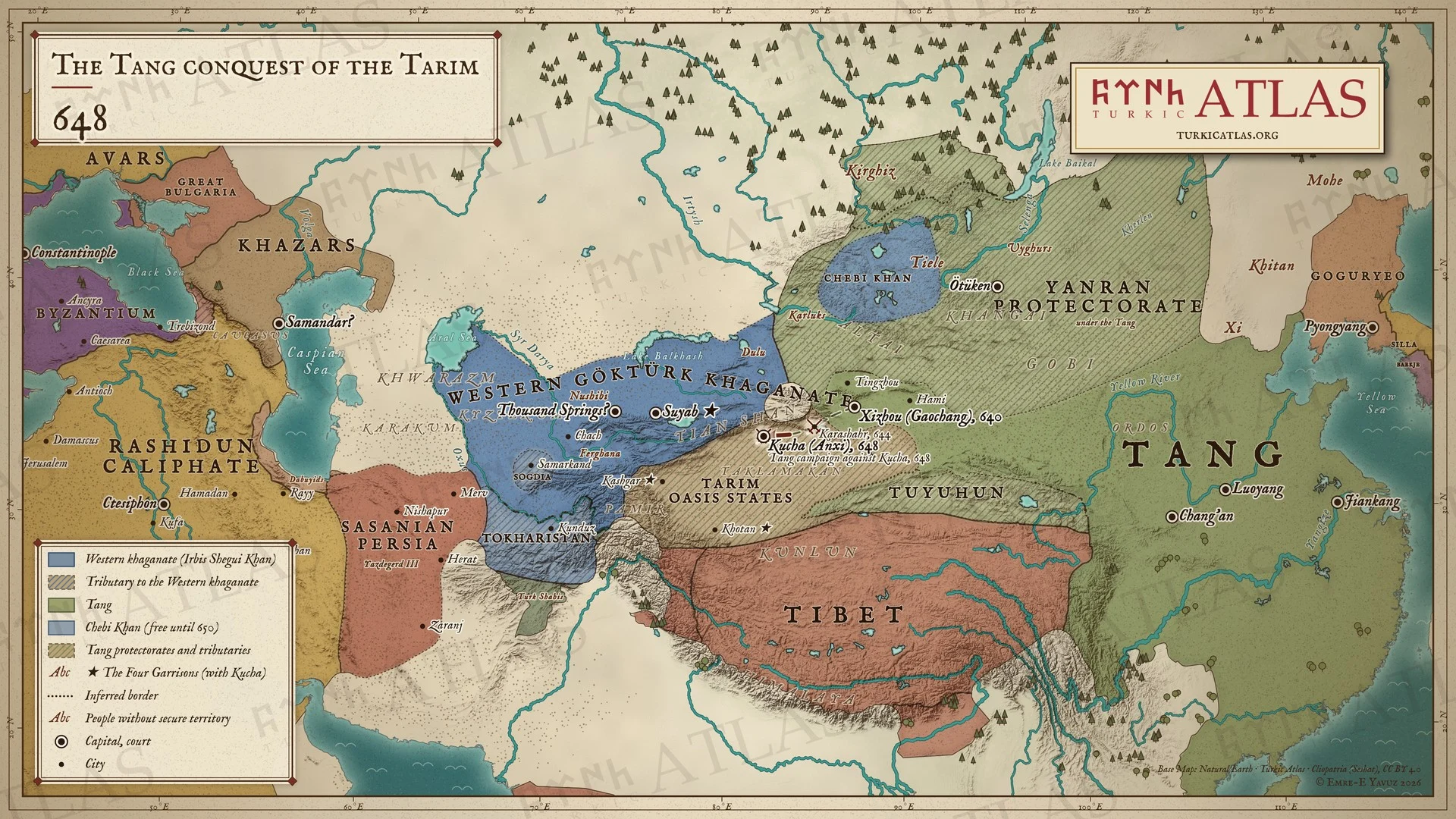
The Jiu Tang Shu tells the story of the Four Garrisons in one passage of its chapter on the western peoples. Taizong broke Kucha, moved the Anxi protectorate into its capital and made Guo Xiaoke protector there. Guo also governed Khotan, Kashgar and Suyab. The four were called the Four Garrisons.[3] What had been the southern edge of a steppe empire became the western edge of a Chinese one. The same oasis carried both.
Gaozong gave the garrisons up. When he came to the throne, he did not wish to enlarge the empire’s territory and burden its people. He ordered the officials to abandon Kucha and the other garrisons and to move Anxi back to Xizhou, where it had stood before.[3] The passage gives no year for the order. The Tibetans then came in force and took the walled towns and forts of the Four Garrisons west of Karashahr.[3] In 692, under Empress Wu, Wang Xiaojie, commander of the Wuwei army, and Ashina Zhongjie routed the Tibetans and recovered Kucha, Khotan and the other garrisons.[3] Anxi was set up at Kucha once more and held with thirty thousand Han soldiers.[3] The troops, their clothing and their grain had to be sent across the desert. Those who memorialized the throne often asked for the garrisons to be given up again. Empress Wu refused.[3]
The garrison went when the empire’s armies were called home after 755. The Tarim passed to the Tibetans and then, after 840, to the Uyghurs who came west out of the fall of their own khaganate.
References
- ^ a b c d e Sui Shu (Book of Sui), juan 83
- ^ Laufer 1919, p. 504–506
- ^ a b c d e f g h i Jiu Tangshu (Old Book of Tang), juan 198
- ^ Xin Tangshu (New Book of Tang), juan 221
- ^ Laufer 1919, p. 222
- ^ a b c Record of the Western Regions, juan 1
- ^ Lüders 1930, p. 21,23
- ^ Lüders 1930, p. 13,21
- ^ Lüders 1930, p. 4,27
- ^ Lüders 1930, p. 23
- ^ Lüders 1930, p. 21–23
- ^ Lüders 1930, p. 27
- ^ Lüders 1930, p. 22–23
- ^ Grünwedel 1920, i 27–28
- ^ Grünwedel 1920, i 29
- ^ Grünwedel 1920, ii 109–111
- ^ Grünwedel 1920, ii 111
- ^ Yavuz 2025
- ^ a b Sui Shu (Book of Sui), juan 84
- ^ a b c Xin Tangshu (New Book of Tang), juan 215
Sources
- Sui Shu (Book of Sui), juan 83, 84
- Xin Tangshu (New Book of Tang), juan 215, 221 (after Jiu Tangshu)
- Jiu Tangshu (Old Book of Tang), juan 194, 198
- Record of the Western Regions, juan 1
Literature
- Édouard Chavannes, Documents sur les Tou-Kiue (Turcs) occidentaux (1903)
- Peter B. Golden, An Introduction to the History of the Turkic Peoples (1992)
- Étienne de la Vaissière, Sogdian Traders: A History (2005)
- Emre-E. Yavuz, The Gokturk Empire: 2nd Edition (2025)
- Heinrich Lüders, Weitere Beiträge zur Geschichte und Geographie von Ostturkestan (1930)
- Albert Grünwedel, Alt-Kutscha. Archäologische und religionsgeschichtliche Forschungen an Tempera-Gemälden aus buddhistischen Höhlen der ersten acht Jahrhunderte nach Christi Geburt (1920)
- Berthold Laufer, Sino-Iranica. Chinese Contributions to the History of Civilization in Ancient Iran (1919)
- Albert Herrmann, Die alten Seidenstrassen zwischen China und Syrien. Beiträge zur alten Geographie Asiens, Bd. 1 (1910)
What links here26
- Battles & Events
- Music of Empress Ashina (568) · Submission of Ishbara (585)
- Places
- Aksu · Anxi Protectorate · Aquileia · Issyk-Kul · Jade Gate · Karashahr · Luntai · Quli · Sanmi Mountain · Tarim Basin · Wulei · Xihai · Yingsuo
- Institutions and Titles
- Han Military Farms in the Western Regions · Trade Routes of the Steppe · Yanhongda
- Sources
- Life of Xuanzang · Tongdian
Cite this article
Yavuz, Emre-E. “Kucha.” Turkic Atlas, revised 8 November 2026. https://turkicatlas.org/places/kucha/
Last revised: 8 November 2026

