
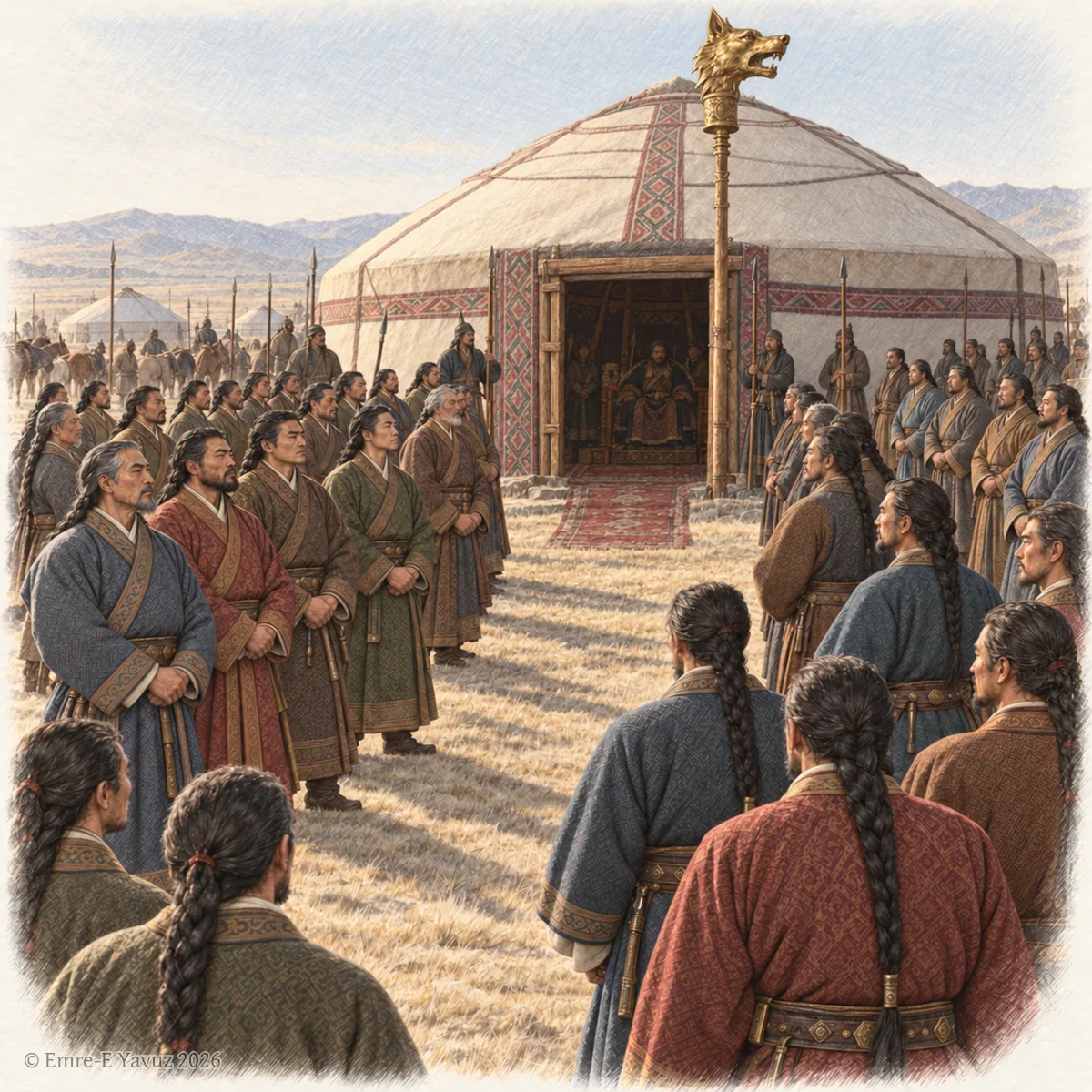
The twenty-eight ranks were the order of offices of the Göktürk khaganate as the Chinese histories describe it.[1] The Zhou Shu names the great offices from the yabgu down. It says that, with the lesser offices, there were twenty-eight grades in all, every one of them hereditary.[2] None of the histories names all twenty-eight.[1]
The order in the Zhou Shu and the Sui Shu
The Zhou Shu gives five great offices in sequence: first the yabgu, then the shad, then the tegin, then the silifa, then the tutunfa. After them come the lesser offices.[2] The transmitted text writes mo, 沒, in the place of the shad. The edition corrects it to she, 設.[2] The Sui Shu and the Bei Shi give the same five offices in the same order. They give the same count of twenty-eight.[3]
The order in the Tang works
The Tongdian and the Jiu Tang Shu arrange the order differently.[4] They set two groups apart. The first group is the khan’s sons and younger brothers, who were called tegin. The second is the men who commanded the troops of the separate divisions, who were called shad.[4] The great offices follow in a single line: Külüg Chur first, then apa, then xielifa, then tudun, then irkin.[4] The yabgu does not appear in this list.[4]
The Jiu Tang Shu gives no number.[5] It says that the offices passed from generation to generation, without a fixed number of holders. When a father or elder brother died, a son or younger brother took his place.[5]
The Xin Tang Shu names eleven titles below the khan: the shad, the tegin, the yabgu, Külüg Chur, apa, silifa, tudun, irkin, yanhongda, xielifa and dagan.[6] It returns to the count of twenty-eight. It adds that the offices were hereditary and had no fixed number of holders.[6] Its list has both silifa, the spelling of the Zhou Shu, and xielifa, the spelling of the Jiu Tang Shu.[7]
The ten grades of the Tongdian
The Tongdian gives a second count. At first, it says, the titles of high and low numbered ten grades.[8] They took their names from the body, from age, from colour, beard and hair, from wine and meat, or from the names of animals.[8]
Examples follow. The brave and strong were called shiboluo and also yinghefu.[8] The fat were called daluobian, after a short, thick wine vessel. This office was especially noble and was held only by sons and younger brothers.[8] From the Göktürk words for old, horse, black and hair came the Geli Daguan, the Helan Suni Que, the Keluo Chuo and the Suoge Tudun.[8] Wine gave the Funi Rehan, who watched over wrongdoing and kept the order of precedence. Meat gave the Anchan Juni, who managed the household.[8] At times a Fulin Khan was set up, named after the wolf.[8] Great families living at home called one another yi khan, house khan.[8]
Counted with shiboluo and yinghefu as one, the examples come to ten, the number of the opening sentence. The passage does not say that they are the ten grades.[8] The Zhou Shu, the Sui Shu, the Bei Shi and the two Tang histories do not have the passage.[9] No source sets the ten grades beside the twenty-eight.[10]
Khans within the order
The khan stood above the order, but he was not the only man with that title. The Tongdian says that some khans ranked below the yabgu.[8] The Sui Shu gives examples. Anluo, who gave up the throne to Ishbara, was called the second khan. In the west, Heshana, then called Chuluo Khan, set up two lesser khans to rule parts of his people.[11]
The offices of the west
For the western Göktürks, the Sui Shu names two offices of counsel, the sifa and the yanhongda. Their holders deliberated the affairs of state.[11] The rest of their offices, it says, were as in the eastern realm.[11] The Bei Shi repeats this.[12]
The Tang works give the western list in more detail.[13] The Tongdian names the yabgu, the shad and the tegin as offices always held by the khan’s sons, younger brothers and kinsmen. The Jiu Tang Shu names the yabgu and the tegin in the same way.[13] Both then list further offices, among them the yanhongda, the xielifa, the tudun and the sijin. They say that all of them passed by inheritance.[13]
Every dynastic history that describes the order calls its ranks hereditary.[9]
References
- ^ a b Zhou Shu (Book of Zhou), juan 50; Sui Shu (Book of Sui), juan 84; Xin Tangshu (New Book of Tang), juan 215
- ^ a b c Zhou Shu (Book of Zhou), juan 50
- ^ Sui Shu (Book of Sui), juan 84; Bei Shi (History of the Northern Dynasties), juan 99
- ^ a b c d Tongdian, juan 197; Jiu Tangshu (Old Book of Tang), juan 194
- ^ a b Jiu Tangshu (Old Book of Tang), juan 194
- ^ a b Xin Tangshu (New Book of Tang), juan 215
- ^ Xin Tangshu (New Book of Tang), juan 215; Zhou Shu (Book of Zhou), juan 50; Jiu Tangshu (Old Book of Tang), juan 194
- ^ a b c d e f g h i j Tongdian, juan 197
- ^ a b Zhou Shu (Book of Zhou), juan 50; Sui Shu (Book of Sui), juan 84; Bei Shi (History of the Northern Dynasties), juan 99; Jiu Tangshu (Old Book of Tang), juan 194; Xin Tangshu (New Book of Tang), juan 215
- ^ Tongdian, juan 197; Zhou Shu (Book of Zhou), juan 50
- ^ a b c Sui Shu (Book of Sui), juan 84
- ^ Bei Shi (History of the Northern Dynasties), juan 99
- ^ a b c Tongdian, juan 199; Jiu Tangshu (Old Book of Tang), juan 194
Sources
- Zhou Shu (Book of Zhou), juan 50
- Sui Shu (Book of Sui), juan 84
- Bei Shi (History of the Northern Dynasties), juan 99 (after Wei Shu, Zhou Shu and Sui Shu)
- Tongdian, juan 197, 199 (after Sui Shu and Zhou Shu)
- Jiu Tangshu (Old Book of Tang), juan 194
- Xin Tangshu (New Book of Tang), juan 215 (after Jiu Tangshu)
What links here14
- Institutions and Titles
- Anchan Juni · Army of the Steppe Empires · Funi Rehan · Geli Daguan · Helan Suni Que · Ishbara (Title) · Keluo Chuo · Külüg Chur · Suoge Tudun · Tegin · Yanhongda · Yi Khan · Yinghefu
- Languages
- Chinese transcriptions of Turkic
Cite this article
Yavuz, Emre-E. “The Twenty-Eight Ranks.” Turkic Atlas, revised 7 November 2026. https://turkicatlas.org/institutions/twenty-eight-ranks/
Last revised: 7 November 2026

