
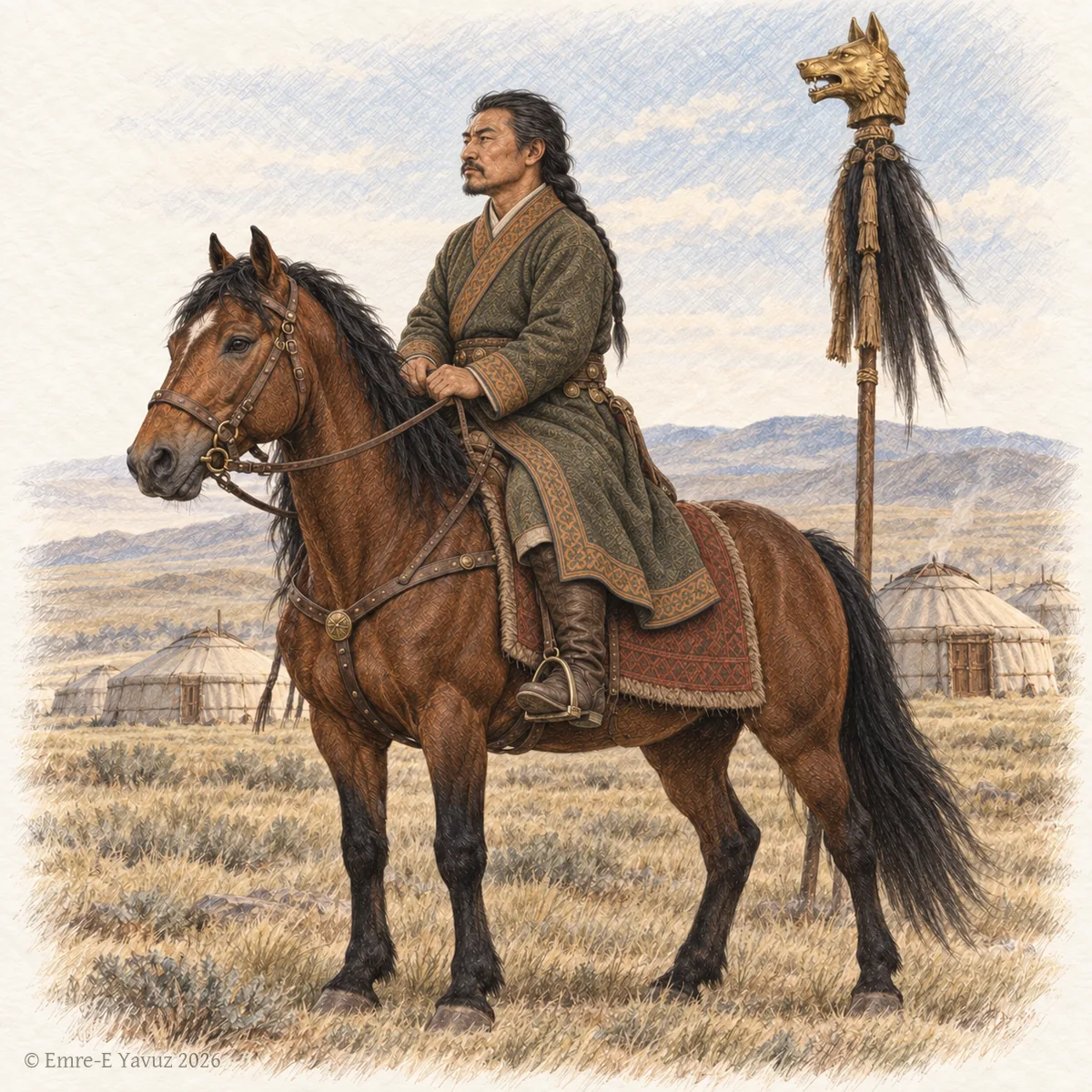
Külüg Chur is the first of the great offices of the Göktürks in the Tongdian and the Jiu Tang Shu.[1] The Chinese write it 屈律啜, quluchuo.[1]
The office in the sources
The Tongdian and the Jiu Tang Shu describe the order in nearly the same words.[1] The khan’s sons and younger brothers are tegins. The men who lead the troops of a separate division are shads.[1] Then come the great offices: first the quluchuo, then the apa, the xielifa, the tudun and the sijin.[1] The Jiu Tang Shu adds that these offices passed down the generations and had no fixed number of holders.[2] When a father or an elder brother died, a son or a younger brother took his place.[2]
The Xin Tang Shu orders the great ministers differently.[3] It names the yabgu first and the quluchuo second. The list runs on to the dagan and a total of twenty-eight grades, all hereditary.[3] For the western Göktürks the Jiu Tang Shu writes the title 屈利啜, quli chuo, and names it after the yijin.[2] The Tongdian gives the same western list.[4]
Reconstruction of the title
The third character, 啜, renders the rank chur.[5] The first two, 屈律, have been reconstructed in more than one way. One reconstruction renders the whole title Kül Chur.[5] A second, Külüg Chur, takes the first part to be külüg, “famous”, the word with which the Kül Tegin inscription praises the founding khans.[6] The Chinese write külüg as chü-lu in the name of the Uyghur general Külüg Baga.[7] An earlier attempt to match the titles of the Tang lists with Turkic words left the title among those too doubtful to identify.[8]
The inscriptions also know a title kül čur.[9] The Bilge Khan inscription names a Kül Čur at the head of the Tardush begs when Bilge Khan came to the throne.[9][10] No source says whether that title and 屈律啜 are one.
References
- ^ a b c d e Tongdian, juan 197; Jiu Tangshu (Old Book of Tang), juan 194
- ^ a b c Jiu Tangshu (Old Book of Tang), juan 194
- ^ a b Xin Tangshu (New Book of Tang), juan 215
- ^ Tongdian, juan 199
- ^ a b Chavannes 1903, p. 164
- ^ Kül Tegin inscription
- ^ Golden 1992, p. 162
- ^ Thomsen 1896, p. 59
- ^ a b Bilge Khan inscription; Thomsen 1896, p. 130–131
- ^ Tekin 1968, p. 280, 353
Sources
- Tongdian, juan 197, 199 (after Sui Shu and Zhou Shu)
- Jiu Tangshu (Old Book of Tang), juan 194
- Xin Tangshu (New Book of Tang), juan 215 (after Jiu Tangshu)
- Kül Tegin inscription
- Bilge Khan inscription
Literature
- Peter B. Golden, An Introduction to the History of the Turkic Peoples (1992)
- Édouard Chavannes, Documents sur les Tou-Kiue (Turcs) occidentaux (1903)
- Vilhelm Thomsen, Inscriptions de l'Orkhon déchiffrées (1896)
- Talât Tekin, A Grammar of Orkhon Turkic (1968)
What links here1
- Institutions and Titles
- Yanhongda
Cite this article
Yavuz, Emre-E. “Külüg Chur.” Turkic Atlas, revised 8 November 2026. https://turkicatlas.org/institutions/kulug-chur/
Last revised: 8 November 2026

