In 209 BC a man killed his father and made the Xiongnu the first empire of the eastern steppe. Their wars with Han China shaped two centuries, and the Xianbei took their place. In the 370s the Huns crossed the Don, and under Attila their realm reached from the Caucasus to the confines of France. Whether the Huns continue the Xiongnu is still argued. The path follows seven steps, from the first steppe empire to the Hun king whose realm broke apart in 453.
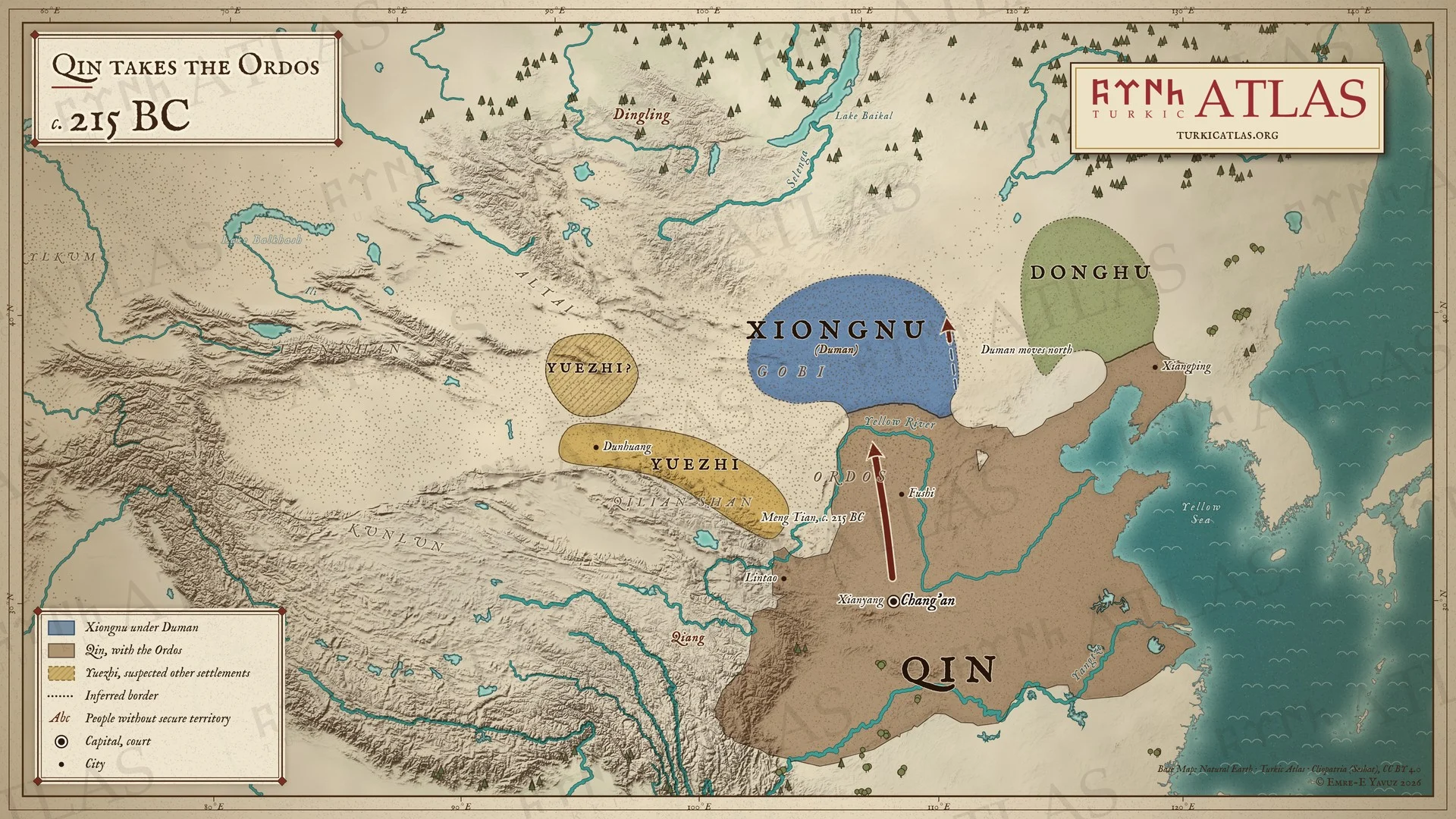
Map of East Asia around 215 BC: Qin with the Ordos taken by Meng Tian, the Xiongnu under Duman north of the Yellow River, the Donghu in the east and the Yuezhi between Dunhuang and the Qilian mountains, with a second reading in the Tian Shan
c. 215 BC: The First Emperor of Qin sends Meng Tian north. He takes the Ordos inside the great bend of the Yellow River and makes the river the frontier. The Xiongnu chanyu Duman withdraws to the north; how far, the source does not say. The Donghu hold the east, the Yuezhi the land between Dunhuang and the Qilian mountains; a second reading places them in the Tian Shan. Modern map; the borders in the steppe are approximate.
© Emre-E Yavuz 2026

1/7

Xiongnu

209 BC–155

The first nomad empire of the eastern steppe, known only from Chinese sources.

From the end of the third century BC the Xiongnu dominated the eastern steppe, and for two centuries they were the chief adversary of Han China. They were the first nomadic empire of the region. They left no text of their own, so all that is known of them comes from Chinese histories. When Qin armies pushed them north, the tribes united. In 89 the Han and their allies broke the northern half, and the Xianbei took its place.

  • Xiongnu

Read the article →

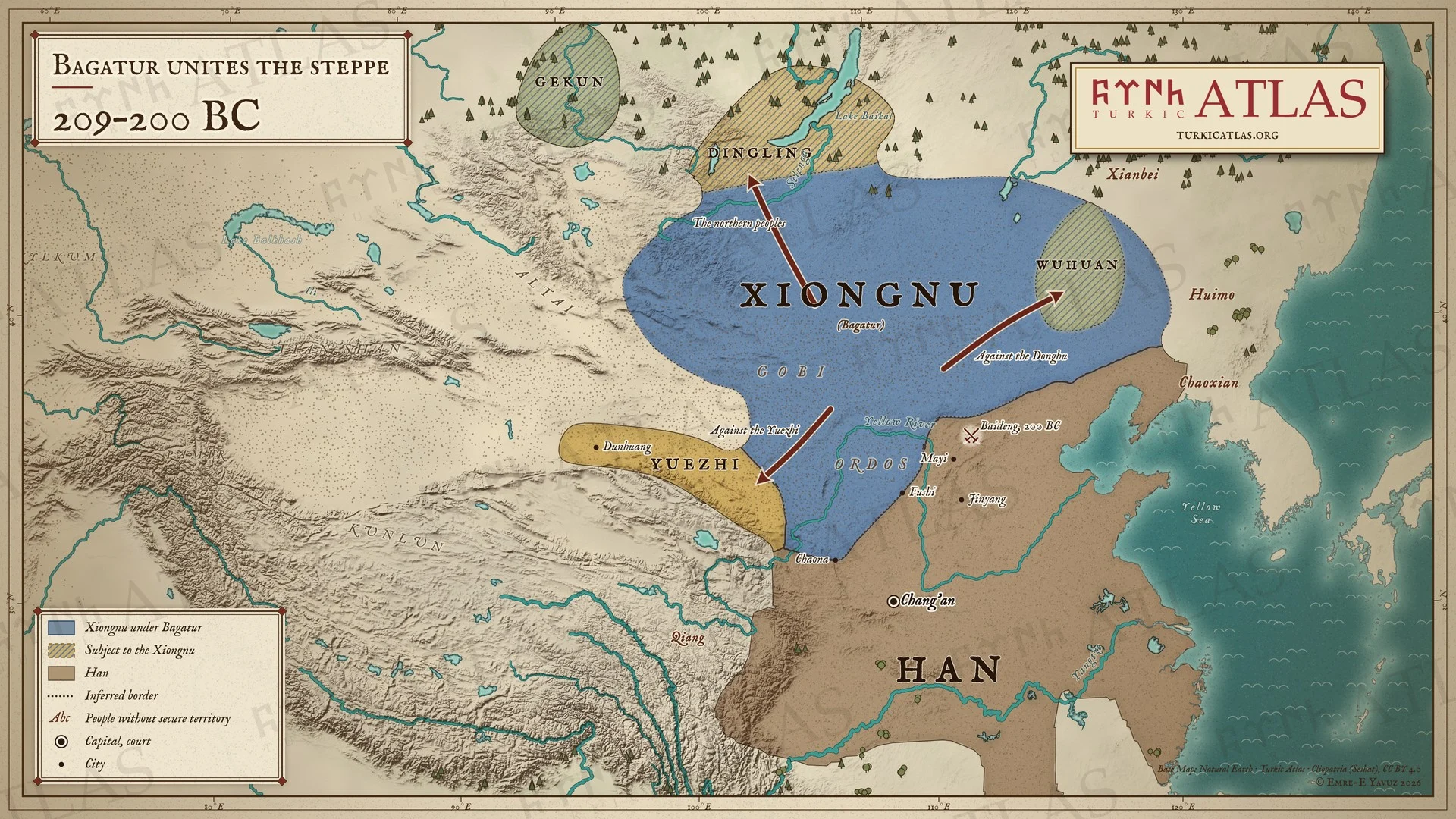
Map of East Asia from 209 to 200 BC: the Xiongnu under Bagatur from the Ordos to Lake Baikal, the Wuhuan, Dingling and Gekun as their subjects, the campaigns against the Donghu, the Yuezhi and the northern peoples, the Han in China and the siege of Baideng
209–200 BC: Bagatur (Modu Chanyu) kills his father Duman and becomes chanyu. He destroys the king of the Donghu, drives back the Yuezhi, retakes the land Meng Tian had seized as far as Chaona and Fushi, and subjects the Dingling, the Gekun and the other peoples of the north; the Wuhuan pay him tribute. In 200 BC he surrounds the Han emperor Gaozu at Baideng near Pingcheng. Modern map; the roads are drawn, and the borders in the steppe are approximate.
© Emre-E Yavuz 2026

2/7

Bagatur (Modu Chanyu)

209 BC–174 BC

Bagatur in a modern portrait.
Bagatur in a modern portrait.© Emre-E Yavuz 2026

The ruler who made the confederation an empire, and the name he bears.

Bagatur came to the throne in 209 BC by killing his father Duman. He destroyed the Donghu in the east, drove the Yuezhi west and subdued the peoples of the north. In 200 BC he shut the Han emperor Gaozu up on the hill of Baideng for seven days, and a treaty followed. By his death in 174 BC the Xiongnu held the steppe from Manchuria to the Tarim. The Chinese wrote his name 冒頓. Bagatur is a reconstruction.

  • Xiongnu

Read the article →

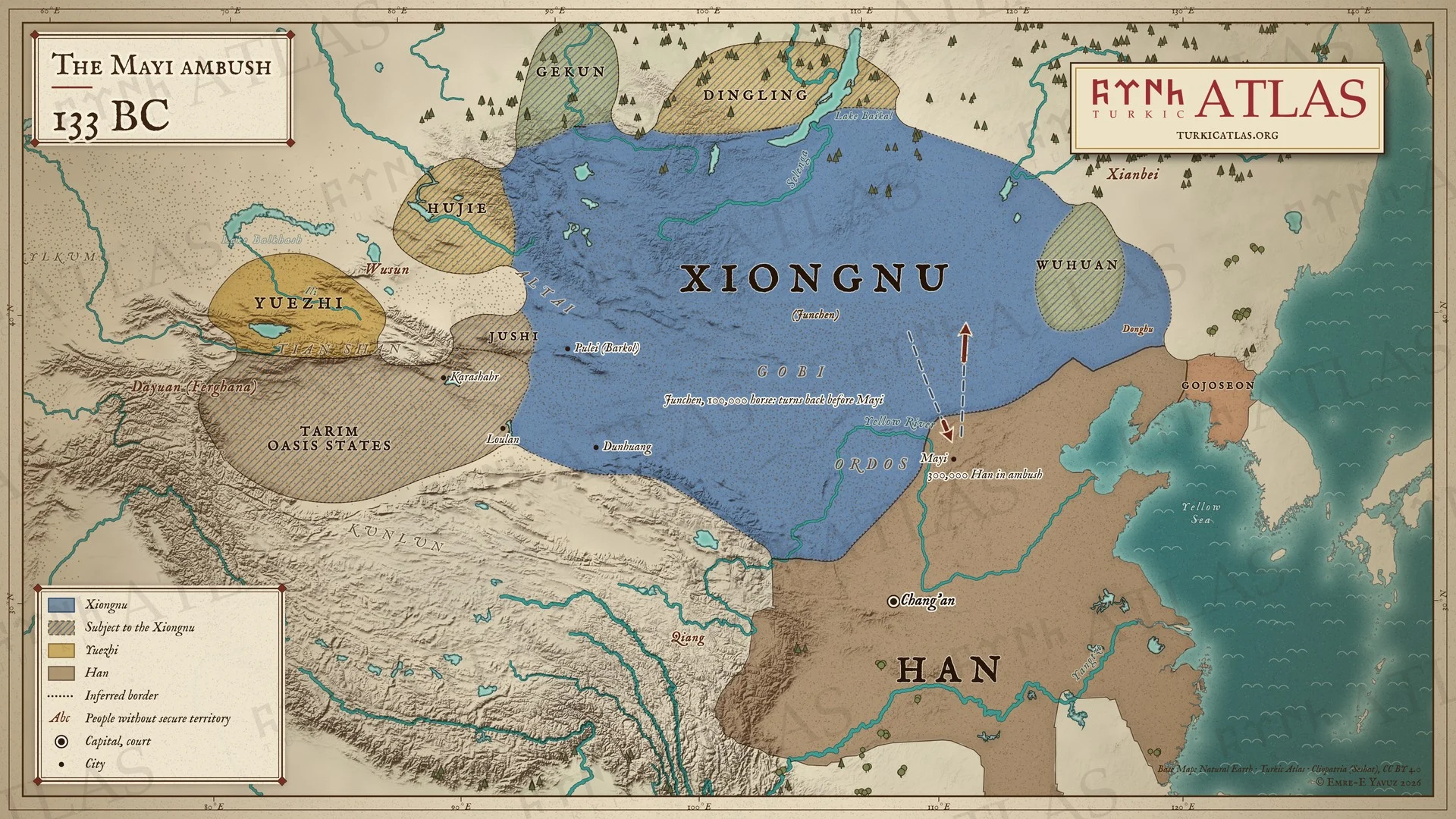
Map of East Asia in 133 BC: the Xiongnu under Junchen with the Ordos and the Hexi corridor, their subjects from the Tarim to the Wuhuan, the Yuezhi on the Ili, the Han, and the march of the chanyu towards Mayi, where three hundred thousand Han lie in ambush, and his withdrawal
133 BC: The Han hide three hundred thousand men around the frontier town of Mayi and offer the town to the chanyu Junchen. He comes over the border with a hundred thousand horse, sees the cattle grazing unattended a hundred li short of the town, learns of the ambush from a captured officer and turns back. The heqin settlement ends, and sixty years of open war begin. Modern map; the road of the chanyu is drawn, and the borders in the steppe are approximate.
© Emre-E Yavuz 2026

3/7

The Xiongnu–Han Wars

200 BC–93

Two centuries of war and treaties between the Han and the Xiongnu.

The treaty after Baideng held until 133 BC, when the Han hid 300,000 men near Mayi to trap the chanyu, the Xiongnu ruler. He turned back. The Xiongnu broke the treaty, and the Han went over to attack. The campaigns of 119 BC left the Xiongnu no royal court south of the Gobi. From 57 BC rival chanyus fought each other. The northern court was broken in AD 89 to 91, and its last claimant was beheaded in 93.

  • Xiongnu

Read the article →

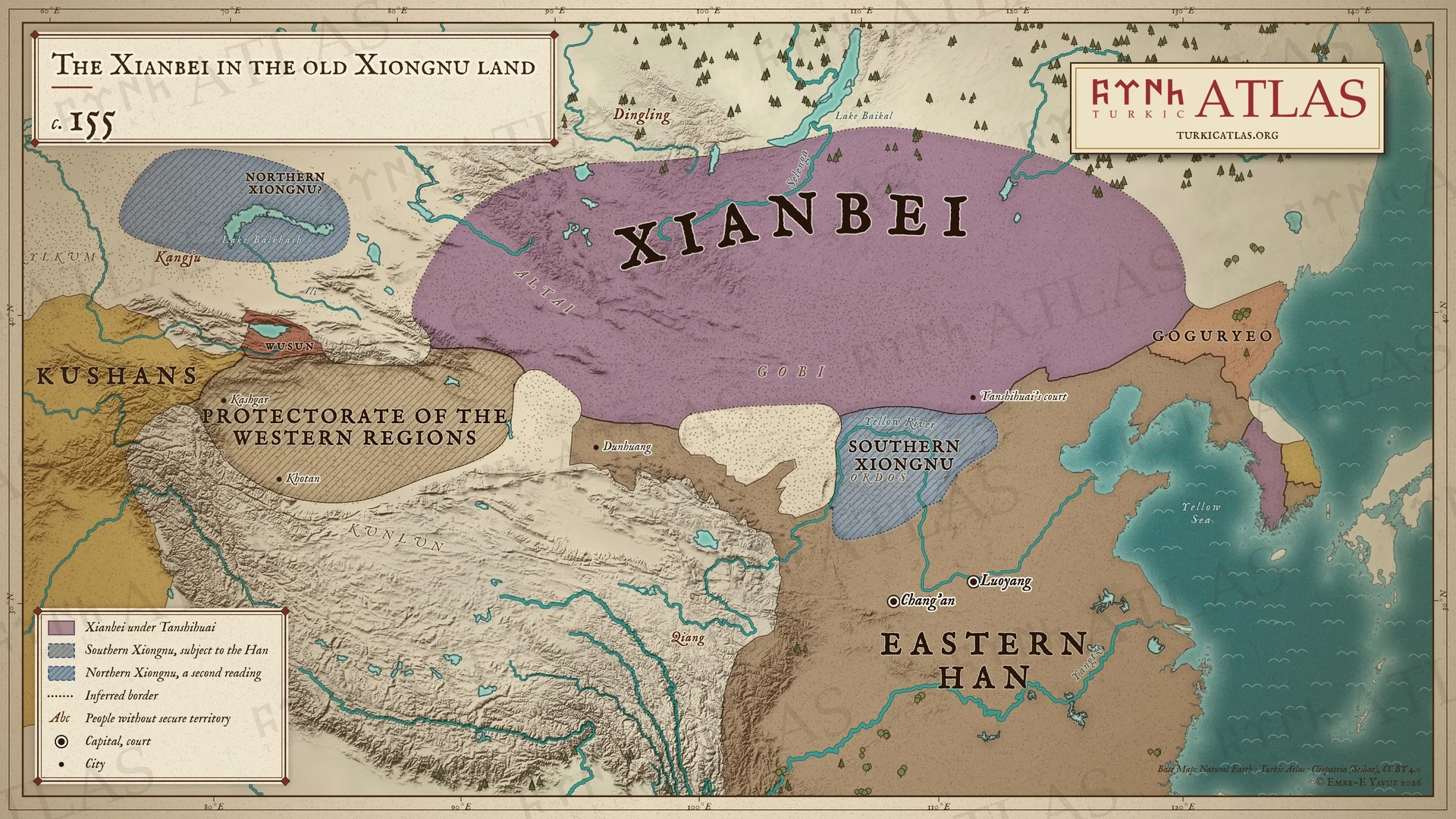
Map of the Xianbei about 155: the realm of Tanshihuai over the Mongolian steppe, the Southern Xiongnu inside the frontier of the Eastern Han, the protectorate of the Western Regions, the Wusun and the Kushans, and Northern Xiongnu north-west of Kangju as a second reading
c. 155: Under Tanshihuai the Xianbei hold the old land of the Xiongnu in the Mongolian steppe. The Southern Xiongnu live inside the Han frontier, and the Han govern the oases of the west through the protectorate of the Western Regions. A second reading places Northern Xiongnu north-west of Kangju. Modern map; the borders in the steppe are approximate.
© Emre-E Yavuz 2026

4/7

Xianbei

87–235

The people who took the Xiongnu's place on the eastern steppe.

The Xianbei were a branch of the Donghu, whom Bagatur had once broken. At the end of the first century Dou Xian's campaigns drove the northern chanyu out, and the Xianbei moved onto his ground. More than a hundred thousand tents of Xiongnu who stayed behind called themselves Xianbei. Their one ruler of the first rank, Tanshihuai, took the whole old Xiongnu country. From the Xianbei came the Tuoba, who founded the Northern Wei.
Read the article →

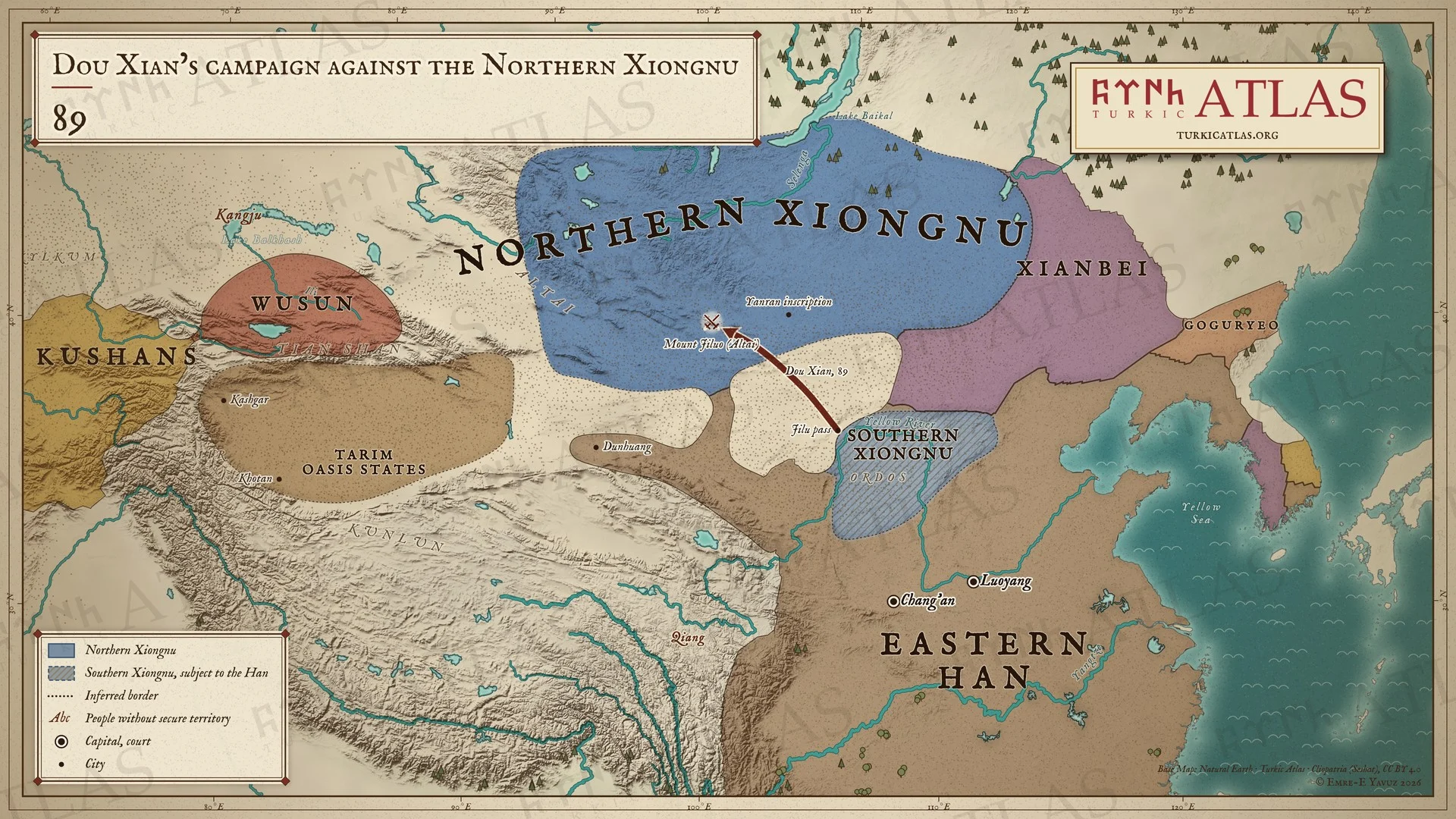
Map of Dou Xian’s campaign in 89: the Northern Xiongnu in the Mongolian steppe, the Southern Xiongnu subject to the Eastern Han, the march from the Jilu pass to the battle at Mount Jiluo in the Altai and the Yanran inscription, with the Xianbei in the east and the Wusun, the oases of the Tarim and the Kushans in the west
89: Dou Xian marches out from the Jilu pass with the Southern Xiongnu and defeats the northern chanyu at Mount Jiluo in the Altai; an inscription on Mount Yanran records the victory. The Southern Xiongnu are subject to the Han, and the Xianbei hold the east. Modern map; the road is drawn, and the borders in the steppe are approximate.
© Emre-E Yavuz 2026

5/7

The Huns and the Xiongnu

91–469

Whether the Huns of Europe continue the Xiongnu: the readings side by side.

In the 370s the Huns appeared in Europe, and since the eighteenth century many have taken them for the Xiongnu. One reading holds that the two are one people with a Turkic-speaking elite. A second holds that a shared name is not a shared people. The name, the cauldrons and some customs point east. The graves and the names do not show a people arriving intact. Nearly three centuries lie between 91 and the 370s, and no source follows them.
Read the article →

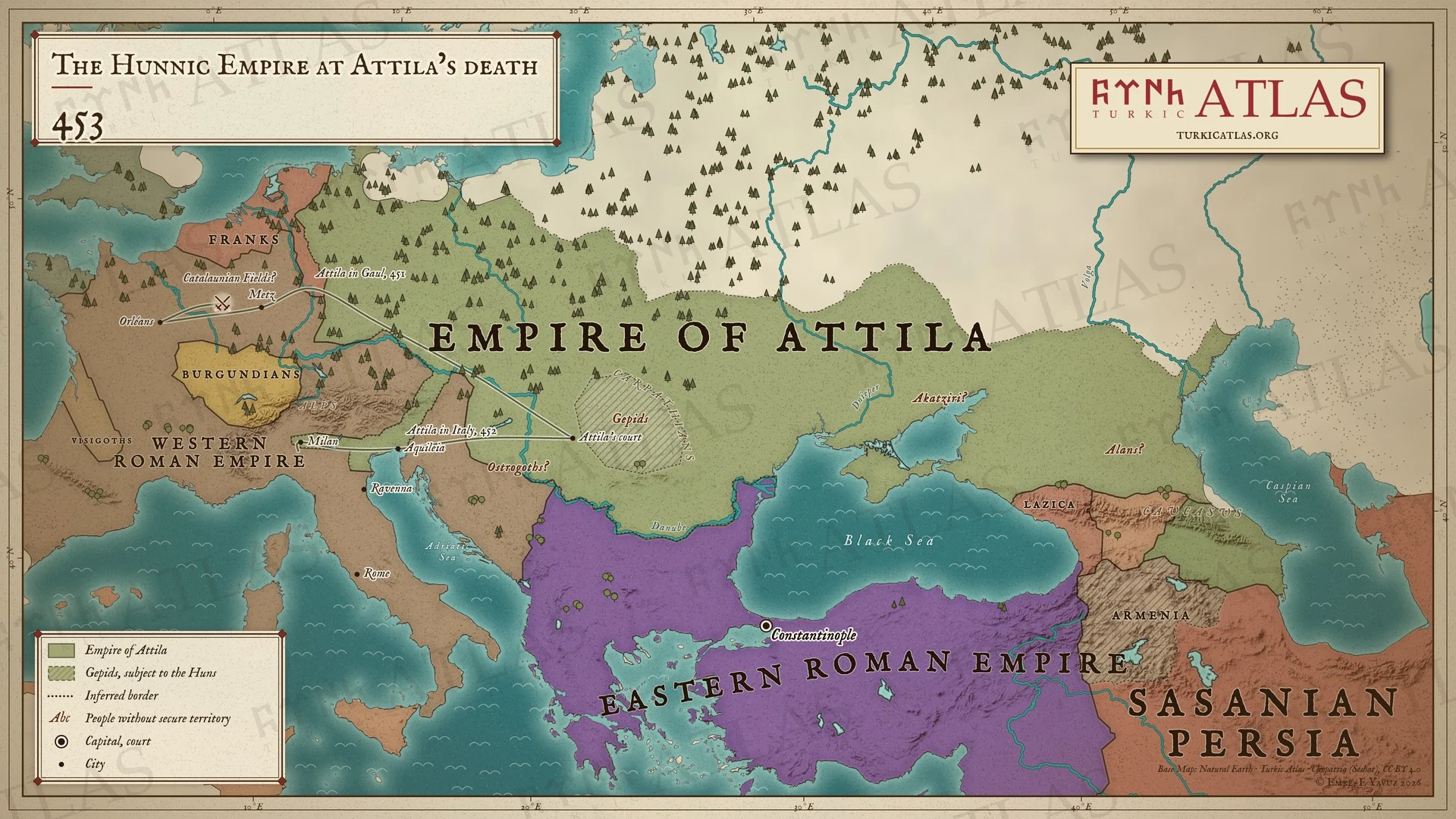
Map of Europe at Attila's death in 453: the Hunnic Empire from the Rhine to the Caspian Sea with the Gepids as subjects, the Western and Eastern Roman Empires, the Visigoths, Franks and Burgundians, Sasanian Persia, and the routes of Attila's campaigns in Gaul in 451 and in Italy in 452
453: At Attila's death the Hunnic Empire reaches from the Rhine to the Caspian Sea, and the Gepids and other peoples are subject to the Huns. Thin lines mark Attila's campaigns in Gaul in 451 and in Italy in 452. Modern map; the borders of the realm are approximate, and the site of the Catalaunian Fields is disputed.
© Emre-E Yavuz 2026

6/7

Huns

370–469

The people who crossed the Don in the 370s and built an empire in Europe.

In the 370s the Huns crossed the Don and broke the Alans and the Goths north of the Black Sea. In the following eighty years they built an empire, a great power under Rua, then Bleda and Attila. Under Attila it ruled from the Caucasus to the confines of France and Denmark. After his death in 453 it broke apart, and the death of his son Dengizich in 469 ended the dominance of the Huns.

  • Huns

Read the article →

7/7

Attila

434–453

The most powerful king the Huns ever had, as a Roman embassy saw him.

Attila ruled the Huns from the 430s until his death in 453, first with his brother Bleda, then alone. He made the eastern Roman empire pay him ever more gold and invaded Gaul in 451 and Italy in 452. In 449 Priscus, with a Roman embassy, saw him eat from a wooden plate while his guests ate from silver. Attila died the night after his last wedding. Almost all that is known of the man comes from Priscus.

  • Hunnic Empire

Read the article →

Map of East Asia around 215 BC: Qin with the Ordos taken by Meng Tian, the Xiongnu under Duman north of the Yellow River, the Donghu in the east and the Yuezhi between Dunhuang and the Qilian mountains, with a second reading in the Tian Shan© Emre-E Yavuz 2026
c. 215 BC: The First Emperor of Qin sends Meng Tian north. He takes the Ordos inside the great bend of the Yellow River and makes the river the frontier. The Xiongnu chanyu Duman withdraws to the north; how far, the source does not say. The Donghu hold the east, the Yuezhi the land between Dunhuang and the Qilian mountains; a second reading places them in the Tian Shan. Modern map; the borders in the steppe are approximate.
Map of East Asia from 209 to 200 BC: the Xiongnu under Bagatur from the Ordos to Lake Baikal, the Wuhuan, Dingling and Gekun as their subjects, the campaigns against the Donghu, the Yuezhi and the northern peoples, the Han in China and the siege of Baideng© Emre-E Yavuz 2026
209–200 BC: Bagatur (Modu Chanyu) kills his father Duman and becomes chanyu. He destroys the king of the Donghu, drives back the Yuezhi, retakes the land Meng Tian had seized as far as Chaona and Fushi, and subjects the Dingling, the Gekun and the other peoples of the north; the Wuhuan pay him tribute. In 200 BC he surrounds the Han emperor Gaozu at Baideng near Pingcheng. Modern map; the roads are drawn, and the borders in the steppe are approximate.
Map of East Asia in 133 BC: the Xiongnu under Junchen with the Ordos and the Hexi corridor, their subjects from the Tarim to the Wuhuan, the Yuezhi on the Ili, the Han, and the march of the chanyu towards Mayi, where three hundred thousand Han lie in ambush, and his withdrawal© Emre-E Yavuz 2026
133 BC: The Han hide three hundred thousand men around the frontier town of Mayi and offer the town to the chanyu Junchen. He comes over the border with a hundred thousand horse, sees the cattle grazing unattended a hundred li short of the town, learns of the ambush from a captured officer and turns back. The heqin settlement ends, and sixty years of open war begin. Modern map; the road of the chanyu is drawn, and the borders in the steppe are approximate.
Map of the Xianbei about 155: the realm of Tanshihuai over the Mongolian steppe, the Southern Xiongnu inside the frontier of the Eastern Han, the protectorate of the Western Regions, the Wusun and the Kushans, and Northern Xiongnu north-west of Kangju as a second reading© Emre-E Yavuz 2026
c. 155: Under Tanshihuai the Xianbei hold the old land of the Xiongnu in the Mongolian steppe. The Southern Xiongnu live inside the Han frontier, and the Han govern the oases of the west through the protectorate of the Western Regions. A second reading places Northern Xiongnu north-west of Kangju. Modern map; the borders in the steppe are approximate.
Map of Dou Xian’s campaign in 89: the Northern Xiongnu in the Mongolian steppe, the Southern Xiongnu subject to the Eastern Han, the march from the Jilu pass to the battle at Mount Jiluo in the Altai and the Yanran inscription, with the Xianbei in the east and the Wusun, the oases of the Tarim and the Kushans in the west© Emre-E Yavuz 2026
89: Dou Xian marches out from the Jilu pass with the Southern Xiongnu and defeats the northern chanyu at Mount Jiluo in the Altai; an inscription on Mount Yanran records the victory. The Southern Xiongnu are subject to the Han, and the Xianbei hold the east. Modern map; the road is drawn, and the borders in the steppe are approximate.
Map of Europe at Attila's death in 453: the Hunnic Empire from the Rhine to the Caspian Sea with the Gepids as subjects, the Western and Eastern Roman Empires, the Visigoths, Franks and Burgundians, Sasanian Persia, and the routes of Attila's campaigns in Gaul in 451 and in Italy in 452© Emre-E Yavuz 2026
453: At Attila's death the Hunnic Empire reaches from the Rhine to the Caspian Sea, and the Gepids and other peoples are subject to the Huns. Thin lines mark Attila's campaigns in Gaul in 451 and in Italy in 452. Modern map; the borders of the realm are approximate, and the site of the Catalaunian Fields is disputed.
  1. 1. Xiongnu
  2. 2. Bagatur (Modu Chanyu)
  3. 3. The Xiongnu–Han Wars
  4. 4. Xianbei
  5. 5. The Huns and the Xiongnu
  6. 6. Huns
  7. 7. Attila

Begin with Xiongnu →