
First the way of life of the Eurasian nomads, the herders of the steppe belt. Then five terms that come up again and again in the history of the steppe empires: the wooded mountain country from which the steppe was ruled, the skill of shooting from horseback, the sky that seats and unseats khans, the unwritten law, and the fortune that made a man fit to rule. This path gives them in six steps. It gives the terms that all the other paths need.
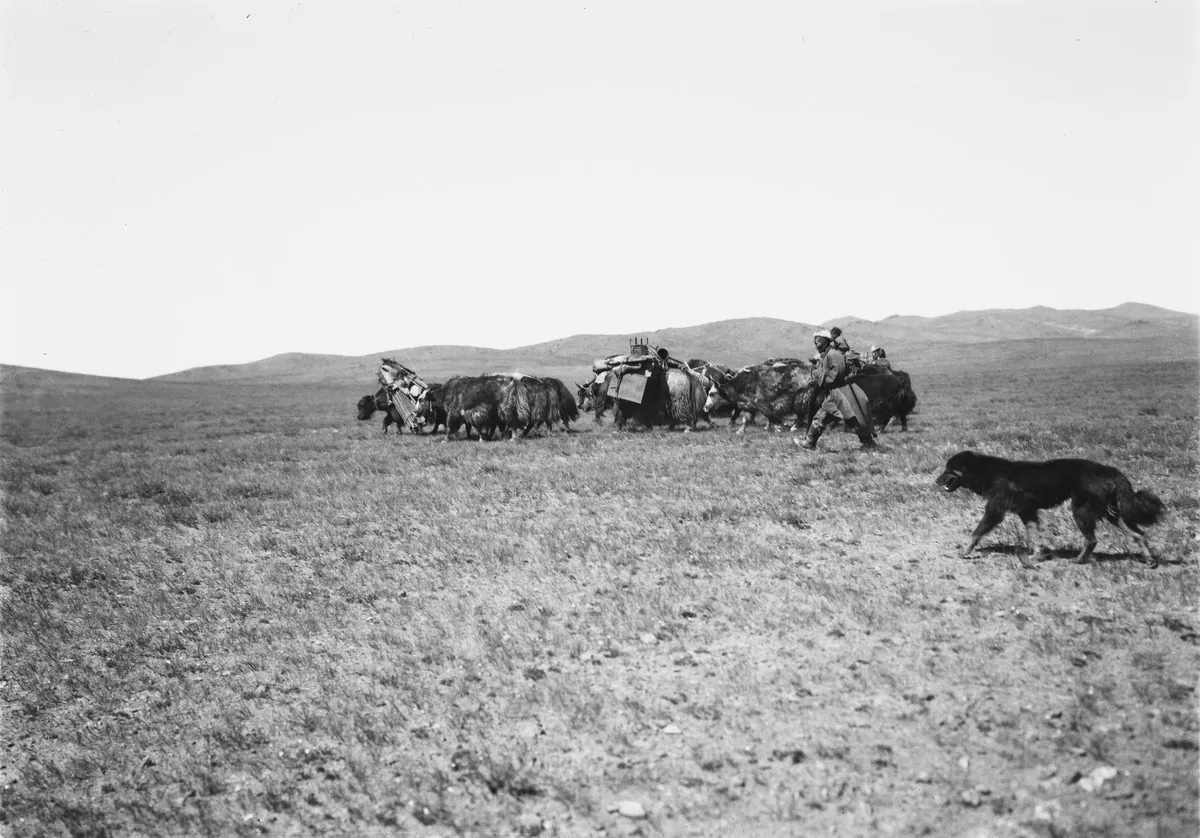
A family on the move across the steppe, its goods loaded on yaks
A Mongol family moving across the steppe in 1909, with their goods carried on yaks.

1/6

Eurasian Nomads

Who the steppe nomads were, how they lived, and what they needed from their settled neighbours.

The steppe is a belt of grassland that runs from the plain of Hungary to Manchuria. Its peoples lived by their herds of sheep and horses and moved with them between set pastures at set times. Herding alone did not give them everything they needed: grain and cloth came by trade, tribute or raid from settled neighbours. When many groups were joined under one ruler, a steppe empire arose, from the Xiongnu to the Göktürks and the Uyghurs.
Read the article →

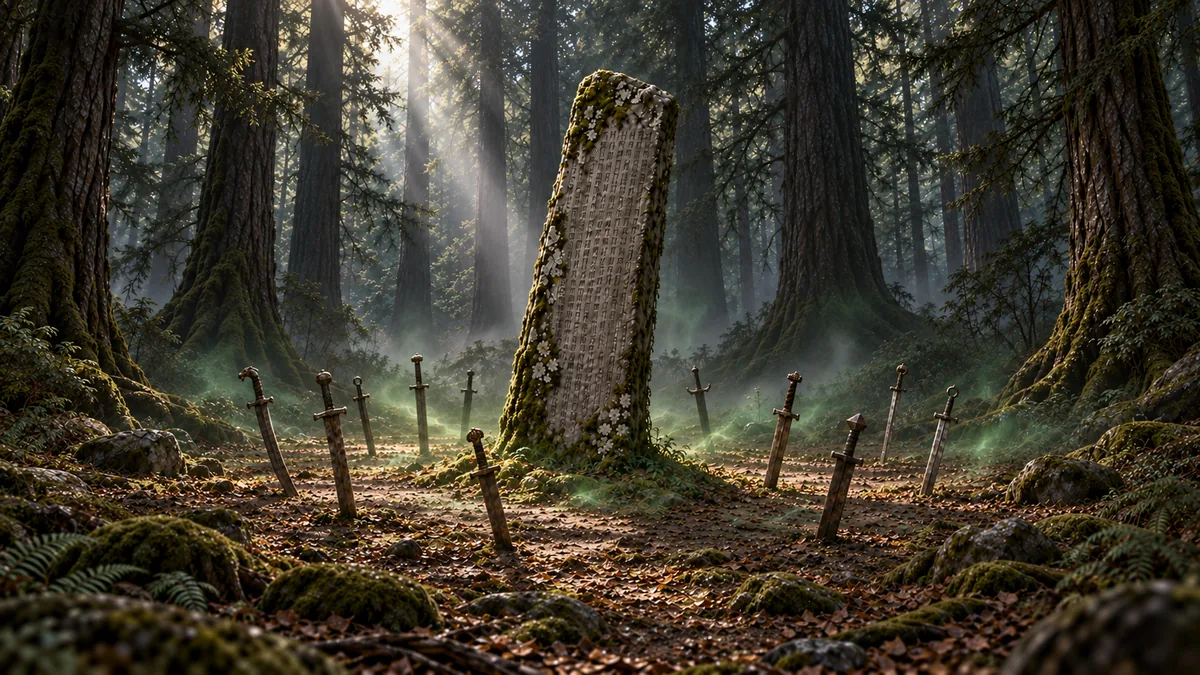
Ötüken in a modern illustration: an inscribed stele in the forested upland, with swords set upright in the ground around it.

2/6

Ötüken

400–840

The place the steppe was ruled from, and why a khan had to hold it.

Ötüken was a wooded mountain country in central Mongolia, around the Orkhon valley and the Khangai. It was not a city. The inscriptions of the Göktürks, who ruled the steppe from 552, call it sacred and say that no place is better for holding the realm. Xiongnu, Rouran, Göktürks and Uyghurs each kept the seat of their power there. Bumin, the Göktürk founder, entered it in the spring of 552 and took the title of khan.
Read the article →

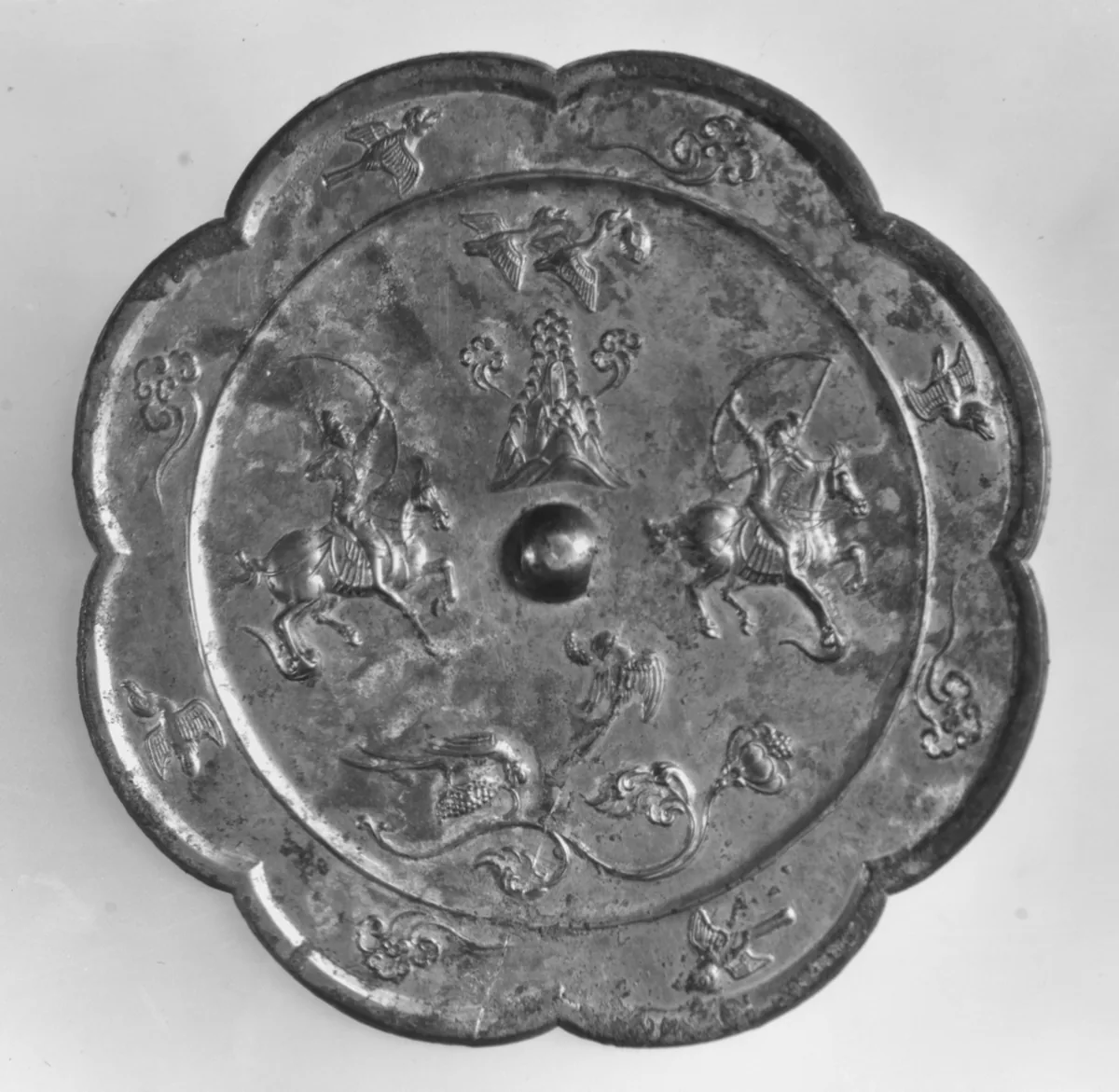
A round bronze mirror with lobed rim; two horsemen at full gallop draw their bows among birds, clouds and a mountain
Bronze mirror with a hunting scene, China, Tang dynasty, eighth century. Two horsemen draw their bows at full gallop.

3/6

Mounted Archery

Shooting from horseback, as the Chinese histories describe it.

The Shiji, a Chinese history completed about 90 BC, says that Xiongnu children rode sheep and shot birds and mice with the bow. Every man strong enough to draw the bow became an armoured horseman. The Sui Shu calls the Göktürks good at riding and shooting. Settled courts liked to watch it: in 426 the Northern Wei emperor Taiwu built a terrace for it, and from 725 the Tang emperor Xuanzong often had Göktürks gallop and shoot inside his guard.
Read the article →

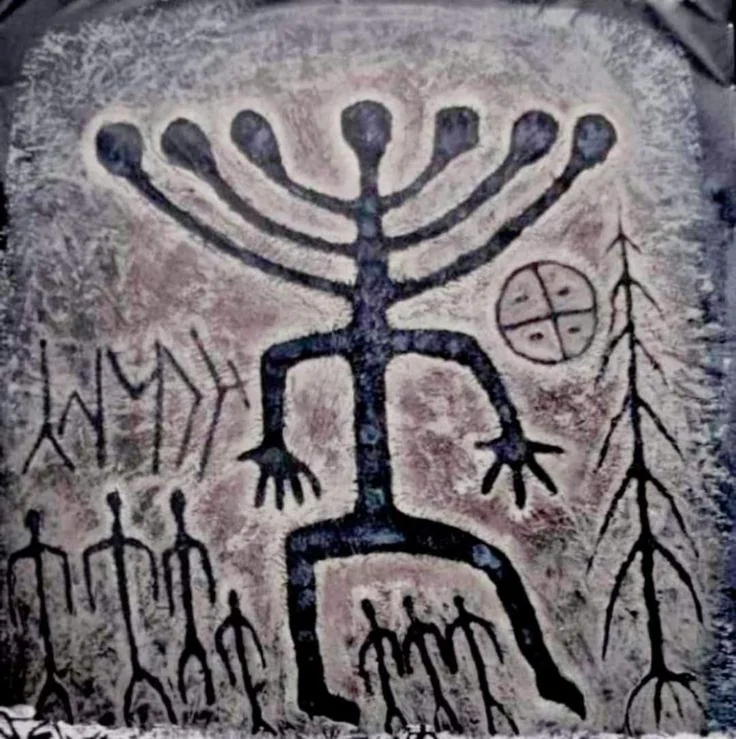
A dark figure with seven rays ending in round knobs rising from its head, arms spread, above a row of small figures, beside a quartered circle, a tree and runic signs
A figure with a rayed head over a row of smaller figures, beside a quartered circle, a tree and signs in the manner of Old Turkic runes: an image in the style of steppe rock art.

4/6

Tengri

The sky that raises khans, and the one divine name the Göktürks wrote.

Tengri is the sky, and the power that seats and unseats khans. It is the only divine name the Göktürks wrote in their own language and script. In the Kül Tegin inscription of the eighth century, Ilterish, who founded the Second Khaganate, took realms because Heaven so ordained, and Heaven gave his men strength. The Chinese histories name no god. They report the sacrifice to the spirit of heaven in the middle of the fifth month.
Read the article →

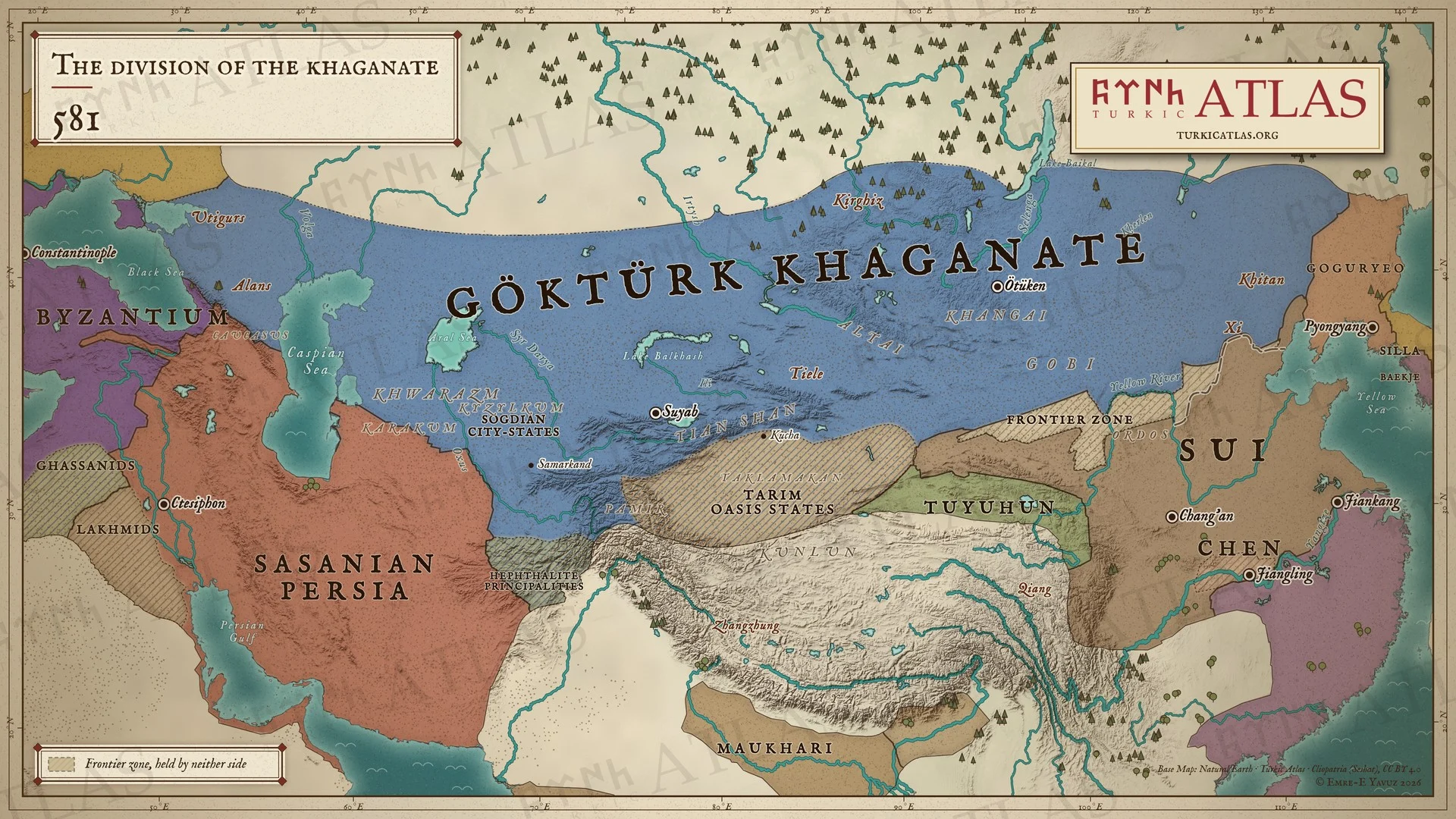
Map of Asia in 581: the undivided Göktürk Khaganate from the Black Sea to the Khitan with the court at Ötüken, the Tarim oasis states and the Hephthalite principalities as tributaries, beside the Eastern Roman Empire, Sasanian Persia, the Sui, the Chen, the Tuyuhun and Goguryeo, and between the steppe and China the wall of the Northern Qi and a hatched frontier zone
The Göktürk Khaganate in 581, the year of Taspar's death, still undivided from the Black Sea to the Khitan, with the court at Ötüken; beside it the Sui, whose rule began that year, the Chen, Sasanian Persia and the Eastern Roman Empire. Between the steppe and China stand the wall of the Northern Qi (556) and a frontier zone held by neither side. Modern map; the frontiers are approximate.
© Emre-E Yavuz 2026

5/6

Töre

The unwritten law of the Göktürks, and the succession it could not enforce.

The Göktürks had two words for what held them together. Tengri was the sky; törü, in its modern form Töre, was the law: the custom that said who succeeded whom, what was punished, and whom a widow married. It was not written down. The inscriptions say that Bumin and his brother Istemi took the realm and the törü in hand. In 581 the assembly of nobles, the toy, set aside the dying khan Taspar's wish, and the quarrel split the khaganate.

Read the article →

6/6

Kut

The fortune from Tengri that made a man a khan.

A khan ruled because he had Kut. The word is rendered fortune, blessing or heavenly favour: what Tengri gave to the man he chose. In the Kül Tegin inscription the khan says he sat on the throne because Heaven commanded it and because his Kut was there. Kut could also be lost. The inscriptions describe the fifty years under the Tang as a fortune forfeited, and Ilterish, who restored the state, is remembered as Kutluk, the one who has Kut.

Read the article →

A family on the move across the steppe, its goods loaded on yaks
A Mongol family moving across the steppe in 1909, with their goods carried on yaks.
Ötüken in a modern illustration: an inscribed stele in the forested upland, with swords set upright in the ground around it.
A round bronze mirror with lobed rim; two horsemen at full gallop draw their bows among birds, clouds and a mountain
Bronze mirror with a hunting scene, China, Tang dynasty, eighth century. Two horsemen draw their bows at full gallop.
A dark figure with seven rays ending in round knobs rising from its head, arms spread, above a row of small figures, beside a quartered circle, a tree and runic signs
A figure with a rayed head over a row of smaller figures, beside a quartered circle, a tree and signs in the manner of Old Turkic runes: an image in the style of steppe rock art.
Map of Asia in 581: the undivided Göktürk Khaganate from the Black Sea to the Khitan with the court at Ötüken, the Tarim oasis states and the Hephthalite principalities as tributaries, beside the Eastern Roman Empire, Sasanian Persia, the Sui, the Chen, the Tuyuhun and Goguryeo, and between the steppe and China the wall of the Northern Qi and a hatched frontier zone© Emre-E Yavuz 2026
The Göktürk Khaganate in 581, the year of Taspar's death, still undivided from the Black Sea to the Khitan, with the court at Ötüken; beside it the Sui, whose rule began that year, the Chen, Sasanian Persia and the Eastern Roman Empire. Between the steppe and China stand the wall of the Northern Qi (556) and a frontier zone held by neither side. Modern map; the frontiers are approximate.
  1. 1. Eurasian Nomads
  2. 2. Ötüken
  3. 3. Mounted Archery
  4. 4. Tengri
  5. 5. Töre
  6. 6. Kut

Begin with Eurasian Nomads →

