
Funian is the second of the three khans raised at the end of the interregnum. Of them he is the only one whose death was a public act of state.[1]
Raised at Xiazhou
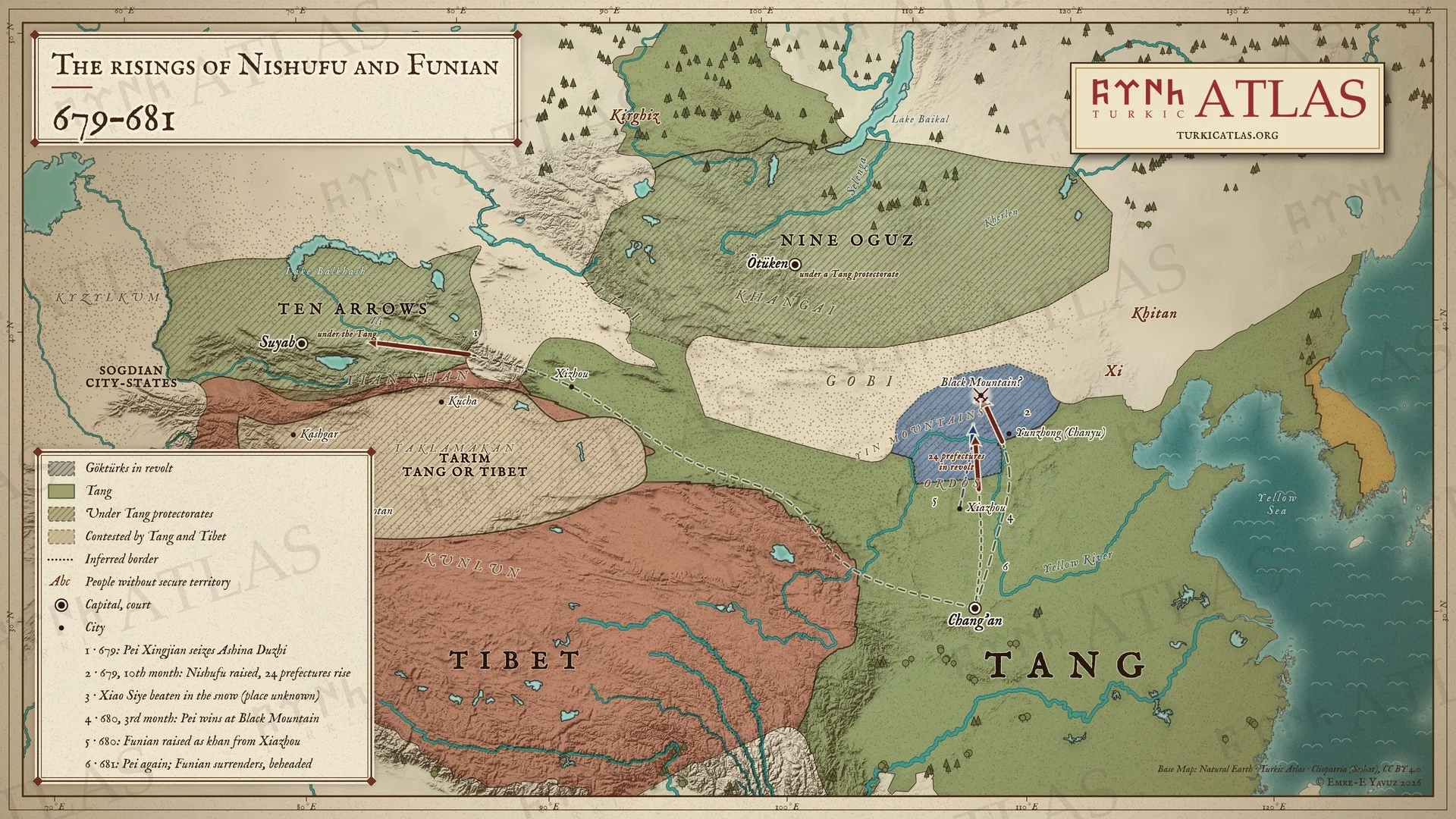
In 680, months after Nishufu had been killed by his own men, the Göktürks fetched Funian from Xiazhou. He was a son of Ilig’s elder cousin, and so of the ruling house in a line the chapter is careful to give.[1] They were about to cross the Yellow River and set him up as khan. The tribes answered and followed him.[1]
That descent is the difference between him and Nishufu. Where the chapter says nothing about Nishufu’s family, it places Funian in the house of the khans in the first clause of his sentence.[1] The men of 680 went to find an Ashina, and they found one at a Tang frontier prefecture.
The surrender
Pei Xingjian came north a second time, with Cao Jishu, Cheng Wuting, Li Chongzhi and Li Wenjian.[1] The chapter compresses the campaign into a single clause. Funian, hard pressed, went to Xingjian and surrendered.[1]
What Xingjian did next is given without comment. He took Funian prisoner to the capital. Funian was beheaded in the East Market.[1] The East Market was where Chang’an executed criminals in public.
The chapter reports the surrender and the beheading in consecutive clauses and does not join them. Whether terms had been given, and whether the execution broke them, is not stated there.
Consequences
The sentence that follows in the chapter is the next rising. In 683 the Göktürk Ashina Kutlug rebelled again.[1] The man who did it, Ilterish, began by gathering the people who had scattered from Funian’s defeat. There were five thousand of them, in the Zongcai mountains, and they lived as a robber band before they were an army.[1]
Funian’s rising therefore supplied the next one with its men. The sources do not say whether the manner of his death also supplied it with its resolve. They do not rule it out either. What is on record is that no khan of the Second Khaganate ever surrendered to a Tang commander again.
References
Sources
- Jiu Tangshu (Old Book of Tang), juan 194
- Xin Tangshu (New Book of Tang), juan 215 (after Jiu Tangshu)
Literature
- Liu Mau-tsai, Çin Kaynaklarına Göre Doğu Türkleri (1958, Turkish edition)
- Peter B. Golden, An Introduction to the History of the Turkic Peoples (1992)
What links here10
- Persons
- Ashide Yuanzhen · Nishufu Khan · Pei Xingjian
- States
- Tang · The Göktürk interregnum, 630–682
- Places
- Xiazhou
- Institutions and Titles
- Livestock Raids · The Economy of the Steppe Empires
Cite this article
Yavuz, Emre-E. “Ashina Funian.” Turkic Atlas, revised 7 November 2026. https://turkicatlas.org/persons/ashina-funian/
Last revised: 7 November 2026

