
- 400
- 500
- 600
- 700
- 800
- 900
- Rouran 400–554
- First Göktürk 552–630
- Tang rule 630–682
- Second Göktürk 682–744
- Uyghur 744–840
- Kirghiz 840–924
- Huns 370–469
- Western Göktürk 552–659
- Türgesh 699–766
- Karluk 766–800
- Khazar 650–969
In the third month of 630 the last khan of the eastern Göktürks was taken alive in a kinsman’s camp and sent to Chang’an.[1] For the next fifty-two years the eastern steppe had no khan of its own. The Kül Tegin inscription, carved a century later, gives the period one line and one number: elig yıl isig küçüg birmis, “for fifty years they gave their toil and their strength.”[2][3]
For fifty years they gave their toil and their strength. Eastward, toward the sunrise, they campaigned for him as far as the Bökli kagan; westward they campaigned for him as far as the Iron Gate. To the Chinese kagan they gave up their realm and their law.
That is the period as the Orkhon inscription sees it. From Chang’an it was an administrative success that held for nearly fifty years.
The debate of 630
The collapse left the Tang with a problem of numbers. Some of Ilig’s people had fled to the Xueyantuo, and some had fled into the Western Regions. A great many had surrendered.[1] The court was asked how to secure the frontier. The answers that survive are worth setting out, because the one that won shaped the next half-century.
Most of the officials wanted dispersal. They argued that the Göktürks had raided China for generations and that heaven had now broken them. The Göktürks had come in not out of admiration but out of need. The officials proposed to break up their tribes and move them south of the Yellow River into Yan and Yu. There the Göktürks would be scattered through the prefectures and set to ploughing and weaving. A million barbarians would become taxpayers, China would gain households, and the country beyond the passes would stay empty for good.[1]
Wen Yanbo, the Director of the Secretariat, argued alone against this plan. He cited the Later Han precedent of settling the surrendered Xiongnu below the Wuyuan frontier. The tribes should be kept whole and serve as a shield, and they should not be cut off from their own customs. That would fill an empty land and show no suspicion, whereas sending them into Yan and Yu went against their nature.[1]
Wei Zheng answered him with the sharpest speech in the chapter. In his view the Göktürks had never been so utterly broken, and heaven had cut them off. They had raided China for generations, and the people had their grievance. He wanted them sent back north of the river to their own land. Nearly a hundred thousand had come in, and in a few years they would multiply many times over. Settled in the armpit of the state, close to the royal domain, they were a disease of the heart and belly.[1] For his warning he reached back to the Jin dynasty. The Hu had been settled near the commanderies, and Guo Qin and Jiang Tong had urged the emperor to drive them out. He had not listened, and a few years later the Hu had overturned the capital. Wei Zheng called the policy rearing a beast and keeping the trouble for oneself.[1]
Wen Yanbo won with the argument that the way of the sage excludes no one. In a few years the Göktürks would all be farmers, and their chiefs could serve in the palace guard.[1] The emperor took his plan.
The prefectures
What followed was not a protectorate in the later sense but a line of commands. Four prefectures, Shun, You, Hua and Chang, were set up in the Shuofang country, from Youzhou to Lingzhou. Ilig’s own territory was divided into six prefectures. The Dingxiang command stood on the left and the Yunzhong command on the right, to govern the tribes.[1] The chiefs who came in were made generals and palace officers. More than a hundred of them held the fifth rank or above, and several thousand households settled in Chang’an itself.[1]
The inscription means this arrangement when it says that the lords who went over took Chinese titles.[2] One study reads the phrase tabgaçgı begler by its suffix -gı as “the lords who had become Chinese”, and finds this perhaps the more fitting of two renderings.[4] The arrangement also made a restoration possible fifty years later, because it left the tribes standing as tribes. The loose-rein prefectures have their own article. A study of the line ekin ara idi oksuz in the Kül Tegin inscription suggests that ok, “arrow”, may have meant “province”, since the Tang governed the subjected Göktürks in six provinces, though it cites no text for this sense of the word.[5] A runic text of four lines on the rocks of Del Uul in the Dund Govi province of Mongolia has been read as saying that “our wise elder brother and we did not receive the title irkin”.[6] Its finder thinks it may have been cut in the years of Tang overlordship, about 630 to 680.[6]
Ashina Simo’s khanate, 639 to 643
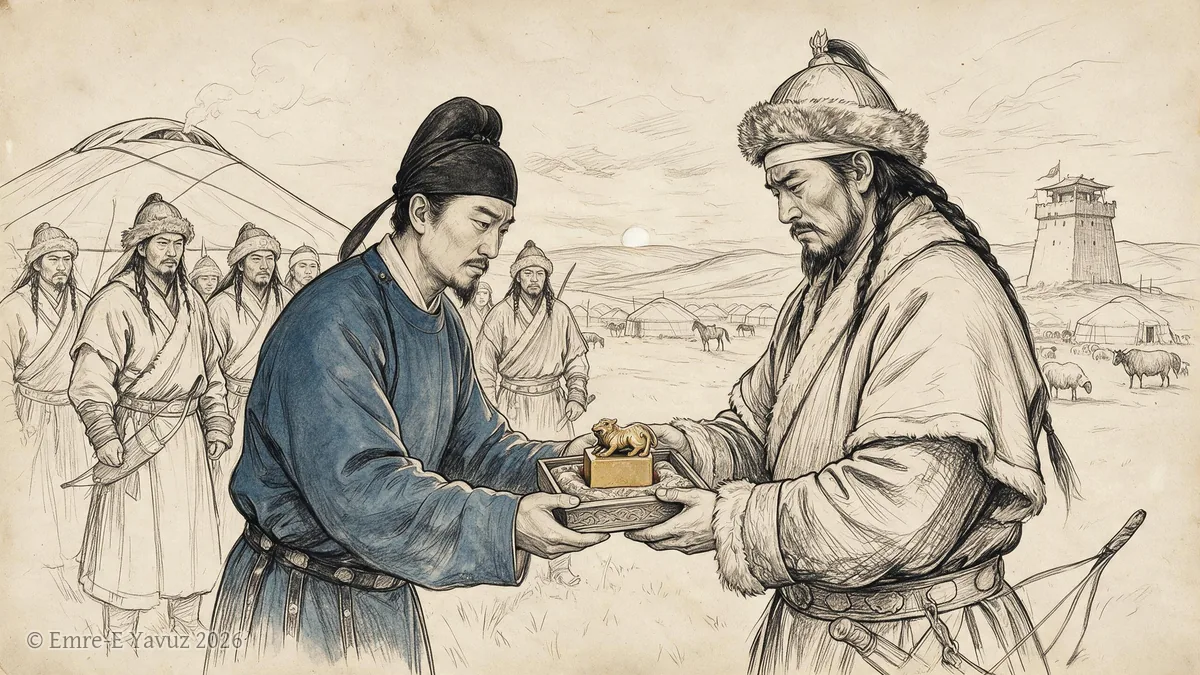
In 639 a nephew of Ilig named Jiesheshuai gathered some forty men of his tribe at the Jiucheng palace. At night they attacked the imperial camp, broke through the fourth curtain and killed several dozen guards. Then Jiesheshuai was driven off and caught.[1] The attempt failed completely, but it changed everything. Memorials multiplied saying that keeping the Göktürks inside China was a mistake, and the court reversed itself.[1] The tribes were moved back north of the Yellow River. Ashina Simo, a clansman of Ilig, was by then a Tang general and a commandery prince. He was set up as khan over the tribes.[1]
Simo’s khanate lasted about five years. It is the clearest test the period offers of whether a khan could be granted from outside. A hundred thousand people crossed the river with him, and forty thousand of them could fight. He could not hold them, and none were content under him.[1] In 643 they rebelled as one and crossed back south. They asked to be settled between Sheng and Xia, and the court allowed it.[1] Simo rode to Chang’an and took a general’s commission. He followed the Liaodong campaign and was hit by a stray arrow. The emperor sucked the blood from the wound himself.[1]
Chebi Khan in the north, to 650
While Simo was being invested on the river, another Ashina held the far north on his own account. Chebi had a camp north of the Golden Mountain and a hereditary title of lesser khan. After 630 the northern tribes had wanted to raise him as great khan. He had not dared to take the title while the Xueyantuo held it.[1] When the Xueyantuo turned on him, he fled back to his old ground, ten thousand li from Chang’an, with thirty thousand fighting men. There he called himself khan on his own authority.[1] The Karluks to his west and the Kirghiz to his north were subject to him.[1]
In 650 he was brought down. No army from the south did it. A column under Gao Kan, raised from Uyghurs and Pugu, did it together with his own chiefs, who went over one after another.[1] When the Tang force reached the Axi mountains, he called his men and none came.[1]
Ashina She’er in Tang service
Not every Ashina who left the steppe came as a prisoner. Ashina She’er was a son of Chula Khan.[7] At the age of eleven he was already known among his own people for courage and wit.[7] He became Tuo Shad and set up his headquarters north of the desert. There he ruled the Tiele, Qigu and Tongluo tribes together with Yugu Shad.[7] He held the post for ten years and levied nothing from the tribes. Some chiefs scorned him for not growing rich. He answered that if the tribes were prosperous, that was enough for him.[7][8] On one account, he also refused to lend Ilig his troops.[9]
In the rising of the Tiele tribes the Xueyantuo and the Uyghurs beat Yugu Shad. She’er fought them and was beaten as well.[7][9] After Ilig’s fall, and after the death of the western yabgu, the Western Göktürks fought among themselves for the realm. She’er feigned submission, marched west and took half of their lands, which gave him a following of more than a hundred thousand. He styled himself Dubu Khan.[7][9] Then he rode north of the desert against the Xueyantuo with more than fifty thousand horse. The campaign lasted over a hundred days. His men were worn out by the long service and deserted him, and the Xueyantuo beat him. He fell back on Gaochang with about ten thousand men.[7][9]
In 635 he came over to the Tang with his people and was made Great General of the Left Cavalry Guard. More than a year later the emperor gave him the princess of Hengyang as his wife.[7] In 640 he served as marching commander in the campaign that took Gaochang.[7] In 645 he followed Taizong to Liaodong. In 647 he was named great commander of the Kunqiu route against Kucha. The next year he beat the Chumi on the way, took the town of Dabohuan and captured the king of Kucha.[7] On one account, he led thirteen Tiele tribes and ten thousand Göktürk horsemen in this campaign.[10] When Taizong died, She’er asked to be buried with him, and Gaozong refused. He died in 655 and was buried at Zhaoling.[7] One modern account dates his submission to 637 instead.[9]
The protectorates of Shanyu and Hanhai
According to the chapter, after Chebi the Göktürks were all subjects within the frontier. Two protectorates were established over them: Shanyu and Hanhai. Shanyu held three commands, Langshan, Yunzhong and Sanggan, and fourteen prefectures. Hanhai held seven commands and eight prefectures. Each command and prefecture had its own chief as commander or prefect.[1][11] The emperor performed the Feng sacrifice at Mount Tai. The commander of Langshan and more than thirty other chiefs rode in his train, and their names were cut into the stele.[1]
The chapter then records that from 650 onward the northern border had no trouble for nearly thirty years.[1][12]
The Xin Tang Shu tells the names in two steps. In the first years of Linde, 664 to 665, the Yanran protectorate was renamed Hanhai. The old Hanhai protectorate was moved to the ancient city of Yunzhong and called the Yunzhong protectorate. The prefectures north of the desert came under Hanhai, and those south of it under Yunzhong.[13] A modern account has the same renaming of Yanran to Hanhai in 664, with the Gobi as the boundary between the two protectorates.[14]
Yunzhong was the former seat of the Sui princess Yicheng. After Ilig’s fall, Li Jing had settled a few hundred tents of beaten Göktürks there, under an Ashide chief.[13] The people grew in number, and the chief asked that a prince be made their khan, to rule them from afar. The emperor Gaozong answered that the khan of the day was the chanyu of old. He renamed the Yunzhong protectorate Shanyu and appointed Prince Xulun of Yin as its protector.[13] One account dates the name Shanyu to the founding of the protectorate in 650, and holds that the Tang took it from the Southern Xiongnu because Göktürk princes lived there.[15]
The risings of 679 to 682
The quiet ended in 679. Two chiefs of the Ashide within the Shanyu protectorate, Wenfu and Fengzhi, rose together. They set up Nishufu as khan, and twenty-four prefectures went over with them.[1] The first Tang force sent against them was beaten and lost more than ten thousand men. The second force, under Pei Xingjian, had more than three hundred thousand men. It broke Wenfu. Nishufu was killed by his own people, and Fengzhi was taken.[1] Pei Xingjian is also said to have set a trap with his supply wagons. He expected the Göktürks to attack the train. He hid five picked soldiers with long swords and crossbows in each of three hundred wagons and put a few weak men to walk beside them. The Göktürks seized the wagons, unharnessed the horses and began to plunder the food. Then the soldiers sprang out and shot them down, and Chinese detachments posted on the road cut off those who fled.[16][10]
In 680 the tribes fetched Ashina Funian, a son of Ilig’s elder cousin, from Xiazhou. They were about to cross the river and make him khan, and the tribes answered him as they had answered Nishufu.[1] Pei Xingjian came north again. Funian surrendered to him in extremity and was carried to Chang’an. There he was beheaded in the East Market.[1]
Two years later a distant kinsman of Ilig gathered the men who had scattered after Funian’s defeat. He went into the Zongcai mountains with some five thousand of them and raided the Nine Surnames for horses and sheep. Then he declared himself khan.[1] This was Ilterish, and the war of restoration begins with him.
Character of the period
Three of the four khans of the interregnum were Ashina, and all four were unmade. Simo was given his title and could not hold his people. Chebi took his own title and was hunted down by a coalition of the tribes he had ruled. Nishufu was killed by his own men. Funian surrendered and was executed. The fourth attempt in four years succeeded. The difference between it and the others is not obviously one of person or plan.
What the fifty years left was the shape of what came after. The tribes were never broken up, and the Ashina were never extinguished. The chiefs who served the Tang as prefects kept their followings intact. Ilterish’s own grandfather had been one of them, a hereditary tudun under the commander of Yunzhong.[1] The system that governed the Göktürks for fifty years also preserved the material for their return.
Rulers
- Ashina Simoa639–643
- Chebi Khan?–650
- Nishufu Khan679–680
- Ashina Funian680–681
On the succession
- aAshina Simo: No khan stood over the eastern tribes between Ilig's capture in 630 and Simo's investiture in 639. The nine years are not a missing reign but the vacancy itself: the Tang held the tribes through the jimi prefectures and set up no khan until Taizong sent Simo north.
- Ashina Simo639–643
- Chebi Khan?–650
- Nishufu Khan679–680
- Ashina Funian680–681
References
- ^ a b c d e f g h i j k l m n o p q r s t u v w x y z aa ab ac Jiu Tangshu (Old Book of Tang), juan 194
- ^ a b Kül Tegin inscription
- ^ Kayra 1996, p. 151–153
- ^ Kayra 1996, p. 155,157
- ^ Tuna 1993, p. 79
- ^ a b Battulga 2000, p. 48
- ^ a b c d e f g h i j k Jiu Tangshu (Old Book of Tang), juan 109
- ^ Taşağıl 1999, p. 50–51
- ^ a b c d e Taşağıl 1999, p. 51
- ^ a b Taşağıl 1999, p. 61
- ^ Taşağıl 1999, p. 48–49
- ^ Taşağıl 1999, p. 50
- ^ a b c Xin Tangshu (New Book of Tang), juan 215
- ^ Taşağıl 1999, p. 49
- ^ Taşağıl 1999, p. 2, 59
- ^ Xin Tangshu (New Book of Tang)
Sources
- Jiu Tangshu (Old Book of Tang), juan 109, 194
- Xin Tangshu (New Book of Tang), juan 215 (after Jiu Tangshu)
- Kül Tegin inscription
Literature
- Liu Mau-tsai, Çin Kaynaklarına Göre Doğu Türkleri (1958, Turkish edition)
- Peter B. Golden, An Introduction to the History of the Turkic Peoples (1992)
- Emre-E. Yavuz, The Gokturk Empire: 2nd Edition (2025)
- Ahmet Taşağıl, Gök-Türkler, Bd. II (1999)
- Osman Kemal Kayra, Orhun Anıtlarında Sıfatlar, Sıfat Tamlamaları ve Bunlara İlişkin Bazı Açıklamalar (1996)
- Osman Nedim Tuna, „Ekin ara idi oksuz kök türk ança olurur ermiş“ (KT, D, 2–3) İbaresi Üzerine (1993)
- Tsendiyn Battulga, Moğolistan’da Yeni Bulunan Göktürk Yazıtları (2000)
What links here16
- Persons
- Gao Kan · Töles Khan
- Battles & Events
- Battle of the Iron Mountain (630) · Capture of Ilig Khan (630) · The Court Debate of 630
- Lineages
- Ashide
- Institutions and Titles
- Loose-rein prefectures
- Sources
- Kül Tegin inscription
Cite this article
Yavuz, Emre-E. “The Göktürk interregnum, 630–682.” Turkic Atlas, revised 7 November 2026. https://turkicatlas.org/polities/turk-interregnum/
Last revised: 7 November 2026

