
Ilterish Khan was the founder of the Second Göktürk Khaganate. The Tang history knows him as Gudulu, a distant kinsman of Ilig and an Ashina. In 682 he gathered the fugitives of a crushed revolt into the hills north of the frontier.[1] He made himself khan with five thousand men. He raided the Tang every year until he died of illness in the early 690s.[1] The monuments of his sons on the Orkhon describe him as the man whom Heaven took by the crown of the head and raised up. Heaven did this so that the Göktürk people should not perish.[2] According to the same monuments, he went out with seventeen men. He campaigned forty-seven times and gave the people back their realm and their law.[2] The monument of his counsellor on the Tola says that a shad led seven hundred men and that the counsellor made him khan.[3] These are three accounts, and each is the version its author needed. Turkic Atlas gives all three.
Names
- 𐰃𐰠𐱅𐰼𐰃𐰾: 𐰴𐰍𐰣KutlukOld TurkicTonyukuk inscription
- 骨咄祿ChineseJiu Tangshu 194
- 不卒祿ChineseJiu Tangshu 194
- Elterish KhanEnglish
Gudulu 骨咄祿 renders the Turkic name Kutluk, “possessed of Kut”. Kut is the fortune Heaven gives a ruler. One account calls kutlug a title and not a name, and finds the word also as a qualifier of the rank çigşi in a Yenisei epitaph.[4] The inscriptions use the throne name Ilterish, “he who gathers the realm”. The Tang history never gives this name. One analysis explains Ilterish as il teriš, “the one who gathers the tribes”. The word el means both land and people, so that realm and tribes are two meanings of the same compound.[5] On the same analysis the throne names Ilterish and El Etmiš, later borne by Bayanchur, are built alike.[5] The Ongin inscription spells the name without the initial i.[6] One analysis takes it for a name that he adopted in 682, when he restored the khaganate.[6] Here the name is written with a final k. Turkological spelling gives Qutluġ, with a voiced velar at the end. That sound did not stand at the end of a word in Göktürk speech. The -ġ of the transcriptions is a convention of the system, not a sound of the language. The Chinese transcription 祿 lu supports the voiceless pronunciation. After the disaster of 687, Empress Wu had his name written Buzulu, “not finishing his fortune”, a play on the Chinese characters. The Tang history records it with satisfaction.[1]
Background
Since 630 the eastern Göktürks had lived under Tang administration. They lived along the frontier and in the six prefectures of the Ordos loop. They were governed through their own chiefs under Chinese protectorates. The Kül Tegin inscription says that the Göktürk begs gave up their Göktürk titles in these years.[7] In 680 the Ashide chiefs, who had been in revolt since the year before, fetched Ashina Funian from Xiazhou. Funian was the son of an elder cousin of Ilig. The chiefs meant to cross the Yellow River and make him khan. The tribes rose again.[1] Pei Xingjian’s army drove Funian to surrender. He was beheaded in the eastern market of Chang’an in 681.[1] Gudulu’s grandfather had been a chieftain under the Tang governor of Yunzhong, the country outside the wall north of Datong. He held the hereditary title tudun chuo. The family was one of those through which the Tang governed.[1]
Rising (682)
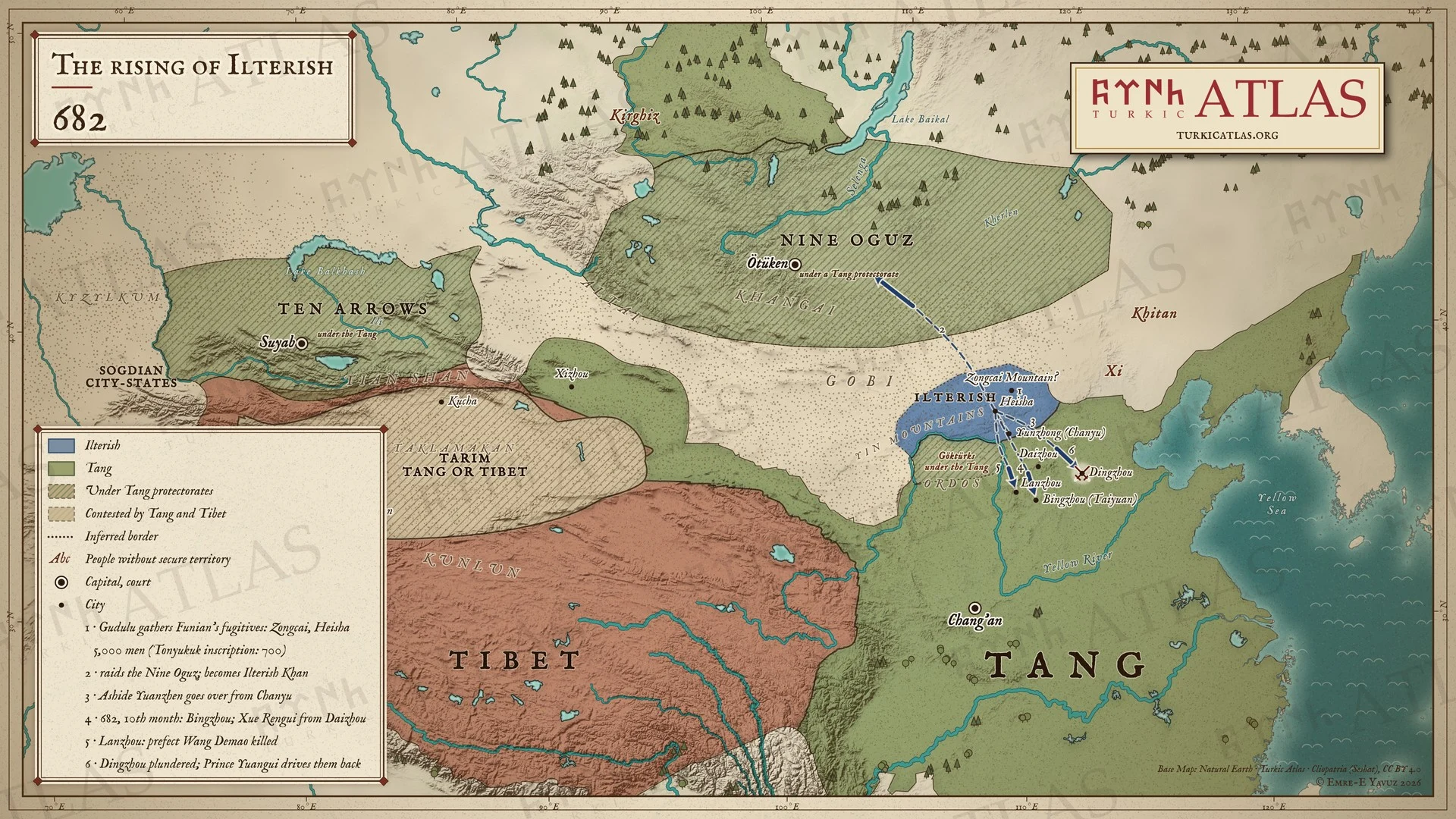
“When Funian had been crushed, Gudulu gathered the scattered fugitives, went into the Zongcai mountains and made himself the head of a band of robbers, more than five thousand strong. He raided the Nine Surnames as well and took great numbers of sheep and horses.[1] Gradually he grew strong, and then he set himself up as khan.”[1] He made his younger brother Mochuo, the later Kapgan, shad. He made Duoxifu yabgu.[8][9] The Xin Tang Shu adds that he fortified the town of Heisha, the Black Sands, north of the frontier.[8] The Xin Tang Shu dates the rising to 682, the Jiu Tang Shu to 683. The literature follows 682.
The man who made the rising a state came to it from the Tang side. Ashide Yuanzhen was in charge of the surrendered tribes under the Shanyu protectorate, and he was in prison for some offence. When Gudulu came raiding, Yuanzhen asked to be let out to bring the tribes to order. He went straight over to Gudulu.[1] “Gudulu was delighted to get him, made him Apa Tarkan and put him in sole charge of military affairs.”[1] Tonyukuk says in his own inscription that he joined the shad among the seven hundred. He says that he asked himself “Shall I make him khan?” and did so. Whether Yuanzhen is Tonyukuk is the question the Tonyukuk article treats. The Tang history has Yuanzhen fall in the war against the Türgesh before Gudulu died. The equation has to explain that away.
Raids on the Tang (683–687)
The Tang history counts the raids. In 683 he raided Weizhou, where the governor of Fengzhou was killed. In 684 he raided Shuozhou, where the frontier commander Cheng Wuting was appointed against him.[1] In 686 he raided Shuozhou and Daizhou, where a relieving Tang force met him at Xinzhou and lost five thousand men. In 687 he raided Changping in Hebei, with Yuanzhen at his side, and in the eighth month Shuozhou again.[1] There Heichi Changzhi beat him heavily at Huanghuadui. He drove him forty li and over the desert.[1] The Tang colonel Cuan Baobi was hungry for the credit. He took thirteen thousand picked men two thousand li beyond the frontier to finish Gudulu.[1] Before the attack he sent the Göktürks a message, and so gave them warning. He lost his whole army. Baobi was executed, and the empress renamed the khan.[1]
The Tonyukuk inscription tells the same years from inside. The rising at first lived north of the frontier, at Čogay Kuzı and Kara Kum, on deer and hare. Enemies surrounded it.[10] A fugitive brought word that the new khan of the Nine Oguz was building a coalition with China and the Kıtañ.[11] The aim was to make sure that “no master arise in the land of the Türk Sir people”.[10] The counsellor persuaded the khan to strike first. He beat the Oguz on the Tola with two thousand men against an army put at three or six thousand.[12][13] He then brought khan and people into the Ötüken land, after which the peoples of the four quarters came in.[14] On one account, Ilterish left the Yin Shan in 687 and turned his army to the heartlands of central and northern Mongolia. Between 687 and 691 the Tokuz-Oghuz and the Uyghurs, who held these lands, were routed and subjugated. Their chief, Abuz Khan, fell in battle, and the centre of the state moved to the Ötüken mountains.[15] By his own account, Tonyukuk was the first to bring a Göktürk army to the towns of Shantung and the sea. There the khan sacked twenty-three towns. The Hebei raid of 687 is the obvious match.
Organisation of the restored state
The Kül Tegin inscription gives the constitutional side. Ilterish gathered seven hundred men. He then set in order “a people that had lost its realm, a people that had lost its khan”, according to the law of the forefathers.[2] He organised the Tölis and the Tardush and gave them a yabgu and a shad.[2] To the south the Chinese were enemies, and to the north Baz Khan and the Nine Oguz. The Kirghiz, the Kurıkan, the Thirty Tatar, the Kıtañ and the Tatabı were enemies all around.[2] Another interpretation takes baz in the northern clause as a common word meaning “subject, vassal”, not as a name.[16] “My father the khan campaigned forty-seven times and fought twenty pitched battles”.[2] He took the realm from those who had realms and the khan from those who had khans. Then he “flew away”.[2] At his grave the image of a slain enemy was set up as the first balbal. According to one interpretation, this enemy was Baz Khan of the Oguz.[2] Tonyukuk’s count is seventeen battles with the Chinese, seven with the Kıtañ, five with the Oguz, “and in all of it his counsellor was I myself, and his commander was I myself”.[17][18][19]
Death and succession
“Gudulu died of illness in the Tianshou period”, between 690 and 692. The literature writes 691.[1] One survey writes 692 for his death and gives Kapgan’s reign as 692 to 716.[20] A second work puts Ilterish’s death at the end of 691 and Kapgan’s accession in 692.[21] His wife, Il-Bilge Katun, is named beside him on the Orkhon. She is the woman whom Heaven raised up with him.[22] His sons were small: Bilge was eight years old and Kül Tegin seven. His brother Mochuo “usurped the position and set himself up as khan”.[1] Twenty-five years later the sons killed the uncle’s sons and took the throne back. The monuments they raised are the reason the founder’s memory survives in his own people’s words.
Ilterish is the second founder of the Göktürk state, and the inscriptions treat him as the equal of Bumin. The same formula serves both: Heaven raises a khan so that the people should not perish.[2] What distinguishes him from Bumin is the evidence. Bumin is known from Chinese notices and from a monument raised two centuries after him. By contrast, Ilterish is known from the Chinese, from his sons, and from the man who claims to have made him. All of these sources lie within living memory of his death.
References
- ^ a b c d e f g h i j k l m n o p q Jiu Tangshu (Old Book of Tang), juan 194
- ^ a b c d e f g h i Kül Tegin inscription
- ^ Tonyukuk inscription; Tekin 1968, p. 283
- ^ Erhan 2011, p. 18
- ^ a b Tekin 2003, p. 97
- ^ a b Clauson 2011 (translation); original 1957, p. 29
- ^ Litvinsky 1996, p. 330
- ^ a b Xin Tangshu (New Book of Tang), juan 215
- ^ Taşağıl 2004, p. 8–18
- ^ a b Tonyukuk inscription
- ^ Tekin 1994, p. 5, 32
- ^ Tekin 1994, p. 8–9
- ^ Orkun 1994, p. 104–105
- ^ Tonyukuk inscription; Tekin 1968, p. 285
- ^ Litvinsky 1996, p. 331
- ^ Tekin 1968, p. 310
- ^ Tonyukuk inscription; Tekin 1968, p. 289
- ^ Tekin 1994, p. 21
- ^ Taşağıl 2004, p. 17
- ^ Kafesoğlu 1997, p. 115
- ^ Taşağıl 2004, p. 18, 19–20
- ^ Kül Tegin inscription; Tekin 1968, p. 335
Sources
- Jiu Tangshu (Old Book of Tang), juan 194
- Xin Tangshu (New Book of Tang), juan 215 (after Jiu Tangshu)
- Tonyukuk inscription
- Kül Tegin inscription
- Bilge Khan inscription
Literature
- Peter B. Golden, An Introduction to the History of the Turkic Peoples (1992)
- Friedrich Hirth, Nachworte zur Inschrift des Tonjukuk. Beiträge zur Geschichte der Ost-Türken im 7. und 8. Jahrhundert nach chinesischen Quellen (1899)
- Emre-E. Yavuz, The Gokturk Empire: 2nd Edition (2025)
- Talât Tekin, A Grammar of Orkhon Turkic (1968)
- Ahmet Taşağıl, Gök-Türkler, Bd. III (2004)
- Talât Tekin, Tunyukuk Yazıtı (1994)
- Talât Tekin, Orhon Türkçesi Grameri (2003)
- B. A. Litvinsky; Zhang Guang-da; R. Shabani Samghabadi (ed.), History of Civilizations of Central Asia, Vol. III (1996)
- İbrahim Kafesoğlu, Türk Millî Kültürü (1997)
- Gerard Clauson; übersetzt von F. Yelda Şahin, Ongin Yazıtı (2011 (translation); original 1957)
- Aydın, Erhan, Yenisey Yazıtlarında Geçen Unvanlar ve Unvan Niteleyicileri (2011)
- Hüseyin Namık Orkun, Eski Türk Yazıtları (1994)
What links here52
- Persons
- Ashide Yuanzhen · Ashina Funian · Bars Beg · Bilge Khan · Duoxifu · Kapgan Khan · Kül Tegin · Kutluk Tegin · Nishufu Khan · Pei Xingjian · Tonyukuk
- Conflicts
- Göktürk war of restoration, 679–687
- Places
- Hebei · Shanyu Protectorate · Shiveet Ulaan · Shuozhou · Youzhou · Yunzhong
- Peoples
- Bayirku · Eurasian Nomads · History of the Turkic peoples · Kurykan · Tatars · The Great Empires of the Steppe
- Institutions and Titles
- Army of the Steppe Empires · Böri (Guard) · Chur · Çigşi · Fulin Khan · Kut · Livestock Raids · Loose-rein prefectures · Shad · The Economy of the Steppe Empires · Tölis and Tardush · Tudun · Yabgu
- Religions
- Animism · Asena the She-Wolf (Gök Börü) · Burial and the balbal · Raising on the Felt · Tengri · Yer-Su Spirits
- Sources
- Kül Tegin inscription · Ongi inscription · Rock inscriptions found in Mongolia, 2018 to 2021 · Tonyukuk inscription
- Controversies
- The Göktürks and the Xiongnu
Cite this article
Yavuz, Emre-E. “Ilterish Khan.” Turkic Atlas, revised 8 November 2026. https://turkicatlas.org/persons/ilterish-khan/
Last revised: 8 November 2026

