
Pei Xingjian put down the risings that preceded the restoration of the Göktürk state. He did so twice.[1]
The rising of 679
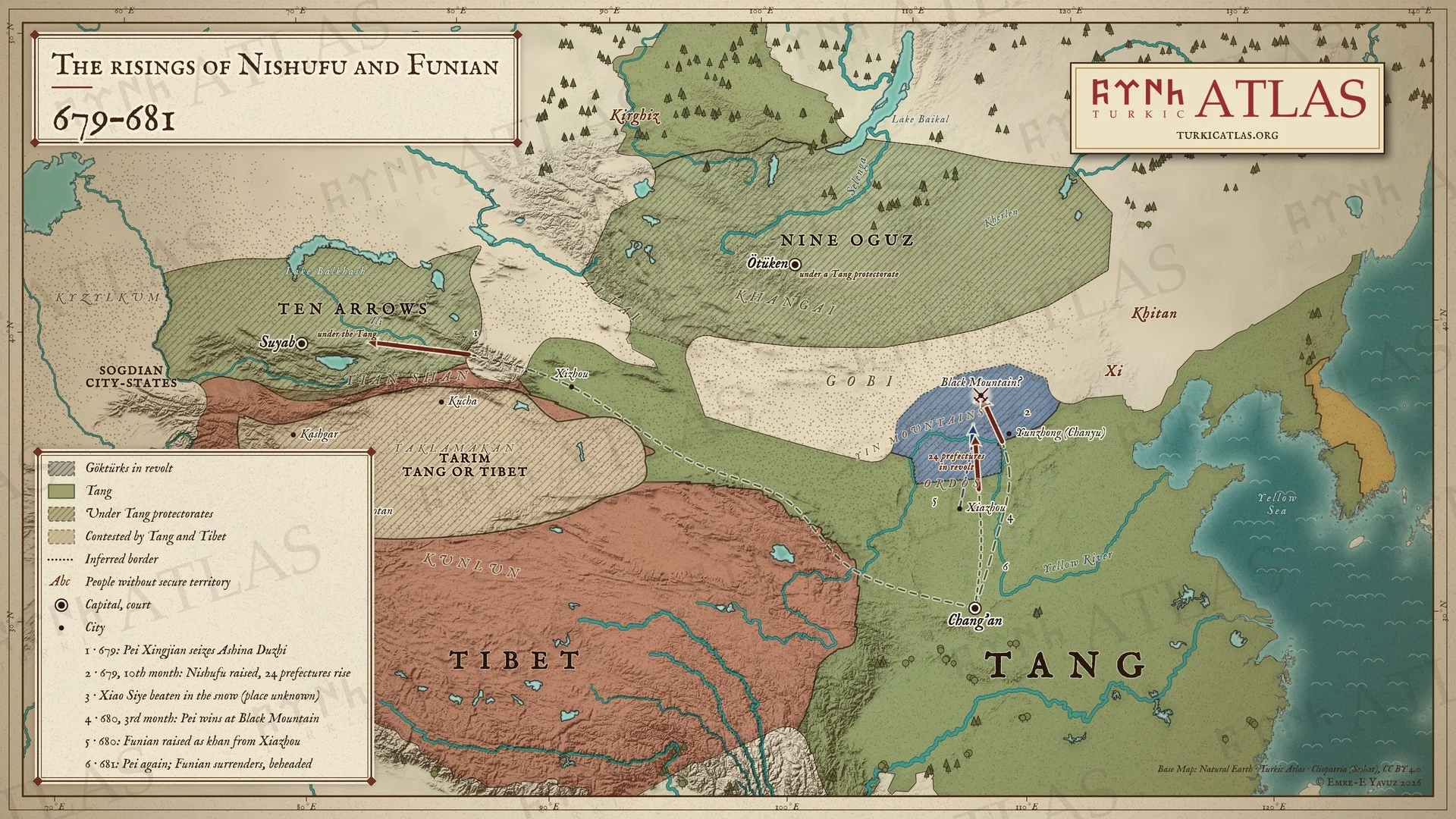
Two chiefs of the Ashide raised the surrendered tribes of the Ordos and set up a khan. Twenty-four prefectures went over with them.[1] The first Tang army sent against them was beaten.[1]
The second Tang army, under Pei Xingjian, broke Ashide Wenfu.[1] The khan they had raised, Nishufu, was killed by his own people. Fengzhi was taken.[1]
Funian
The tribes rose again behind Ashina Funian, the son of an elder cousin of Ilig. They fetched him from Xiazhou to make him khan.[1] Pei Xingjian’s army drove him to surrender. He was beheaded in the eastern market of Chang’an in 681.[1]
The Tang had now executed two khans of two risings in two years. The men who had submitted to save themselves had watched it happen. A year later Ilterish went into the Chugay mountains with a few hundred men. He did not surrender to anybody.[2]
Consequences
The risings of 679 and 681 failed because their leaders stayed within reach of the Tang frontier and let themselves be brought to terms. The rising of 682 succeeded because it went north. There a Chinese army had to be supplied across the desert to reach it.[2]
Pei Xingjian’s campaigns are therefore part of the same story as the war of restoration. They taught the next leaders where not to stand.
References
Sources
Literature
- Peter B. Golden, An Introduction to the History of the Turkic Peoples (1992)
- Emre-E. Yavuz, The Gokturk Empire: 2nd Edition (2025)
Cite this article
Yavuz, Emre-E. “Pei Xingjian.” Turkic Atlas, revised 23 October 2026. https://turkicatlas.org/persons/pei-xingjian/
Last revised: 23 October 2026

