
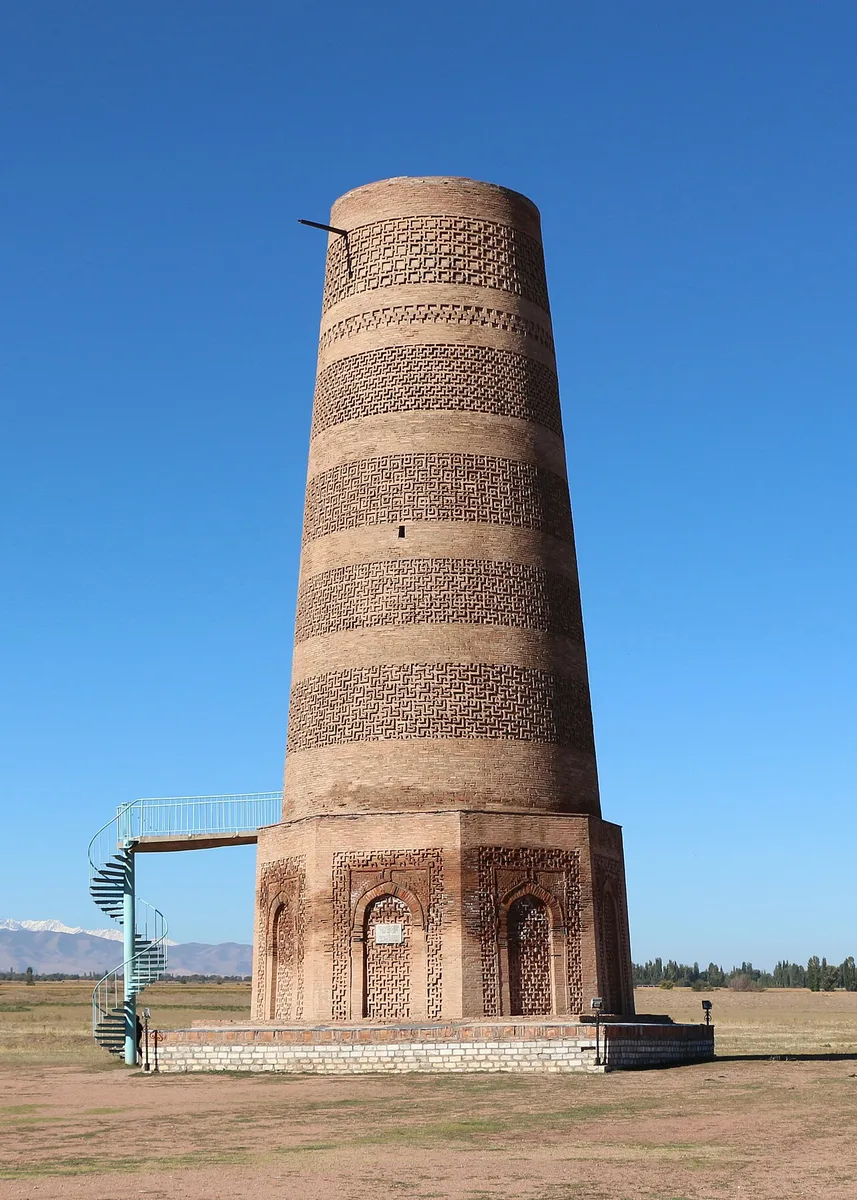
Balasaghun lay at the eastern end of the land of Argu, which Mahmud al-Kashgari reckons from Isfijab to Balasaghun.[1] In his day its people spoke both Sogdian and Turkic. A people called the Soghdaq lived there. They were Sogdians from the land between Bukhara and Samarkand who had taken the dress and manners of the Turks.[1] Around 898 a Muslim mystic travelled to “Turkestan”, which designates the region of Balasaghun.[2] Samanid copper coins found at Balasaghun are pierced with a square hole in the Chinese manner. This is a last trace of the old connections of the region.[3]
The prologues added to the Kutadgu Bilig some time after 1070 say that its poet, Yusuf Khass Hajib, came from Balasaghun. They call the town Quz Ordu.[4] The poem itself does not name the town.[5]
References
- ^ a b Dīvān Lughāt al-Turk
- ^ de la Vaissière 2005a, p. 316
- ^ de la Vaissière 2005a, p. 327
- ^ Dankoff 1983, p. 259–261
- ^ Kutadgu Bilig
Sources
Literature
- Étienne de la Vaissière, Sogdian Traders: A History (2005)
What links here5
- States
- Kara-Khanid Khanate
- Places
- Argu
- Institutions and Titles
- Metals and Metalworking in Kashgari's Dictionary
- Languages
- The Turkic languages
- Sources
- Kutadgu Bilig
Cite this article
Yavuz, Emre-E. “Balasaghun.” Turkic Atlas, revised 7 November 2026. https://turkicatlas.org/places/balasaghun/
Last revised: 7 November 2026


