
- 400
- 500
- 600
- 700
- 800
- 900
- Rouran 400–554
- First Göktürk 552–630
- Tang rule 630–682
- Second Göktürk 682–744
- Uyghur 744–840
- Kirghiz 840–924
- Huns 370–469
- Western Göktürk 552–659
- Türgesh 699–766
- Karluk 766–800
- Khazar 650–969
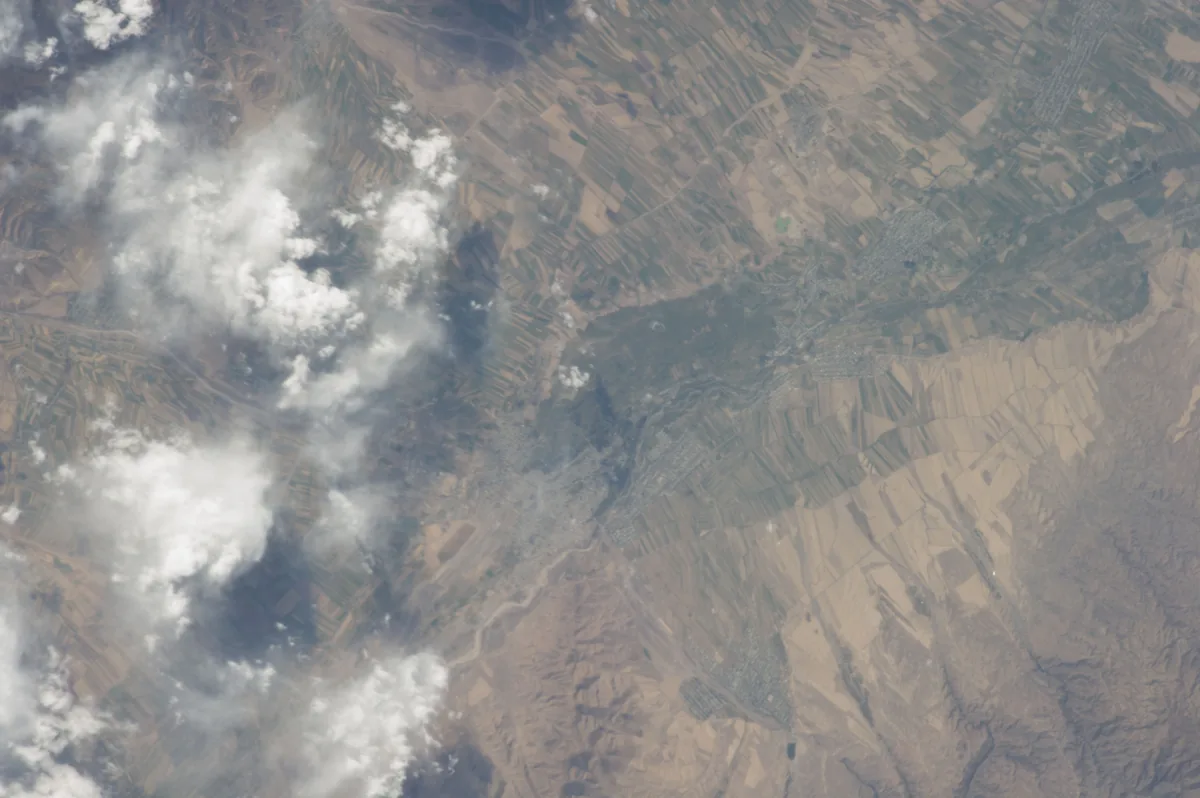
Suyab stood on the Chu, in the piedmont north of the Kirghiz Alatau, where the rivers come down from the mountains toward Lake Balkhash. The site is known today as Ak-Beshim, near Tokmak in Kyrgyzstan. For two centuries Suyab was the fixed point of the western Göktürks. It was the seat that Tardush held in place of the Altai. It was the town where the pilgrim Xuanzang met Tong Yabgu. It was the line that divided the Ten Arrows, and the river on which the last khan lost his following. It was the capital of the Türgesh until the Karluks took it in 766.[1]
A Sogdian town
Suyab was a Sogdian foundation before it was a Göktürk seat. The Talas plain and the whole piedmont north of the Kirghiz Alatau to Issyk Kul owed their first towns to Sogdian colonists of the fifth and sixth centuries. Excavation at Suyab (the site of Ak-Beshim) and at Navaket (the site of Krasnaya Rechka) shows towns growing up around castles built on the Sogdian model. The colonisation ran along an east–west line on the piedmont, between five hundred and a thousand metres. The soils there are grey, and with abundant water they carried wheat, vines and orchards.[2] Vine and wine were everyday goods of the Sogdian towns. The Sui Shu says of Kang, in the Zarafshan valley, that rich families laid up a thousand shi of grape wine, which kept for years.[3] The same study interprets the colonies as the work of nobles making estates on virgin land, farms first and trading posts second. For the pattern it cites the tradition of Narshakhi. According to this tradition, the landholders and rich merchants of the Bukhara district fled the tyrant Abrui to Turkistan and Taraz and built a city named after their leader. Xuanzang passed through around 630. He wrote that from the town of the Suye river as far as Kesh the land was called Suli, and the people were called the same. In his eyes, therefore, Chach and Semirech’e were part of Sogdiana. He wrote of Suyab and Talas that the western merchants of all lands lived there together. He wrote of the Sogdians from Suyab onward that they were crafty and covetous. Parent and child alike planned how to get wealth. Those who tilled the earth and those who sought profit were divided about in half. The Tang description of the western regions draws on Xuanzang and has the same. Five hundred li north-west of the Ling mountains one reaches the city of the Suye river, where the Hu merchants of the neighbouring states live mixed together. West of Suyab are several dozen towns, each with a chief, all subject to the Göktürks. From Suyab to Kesh the people wear woollen cloth and bind their brows with silk.[4]
The seat of the western Göktürks
The western seat was at Suyab from Tardush onward. According to this account, he ruled the west no longer from the Altai, like his father, as a neighbour of the eastern khans, but from Suyab in present-day Kyrgyzstan.[1] By the time Tong Yabgu ruled, the residence of the yabgus had lain there for some years. It lay far from the sacred forest of Ötüken, where the khans of the east still lived.[1] The fixed seat may be a sign that the western Göktürks were beginning to settle. The Chinese chapters are less tidy. They put Shegui’s court at Sanmi mountain north of Kucha.[5] They have Tong Yabgu move his court to the Thousand Springs north of Chach, four hundred li west of Suyab. There, the Tang description says, the khan went every year to escape the heat among tame deer that wore bells and rings.[5] Modern accounts identify the Thousand Springs as the khan’s summer residence. They place his ordinary range in the Ili valley, the old Wusun land.[4] The two accounts are not in conflict if Suyab is the town and the Thousand Springs the pasture. Turkic Atlas gives the seats of each reign under the western khaganate.
The fullest picture is Xuanzang’s. In 629, or at the beginning of 630, the pilgrim met the khan near Suyab.[6] The town was four kilometres across. It was not large, but it was splendid beside the average nomadic settlement. Various non-Chinese merchants of the surrounding peoples gathered and lived there. The soil suited red millet and grapes. The woods were thin, the climate was windy and cold, and the people wore twisted wool.[6] The Tong Yabgu article contains Xuanzang’s scene: the khan in green satin with his hair to his waist, the two hundred ministers in embroidered robes, the tent shining with gold, and the envoys from China and Gaochang whose letters were read. It also contains the wine and music for the envoys, the grape syrup for the pilgrim, and the ruler who would not sit on wood because the Göktürks honour fire. The king of Gaochang, the khan’s ally and almost his vassal, had given the pilgrim letters for him. The khan gave the pilgrim a young man as guide and interpreter as far as Kapisa, the southern limit of his states. The khan died in 630, soon after the pilgrim had passed.[4] Bahram Chobin, the Persian general who fled to the Göktürks after his defeat, rose to be a respected general at Suyab. Khosrow II then had him poisoned. The Bahram article tells the story.[1]
The Ten Arrows and the Tang
When the west dissolved after Tong Yabgu, Suyab became the line on the map. The Xin Tang Shu says that the khan Shaboluo Dielishi divided his state into ten parts. One man was set over each part, and each was given an arrow.[5] The five Üç Tuğlu with their five great chuo lived east of Suyab. The five Nushibi with their five great sijin lived west of it.[5] Twenty years later the river saw the end of the last khan. Su Dingfang had broken Ashina Helu at the Yedie river and at Jinya mountain. He followed Helu to the water of Suyab and took his whole following from him. Helu fled on to Chach, and there he was seized.[5] The Tang then garrisoned the town. The chapter names a commander of the Suyab garrison who beat the Nishu sijin and the Türgesh in the 690s.[5] It names an Ashina governor who took the tents west of Suyab, thirty thousand of them, into submission in the 700s.[5] It names, last, the Tang-made khan of the Ten Arrows, Ashina Xin. A Türgesh tarkan killed him at Julan city west of Suyab, “and so the western Göktürks perished”.[5] A great deal of Chinese silk reached the Tarim and the west in the eighth century as the pay of soldiers and officials stationed in all the towns from Dunhuang to Suyab. The poet Li Bo was born at Suyab in 701.[2]
The Türgesh and the Karluks
From 690 Suyab was the centre of the Türgesh. It was the urban seat from which their khans Wuzhile, Saqal and Sulu ruled the west until the Arab victory of 737 broke them.[7] The Kül Tegin inscription, from the other side of the Altai, names among the mourners of 732 “my son the khan of the Türgeš, of the Ten Arrows”. This khan sent the seal-keepers Makarač and Oguz Bilge.[7] The Karluks had been driven out of Mongolia by the Uyghurs about 745. They took Suyab in 766 and were complete masters of the western Göktürk lands.[8] The Ten Arrows article tells that sequel.
Assessment
Suyab is the one place where the western Göktürks can be seen standing still. A Sogdian farm town became the seat of a khan whose states ran to the Indus. The town outlived the khanate. The Tang held it, the Türgesh ruled from it, and the Karluks took it. The merchants of all lands went on living there together. What Xuanzang saw on the Chu in 630 was a court of two hundred ministers in silk beside a town of grape-growers and traders. It is the clearest picture the sources give of a Göktürk capital in the west. It was not a city of the Göktürks, but a city under them.
References
Sources
- Xin Tangshu (New Book of Tang), juan 215 (after Jiu Tangshu)
- Kül Tegin inscription
- Sui Shu (Book of Sui), juan 83
Literature
- Emre-E. Yavuz, The Gokturk Empire: 2nd Edition (2025)
- Étienne de la Vaissière, Sogdian Traders: A History (2005)
- Peter B. Golden, An Introduction to the History of the Turkic Peoples (1992)
- Édouard Chavannes, Documents sur les Tou-Kiue (Turcs) occidentaux (1903)
What links here57
- Persons
- Ashina Helu · Askel · Bahram Chobin · Damozhi · Heraclius · Ishbara Tolis Khan · Istemi · Si Yabgu Khan · Su Dingfang · Tardush · Tong Yabgu · Töremen Apa · Üç Tuğlu Khan
- Battles & Events
- Abrui and Shir-i Kishvar · Göktürk Succession Crisis (581) · Murder of Bahram Chobin · Siege of Tiflis (627–629) · Xuanzang's visit to Tong Yabgu
- Places
- Beiting · Bukhara · Gaochang · Issyk-Kul · Kucha · Sogdiana · Talas · Thousand Springs · Tian Shan · Tiflis
- Peoples
- Chumukun · History of the Turkic peoples · Karluk · Nushibi · On Oq · Sogdians · The Great Empires of the Steppe · Türgesh
- Institutions and Titles
- Chur · Daguan · Göktürk Dress and Hair · Göktürk Weapons · Irkin · Towns and Villages of the Turks in the Hudud al-ʿĀlam · Trade Routes of the Steppe · Türgesh and Karluk Coinage
- Religions
- Fire Worship
- Foods
- Bread · Grape Wine in Central Asia
- Customs & Pastimes
- Seating at the Feast · The Göktürk Feast
Cite this article
Yavuz, Emre-E. “Suyab.” Turkic Atlas, revised 8 November 2026. https://turkicatlas.org/places/suyab/
Last revised: 8 November 2026

