
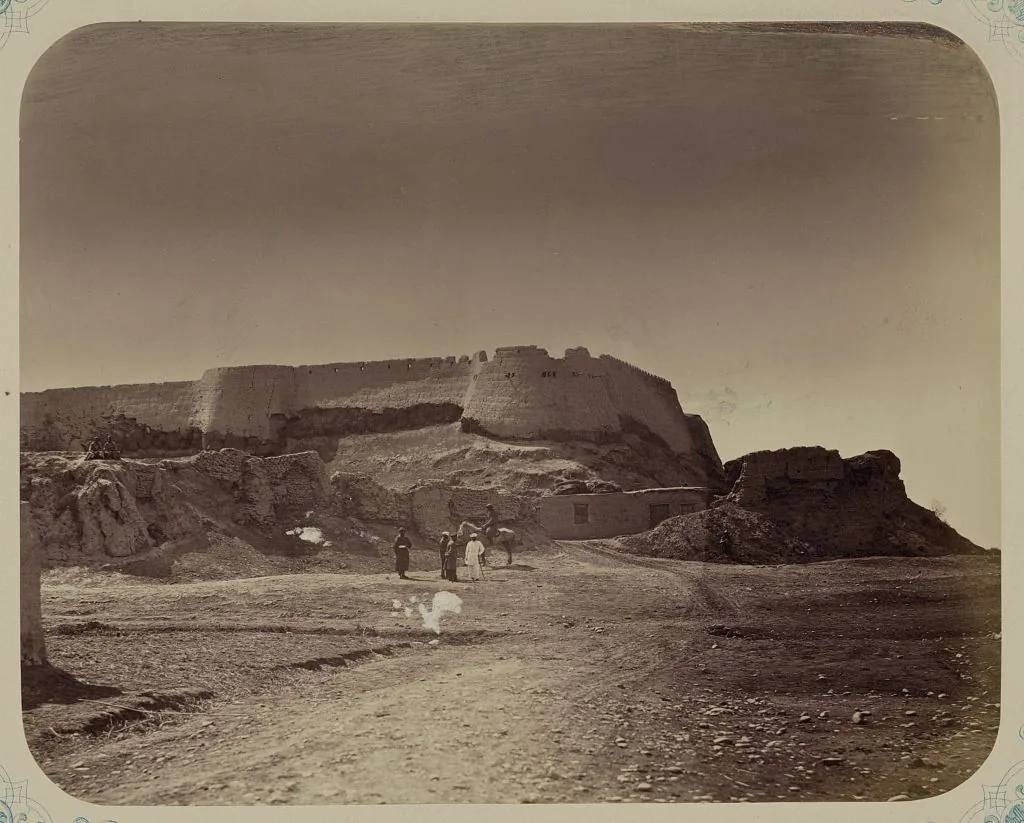
The Talas is a river running north-west out of the Tian Shan. The town that took its name stood on the road between the Syr Darya and the passes into the Seven Rivers country. It is one of the places at which the western steppe, Transoxiana and the Tarim all lie within a few days’ march. It changed hands whenever any of the three did.
The Türgesh wars
The city enters the Chinese record as a stronghold in the collapse of the Türgesh. In 738 two of Sulu Khan’s own commanders attacked him by night and killed him. His people broke into the Yellow and the Black factions, which held each other in suspicion and hatred.[1] Sulu’s son was raised as khan at Suyab. He drew the Black Surname khan Erwei Tegin to hold the city of Talas, and the two together attacked the man who had killed Sulu.[1]
The Tang came in on the other side. The imperial commissioner of the western desert marched with the killer and with the kings of Chach and Kesh. He broke Sulu’s son at Suyab and took him.[1] The commander of the Kashgar garrison then came up with the king of Ferghana and fell on Talas. The Black Surname khan and his brother were beheaded. The city of Yejian was entered. The Jiaohe Princess, Sulu’s katun and Erwei’s katun were all recovered.[1]
Within three years of a single murder, a Tang army and its local allies took apart, at Suyab and at Talas, the power that had held the western steppe for forty years.[1]
The battle of 751
Ten years later a Tang army and an Abbasid army met on the same river. The Karluk contingent that had come with the Tang changed sides during the fighting. The Tang force was destroyed. Chinese power never returned west of the Pamirs. The article on the battle follows it and the argument about what it decided.
The place afterwards
Talas remained a town of the Turkic west under the powers that followed. The road it stood on carried the traffic between the caliphate and the steppe for centuries after the empires that fought over it had gone.
Runiform stones
The upper Talas valley in Kyrgyzstan has given a group of runiform stones. The first was found in 1896 near the village of Kirk-Kazyk, south-east of the town of Talas.[2] A teacher, M. M. Gastev, and the district chief V. A. Kallaur are named as its finders.[3] It has four half-lines and is kept in the Hermitage.[3] Four more stones were found in 1898.[4] A second stone, found west of the first, has been in the museum at Bishkek since 1961.[5] Some scholars have a man give his name on it as Kara Chor and say that his enemy cannot stand against him.[6] By 1993, more than twenty runiform inscriptions had been found in the Talas region.[7]
A wooden rod from the pyrite deposit of Açık-Taş in the valley bears runiform signs on all four sides.[8] It is kept in the Hermitage, and its interpretation is not settled.[8] Two inscriptions found in 1981 at the Kuru-Bakayır pass in the Talas Ala-Too are transliterated kutchor and sharga.[9] Some scholars take sharga for a Sogdian word, “lion”.[9] Neither report dates the stones.[10] The runiform inscriptions of Talas and the Tian Shan have their own article, which sets out the whole group.
References
Sources
- Xin Tangshu (New Book of Tang), juan 215 (after Jiu Tangshu)
Literature
- Peter B. Golden, An Introduction to the History of the Turkic Peoples (1992)
- Édouard Chavannes, Documents sur les Tou-Kiue (Turcs) occidentaux (1903)
- Emre-E. Yavuz, The Gokturk Empire: 2nd Edition (2025)
- Étienne de la Vaissière, Sogdian Traders: A History (2005)
- Çetin Cumaguloviç Cumagulov, Vilhelm Thomsen'in Çalışmaları ve Kırgızistan'da Bulunan Göktürk Yazıtları (1993)
- Çumagulov, Çetin, Göktürk Harfli Yazıtların Kırgızistan’daki Araştırılması, Muhafazası ve Bugünkü Durumu (2000)
What links here19
- Persons
- Tong Yabgu · Zemarchos
- Conflicts
- Göktürk Expansion along the Silk Road · Göktürk Expansion into Europe · The Göktürk–Sasanian Trade Conflict
- Battles & Events
- Abrui and Shir-i Kishvar · Istemi's campaign against Persia, 569 · The embassy of Zemarchos, 569
- Places
- Issyk-Kul · Thousand Springs
- Institutions and Titles
- Göktürk Dress and Hair · Trade Routes of the Steppe
- Customs & Pastimes
- Seating at the Feast · The Göktürk Feast
Cite this article
Yavuz, Emre-E. “Talas.” Turkic Atlas, revised 8 November 2026. https://turkicatlas.org/places/talas/
Last revised: 8 November 2026

