
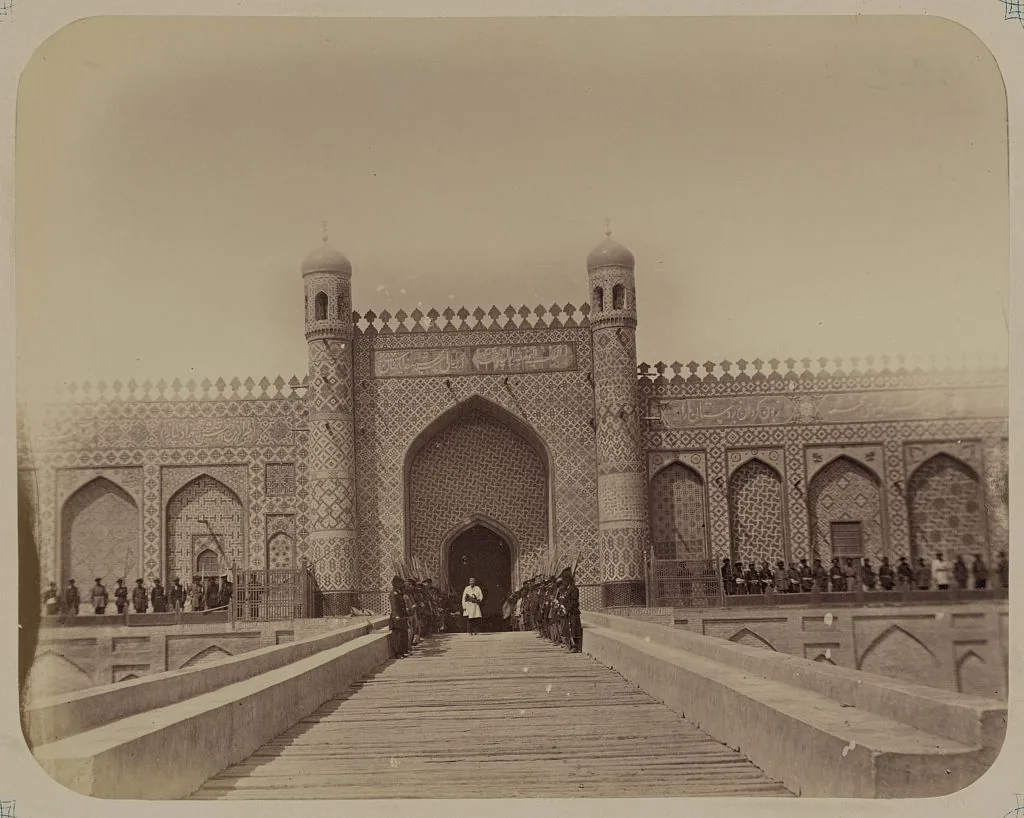
Ferghana is the valley of the upper Syr Darya, enclosed by mountains on three sides, east of Sogdiana and Chach. The Han called its country Dayuan. It was the first country of the west that a Chinese envoy saw. The Shiji opens its chapter on the western peoples with the words “The traces of Dayuan were seen first by Zhang Qian.”[1] Most commentators take Dayuan for Ferghana. It has also been identified with Sogdiana.[2][3] The later dynastic histories identify the old Dayuan with Poluona, which is Ferghana.[4] The Chinese Wan may be a transcription of the local name. It connects the name with Sogdian band, a stronghold or bridgehead. The character for great, da, sets the country apart from the small state of Xiaowan in the Tarim basin.[5] The Han Shu lists Xiaowan among the oases of the southern road.[6]
Dayuan in the Shiji
Zhang Qian reached Dayuan after his escape from the Xiongnu. Its king had heard of the wealth of the Han. He gave Zhang Qian guides to Kangju and the Yuezhi.[1] The report of Zhang Qian describes a settled country. Its people farmed rice and wheat and made grape wine. It had walled towns and houses, more than seventy towns large and small, and some hundreds of thousands of people. They fought with bows and spears from horseback.[1][7] The rich stored wine in quantity, up to ten thousand shi, and kept it for decades. The horses were fed on alfalfa.[1] Dayuan had many fine horses. These horses sweated blood and were said to descend from heavenly horses.[1] Han envoys took the seeds of the alfalfa and of the grape home with them. The emperor had both planted in rich ground and beside his palaces.[1][8] Kangju lay to its north, the Great Yuezhi to its west, Daxia to its south-west and the Wusun to its north-east.[1]
The Chinese texts describe the people of Dayuan as former nomads who had settled and were still masters of mounted warfare.[2] From the second century BC the Kugai-Karabulak culture of Ferghana entered a wider exchange. Han silks have been found in its tombs, and large town sites such as Akhsikent are known.[2]
The Han war against Dayuan
The emperor loved the horses of Dayuan. He first named the horses of the Wusun heavenly horses. When he obtained the blood-sweating horses of Dayuan, he renamed the Wusun horses “Far West” and gave the name heavenly horses to the horses of Dayuan.[1] Envoys went out one after another, five or six to more than ten parties a year. The largest parties were several hundred men strong.[1][9]
The finest horses were kept at the town of Ershi. Dayuan would not give them up. The emperor sent envoys with a thousand pieces of gold and a golden horse to ask for them. The nobles of Dayuan refused. The Han were far away, they said, and could not bring an army across the desert.[1] The envoys smashed the golden horse and left. The town of Yucheng on the eastern border attacked and killed them.[1]
In the first year of Taichu, 104 BC, the emperor sent Li Guangli, the “General of Ershi”, with six thousand horsemen of the dependent states and tens of thousands of young men of bad reputation.[1] The small states on the road shut their gates. The army that reached Yucheng was a few thousand hungry men. It was beaten and turned back. Of those who had set out, one in ten or two in ten returned to Dunhuang.[1] A second army set out from Dunhuang. On the road Luntou refused to open its gate. The army stormed it in a few days. From there it marched without hindrance to the city of Dayuan and besieged it.[1][10] The nobles killed their king and offered the horses. The Han took some tens of the finest horses and more than three thousand of the middling sort. They set up a noble named Meicai as king and withdrew.[1] Among the arguments for accepting the terms was that Dayuan had recently obtained men of Qin, that is Chinese, who knew how to dig wells.[1]
Later history
The name the Sogdians used for the Chinese, the men of Qin, seems to have been used in Ferghana as well. The Xiongnu used it for the Chinese of the Han.[11] In 285 the Jin emperor Wu gave the ruler of Ferghana the title of king. In 331 an embassy from Ferghana brought cotton and coral to the court of Shi Le.[12]
The Arabs under Qutayba ibn Muslim conquered Ferghana with Sogdiana, Khorezm and Chach between 705 and 715.[13] The Arab armies captured and massacred the Sogdian exiles in Ferghana. They spared the merchants, whose wealth came from the trade in Chinese goods.[14] In the ninth century soldiers from Ferghana served the caliphs at Samarra. They lived in quarters kept apart from the town and forbidden all needless trade.[15]
References
- ^ a b c d e f g h i j k l m n o p Shiji, juan 123
- ^ a b c de la Vaissière 2005a, p. 27
- ^ Herrmann 1910, p. 5
- ^ de la Vaissière 2005a, p. 28
- ^ Markwart 1938, p. 173
- ^ Han Shu, juan 96
- ^ Laufer 1919, p. 221,372
- ^ Laufer 1919, p. 221
- ^ Laufer 1919, p. 210
- ^ Herrmann 1910, p. 119–120
- ^ de la Vaissière 2005a, p. 23
- ^ de la Vaissière 2005a, p. 61
- ^ de la Vaissière 2005a, p. 266
- ^ de la Vaissière 2005a, p. 278
- ^ de la Vaissière 2005a, p. 284
Sources
Literature
- Étienne de la Vaissière, Sogdian Traders: A History (2005)
- Albert Herrmann, Die alten Seidenstrassen zwischen China und Syrien. Beiträge zur alten Geographie Asiens, Bd. 1 (1910)
- Berthold Laufer, Sino-Iranica. Chinese Contributions to the History of Civilization in Ancient Iran (1919)
- Josef Markwart, Wehrot und Arang. Untersuchungen zur mythischen und geschichtlichen Landeskunde von Ostiran (1938)
What links here12
- Persons
- Emperor Wu of Han · Er Chanyu · Li Guangli · Qutayba ibn Muslim · Xulihu Chanyu · Zhang Qian
- Customs & Pastimes
- The New Year on the Steppe
Cite this article
Yavuz, Emre-E. “Ferghana.” Turkic Atlas, revised 8 November 2026. https://turkicatlas.org/places/ferghana/
Last revised: 8 November 2026

