
- 400
- 500
- 600
- 700
- 800
- 900
- Rouran 400–554
- First Göktürk 552–630
- Tang rule 630–682
- Second Göktürk 682–744
- Uyghur 744–840
- Kirghiz 840–924
- Huns 370–469
- Western Göktürk 552–659
- Türgesh 699–766
- Karluk 766–800
- Khazar 650–969
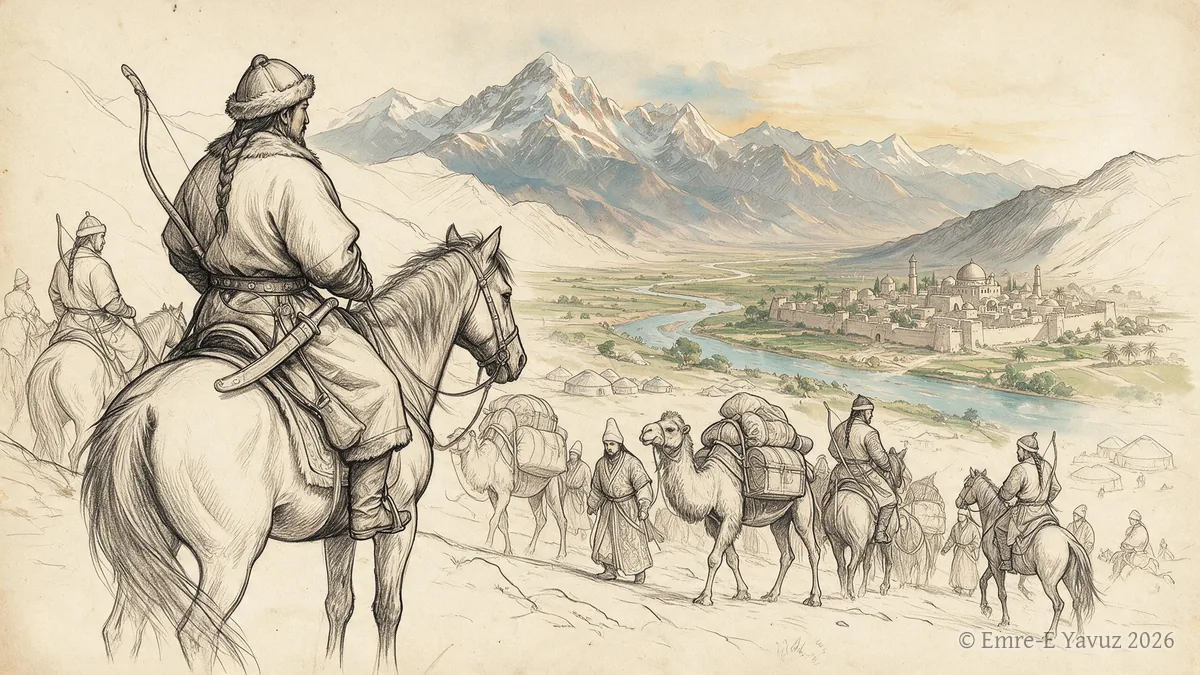
The Göktürk expansion along the Silk Road was the advance of the western wing of the khaganate from the Altai to the Oxus, the Caspian and the Caucasus between 553 and 629. Istemi, the younger brother of the founder Bumin, began it in the spring of 553.[1] Within a decade he had destroyed the Hephthalite realm together with Persia.[2] The Sogdians of Sogdiana, once subjects of the Hephthalites, became subjects of the Göktürks. Their merchants set out to sell the khaganate’s raw silk in the west.[3] The same victory made the Göktürks neighbours of Sasanian Persia along the Oxus.[4] The quarrel over the silk trade then turned the partners into enemies.[5]
The Sogdian Maniakh led the next embassy around Persia to Constantinople.[5] By 570 Göktürk envoys were urging Justin II to attack Persia from one side while they attacked it from the other.[6] The conflict outlasted Istemi. In the reign of his son Tardush a Göktürk army crossed the Oxus in 588 and was defeated by Bahram Chobin.[7] A generation later Istemi’s great-grandson Tong Yabgu joined the Byzantine emperor Heraclius and struck Persia through the Caucasus.[8]
Istemi’s western command
Bumin died in 552. The realm was divided.[9] The west of the khaganate, with Dzungaria, Lake Balkhash and the lands of the Issyk-Kul, fell to Istemi.[9] He held it as yabgu, the second title of the state.[10] The yabgu had troops of his own and could conduct his own foreign policy. He remained formally subordinate to the khan in the east.[10]
By the summer of 553 Istemi had reached the Seven Rivers, the Zhetysu of what is now south-eastern Kazakhstan.[1] A figure of a hundred thousand warriors has long been repeated for his army. One estimate holds it to be an exaggeration and puts the force at thirty to fifty thousand.[11] On the same reckoning his army reached Lake Balkhash only in 555.[12] In those two years he brought every tribe and every small state of the western steppe under Göktürk rule, by force where force was needed.[12]
Dzungaria and the Tarim basin
At about the same time the Göktürks took the oasis cities of the Tarim basin.[13] They regarded themselves as heirs of the Rouran, their former overlords. They therefore considered themselves entitled to every land the Rouran had once ruled.[13] Their road led from Dzungaria, the old country of the Tiele south of the Altai, through the Dzungarian Gate. This corridor is about eighty kilometres wide, between the Dzungarian Alatau and the Tarbagatai.[14]
The boundary between Istemi’s west and the east of Issik and then Mukan ran from the Altai through Dzungaria to that gate.[15] The Göktürks took control of Kucha and the other city-states of the basin. They left their internal affairs to their own rulers.[16] With the Tarim and the Seven Rivers in hand, the khaganate bordered on the Hephthalites along the Syr Darya.[17]
The conquest in the Chinese histories
The Zhou Shu says that Mukan, Bumin’s son and khan in the east, crushed the Hephthalites in the west. He drove the Khitan to the east and annexed the Qigu in the north.[18] The text adds that his realm reached ten thousand li from the Liao sea to the western sea.[18] The Sui Shu repeats the victory over the Hephthalites under Mukan’s name.[19] Neither history names Istemi.[18] The silence has been explained by Mukan’s position as supreme khan. Every success of his reign was credited to him, whether or not he won it in person.[20]
The Jiu Tang Shu names the western founder in the pedigree of a later western prince.[21] According to the passage, Istemi followed the chanyu. He commanded ten great chiefs and a hundred thousand soldiers and went to pacify the Hu kingdoms of the western regions. He made himself khan and called his people the tribes of the ten surnames.[21] Modern accounts take the chanyu of the passage to be Bumin. They read the passage as showing that the division into east and west existed in effect from the time of the two brothers.[22] The Xin Tang Shu adds that Istemi’s son, Tardush Khan, was the first to hold the old land of the Wusun apart from the eastern Göktürks.[23]
The alliance with Khosrow I
The Hephthalites ruled Sogdiana through garrisons. Their largest garrison stood at Bukhara.[24] An account drawn from the records of Bukhara has seven Sogdian kings meet in the city and send to Istemi, asking him to drive the Hephthalites out of their country.[25]
Khosrow I of Persia had his own account to settle with the Hephthalites. They had killed his grandfather Peroz.[26] Tabari says that Khosrow allied himself with the khagan by marriage before marching against the Hephthalites. He told the khagan of his plan and bade him march against them too.[26] Khosrow then killed their king and destroyed his whole house. He pushed beyond Balkh and quartered his troops in Ferghana.[26] Scholars have doubted that Khosrow ever held the country beyond the river. He will have reached about as far as Balkh and Tokharistan, they argue, while Istemi attacked from the north.[27]
Tabari also names the child of the marriage. Khosrow chose as his successor Hormizd, whose mother was the daughter of the khagan and the khatun.[28] An Armenian writer appears to give the queen’s name as Kaien.[29] When the marriage was made is disputed. One reconstruction sets the alliance and the wedding in 554, before the war. It records a second version in which the wedding followed the victory.[30] A third account places the marriage at the pact that closed the war. It names the bride Kayan and makes Hormizd IV most probably her son.[31]
The fall of the Hephthalites
Tabari’s account of the Hephthalite war gives the victory to the khagan.[32] The khagan was the boldest and mightiest of the Göktürks and had the most numerous troops. He killed Warz, king of the Hephthalites, together with the greater part of his army.[32] He took their wealth and their land, except the parts that had fallen into Khosrow’s hand.[32] Tabari calls him Sinjibu, and Menander calls him Silziboulos or Dizaboulos. The names are taken to be one, and the man to be Istemi.[33] Menander preserves a boast of Istemi from these years.[34] He said that the Avars were neither birds nor fish. When his war against the Hephthalites was finished, he would fall on them too.[34]
The Göktürks moved into Sogdiana in 557 or 560.[35] In one reconstruction the final engagement was the battle of Bukhara, where Istemi’s armies defeated the garrison of the Hephthalite ruler Ghadfar.[36] The fighting reportedly lasted seven days and seven nights. On the eighth day the Göktürks broke through.[36] Faganish, a Hephthalite commander, fled south into Bactria. Ghadfar took refuge with the Persians.[36] An older statement, which cites no source, places the Göktürk victory at Nasaf instead.[37]
The Persian army then appeared on the Oxus under Khosrow himself. There was no battle.[38] Istemi and Khosrow had planned the war between them in secret.[38] The Göktürks had attacked from the north-east and the Persians from the south-west.[2] Where and how the two kings came to terms is not recorded.[38]
The date of the Hephthalite collapse
The year of the collapse is disputed. One reckoning puts it about 560, with the battle of Bukhara as its end.[2] A second puts the destruction of the Hephthalite state in 557.[39] A third sets it between 563 and 567.[40] This third reckoning rests on two fragments of Menander. In one, Istemi promises to attack the Avars once the Hephthalite war is over. In the other, the envoys of 568 report the Hephthalites wholly subdued.[40] The first fragment gives no year.[34] It survives among detached maxims, and its place after the events of 562 is the arrangement of the editor. Other reckonings give 557, 558, 563 and 565.[41] A further account ties the Persian opportunity to the same years, 563 to 567. Khosrow I wished to destroy the Hephthalite empire, and he found his chance while his enemies were at war with the expanding Göktürk state. After 567, on this account, the Hephthalite lands north of the Oxus came under Göktürk control, and Khosrow gained the south without much fighting.[42] The Chinese annals record a Hephthalite embassy for the last time in 558, and Persia paid the Hephthalites tribute until at least 545.[42]
Menander also records a Persian claim.[43] At the peace talks of 562 the Persian envoy boasted that Khosrow had overthrown the power of the Hephthalites.[43] By 568 the Göktürk envoys in Constantinople could tell Justin II that they had made the Hephthalites tributary.[44] Asked whether they had taken the whole power of the Hephthalites, they answered: entirely.[44]
The partition on the Oxus
The victors divided the Hephthalite lands.[45] Everything north and east of the Oxus went to the Göktürks and everything west of it to Persia, with Bukhara between them.[45] For the first time the Göktürk khaganate bordered directly on Sasanian Persia.[4] A small district south-east of Bukhara fell to neither side and later became a point of friction.[4] The pass of the Iron Gate, north of the river, marked the limit between the two empires.[37]
The Persian and Arabic historians give Persia the larger share.[46] In Dinawari’s version Khosrow took Tokharistan, Zabulistan, Kabulistan and Chaghaniyan. Istemi took Chach, Ferghana, Samarkand, Kesh and Nasaf as far as Bukhara.[27] Dinawari adds that Khosrow’s son Hormizd later drove the khagan out of all of it.[27] Some scholars reject that addition, since Menander has the Sogdians subject to the Göktürks after the Hephthalite fall.[27] A different reconstruction dates the partition treaty to 566 or 571.[47] It gives Khosrow all the former Hephthalite lands south of the Amu Darya, and the Göktürks Sogd, Shash, Ferghana and eastern Turkestan.[47]
The frontier was not settled at once. Istemi did not pursue the Hephthalite remnant. He offered it a pact. Faganish, whom the Hephthalite nobles had crowned king in Bactria, became Istemi’s vassal.[48] Hephthalite warriors were taken into Istemi’s army and kept their lesser royal titles.[48] According to one account, a Göktürk force appeared in 560 at Gurgan on the Caspian, inside Persia.[49] Khosrow marched there and met Istemi in person. Istemi declared that he wanted no war.[49] At that meeting Istemi handed Faganish over to Persia. Part of the Hephthalites then became a Sasanian client.[49] In return the two rulers fixed the frontier along the Oxus from the Aral Sea. They concluded a pact of non-aggression, sealed with the marriage of Istemi’s daughter to Khosrow.[50]
Sogdiana under Göktürk rule
Sogdiana had no single king.[4] Each city had its own king, or queen.[4] The Göktürks became the new overlords of the country. They took all its cities, Bukhara and Samarkand among them, under their protection.[4] The Ashina nobility took quarters at Bukhara, and a Göktürk garrison stayed there. Most of the army went back to the steppe.[51] In the following years many Göktürks settled in the cities along the Silk Road, Tashkent and Samarkand among them. There they came into close contact with the Sogdians.[52] Under Istemi, canals damaged in decades of war were repaired. The potters and glassmakers of the Tashkent oasis improved their craft.[53]
The Sogdian cities kept a large measure of autonomy under the khaganate. Sogdian served as one of its official languages.[54] A genuine fusion of Sogdians and Göktürks after the conquest of 560 has been proposed.[55] At the end of the seventh century one of the kings of Panjikent was a Göktürk.[55] Chach, the oasis of Tashkent, fell to the Göktürks in every version of the partition. It later lay beside the court of Tong Yabgu.
The Sogdians had been at the Göktürk court from the beginning.[56] The first envoy the Western Wei sent to Bumin, in 545, was An Nuopantuo, a Sogdian of Jiuquan.[57] The Sogdians administered the commercial interests of the khaganate. They urged it on towards Constantinople, the final market of the silk that the Göktürks drew out of China.[58]
The silk came from China.[18] The Zhou Shu records that after the marriage alliance the Zhou court gave the Göktürks a hundred thousand pieces of silk every year. According to the same text, the Qi emptied their treasury to do the same.[18] The Sogdians of the empire proposed to the Göktürk princes a way to double the profit from this silk: carrying the surplus to the west.[59] The whole western growth of the Sogdian trading network came out of that proposal.[59]
The embassies to Persia
The first road to the western market ran through Persia.[3] Menander writes that, when the power of the Göktürks had grown great, the Sogdians, once subjects of the Hephthalites and now of the Göktürks, asked their king for an embassy to the Persians.[3] They wanted to sell raw silk to the Medes.[3] Istemi agreed and sent Sogdian envoys under Maniakh.[60] One account dates the embassies to Ctesiphon to 568.[53] In it the heads of the Sogdian merchant guilds ask Istemi’s leave to seek from Khosrow the right to trade across Persia. Istemi agrees reluctantly.[61]
Menander says that Khosrow did not want the trade, because it would give the Göktürks free access to Persian territory.[60] He put the envoys off from day to day and then took counsel. His adviser was Katulph, a Hephthalite who had betrayed his own people to the Göktürks and afterwards gone over to the Persians.[60] Katulph told the king to buy the silk at its price and burn it before the envoys’ eyes. The king would then not seem to wrong them, and it would be plain that he wanted no silk from the Göktürks.[60] The silk was burned, and the envoys went home displeased.[60] A different version has the goods burned in the open street, so that Khosrow could show that he acted from Persian interest.[62]
A second embassy followed, of Göktürks this time.[60] Khosrow, his officials and Katulph judged friendship with the Göktürks wholly against Persian interest, “for the Scythian race is untrustworthy”.[63] He had envoys poisoned. In Menander all but three or four of them died of poison mixed into their food. The Persians gave out that the northerners could not bear the dry heat of Persia.[5] Another version has part of the embassy poisoned at a dinner, with only a few Göktürks spared.[64] Istemi, whom Menander calls shrewd and clever, understood that his envoys had been murdered.[5] “From this began the enmity of the Persians and the Göktürks”, Menander writes.[5]
The bonfire may have been a policy of the frontier rather than a blockade. The Sasanians had a merchant class of their own and kept foreign traders to their frontier markets.[65] After the common victory the Persian court resolved to check the Göktürks by every means.[66] The first step was a proud refusal to use silk, the most symbolic fruit of Göktürk expansion. Burning it instead of confiscating it gave the Göktürks no pretext for war.[66]
Maniakh then advised Istemi to court the Romans, who used more silk than any other people. He offered to go to them himself.[5] He crossed the Caucasus and reached Constantinople at the beginning of the fourth year of Justin II.[3] One reckoning puts his arrival in the summer of 568.[67] There the Göktürk envoys asked for peace and a military alliance. They offered to make war on every enemy of Rome in their part of the world.[68]
Khosrow’s fortifications and Istemi at Sul
Khosrow fortified his northern frontier. Tabari reports that he raised towns, castles and walls in the region of Sul with stone quarried in Gurgan, so that the inhabitants could take refuge from a sudden attack.[69] He fortified the gate of Sul and the roads and passes by which an enemy from the north would have to march.[70] Sul has been identified with a place in Gurgan, south-east of the Caspian.[71] On this identification, Tabari mixes the walls of Gurgan with those of the Caucasus. The khagan’s target was then the part of Khorasan that the walls of Gurgan protected.[33]
Tabari then brings Istemi to the gate.[32] The khagan won over the Abkhaz, the Bangar and the Balangar. They told him that the kings of Persia had always bought them off with payments.[32] He set out with a hundred and ten thousand warriors and came near Sul.[72] He demanded money for himself and the old payments for the three peoples. He threatened to overrun the country if they were refused.[72] Khosrow refused.[70] The gate of Sul was fortified, and five thousand men held the Armenian frontier.[70] When Istemi heard how strong the fortifications were, he went home with his people.[70]
Tabari gives no year for the demand. It has been argued that the Göktürks and the Persians could clash only after the fall of the Hephthalite realm. This view notes a bold campaign of the khagan against Persia in 569 or 570.[33]
Istemi’s campaign against Persia, 569
Justin II sent Zemarchos, a Cilician and then general of the eastern cities, back with Maniakh.[68] The embassy left Constantinople at the beginning of August, at the end of the fourth year of Justin’s reign.[68] Counted from Justin’s accession in November 565, that is August 569. An older count puts the departure in August 568.[73] Istemi received the embassy on a mountain called Ektag, in a tent, seated on a golden chair on two wheels.[74]
While Zemarchos was still at court, Istemi decided to take him on his campaign against the Persians.[75] Zemarchos was to follow him with twenty servants and companions. The other Romans were sent to wait in the country of the Kholiatai.[75] On the march they camped at a place called Talas. A Persian envoy met Istemi there.[76] Istemi invited both envoys to a feast and gave the Romans the place of greater honour.[77] He complained at length of the wrongs he had suffered from the Persians and said that this was why he was going to war.[77] The Persian envoy broke the custom of silence at meals. He answered so hotly that those present marvelled at his anger.[77] Then they parted. Istemi prepared the expedition against the Persians.[77]
The expedition may have been a smaller raid for plunder. In this account the envoy’s outburst confirms Istemi in his decision to attack.[78] It dates Istemi’s campaign against Persia to 569.[79] Menander does not say how the campaign went. He sends Zemarchos home with a new Göktürk envoy, Tagma Tarkhan, in place of Maniakh, who had died.[77]
The next notice comes from the Roman side, under the year 570.[80] Menander says that, of the many causes of the war between Rome and Persia, the Göktürks were the one that most roused Justin.[6] They had invaded Media and ravaged the land. They sent an embassy to draw Justin into war with them against the Persians.[6] With the Romans attacking on one side and the Göktürks on the other, the envoys argued, the Persian state would be destroyed in the middle.[6] These hopes elated Justin. He thought he would easily overthrow the Persian power, and he did everything he could to keep the friendship with the Göktürks firm.[6]
The alliance with Byzantium against Persia
The war between Rome and Persia that followed lasted twenty years, from 571 to 590.[81] The Göktürk intrigues are named as its principal cause.[81] Other accounts count among the causes of the twenty years’ war the Romans, who ceaselessly stirred up the Göktürks.[33] The alliance with Justin II was aimed at Persia from its first day. The Göktürk–Byzantine alliance kept that direction for as long as it lasted.
In 576 the Roman envoy Valentinos came to Istemi’s son Turxanthos to renew the treaty.[82] He reminded him of its terms: when Zemarchos first came, the father had declared that the friend of the Romans would be his friend, and their enemy his enemy.[83] Since the Romans were then at war with the Persians, Valentinos urged Turxanthos to attack the Persians too at the right moment.[83] The father, Valentinos said, had chosen of his own will to be a friend of the Romans rather than of the Persians.[84]
Valentinos found Turxanthos in mourning for his father, who had just died. The Roman envoys had to slash their faces with their daggers, as Göktürk mourning required.[85] Turxanthos accused Rome of deceit and of a treaty with the Avars, his runaway slaves.[86] The embassy ended with a Göktürk attack on Bosporos in the Crimea. With it the western quarrel passed to the Göktürk expansion into Europe and the Turkic tribes in Europe.[87]
The first great Göktürk–Persian war, 588–589
Istemi’s son Tardush took over the west after his father’s death.[88] An edict of the Sui emperor from the early 580s says that after Tardush had attacked Jiuquan, the three states of Khotan, Persia and the Hephthalites broke away at one time.[19] Some scholars infer from the edict that Tardush had held them in subjection before.[89]
In 588 the conflict became open war on the Oxus.[90] Tabari dates the invasion to the eleventh year of Hormizd IV. Šāba, the supreme king of the Göktürks, marched against him with three hundred thousand men and reached Badghis and Herat.[91] At the same time, in Tabari’s account, the Roman emperor advanced into the Syrian desert. The king of the Khazars came to Derbent.[92] Hormizd sent the general Bahram Chobin against Šāba with twelve thousand men.[93] After negotiations and fighting, Bahram killed Šāba with an arrow.[94]
Šāba’s son Parmudha came up next.[95] Bahram defeated him and shut him up in one of his fortresses. He pressed him until he surrendered. Then he sent him captive to Hormizd with the treasure of the fortress.[95] In al-Thaʿalibi’s version the fortress is Baikand, one day’s march from Bukhara. This is the merchant town of Paikent.[96] Baikand may have been the citadel in which Šāba kept his treasure.[97]
Who Šāba was is disputed. One reconstruction identifies the leader as Bagha, who invaded as a lesser khan. After crossing the Oxus, Bagha took Balkh, Herat, Talakan and Badghis. He pushed on into Hyrcania.[7] Bahram met him in April 588 at the Hyrcanian rock and defeated him. He pursued the Göktürks to the Oxus.[98] The story that Bahram killed the Göktürk leader with his own arrow is, in this reconstruction, a typical topos of Persian storytelling.[99] Šāba has also been made a son of Tardush, with his defeat placed at Herat in 589.[100] A third explanation takes Šāba and his son to be princes of a small Sogdian dynasty subject to the Göktürks.[97] It rests on the name. The name is identified with Zhaowu, the family name of several princes of the Oxus states in the Chinese histories.[101]
Byzantium was at war with Persia in the same years. Some scholars see the invasion as part of a concerted effort of the western Göktürks, Byzantium and its Arab allies.[102] Theophylact gives the victory over the Göktürks to Hormizd himself. Bahram had distinguished himself in the Turkish campaign. He then raided Suania and sent its booty to the king, before the Romans defeated him in Albania.[103] In 589 Bahram marched east, retook Herat and reached the country of Bukhara.[99] The Göktürks lost settlements along the Oxus. These later came back to them.[104] The war of 588–589 was the first great war between the Göktürks and Persia.
Bahram Chobin among the Göktürks
Bahram rose against Hormizd and made himself king. He lost the civil war that followed to the young Khosrow II, whom the Byzantines supported.[99] In Tabari’s account the defeated Bahram escaped to Khorasan and went on to the Göktürks.[105] He lived in high honour at the court of their king. Then Khosrow sent an agent with a precious jewel. The agent won over the khatun, the king’s wife, and she set assassins on Bahram.[106] In a different account he was a respected general at Suyab, where he uncovered a conspiracy within the Ashina before a Persian agent poisoned him.[99]
A Persian general who had beaten the Göktürks in the field found refuge among them a year or two later. From this it has been concluded that there was no real cultural enmity between the two peoples.[107]
The Oxus lands after 590
The Armenian historian Sebeos tells of the campaigns of the Persian general Smbat Bagratuni against the Kushans and the Hephthalites.[108] The kings of the Kushans called in the great khagan, king of the regions of the north.[109] A host of three hundred thousand crossed the Oxus, defeated the Persian relief force and raided as far as Rey and Isfahan.[110] On an order from the khagan it recrossed the river and went home.[111] Smbat then ravaged Balkh, Herat, Badghis, Tokharistan and Talaqan and camped near Merv.[112] The campaign has been dated to 597 and 598.[113] A later dating places it in 614 and 615. On that dating the Göktürks take part only in the first season.[114] The earlier dating implies that by 598 Tokharistan, Balkh, Badghis, Herat and Talaqan were ruled by Kushan princes, some perhaps of Hephthalite descent, who acknowledged Göktürk suzerainty.[115]
A third account counts a further war in 606 and 607.[116] The Göktürks pushed deep into Persia as far as Ray and Isfahan. Then the western yabgu Shegui withdrew the army to Central Asia for reasons unknown.[116] A general of the Bagratuni house then defeated the Hephthalites, still vassals of the Göktürks, near Balkh.[116] Eight years later, on the same account, Tong Yabgu recovered Bactria.[116] In 625 he campaigned against the Hephthalites, who acknowledged his rule only in part. He advanced as far as the Indus.[117]
Tong Yabgu and the Caucasus campaign
Tong Yabgu was a grandson of Tardush. He succeeded his elder brother Shegui in the west.[23] The Jiu Tang Shu says that he annexed the Tiele in the north, fought Persia in the west and became a neighbour of Jibin in the south.[118] The Xin Tang Shu says that he humbled Persia and Jibin and commanded several hundred thousand bowmen. It says he moved his court to the Thousand Springs north of Shi.[23] Shi is the kingdom of Tashkent, the country of Chach.[119] He gave the kings of the western countries the title of elteber and set a tudun over each to supervise them and collect the taxes.[23]
For the campaign in the Caucasus the emperor Heraclius wanted the Göktürks as allies.[8] His plan was to take Persia in a pincer, himself from the west and the Göktürks from the north.[8] The Armenian history of the Caucasian Albanians, compiled by Movsēs Dasxurancʿi, says that Heraclius sent a noble named Andre north. Andre carried promises of immense treasure. His task was to open the gates of Čoł.[120] The man who answered was the viceroy of the king of the north, second to him in kingship. He was called Jebu Xak’an.[120] He promised to avenge the emperor on his enemies. He sent about a thousand picked horse archers back with the envoy to seal the treaty.[120]
In the thirty-eighth year of Khosrow II, the year of his murder, Jebu Xak’an came with his son and forces beyond counting.[121] The walls the Persian kings had built at great expense across the passes between the Caucasus and the Caspian were destroyed to their foundations at the outset.[121] The northern army and the emperor then besieged Tiflis together, with engines built by Roman engineers.[122] Theophanes the Confessor names the northern commander Ziebel, second in rank after the khagan.[123] Ziebel met Heraclius before Tiflis. He presented his son and gave him forty thousand picked men.[123] From September they marched with the emperor into Persia. As the winter came on, they slipped away until all had gone home.[124]
According to one account, the commanders were Tong Yabgu and his nephew Börü Shad, who appeared before Derbent in 627 with an army the sources call Khazar.[125] In this account Heraclius and Tong Yabgu met in person before the fortress of Narikala at Tiflis.[126] After two months Tong Yabgu withdrew to Suyab and left his nephew before the city.[127] He returned after Heraclius’s victory at Nineveh. Tiflis was taken and plundered.[127]
Whether Jebu Xak’an and Ziebel were Tong Yabgu himself is a long-standing controversy. Josef Marquart (1903) identified the Georgian Gibghu, the Jebu Xak’an of the Armenian history and the Ziebel of Theophanes with Tong Yabgu, the khan of the western Göktürks at that time.[128] Édouard Chavannes (1903) found the equation tempting and rejected it.[129] Chavannes argued that Theophanes and the Armenian history both call the man a chief of the Khazars. The Khazars might depend on the western Göktürks, but they could not be confused with them.[129] The temptation lay in the Chinese record, which credits Tong Yabgu with repeated attacks on Persia.[129]
The Xin Tang Shu ends Tong Yabgu’s story with his murder by his uncle Moheduo.[23] The western khaganate broke apart in the years that followed. The country north of the Caucasus passed to the Khazars.[117]
The conflicts with Persia in sequence
Between the partition on the Oxus and the death of Tong Yabgu the Göktürks and Persia met under arms, or at the edge of arms, many times. In one reconstruction a Göktürk force stood at Gurgan in 560. The meeting ended in a pact.[49] Tabari has Istemi march on the gate of Sul and turn back without a fight, in a year he does not give.[70] Istemi’s campaign against Persia of 569 and the raid on Media that Menander records under 570 followed the break over the silk.[6] The first great Göktürk–Persian war came in 588 and 589. According to one account, there was a second war in 606 and 607. Tong Yabgu’s campaigns closed the series in 625 and, in the Caucasus, in 627 and 628.[116]
One count, which begins with 588, gives three wars against Persia, in 588, 606 and 627.[130] In those three wars, on the same count, the Göktürks won the rest of Sogdiana, large parts of Bactria and of the Caucasus, though the Persians drove them back almost every time.[130] Menander dates the enmity itself from the poisoning of the envoys.[5]
Significance
The expansion joined the steppe to the trade of the oasis cities. The Göktürk empire became a commercial bridge across Eurasia. A pax turcica allowed goods to move freely between east and west.[131] Its instrument was the Sogdians.[58] Maniakh led the embassies to Persia and to Constantinople, and his son inherited his rank at Istemi’s court.[132] Its price was a conflict with Persia that lasted, with long pauses, from the silk embassies of the 560s to the siege of Tiflis in 628.
Some scholars put the economics of the silk trade first. After their victory over the Rouran, the Göktürks controlled the routes of the silk trade between China and Byzantium. They could sell silk to Byzantium directly, without the Persian middlemen, and that led to war with Persia.[133] The Göktürks also needed Chinese silk for their western customers, and in their view this explains many of their wars on the Chinese frontier.[134]
The partition on the Oxus gave both sides a frontier. Every later war was fought across it. The friendship between Göktürks and Sogdians that began under Istemi reached from Greece to Mongolia and lasted into the age of the Uyghurs.[48]
References
- ^ a b Yavuz 2025, p. 260
- ^ a b c Yavuz 2025, p. 89
- ^ a b c d e Menander Protector; Dindorf 1871, p. 45
- ^ a b c d e f Yavuz 2025, p. 274
- ^ a b c d e f g Menander Protector; Dindorf 1871, p. 47
- ^ a b c d e f Menander Protector; Dindorf 1871, p. 68–69
- ^ a b Yavuz 2025, p. 323–324
- ^ a b c Yavuz 2025, p. 361
- ^ a b Yavuz 2025, p. 252–253
- ^ a b Yavuz 2025, p. 444
- ^ Yavuz 2025, p. 260–261
- ^ a b Yavuz 2025, p. 261–262
- ^ a b Yavuz 2025, p. 262–263
- ^ Yavuz 2025, p. 263
- ^ Yavuz 2025, p. 265
- ^ Yavuz 2025, p. 265–266
- ^ Yavuz 2025, p. 267
- ^ a b c d e Zhou Shu (Book of Zhou), juan 50
- ^ a b Sui Shu (Book of Sui), juan 84
- ^ Chavannes 1903, p. 227
- ^ a b Jiu Tangshu (Old Book of Tang), juan 194; Chavannes 1903, p. 38
- ^ Chavannes 1903, p. 38
- ^ a b c d e Xin Tangshu (New Book of Tang), juan 215
- ^ Yavuz 2025, p. 268–269
- ^ Yavuz 2025, p. 269–270
- ^ a b c Tabari; Nöldeke 1879, p. 167
- ^ a b c d Nöldeke 1879, p. 159
- ^ Tabari; Nöldeke 1879, p. 252
- ^ Nöldeke 1879, p. 264
- ^ Kurbanov 2010, p. 185–186
- ^ Yavuz 2025, p. 279
- ^ a b c d e Tabari; Nöldeke 1879, p. 158–159
- ^ a b c d Nöldeke 1879, p. 158
- ^ a b c Menander Protector; Dindorf 1871, p. 9
- ^ Yavuz 2025, p. 270–271
- ^ a b c Yavuz 2025, p. 272
- ^ a b Chavannes 1903, p. 229
- ^ a b c Yavuz 2025, p. 272–273
- ^ Golden 1992, p. 83
- ^ a b Chavannes 1903, p. 226
- ^ Kurbanov 2010, p. 187–188
- ^ a b Kwanten 1979, p. 22
- ^ a b Menander Protector; Dindorf 1871, p. 17
- ^ a b Menander Protector; Dindorf 1871, p. 48
- ^ a b Yavuz 2025, p. 273
- ^ Chavannes 1903, p. 228
- ^ a b Kurbanov 2010, p. 189
- ^ a b c Yavuz 2025, p. 275
- ^ a b c d Yavuz 2025, p. 278
- ^ Yavuz 2025, p. 278–279
- ^ Yavuz 2025, p. 273–274
- ^ Yavuz 2025, p. 276
- ^ a b Yavuz 2025, p. 280
- ^ Golden 1992, p. 144–145
- ^ a b de la Vaissière 2005a, p. 200
- ^ Golden 1992, p. 122
- ^ de la Vaissière 2005a, p. 204
- ^ a b Golden 1992, p. 128
- ^ a b de la Vaissière 2005a, p. 210
- ^ a b c d e f Menander Protector; Dindorf 1871, p. 46
- ^ Yavuz 2025, p. 280–281
- ^ Yavuz 2025, p. 282
- ^ Menander Protector; Dindorf 1871, p. 46–47
- ^ Yavuz 2025, p. 282–283
- ^ de la Vaissière 2005a, p. 231
- ^ a b de la Vaissière 2005a, p. 232
- ^ Yavuz 2025, p. 285
- ^ a b c Menander Protector; Dindorf 1871, p. 49
- ^ Tabari; Nöldeke 1879, p. 157–158
- ^ a b c d e Tabari; Nöldeke 1879, p. 159–160
- ^ Nöldeke 1879, p. 123
- ^ a b Tabari; Nöldeke 1879, p. 159
- ^ Yavuz 2025, p. 290
- ^ Menander Protector; Dindorf 1871, p. 50–51
- ^ a b Menander Protector; Dindorf 1871, p. 52
- ^ Menander Protector; Dindorf 1871, p. 52–53
- ^ a b c d e Menander Protector; Dindorf 1871, p. 53
- ^ Yavuz 2025, p. 292
- ^ Yavuz 2025, p. 388
- ^ Menander Protector; Dindorf 1871, p. 68
- ^ a b Chavannes 1903, p. 239
- ^ Menander Protector; Dindorf 1871, p. 84–86
- ^ a b Menander Protector; Dindorf 1871, p. 86
- ^ Menander Protector; Dindorf 1871, p. 88
- ^ Menander Protector; Dindorf 1871, p. 89
- ^ Menander Protector; Dindorf 1871, p. 87
- ^ Menander Protector; Dindorf 1871, p. 89–90
- ^ Yavuz 2025, p. 294
- ^ Chavannes 1903, p. 49
- ^ Yavuz 2025, p. 323
- ^ Tabari; Nöldeke 1879, p. 269
- ^ Tabari; Nöldeke 1879, p. 269–270
- ^ Tabari; Nöldeke 1879, p. 270–271
- ^ Tabari; Nöldeke 1879, p. 271
- ^ a b Tabari; Nöldeke 1879, p. 272
- ^ Chavannes 1903, p. 242
- ^ a b Chavannes 1903, p. 243
- ^ Yavuz 2025, p. 324
- ^ a b c d Yavuz 2025, p. 325
- ^ Golden 1992, p. 132
- ^ Nöldeke 1879, p. 269
- ^ Golden 1992, p. 133
- ^ Theophylact Simocatta; Whitby 1986, p. 80-83
- ^ Yavuz 2025, p. 332
- ^ Tabari; Nöldeke 1879, p. 287
- ^ Tabari; Nöldeke 1879, p. 289
- ^ Yavuz 2025, p. 326
- ^ Sebeos, ch. 28
- ^ Sebeos, ch. 28
- ^ Sebeos, ch. 28
- ^ Sebeos, ch. 28
- ^ Sebeos, ch. 28
- ^ Chavannes 1903, p. 251
- ^ Howard-Johnston 1999, p. 184
- ^ Chavannes 1903, p. 252
- ^ a b c d e Yavuz 2025, p. 359
- ^ a b Yavuz 2025, p. 372
- ^ Jiu Tangshu (Old Book of Tang), juan 194; Chavannes 1903, p. 24
- ^ Chavannes 1903, p. 24
- ^ a b c Movsēs Dasxurancʿi; Dowsett 1961, p. 87
- ^ a b Movsēs Dasxurancʿi; Dowsett 1961, p. 83
- ^ Movsēs Dasxurancʿi; Dowsett 1961, p. 85
- ^ a b Theophanes the Confessor; Scott 1997, p. 447
- ^ Theophanes the Confessor; Scott 1997, p. 448
- ^ Yavuz 2025, p. 362
- ^ Yavuz 2025, p. 368
- ^ a b Yavuz 2025, p. 370
- ^ Marquart 1903, p. 394
- ^ a b c Chavannes 1903, p. 256
- ^ a b Yavuz 2025, p. 428
- ^ Golden 1992, p. 153
- ^ Menander Protector; Dindorf 1871, p. 46–53
- ^ Kwanten 1979, p. 39
- ^ Kwanten 1979, p. 39–40
Sources
- Menander Protector
- Tabari
- Theophylact Simocatta
- Movsēs Dasxurancʿi
- Sebeos, ch. 28
- Theophanes the Confessor (after Theophylact Simocatta)
- Zhou Shu (Book of Zhou), juan 50
- Sui Shu (Book of Sui), juan 84
- Jiu Tangshu (Old Book of Tang), juan 194
- Xin Tangshu (New Book of Tang), juan 215 (after Jiu Tangshu)
Literature
- Emre-E. Yavuz, The Gokturk Empire: 2nd Edition (2025)
- Peter B. Golden, An Introduction to the History of the Turkic Peoples (1992)
- Édouard Chavannes, Documents sur les Tou-Kiue (Turcs) occidentaux (1903)
- Josef Marquart, Osteuropäische und ostasiatische Streifzüge (1903)
- Theodor Nöldeke, Geschichte der Perser und Araber zur Zeit der Sasaniden. Aus der arabischen Chronik des Tabari übersetzt und mit ausführlichen Erläuterungen und Ergänzungen versehn (1879)
- Étienne de la Vaissière, Sogdian Traders: A History (2005)
- Aydogdy Kurbanov, The Hephthalites: Archaeological and Historical Analysis (2010)
- Ludwig Dindorf (ed.), Historici Graeci minores, Bd. II: Menander Protector et Agathias (1871)
- Charles J. F. Dowsett (trans.), The History of the Caucasian Albanians by Movsēs Dasxuranci (1961)
- R. W. Thomson (trans.), James Howard-Johnston (commentary), The Armenian History attributed to Sebeos (1999)
- Cyril Mango, Roger Scott (trans.), The Chronicle of Theophanes Confessor: Byzantine and Near Eastern History AD 284–813 (1997)
- Michael Whitby, Mary Whitby (trans.), The History of Theophylact Simocatta (1986)
- Luc Kwanten, Imperial Nomads. A History of Central Asia, 500–1500 (1979)
What links here7
- Persons
- Istemi
- States
- First Göktürk Khaganate
- Battles & Events
- Smbat Bagratuni's war with the khan
- Institutions and Titles
- Trade Routes of the Steppe
Cite this article
Yavuz, Emre-E. “Göktürk Expansion along the Silk Road.” Turkic Atlas, revised 8 November 2026. https://turkicatlas.org/conflicts/gokturk-expansion-along-the-silk-road/
Last revised: 8 November 2026

