
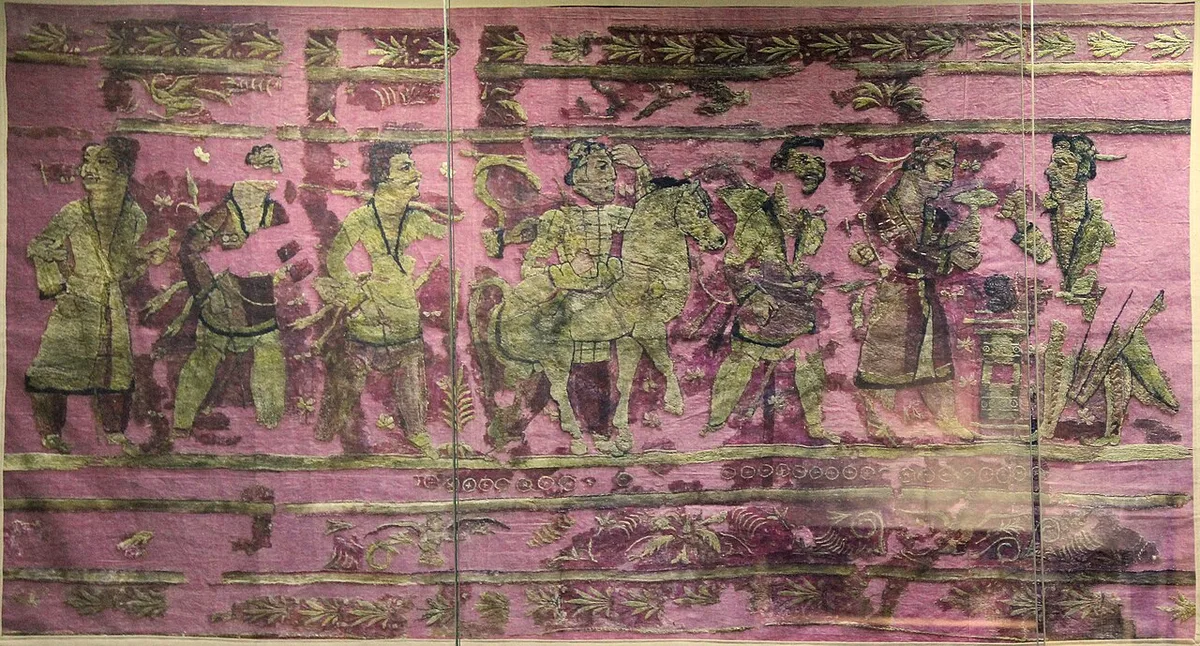
Noin Ula is a group of burial mounds in the mountains of the same name in northern Mongolia. The mountains lie about a hundred kilometres from Ulaanbaatar, in the basin of the Selenga.[1] The older literature writes Noin-Ula or Noyun-Ula, and recent work writes Noyon Uul. The graves are commonly assigned to the Xiongnu.[2]
Excavation
The Russian Geographical Society sent P. K. Kozlov to northern Mongolia, and his expedition opened the mounds.[3] Reports differ: one dates the work to 1924 and 1925, another to 1923 and 1924.[4] The mounds stand in three groups on the slopes and along the rivers. The expedition opened 212 of them, one by one.[3] It took five of them, numbers 1, 6, 12, 23 and 25, for the graves of Xiongnu princes.[3]
The graves
Water that ran into the graves froze quickly and stayed frozen for centuries. Textiles, woodwork and even bodies survived in them.[3] Above ground each grave was raised in the shape of a pyramid of stone and earth.[3] Below, a pit deepened in steps and led through a passage to the coffin chamber. The chamber lay nine metres down and was lined with cut planks and logs. The coffin was about three metres long.[5] Some coffin lids kept remains of silk, which shows that the coffins were covered with silk. Gold plaques and traces of glue on the fabric show that the silk was adorned with gold plaques and glued to the coffin. Traces of lacquer and paint inside the coffins suggest that the inside had been painted.[6]
The grave with the number 6 held furniture legs and Chinese and Iranian fabrics of the finest kind.[6] The grave with the number 25 yielded a piece of cloth with the portrait of a Xiongnu, and 85 gold plaques.[6] Another report names Chinese lacquer, small works of art, silver phalerae and textiles. One textile carries the portrait of a man, and a felt hanging has an animal combat worked in appliqué.[7]
Tamga-like signs are found on the undersides of lacquer cups from several mounds of the Sudzukte group, numbers 6, 20, 23 and 31, and from Tzurumte.[8]
Equipment
The princely graves held a bow stiffened with bone plates and three-edged arrows. A note names a Chinese lacquer bowl of the year 2 BC as the dating find for the grave with the bow.[2] The remains of a wooden saddle were found too, and they belong to the oldest datable saddles of their kind.[9] The handle of a cauldron of the Ordos type lay in one of the graves.[10] The skulls show no artificial deformation.[11] The articles on the composite bow and on harness and saddle set out the weapons.
Date
The accounts date the graves differently. One puts them at the beginning of the first century BC.[12] Another dates the princely graves to about the turn of the era, by Chinese lacquer cups.[13] A third puts the royal graves of the Xiongnu at Noin Ula in the first century AD.[14] One study draws the plan of Tomb 20 at Noyon Uul as the example of the square tomb, one of the two forms of late Xiongnu burial in Mongolia.[15]
Attribution of the graves
Some burials of the Xiongnu period in Mongolia, like the tombs opened at Noyon Uul in the 1920s, are monumental and belonged to an elite with access to vast local resources and to imported Chinese goods. That the culture of the large necropolises and elite burials of Mongolia, which appeared around the first century BC, belongs to the historical Xiongnu empire has yet to be demonstrated.[16]
The princes of Noin Ula may have been rulers of Mongol or Tungus tribes in the east of the empire. It adds that this does not show the Xiongnu to have been Tungusic, because the empire rested on a confederation of tribes. The chiefs of its Turkic and Mongol tribes formed the aristocracy.[17] A different position puts the Xiongnu at the head of a line of Turkic peoples that carried the culture of the steppe.[14] It describes the finds of Noin Ula as a mixture of Han Chinese, steppe and Pontic Greek work, and regards part of them as the witness of a northern nomad culture centred on the Selenga basin.[7] The finds themselves therefore speak for a mixed culture, and they do not settle the language of the princes. The question is taken up in the articles on the language of the Xiongnu and the Göktürks and the Xiongnu.
A silver plaque
A silver plaque used as a horse ornament shows a broad-antlered animal between two slender trees on a mound. It has been understood as an early form of the tale that Juvaini records in the thirteenth century for the origin of the Uyghurs, with two trees at the meeting of the Tola and the Selenga, a mound and five children.[18] The tale is written down some twelve centuries after the graves, and the link is an interpretation of the motif.
References
- ^ Rásonyi 1993, p. 41; 58; Ögel 1984, p. 41; 58
- ^ a b Werner 1956, p. 47
- ^ a b c d e Ögel 1984, p. 58
- ^ Ögel 1984, p. 58; 41; Rásonyi 1993, p. 58; 41
- ^ Ögel 1984, p. 58–59
- ^ a b c Ögel 1984, p. 59
- ^ a b Rásonyi 1993, p. 41–42
- ^ Bogdanov 2017, p. 17–18
- ^ Werner 1956, p. 51
- ^ Werner 1956, p. 59
- ^ Werner 1956, p. 10
- ^ Ögel 1984, p. 57
- ^ Werner 1956, p. 8, 59
- ^ a b Rásonyi 1993, p. 41
- ^ Miller 2014, p. 28
- ^ Cosmo 2011, p. 38
- ^ Ögel 1984, p. 48–49, 57, 70
- ^ Rásonyi 1993, p. 45
Literature
- Bahaeddin Ögel, İslâmiyetten Önce Türk Kültür Tarihi. Orta Asya Kaynak ve Buluntularına Göre (1984)
- László Rásonyi, Tarihte Türklük (1993)
- Joachim Werner, Beiträge zur Archäologie des Attila-Reiches (1956)
- Nicola Di Cosmo, Ethnogenesis, Coevolution and Political Morphology of the Earliest Steppe Empire: The Xiongnu Question Revisited (2011)
- Bryan K. Miller, Xiongnu “Kings” and the Political Order of the Steppe Empire (2014)
- Evgeniy S. Bogdanov, The Origin of the Tamgas of the Xiongnu (2017)
What links here12
- States
- Uyghur Khaganate · Xiongnu
- Places
- Gol Mod
- Peoples
- Huns
- Institutions and Titles
- Bronze Mirrors of the Steppe · Composite bow · Horse harness · Hunnic Cauldrons · Lacquerware · Wagons of the Steppe Peoples
- Controversies
- The Göktürks and the Xiongnu · The Huns and the Xiongnu
Cite this article
Yavuz, Emre-E. “Noin Ula.” Turkic Atlas, revised 8 November 2026. https://turkicatlas.org/places/noin-ula/
Last revised: 8 November 2026


