
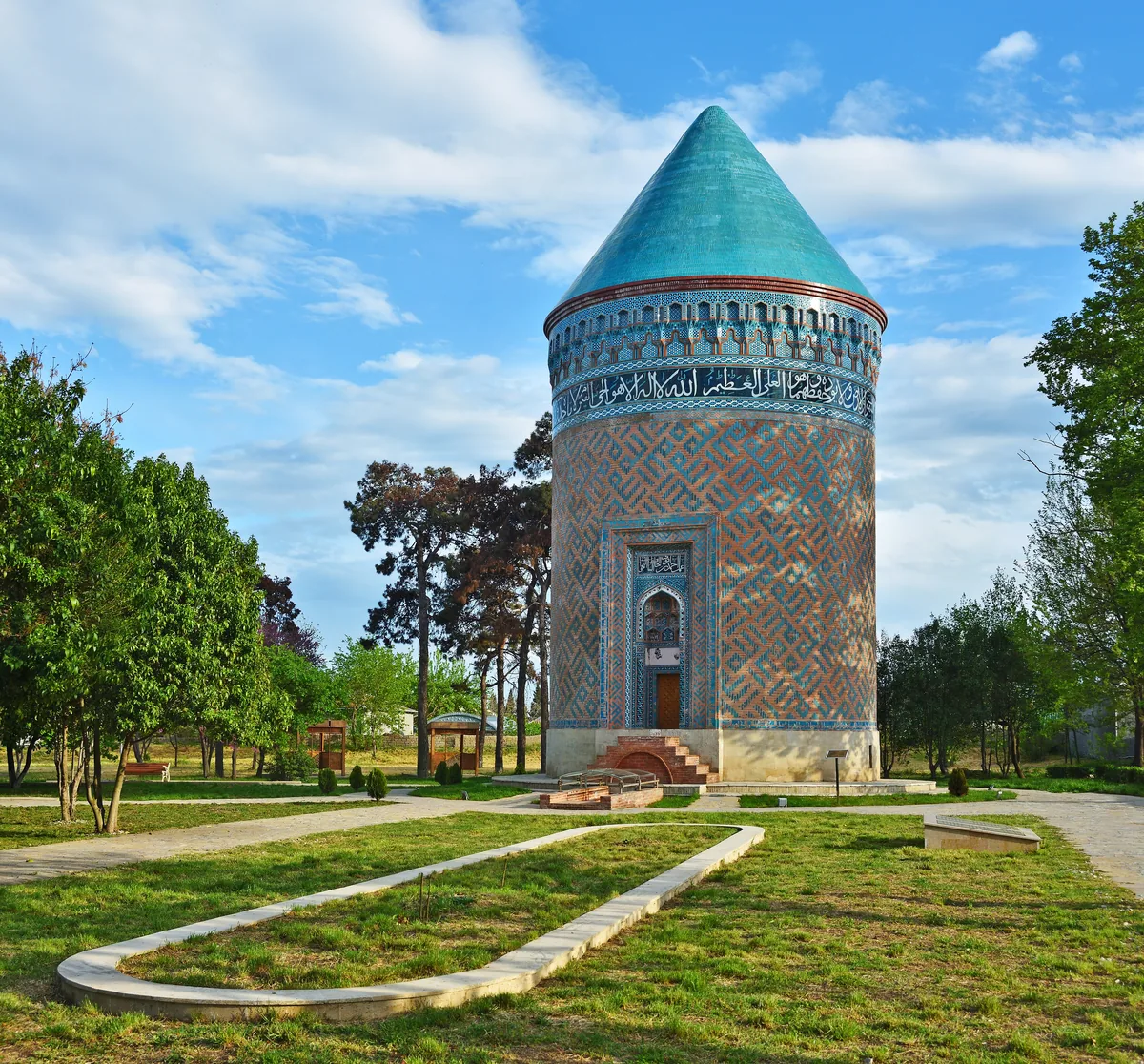
Partaw was the capital of Caucasian Albania, the country through which the Kur flows to the Caspian.[1] The History of the Caucasian Albanians says that it was built as the great town of Perozapat by order of the Persian king Peroz and was later called Partaw.[2] It is identified with the present town of Barda in Azerbaijan.[3]
The first invasion
The northern army of the Caucasus campaign came to Albania in the year that the History counts as the thirty-eighth of Khosrow II.[4] By that count the year is 628.[5] Another reckoning puts the invasion in 627.[6] The History calls the army Khazars and its ruler Jebu Xak’an.[4] The name joins two Turkic titles, yabgu and khagan.[5] He has been identified with Tong Yabgu. Another view doubts it.[5]
Khosrow had sent Gaysak as governor of Albania. Gaysak decided to hold the country in Partaw, its great capital and fortress.[4] He shut up most of the people of the surrounding cantons in the city. He allied himself with the nobles and the townsmen.[4] The walls the Persian kings had built between the Caucasus and the Caspian fell at the very outset.[4]
The commander of Partaw learned of the slaughter that had gone before.[7] When the enemy was within three miles, the commander tried to address the garrison and could not speak for fear.[7] The crowd left its goods behind and fled through the four gates of the city to the mountains of Arcax.[7] The pursuers overtook one group at the foot of the mountain opposite the village of Kalankatuk’ in Uti. They killed some and took others back to their camp.[7] Gaysak escaped to Persian territory with his family.[8] The army moved on into Georgia. It laid siege to Tiflis.[8]
The episode has been summarised as the sack of Partaw.[9] A second account has the Göktürks occupy Partaw among the many settlements of the region.[3]
Šat’s camp
The ruler came down a second time with his son Šat. They besieged Tiflis.[10] The second invasion probably came in the spring of 629.[11] He took the city and carried the treasure home. He left the army to Šat, with orders to march on Albania.[12] Šat’s envoys called on the Persian governor and on the catholicos Viroy to submit. The Persian fled to Persia. The catholicos played for time.[13] Then the army fell on the whole of Albania on one day and at one hour.[14]
The catholicos gathered the nobles at the fortress of Caraberd and led them with gifts to Šat.[15] They found him encamped in the province of Uti, close to the north of the great city of Partaw, among the swamps.[16] The men of the camp drank from silver cups and beakers chased in gold, taken in the plunder of Tiflis.[16] Šat swore by the life of his father Jebu Xak’an to stop the raiding.[17] He said that his father had received the three kingdoms of the Albanians, the Lpʿinkʿ and Čoł as his royal patrimony for ever.[17]
Šat sent the catholicos back to live in the city.[18] At the catholicos’s request he ordered all prisoners released. He sent officers called tʿnduns through the camps to see it done.[18] The word is the Göktürk title tudun.[19]
References
- ^ Movsēs Dasxurancʿi; Dowsett 1961, p. 4
- ^ Movsēs Dasxurancʿi; Dowsett 1961, p. 25
- ^ a b Yavuz 2025, p. 368
- ^ a b c d e Movsēs Dasxurancʿi; Dowsett 1961, p. 83
- ^ a b c Dowsett 1961, p. 83
- ^ Howard-Johnston 1999, p. 188
- ^ a b c d Movsēs Dasxurancʿi; Dowsett 1961, p. 84
- ^ a b Movsēs Dasxurancʿi; Dowsett 1961, p. 85
- ^ Dowsett 1961, xv
- ^ Movsēs Dasxurancʿi; Dowsett 1961, p. 94
- ^ Dowsett 1961, p. 94
- ^ Movsēs Dasxurancʿi; Dowsett 1961, p. 95
- ^ Movsēs Dasxurancʿi; Dowsett 1961, p. 95–96
- ^ Movsēs Dasxurancʿi; Dowsett 1961, p. 96–97
- ^ Movsēs Dasxurancʿi; Dowsett 1961, p. 98–99
- ^ a b Movsēs Dasxurancʿi; Dowsett 1961, p. 99
- ^ a b Movsēs Dasxurancʿi; Dowsett 1961, p. 100
- ^ a b Movsēs Dasxurancʿi; Dowsett 1961, p. 101
- ^ Dowsett 1961, p. 101
Sources
Literature
- Charles J. F. Dowsett (trans.), The History of the Caucasian Albanians by Movsēs Dasxuranci (1961)
- R. W. Thomson (trans.), James Howard-Johnston (commentary), The Armenian History attributed to Sebeos (1999)
- Emre-E. Yavuz, The Gokturk Empire: 2nd Edition (2025)
What links here6
- Conflicts
- The Caucasus campaign, 627–629
- Battles & Events
- Siege of Tiflis (627–629)
- Places
- Derbent
- Institutions and Titles
- Göktürk Dress and Hair · Göktürk Weapons
- Customs & Pastimes
- The Göktürk Feast
Cite this article
Yavuz, Emre-E. “Partaw.” Turkic Atlas, revised 8 November 2026. https://turkicatlas.org/places/partaw/
Last revised: 8 November 2026


