
- 400
- 500
- 600
- 700
- 800
- 900
- Rouran 400–554
- First Göktürk 552–630
- Tang rule 630–682
- Second Göktürk 682–744
- Uyghur 744–840
- Kirghiz 840–924
- Huns 370–469
- Western Göktürk 552–659
- Türgesh 699–766
- Karluk 766–800
- Khazar 650–969
Sasanian Persia was the empire of Iran and Mesopotamia from 224 to 651. The house of Sasan ruled it from Ctesiphon. Apart from China, it was the only sedentary power with which the Göktürks shared a land frontier. Its relation to the Göktürks ran through four stages within a century. The first was a partnership against the Hephthalites. The second brought a closed frontier, a poisoned embassy and Istemi’s campaign against Persia. The third consisted of two great wars across the Oxus. The fourth was the pincer of 627, which helped to bring Persia down. Tabari and Menander are the witnesses to these stages. The Chinese chapters know Persia as the western neighbour that the khans brought low. The Kül Tegin inscription names its people among the mourners of 732.[1]
Persia in the Chinese records
The Zhou Shu gives Persia a chapter of its own. The capital lies at Suli, the old Tiaozhi.[2] The king wore a crown of golden flowers. He sat on a couch with a golden sheep.[2] On taking the throne, the king wrote the name of the most able of his sons on a sealed paper and put it in the treasury. At his death the council opened it. The sons who were not named went out to posts on the frontier.[2] The court appears in Chinese transcription. The king bears the title 翳囋, the queen 防步率 and the king’s sons 殺野. The official 摸胡壇 has charge of lawsuits, 泥忽汗 of the treasury and the passes, 地卑勃 of documents and general business, and 薩波勃 of the armies of the four quarters.[2] Modern accounts take these titles to be renderings of Middle Persian words. The last, the title of the commander of the army, corresponds to the spahbed.[3]
The text also lists the country’s goods: horses and camels, white elephants, large birds’ eggs, pearls, gold and silver, brocade and woollen cloth.[2] It says that the grains and animals are those of China. It adds that there is no rice and no millet.[2][4] It records an embassy in the second year of the Wei emperor Fei, 553.[2]
Before the Göktürks
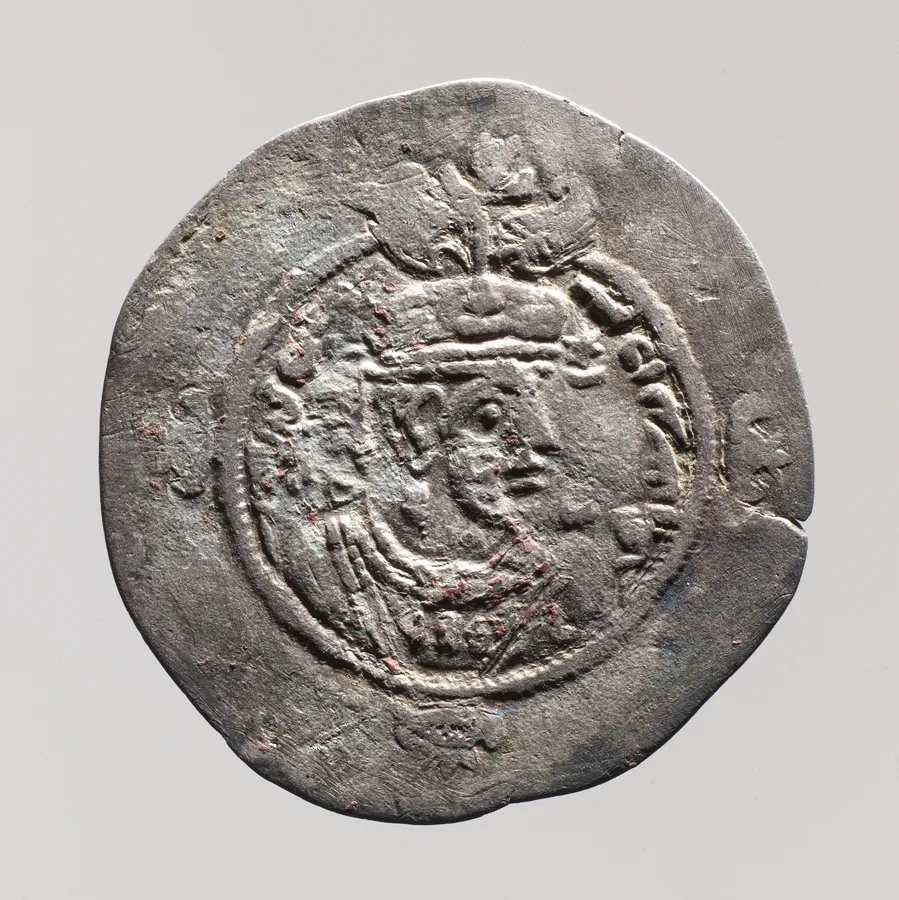
The epic treats the Oxus as the legitimate boundary between Iran and Turan. The Sasanians probably first reached this frontier under Khosrow I.[5] Until then, Balkh had been the seat of a barbarian kingdom. Transoxiana was never Sasanian.[5] These barbarians were the Hephthalites. The Sasanian debt to them was old. The Hephthalites had beaten the Sasanian kings on several occasions. They had killed Peroz in battle in 484. They had also returned his successor Kawad to the throne of Iran more than once as their protégé.[6][7] For decades, at least until the beginning of Khosrow’s reign, they drew a colossal tribute from Persia. On one occasion it was as many silver coins as thirty mules could carry.[6] A great part of the Sasanian monetary supply thus left for Central Asia and eastern Iran. The coins are still found there by the thousand.[6] Tabari gives the Persian memory of Peroz in three episodes. Peroz broke a treaty and tore down a frontier tower. A mutilated man led his army into the desert. The king fell with the greater part of his army, and his body was never found.[8] The Sasanian drachm remained the currency of the Sogdians’ large-scale commerce in the sixth and seventh centuries. A slave was priced in it at Turfan in 639. It was also placed in the mouths of the dead.[6]
Partner: the Hephthalite war
Khosrow may have crushed the Hephthalites in 557, in alliance with the western Göktürk khagan Sinjibu, that is Istemi. If so, Khosrow slew their ruler and divided the territory with the Göktürks.[9] In one of Tabari’s versions, the khagan alone made the kill. He is “the boldest and mightiest of all the Türk”. He killed the king of the Hayāṭila with the greater part of his army. He conquered their land, except the parts that had fallen into Khosrow’s hand.[10] In the other version, Khosrow first allied himself with the khagan by marriage. He then killed the Hephthalite king himself.[11] Dinawari has Khosrow take Tokharistan, Zabulistan, Kabulistan and Chaghaniyan. At the same time Sinjibu took the Sogdian cities as far as Bukhara.[12] Dinawari adds that Khosrow then took Transoxiana. This claim is rejected by some, because Menander shows the Sogdians as Göktürk subjects.[12] The division was made along the Oxus in 560, at a meeting of the two kings at Gurgan.[13] The Hephthalite ruler Faganish was handed over. A daughter of Istemi was married to Khosrow. She became the mother of Hormizd IV.[13] The agreement is also dated to 566 or 571. The marriage is dated to 554, or to the time after the victory.[13] The decisive fight of the war was the battle of Bukhara. It is dated in three ways. In fact, the frontier immediately after the battle was unsettled. A small district south-east of Bukhara fell to neither side. It later became a cause of war. The two kings’ mutual suspicion was justified on both sides.[14]
Enemy: the closed frontier
Tabari’s next chapter is the quarrel. Khosrow fortified the region of the gate of Sul, together with the roads and passes by which the khagan would have to come.[15] Sinjibu won over the Abkhaz, the Bangar and the Balangar. He came with a hundred and ten thousand men and demanded money and the tribute of those peoples.[15] The king refused everything. The khagan went home.[15] He has been identified with Menander’s Silzibulos. It dates his campaign against Persia to 569 or 570, when Zemarchos was with him.[16] Menander tells the quarrel over the silk. The Persians bought the Sogdian silk that Maniakh brought and burned it at Ctesiphon, on the advice of the Hephthalite Katulph. They poisoned the Göktürk embassy, all but three or four men.[17] The Persians then put it about that the envoys had died of the heat. At Talas the Persian envoy was seated below the Roman.[17] Modern accounts read Persian policy as protection rather than blockade. Trade was fixed at frontier towns by permit. Persia had a merchant class of its own to shield. Its refusal was political and aimed at the Göktürks.[6] Their raw silk was the very symbol of the wealth and power of the new enemy. It was the product of the tribute China paid them.[6] The Göktürk alliance with Byzantium had a Persian side. The Romans incited the Göktürks without cease. This was one of the causes of the twenty years’ war between Persia and Rome.[5]
The wars of 588 and 606
Under Hormizd IV came the first great Göktürk–Persian war. The Göktürks crossed the Oxus. Tabari reports that Šāba, the over-king of the Göktürks, advanced as far as Badhghis and Herat in the king’s eleventh year. He led three hundred thousand men.[8] At the same time the Romans, the Khazars at Derbend and two Arab chiefs pressed the other frontiers. Persia was therefore “a sieve with many holes”.[8] Hormizd sent Bahram Chobin with twelve thousand chosen men.[8] Bahram marched beyond Herat and Badhghis. He killed Šāba with an arrow. He beat and captured Šāba’s son Parmudha. He sent the treasure of the Göktürk camp to the king on two hundred and fifty thousand camels.[8] Then Bahram, fearing the king, turned his army against the throne.[8] Some scholars have the Göktürk army under Tardush’s son Šāba beaten at Herat in 589.[18] Others have Bagha beaten at the Hyrcanian rock in April 588. If so, Herat was retaken in 589, together with the khan’s golden throne.[18] Bahram later fled to the Göktürks and died by Khosrow II’s poison.[19] The second great war fell in 606 and 607.[14] A Göktürk army pushed deep into Persian territory, as far as Ray and Isfahan. Shegui withdrew it for reasons unknown.[14] A Sasanian general of Armenian birth then beat the Göktürks’ Hephthalite vassals near Balkh.[14] Eight years later Bactria came back to the Göktürks under Tong Yabgu. In 625 he campaigned to the Indus and set up the yabgu state of Tokharistan.[14] The Xin Tang Shu states the outcome briefly. Tong Yabgu “brought Persia and Jibin low” and had several hundred thousand archers.[20] Xuanzang’s account makes it possible to mark the border of 630. Talakan in Gharjistan was still Göktürk, and the Persian empire began only at Merv.[21]
The pincer of 627
The last stage lay in the Caucasus. Twenty years into the war that Persia had begun in 602, Heraclius sought out Tong Yabgu for a pincer from the north and the west.[14] In 627 Börü Shad took Derbent with an army that the Armenian source calls Khazar.[14] The allies besieged Tiflis. Its Persian marzban refused to change sides. The emperor and the yabgu met before its walls.[14] Heraclius went on to beat the Persians at Nineveh. The Göktürks came back and stormed Tiflis.[14] The alliance contributed significantly to the Byzantine victory and to the collapse of the Sasanian state.[22] Tong Yabgu has been called the first Turkic conqueror of the Persians.[23] Tiflis had passed from a Georgian kingship to a Persian province under marzbans before the allies came.[14] One hypothesis holds that a defeated Nushibi khan, Irbis Shegui, founded the Khazar ruling house in 651, the year in which the Sasanian empire ended. It remains a hypothesis with many problems.[22]
The end
The Arabs destroyed the empire within a generation of Nineveh. Its remains turn up in Sogdian hands.[6] Sasanian silver was bought back from the Arab spoils. Qutayba bought a granddaughter of Yazdgird III, the last king, in Sogdiana and sent her to Iraq. There she became the mother of a caliph.[6] In the seventh century a merchant or refugee could carry Sasanian coins from Central Asia to China. These coins are the last trace of the empire on the Göktürk road. The hoard of Ulugh Art is one of them. It contains 567 drachms of Khosrow II and 281 Arab-Sasanian imitations. A century after the end, the Kül Tegin inscription still names, among the mourners who came from the west in 732, “the Sogdians, the Persians, the city-folk of Bukhara”. It says that the general Enik and Ogul Tarkan led them.[24]
Assessment
Persia was the Göktürks’ partner for a decade. It was their enemy for seventy years. In the end the Göktürks helped the Romans to break it. The relationship followed a pattern typical of the steppe. An alliance was made for a war and dissolved by its spoils. The frontier was never a wall. The empire could not do without the trade and would not let its rival profit from it. The Sasanians left the Göktürks their coin and their model of a fortified gate. The Göktürks left the Sasanians the Khazar state on the northern side of that gate.
Rulers
- Khosrow I531–579King
- Hormizd IV579–590King
Relations with other states
Red is war, blue alliance, gold trade. Where several held at once, the line shows what prevailed; alliance and trade can run side by side. Each line rests on an article. Point at a state to see its weightiest relation, select it to see its events. The slider shows what stood in a given year, and Play runs through the years.
Byzantium395 to 629
- War395Hunnic invasion of 395
- War553 to 629Göktürk Expansion along the Silk Road
- War627 to 629The Caucasus campaign, 627–629
- War627 to 629Siege of Tiflis (627–629)
Western Göktürk Khaganate553 to 630
- War553 to 629Göktürk Expansion along the Silk Road
- War588 to 589Göktürk–Persian war, 588–589
- War606 to 607Smbat Bagratuni's war with the khan
- War627 to 629The Caucasus campaign, 627–629
- War627 to 629Siege of Tiflis (627–629)
- War629 to 630Battle of Lake Sevan (629–630)
First Göktürk Khaganate555 to 571
- Alliance555 to 563The Göktürk–Hephthalite war, 555–563
- War568 to 571The Göktürk–Sasanian Trade Conflictthe quarrel over the silk
- War569Istemi's campaign against Persia, 569
References
- ^ Kül Tegin inscription; Nöldeke 1879
- ^ a b c d e f g Zhou Shu (Book of Zhou), juan 50
- ^ Laufer 1919, p. 529–533
- ^ Laufer 1919, p. 372
- ^ a b c Nöldeke 1879
- ^ a b c d e f g h de la Vaissière 2005a
- ^ Herrmann 1925, p. 565
- ^ a b c d e f Tabari
- ^ Golden 1992, p. 83
- ^ Tabari; Nöldeke 1879, p. 158–159
- ^ Tabari; Nöldeke 1879, p. 167
- ^ a b Nöldeke 1879, p. 159
- ^ a b c Kurbanov 2010; Yavuz 2025
- ^ a b c d e f g h i j Yavuz 2025
- ^ a b c Tabari; Nöldeke 1879
- ^ Nöldeke 1879, p. 158
- ^ a b Menander Protector
- ^ a b Golden 1992; Yavuz 2025
- ^ Yavuz 2025, p. 325
- ^ Xin Tangshu (New Book of Tang), juan 215
- ^ Chavannes 1903
- ^ a b Golden 1992
- ^ Yavuz 2025, p. 371
- ^ Kül Tegin inscription
Sources
- Menander Protector
- Tabari
- Xin Tangshu (New Book of Tang), juan 215 (after Jiu Tangshu)
- Kül Tegin inscription
- Theophylact Simocatta
- Shahnameh
- Zhou Shu (Book of Zhou), juan 50
Literature
- Emre-E. Yavuz, The Gokturk Empire: 2nd Edition (2025)
- Peter B. Golden, An Introduction to the History of the Turkic Peoples (1992)
- Étienne de la Vaissière, Sogdian Traders: A History (2005)
- Aydogdy Kurbanov, The Hephthalites: Archaeological and Historical Analysis (2010)
- Theodor Nöldeke, Geschichte der Perser und Araber zur Zeit der Sasaniden. Aus der arabischen Chronik des Tabari übersetzt und mit ausführlichen Erläuterungen und Ergänzungen versehn (1879)
- Édouard Chavannes, Documents sur les Tou-Kiue (Turcs) occidentaux (1903)
- Berthold Laufer, Sino-Iranica. Chinese Contributions to the History of Civilization in Ancient Iran (1919)
- Albert Herrmann, Die Hephthaliten und ihre Beziehungen zu China (1925)
What links here37
- Persons
- Bahram Chobin · Basich · Chorpan Tarkhan · Heraclius · Hormizd IV · Justin II · Kayen · Kursich · Natra · Parmudha
- States
- Kushan Empire · The Umayyad Caliphate · Western Wei
- Conflicts
- Göktürk Expansion along the Silk Road · Göktürk Expansion into Europe · Göktürk–Persian war, 588–589 · Hunnic invasion of 395 · The Caucasus campaign, 627–629 · The Göktürk–Sasanian Trade Conflict
- Battles & Events
- Battle of Bukhara · Istemi's campaign against Persia, 569 · The Göktürk–Byzantine alliance
- Places
- Bactria · Badghis · Gate of Sul · Gurgan · Khorasan · Lake Sevan · Merv · Oxus · Partaw · Transoxiana
- Peoples
- Alchon Huns · Nezak Shahs · Sabirs
- Institutions and Titles
- Chepetukh
- Religions
- Islam
Cite this article
Yavuz, Emre-E. “Sasanian Persia.” Turkic Atlas, revised 8 November 2026. https://turkicatlas.org/polities/sasanian-empire/
Last revised: 8 November 2026

