
- 400
- 500
- 600
- 700
- 800
- 900
- Rouran 400–554
- First Göktürk 552–630
- Tang rule 630–682
- Second Göktürk 682–744
- Uyghur 744–840
- Kirghiz 840–924
- Huns 370–469
- Western Göktürk 552–659
- Türgesh 699–766
- Karluk 766–800
- Khazar 650–969
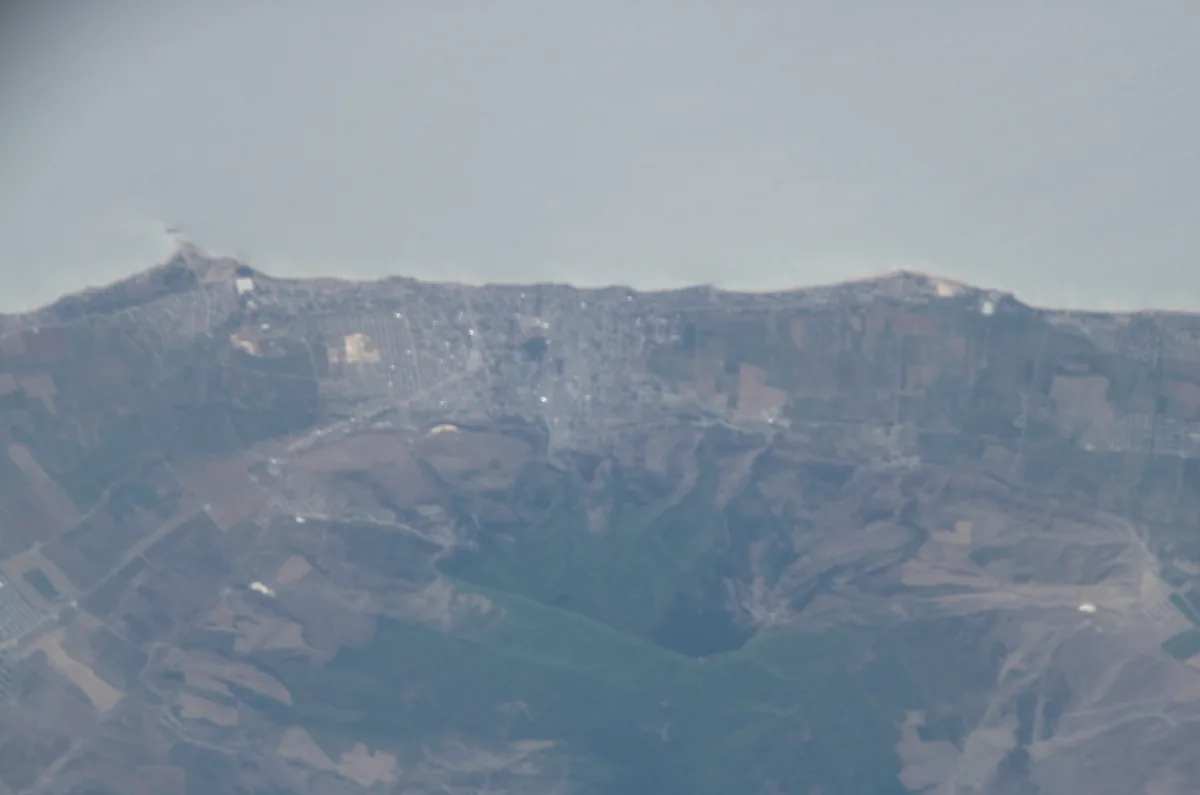
Derbent stands where the last spur of the Caucasus reaches the Caspian. Between mountain and sea it leaves a strip of shore a few kilometres wide. The Persian name means the closed gate, and the Arabic name means the gate of gates. It was one of the strategically most important fortresses of the seventh-century world. Derbent lay squeezed between the Caspian and the foothills, and its rulers controlled the narrow coastal strip. This strip was the only practicable route between the Eurasian steppes in the north and the rich lands of Persia and Mesopotamia in the south.[1] With its fortress of Naryn-Kala it was the key of the Caucasus, the hardest fortress of its age to take, and a military and a commercial node at once.[1]
The Persian gate
Tabari reports the Sasanian works.[2] King Peroz had raised a building of stone in the region of Sul and the Alans to protect his land from the attacks of those peoples. His son Kawad added many more. When Khosrow I became king, he built in the region of Sul cities and castles, walls and many other works. They were to serve the inhabitants for protection and give them refuge from sudden attack.[3] The same chapter tells of the khagan Sinjibu, that is Istemi. He won over the Abkhaz, the Bangar and the Balangar. Then he came with a hundred and ten thousand warriors near the land of Sul and demanded money. Khosrow paid no heed. He had fortified the region of the gate of Sul and secured the roads and passes through which the khagan would have to march. Sinjibu heard how strong the fortifications at Sul were, and went home with nothing achieved.[3] Tabari may have confused the fortifications of Gurgan, on the eastern side of the Caspian, with those of the Caucasus. Balangar lay not far north of Derbend, and the Alans held the Caucasus through the whole middle ages. Nobody quarries stone in Gurgan to build at the Caucasus. The khagan’s arm reached far, but he did not command the Caucasus, and his objective was Khurasan.[2] Al-Thaʿalibi drew on Tabari among other chronicles, and he keeps the works apart.[4] He has Khosrow build stone fortresses in Gurgan, the gate of Sul, five parasangs long and of marble. He also has him build the wall at Bab al-Abwab as a barrier between Iran and the Khazars.[5] He adds that Khosrow built more than a hundred citadels between his empire and the Caucasus. They were to protect the people of Iran against “the Turks, the Khazars and the Rus”.[5]
The Armenian Geography places the Huns of the North Caucasus and their neighbours north of the gate: “North of Darband is the kingdom of the Huns, near the sea; in its western part is Varachan, the city of the Huns, and Chungars and Samandar”. Samandar was the later Khazar city.[6] Tabari names the gate itself once in the years that concern the Göktürks. In 588 Šāba, the king of the Türk, advanced to Herat, and Persia was surrounded on every side. At that time “the king of the Khazars marched with a great army to Derbend and worked mischief and havoc”.[3] The other Persian sources have it that in Hormizd’s council the Khazars were to be beaten, the Romans bought off and the Arabs despised. Here the tradition has already turned into romance.[2]
The Göktürks before Derbent (627)
The Göktürks came to the gate as allies of Byzantium. The emperor Heraclius, twenty years into his war with Persia, sought the support of Tong Yabgu for a pincer movement. The Romans were to advance from the west through Armenia, the Göktürks from the north through the Caucasus.[1] Tong Yabgu sent a thousand-strong armed embassy through Persian territory to the emperor. He ordered his nephew Börü Shad, who held a command of his own, to begin.[1] In 627 Börü appeared before the fortress city of Derbent in Dagestan, then part of the Sasanian empire, with an army that the sources call Khazar.[1] His arrival opened a coordinated offensive. Taking the fortress would open the way for a pincer on the Persian heartland. From Derbent the Göktürks could enter Caucasian Albania and, as they pleased, go on into Persia. The Armenian historian Movses Kagankatvatsi tells the storming. He lived under the later Khazar state, and therefore calls the Göktürks Khazars. This is an anachronism with a true core.[1] In his words, the walls that the Persian kings had built between the Caucasus and the Caspian were struck down and destroyed to their foundations at the very outset.[7] The army then put the defenders of Partaw, the capital of Albania, to flight.[8] Theophanes calls the invaders “the eastern Turks, who are called Chazars”. He has them break through the Caspian Gates under their commander Ziebel and invade Persia.[9] Sebeos has an army pass “through the Pass of Chor with many troops” to assist the king of the Greeks.[10] The Pass of Chor is the pass at Derbent.[11]
With the conquest of Derbent and the Caucasus, Tong Yabgu, Börü Shad and their armies laid the foundation of the later Khazar empire.[1] The Armenian Jebu Xak’an, the Georgian Jibgu and the Greek Ziebel have been identified as one title, Yabgu Khagan. The Khazar ruler who allied with Heraclius bore it.[12] On this identification, Tong Yabgu fought Persia in Transcaucasia as Heraclius’s ally. Its supporters also hold that the Khazars had remained part of the Göktürk polity.[13] From the gate the northern army went on to besiege Tiflis, where Heraclius joined it.[14] Tong Yabgu’s later tax plans show an intention to hold the Caucasus from Tiflis to Derbent.[1] The Armenian history records the tribute. In the second year of the Persian king Artashir the prince of the north sent officials to the craftsmen in gold, silver, iron and copper. He took tribute from the merchants and the fishers of the Kur and the Araxes according to the Persian cadastre.[15] That year ran from June 629 to April 630.[16]
The gate of the Khazars
After the Göktürks the gate belonged to the Khazars. Its history became the history of the wars between the Arabs and the Khazars. It bore the names Bab al-Abwab and Darband, the Darband of the Khazars.[6] Sebeos records an Arab defeat at the gate. An Arab army crossed the Pass of Chor and ravaged the country at the foot of the mountain. The guards of the place called the Gate of the Huns defeated it. An army from the land of the Tʿetalkʿ put the Arabs to the sword.[17] The defeat belongs to the late spring or early summer of 655. The likeliest candidates for the Tʿetalkʿ are the Khazars.[18] The Muslims were victorious over the Türgesh in 737 and the Chinese in 751. They were reaching the outer limits of their imperial drive, and they failed to move the area under their sway beyond the gate.[6] Marwan’s campaign of 737 forced the khagan to a conversion that lasted little longer than the Arab soldiers’ stay on Khazar land.[6] Khazar raiding had been destructive but had occupied no territory.[6] The sources are mute on relations between the Ten Arrows and the Khazars.[6] It is therefore an open question whether the western Göktürk pressure on Arab possessions in Central Asia in the 720s and 730s, under the Türgesh, can be connected with the Khazar invasions of the lands south of Bab al-Abwab in the same years.[6]
Assessment
Derbent is where the steppe meets Persia by land. Every power on either side treated it accordingly. Peroz and Khosrow walled it. Sinjibu turned back from it. Börü Shad took it, the Khazars held it, the Arabs stopped at it. For the Göktürks it was the one fortress in their history that they besieged as allies of an emperor. It was also the gate through which the western Göktürk state passed into the Khazar one.
References
- ^ a b c d e f g h Yavuz 2025
- ^ a b c Nöldeke 1879
- ^ a b c Tabari
- ^ Zotenberg 1900, xix–xx
- ^ a b aṯ-Ṯaʿālibī; Zotenberg 1900, p. 611
- ^ a b c d e f g Golden 1992
- ^ Movsēs Dasxurancʿi; Dowsett 1961, p. 83
- ^ Movsēs Dasxurancʿi; Dowsett 1961, p. 84
- ^ Theophanes the Confessor; Scott 1997, p. 446–447
- ^ Sebeos, ch. 29
- ^ Howard-Johnston 1999, p. 148
- ^ Golden 1992, p. 236
- ^ Golden 1992, p. 135
- ^ Movsēs Dasxurancʿi; Dowsett 1961, p. 85
- ^ Movsēs Dasxurancʿi; Dowsett 1961, p. 104
- ^ Dowsett 1961, p. 104
- ^ Sebeos, ch. 51
- ^ Howard-Johnston 1999, p. 278
Sources
- Tabari
- aṯ-Ṯaʿālibī
- Movsēs Dasxurancʿi
- Theophanes the Confessor (after Theophylact Simocatta)
- Sebeos, chs. 29, 51
Literature
- Emre-E. Yavuz, The Gokturk Empire: 2nd Edition (2025)
- Peter B. Golden, An Introduction to the History of the Turkic Peoples (1992)
- Theodor Nöldeke, Geschichte der Perser und Araber zur Zeit der Sasaniden. Aus der arabischen Chronik des Tabari übersetzt und mit ausführlichen Erläuterungen und Ergänzungen versehn (1879)
- Hermann Zotenberg (ed., trans.), Histoire des rois des Perses par Abou Mansour ʿAbd al-Malik ibn Mohammad ibn Ismaʿil al-Thaʿalibi (1900)
- Charles J. F. Dowsett (trans.), The History of the Caucasian Albanians by Movsēs Dasxuranci (1961)
- Cyril Mango, Roger Scott (trans.), The Chronicle of Theophanes Confessor: Byzantine and Near Eastern History AD 284–813 (1997)
- R. W. Thomson (trans.), James Howard-Johnston (commentary), The Armenian History attributed to Sebeos (1999)
What links here29
- Persons
- Börü Shad · Heraclius · Khosrow I · Marwan ibn Muhammad · Šāba · Tong Yabgu
- Conflicts
- Arab–Khazar Wars (642–737) · Göktürk Expansion along the Silk Road · Göktürk–Persian war, 588–589 · Hunnic invasion of 395
- Battles & Events
- Campaign of Marwan (737)
- Places
- Balanjar · Gate of Sul · Iron Gate · Partaw · Samandar
- Peoples
- Sabirs
- Religions
- Riding Round the Dead · Tengri
- Customs & Pastimes
- Funeral Games of the Caucasian Huns
- Sources
- aṯ-Ṯaʿālibī · Movsēs Dasxurancʿi · Sebeos
Cite this article
Yavuz, Emre-E. “Derbent.” Turkic Atlas, revised 8 November 2026. https://turkicatlas.org/places/derbent/
Last revised: 8 November 2026

