
- 400
- 500
- 600
- 700
- 800
- 900
- Rouran 400–554
- First Göktürk 552–630
- Tang rule 630–682
- Second Göktürk 682–744
- Uyghur 744–840
- Kirghiz 840–924
- Huns 370–469
- Western Göktürk 552–659
- Türgesh 699–766
- Karluk 766–800
- Khazar 650–969
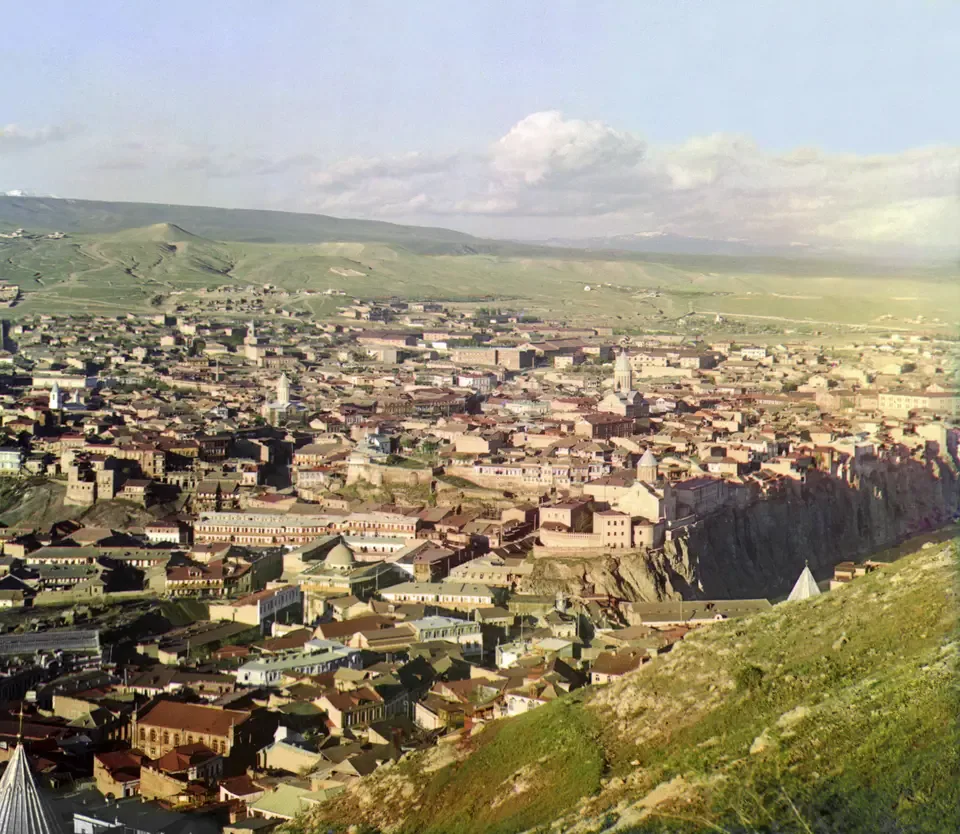
Tiflis, the capital of Kartli between the Black Sea and the Caspian, had long balanced between Byzantium and Persia.[1] In the time of its prince Stephanos, the Georgian chronicle says, the old capital Mtskheta declined while Tiflis grew powerful.[2] Stephanos ruled all Kartli from Tiflis, but he obeyed the Persians.[2] When the Roman and Göktürk allies stood before the city, the Persians administered it. Its Persian leadership refused to change sides.[1] The Georgian chronicle names the man who held it. Stephanos would not rise against the Persians. He fortified his towns and citadels and shut himself up in Tiflis.[3] Theophanes has the Persians look on from the town while the northern commander met the emperor outside it.[4]
The siege of 627
Heraclius and Börü Shad combined siege engines and cavalry. Börü Shad’s forty thousand made the allies far superior in number. The siege still dragged on.[1] Theophanes gives the forty thousand a different place. They were the picked men whom the northern commander Ziebel handed over to the emperor after the meeting, for the march into Persia.[4] It was in the Göktürk camp before the fortress of Narikala that Tong Yabgu and the emperor met.[1] In Theophanes, Ziebel rushed to meet the emperor, kissed his neck and did obeisance. The Persians watched from the town.[4]
In the first siege, as Movses Dasxuranci describes it, the allies relied on engineering rather than escalade. Roman engineers built four-wheeled ballistae for the besiegers. These hurled boulders to breach the wall. The besiegers laid great hides stuffed with stones and sand in the Kur so that the river, which skirts one side of the town, would rise against the wall.[5] The townsfolk repaired what was broken and were not dismayed. A Persian relief force came up under Sahraplakan with a thousand horsemen of the palace guard. The townsfolk then began to mock the two kings from the wall.[5] When they saw the besiegers exhausted, they set on the wall a pumpkin on which they had drawn a face with wide nostrils and a thin moustache. They called down that this was Jebu Xak’an, and they drove a spear into it.[6]
After two months the emperor marched on to Nineveh. The yabgu withdrew to Suyab and left his nephew before the city.[7] In the Armenian account the siege of that year was raised on Heraclius’s advice. His ally should go home for the summer and return the next year.[6] Theophanes has Ziebel go back to his own land after the meeting.[4]
The fall of the city
News of Nineveh encouraged Tong Yabgu. He returned, entered Tiflis with Börü Shad’s army and had it plundered.[7] The Armenian account tells the fall as a second siege by the northern army alone. The ruler came back with his son Šat and besieged the city for two months. Then his men climbed on one another, topped the walls and killed all whom they found.[8] The Persian governor and a native Georgian prince were blinded, strangled and flayed. Their skins were hung from the wall.[9] The second siege probably came in the spring of 629.[10]
The Georgian chronicle knows of no raising of the siege.[11] In its version Stephanos fell in one of his daily sorties, and Heraclius took the city.[12] The commander of the citadel called down from the rampart that the emperor had the beard of a goat. Heraclius read the insult as the goat of the west in the book of Daniel.[13] He gave Tiflis to Adarnase, the eristavi of Kakheti, and left an officer named Jibghu to take the citadel. Jibghu took it within a few days, flayed its commander and sent the skin to the emperor.[14] Jibghu may be the Jebu Xak’an of the Armenian account.[15]
As Heraclius’s ally, Tong Yabgu warred with Iran in Transcaucasia. He contributed significantly to the Byzantine victory and the collapse of the Sasanian state.[16]
References
- ^ a b c d Yavuz 2025, p. 368
- ^ a b Kartlis Tskhovreba; Brosset 1849, p. 224
- ^ Kartlis Tskhovreba; Brosset 1849, p. 225
- ^ a b c d Theophanes the Confessor; Scott 1997, p. 447
- ^ a b Movsēs Dasxurancʿi; Dowsett 1961, p. 85
- ^ a b Movsēs Dasxurancʿi; Dowsett 1961, p. 86
- ^ a b Yavuz 2025, p. 370
- ^ Movsēs Dasxurancʿi; Dowsett 1961, p. 94–95
- ^ Movsēs Dasxurancʿi; Dowsett 1961, p. 95
- ^ Dowsett 1961, p. 94
- ^ Dowsett 1961, p. 86
- ^ Kartlis Tskhovreba; Brosset 1849, p. 225–226
- ^ Kartlis Tskhovreba; Brosset 1849, p. 226
- ^ Kartlis Tskhovreba; Brosset 1849, p. 226–228
- ^ Chavannes 1903, p. 255
- ^ Golden 1992, p. 135
Sources
- Movsēs Dasxurancʿi
- Theophanes the Confessor (after Theophylact Simocatta)
- Kartlis Tskhovreba
Literature
- Emre-E. Yavuz, The Gokturk Empire: 2nd Edition (2025)
- Peter B. Golden, An Introduction to the History of the Turkic Peoples (1992)
- Charles J. F. Dowsett (trans.), The History of the Caucasian Albanians by Movsēs Dasxuranci (1961)
- Cyril Mango, Roger Scott (trans.), The Chronicle of Theophanes Confessor: Byzantine and Near Eastern History AD 284–813 (1997)
- Marie-Félicité Brosset (trans.), Histoire de la Géorgie depuis l'antiquité jusqu'au XIXe siècle, vol. I (1849)
- Édouard Chavannes, Documents sur les Tou-Kiue (Turcs) occidentaux (1903)
What links here19
- Persons
- Bagha Shad · Börü Shad · Heraclius · Tong Yabgu
- Battles & Events
- Meeting of Heraclius and Ziebel (627) · Siege of Tiflis (627–629) · The Göktürk–Byzantine alliance
- Customs & Pastimes
- The Göktürk Feast
- Sources
- Kartlis Tskhovreba · Nikephoros · Theophanes the Confessor
Cite this article
Yavuz, Emre-E. “Tiflis.” Turkic Atlas, revised 8 November 2026. https://turkicatlas.org/places/tiflis/
Last revised: 8 November 2026

