
- 400
- 500
- 600
- 700
- 800
- 900
- Rouran 400–554
- First Göktürk 552–630
- Tang rule 630–682
- Second Göktürk 682–744
- Uyghur 744–840
- Kirghiz 840–924
- Huns 370–469
- Western Göktürk 552–659
- Türgesh 699–766
- Karluk 766–800
- Khazar 650–969
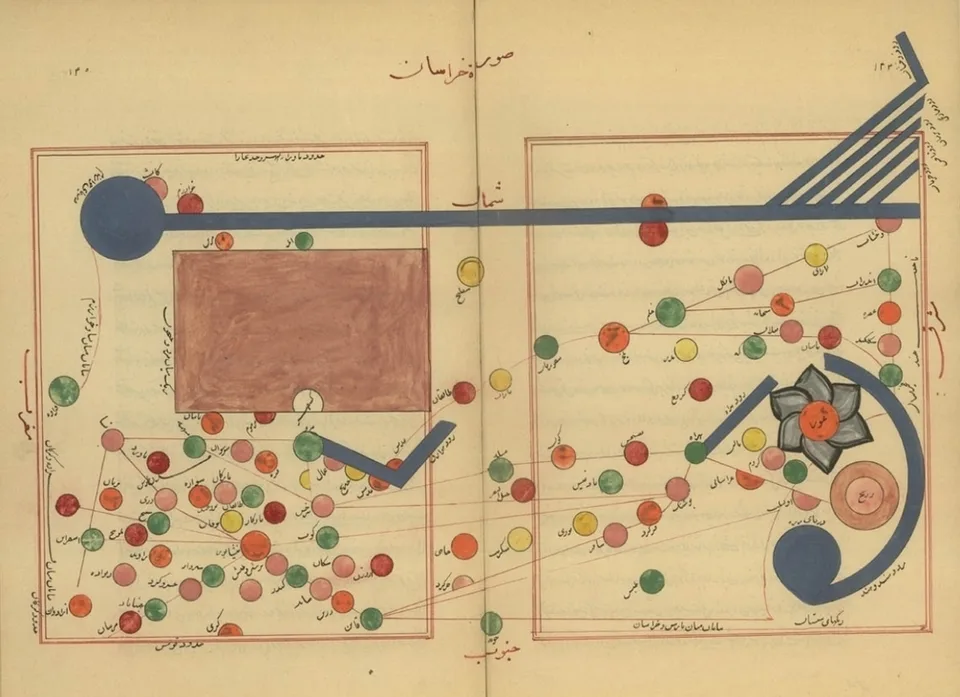
al-Iṣṭakhrī wrote a geography of the Islamic lands about 932, the Kitāb al-Masālik wa-l-Mamālik, and it contains a chapter on the Khazars.[1] Ibn Hawqal, who wrote about 977, takes over much of his text.[2]
The religions
al-Iṣṭakhrī says that the king of the Khazars is a Jew and that about four thousand attendants serve him. The Khazars are Muslims, Christians and Jews, and some are idolaters. The Jews are the smallest group, since most of those called Jews are in fact Muslims and Christians. The king and his court are Jews.[3] In the town it describes, more than ten thousand Muslims are said to live, and they have about thirty mosques.[3]
The customs of the country are those of the heathen. The legal decisions follow old usages that contradict the religion of the Muslims, the Jews and the Christians.[3] From this and similar passages it has been concluded that Turkic law, and not rabbinic law, applied in Khazaria.[4] The king has seven judges, taken from the Jews, the Christians, the Muslims and the idolaters.[5] al-Masʿūdī gives the division. Two judges sit for the Muslims, two for the Khazars, who judge by the Torah, and two for the Christians, and one sits for the Slavs, the Rus and the other pagans.[6]
The khagan
The chief man is called the khagan of the Khazars. He is greater than the king, although the king appoints him.[7] His investiture includes ritual strangulation.[8] The text adds that the khagan is strangled with a piece of silk until he is nearly dead. He is then asked how long he wishes to reign. If he dies before the term he names, that is accepted. If he does not, he is killed when he reaches it.[7] The khaganate is never given to anyone but a Jew. As evidence, the text tells of a Muslim bread-seller who would have been the most worthy heir but was a Muslim.[9] This may mean that members of the royal house were kept from the throne because they held to Islam.[10] The king of Samandar, who was related to the king of the Khazars, was a Jew.[11]
The language
al-Iṣṭakhrī says in one place that the language of the Bulgars is like that of the Khazars.[9] In another place he says that the language of the Khazars is not that of the Turks and not Persian, and that no language of mankind coincides with it.[12] The two notices are understood as a contradiction.[13]
Reliability
The chapter may have been composed from two parts. A source from about 800 may lie behind the older part, but the evidence for that source is not strong.[14] Yāqūt gave the first part of the chapter in his article on the Khazars as if it came from Ibn Fadlan.[15]
Muslim sources present the Muslims as the largest group in Khazaria, though they probably had the cities in mind. The sources are partisan on questions of religion, and nothing allows the sizes of the communities to be tested.[16] What al-Iṣṭakhrī does show is the gap between the court’s faith and the faith of the country. It is the same gap that Ibn Rusta describes. Because Ibn Hawqal copies him, the two count as one witness, not two.
References
- ^ Dunlop 1954, p. 91, 104
- ^ Dunlop 1954, p. 100
- ^ a b c al-Iṣṭakhrī; Dunlop 1954, p. 92
- ^ Dunlop 1954, p. 92
- ^ al-Iṣṭakhrī; Dunlop 1954, p. 93
- ^ al-Masʿūdī; al-Masʿūdī 1863 (MDCCCLXIII auf dem Titelblatt), p. 11
- ^ a b al-Iṣṭakhrī; Dunlop 1954, p. 97
- ^ al-Iṣṭakhrī
- ^ a b al-Iṣṭakhrī; Dunlop 1954, p. 98
- ^ Golden 1992, p. 242
- ^ al-Iṣṭakhrī; Dunlop 1954, p. 95
- ^ al-Iṣṭakhrī; Dunlop 1954, p. 93, 95
- ^ Sinor 1990, p. 263
- ^ Dunlop 1954, p. 102–103
- ^ Dunlop 1954, p. 100–101
- ^ Golden 1992, p. 241–242
Sources
Literature
- Peter B. Golden, An Introduction to the History of the Turkic Peoples (1992)
- Douglas M. Dunlop, The History of the Jewish Khazars (1954)
- Denis Sinor (ed.), The Cambridge History of Early Inner Asia (1990)
- al-Masʿūdī; C. Barbier de Meynard and Pavet de Courteille (trans.), Les Prairies d’or, Bd. II (Texte et traduction) (1863 (MDCCCLXIII auf dem Titelblatt))
Articles resting on this source 6
Itil · Khazar Customs and Tribute · Khazar Dual Kingship · Samandar · The Khazar language · The Khazar–Ashkenazi hypothesis
What links here8
- States
- Khazar Khaganate
- Battles & Events
- Conversion of the Khazars to Judaism
- Institutions and Titles
- Khazar Dual Kingship
- Sources
- Ibn Rusta · The Khazar correspondence
- Controversies
- The Khazar–Ashkenazi hypothesis
Cite this article
Yavuz, Emre-E. “al-Iṣṭakhrī.” Turkic Atlas, revised 8 November 2026. https://turkicatlas.org/sources/al-istakhri/
Last revised: 8 November 2026


