
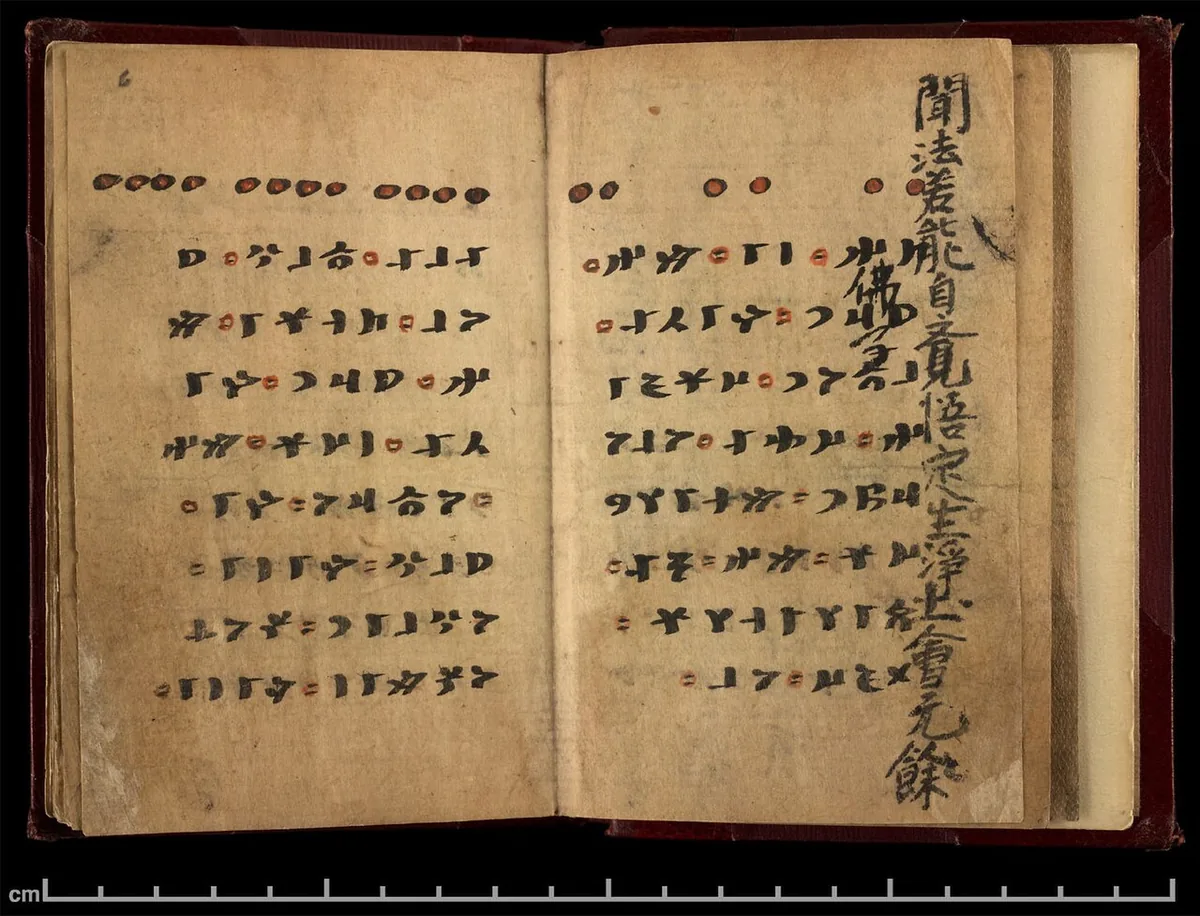
The Irk Bitig is the one long Old Turkic text written in the runiform script on paper, in the form of a book.[1][2] The other runiform manuscripts are shorter, and a few of them are in Middle Iranian languages. The rest of the script stands on stone, on rock and on objects.[3] About fifty texts in runiform script on paper were known in 1990: thirty-four in Germany, twelve in England, two in Japan and one each in the Soviet Union and France.[4] Five of the thirty-four in Germany are written in Middle Iranian, not in Old Turkic.[5] These fragments have been placed in a Manichaean setting of the tenth century.[6] The same script was used for fortune-telling texts and for Manichaean texts.[7] This one was bound, carried and written in. It was left in a walled-up chamber at Dunhuang, together with several tens of thousands of other manuscripts.
The manuscript
It is a small book of fifty-eight leaves, made of twenty-nine sheets glued end to end. It is about 13.6 centimetres high and 8 wide.[1] The Turkic text begins on the back of the fifth leaf and ends on the fifty-seventh. It runs to a hundred and four small pages, and the last two have a colophon in red ink.[1] Pages left blank at the front and the back were later filled with Chinese writing. Chinese hands also covered the margins of two pages of the Turkic text.[1] In the text the words are mostly set apart one by one, and vowels are written more often than on the stone monuments.[8]
The book names itself. On page 101 stands ırk bitig, the omen writing. From the postscript to the fifty-seventh omen it is clear that ırk is the word for each single paragraph.[1] The word is related to the term for divination and omen. It is glossed as meaning the same as the old word for good fortune, luck and chance. This places the book, by its own title, in the same field as Kut.[1]
It has the shelfmark Or. 8212. Aurel Stein found it in the walled chamber at the Halls of the Thousand Buddhas near Dunhuang.[1] The language is the variety usually called the Manichaean ny-dialect. The book is dated on internal grounds to the ninth century.[1][9] The name refers to the spelling of the old palatal nasal ñ as ny, where most Uyghur texts have y. Whether such a spelling marks a dialect or an older stage of the language is argued.[10]
The colophon
The colophon is the reason this manuscript can be placed more exactly than most. It says the book was written on the fifteenth day of the second month in a year of the tiger. This is a date in the twelve-year cycle with no era attached, which is why it resolves to either 17 March 930 or 4 March 942.[1] The 1993 edition holds the ninth century more probable than either date, because of the language.[11]
It also names the people involved. The interpretations differ. The book was long held to have been written for two disciples called Isig Sangun and Itachuk. Tekin reads the colophon differently. In his reading a young and pious disciple at the Tayguntan monastery wrote the book for his elder brother, Sangun Itachuk, “general Itachuk”, and the scribe stays unnamed.[1] Zieme reads two elder brothers, Isig Sangun and It Açuk, and gives the scribe a name, Murwā Khurshid, which is Iranian.[2] In every version the colophon gives a monastery and a day. For a steppe manuscript that is an unusually full account of itself.
The omens
The book has sixty-five numbered paragraphs. Each is a short scene, and each closes with the same formula: know thus, the omen is good, or extremely good, or bad.[1] The scenes are the world of a man on the move. A messenger on a yellow horse and an envoy on a dark brown one bring good tidings.[1] A rich man’s sheep bolts and meets a wolf. It lives because the wolf’s mouth has somehow turned poisonous.[1] A devout old woman left alone in an abandoned camp keeps herself alive by licking a greasy ladle.[1] In omen 15, fog hangs above and dust rises below, and the young birds, the young deer and the children lose their way. By the grace of Heaven they all meet again, safe and sound, in the third year, and the omen is good.[12] In omen 33, a man puts felt into water. The text adds: beat it more, and tie it tightly. The omen is bad.[13] Two omens use the word ordu, the royal camp. In omen 28, a khan who has taken the throne builds one, and his realm stays firm. In omen 34, a khan who has routed the enemy comes back toward his ordu with his soldiers, rejoicing. Both omens are good.[13] Turkic Atlas puts these two lines beside the stone inscriptions under the ordu. About forty of the sixty-five omens take an animal for their subject. The birds among them are the falcon, the hoopoe, the eagle, the swan, the raven and the crane.[14]
At the head of each omen stand three groups of small circles, with one to four circles in a group.[15] They are understood as the record of three throws of a die, a rod with one to four circles marked on its sides. The book is taken to be a manual for interpreting the throws.[16] Three throws with four possible results each give sixty-four combinations. The book has sixty-five omens, one more than the throws can produce.[17]
Three of the omens bear on the religion of the Old Turkic world. All three are treated in their own articles. The first speaks in the voice of the Chinese emperor. He says: I am Tensi, the Son of Heaven, and morning and evening I sit on the golden throne. Tensi is a Chinese title carried into a Turkic book of omens.[1] The second is the road god. He rides a dappled horse and meets two travellers who are afraid of him. He tells them not to fear, because he will give them his divine favour.[1] The twelfth has a man fall to the ground while hunting and say that in heaven is a mighty god. The word for mighty is ärklig. Turkic Atlas rests its treatment of Erklig on the fact that it is here an adjective and not a name.[1]
Reliability
The book is not a source for the Göktürk khaganates. It belongs to the Uyghur period. Some Turkish handbooks nevertheless call it a Göktürk book, because they call the runiform script Göktürk script.[18] Its vocabulary comes from a world in which Manichaean and Buddhist terms were current, and the monastery in its colophon is not a steppe institution. What it is good for is narrower and real. It shows the runiform script still written, still legible and still used for a book two centuries after the Orkhon monuments. It also shows the divine vocabulary of those monuments alive in a text that has nothing to do with imperial legitimacy. That vocabulary includes Tengri above, hearing what men below do.[19]
The Irk Bitig contains no lord of the dead, no Umay, no tiered heaven and no world tree.[1] Those belong to the reconstructed picture and not to the one long runiform text that survives from the period between the inscriptions and the Islamic sources.
References
- ^ a b c d e f g h i j k l m n o p q r Tekin 1993
- ^ a b Zieme 2000, p. 378
- ^ Erdal 2004, p. 7,40
- ^ Sertkaya 1990, p. 167–168
- ^ Sertkaya 1990, p. 172–173
- ^ Sertkaya 1990, p. 173
- ^ Edward 1993, p. 38
- ^ Şükürlü 1993, p. 133
- ^ Tekin 2003, p. 236
- ^ Erdal 2004, p. 12–13, 33–35
- ^ Tekin 1993, p. 1–2
- ^ Tekin 1993, p. 12–13
- ^ a b Tekin 1993, p. 16–17
- ^ Korkmaz 2026, p. 82–83
- ^ Tekin 1993, p. 3
- ^ Tekin 1993, p. 3; 113–114; 1437; von Gabain 2025, p. 3; 113–114; 1437; Seçkin 2015, p. 3; 113–114; 1437
- ^ Tekin 1993, p. 3; 114; von Gabain 2025, p. 3; 114
- ^ Ögel 1995, p. 571
- ^ Tekin 1993, p. 1438–1439; Seçkin 2015, p. 1438–1439
Literature
- Talat Tekin, Irk Bitig: The Book of Omens (1993)
- Emre-E. Yavuz, The Gokturk Empire: 2nd Edition (2025)
- Annemarie von Gabain, Eski Türk Edebiyatı (2025)
- Marcel Erdal, A Grammar of Old Turkic (2004)
- Kuban Seçkin, Irk Bitig: Toplumsal İyi ve Toplumsal Kötünün İnşasında İdeolojik Bir Fal Kitabı (2015)
- Kadir Korkmaz, Irk Bitig’de Falın Niteliğini Belirleyen Bir Unsur Olarak Kuşlar ve Sembolik İşlevleri (2026)
- Talât Tekin, Orhon Türkçesi Grameri (2003)
- Bahaeddin Ögel, Türk Mitolojisi (Kaynakları ve açıklamaları ile destanlar) II (1995)
- Osman Fikri Sertkaya, Kâğıda yazılı Göktürk metinleri ve kâğıda yazılı Göktürk alfabeleri (1990)
- Elisa Cebrailoğlu Şükürlü, Göktürk Yazıtlarında Kelimelerin Noktalanması Özellikleri (1993)
- Tryjarski, Edward, Anonymity, Adaptation and Diffusion of the Asian and European Runic Scripts (1993)
- Peter Zieme, Runik Harfli Birkaç Pasaj Üzerine Kimi Yorum Önerileri (2000)
Articles resting on this source 19
Erklig · Falconry · Felt · Hunting among the Göktürks · Old Turkic · Old Uyghur · Omens and Divination · Ordu · Soul Words · Stakes and Wagers · Tengri · Tengrism · The Battue · The making of Tengrism · The Old Turkic script · The Turkic languages · Umay · Water Cult · Yol Tengri
What links here17
- Institutions and Titles
- Ordu · Post and Communication
- Religions
- Erklig · Iye · Omens and Divination · Tengri · Tengrism · Water Cult · Yol Tengri
- Languages
- Old Turkic · Old Uyghur · The Old Turkic script
- Customs & Pastimes
- Falconry · Hunting among the Göktürks · Stakes and Wagers · The Battue
- Controversies
- The making of Tengrism
Cite this article
Yavuz, Emre-E. “Irk Bitig.” Turkic Atlas, revised 8 November 2026. https://turkicatlas.org/sources/irk-bitig/
Last revised: 8 November 2026

