
- 400
- 500
- 600
- 700
- 800
- 900
- Rouran 400–554
- First Göktürk 552–630
- Tang rule 630–682
- Second Göktürk 682–744
- Uyghur 744–840
- Kirghiz 840–924
- Huns 370–469
- Western Göktürk 552–659
- Türgesh 699–766
- Karluk 766–800
- Khazar 650–969
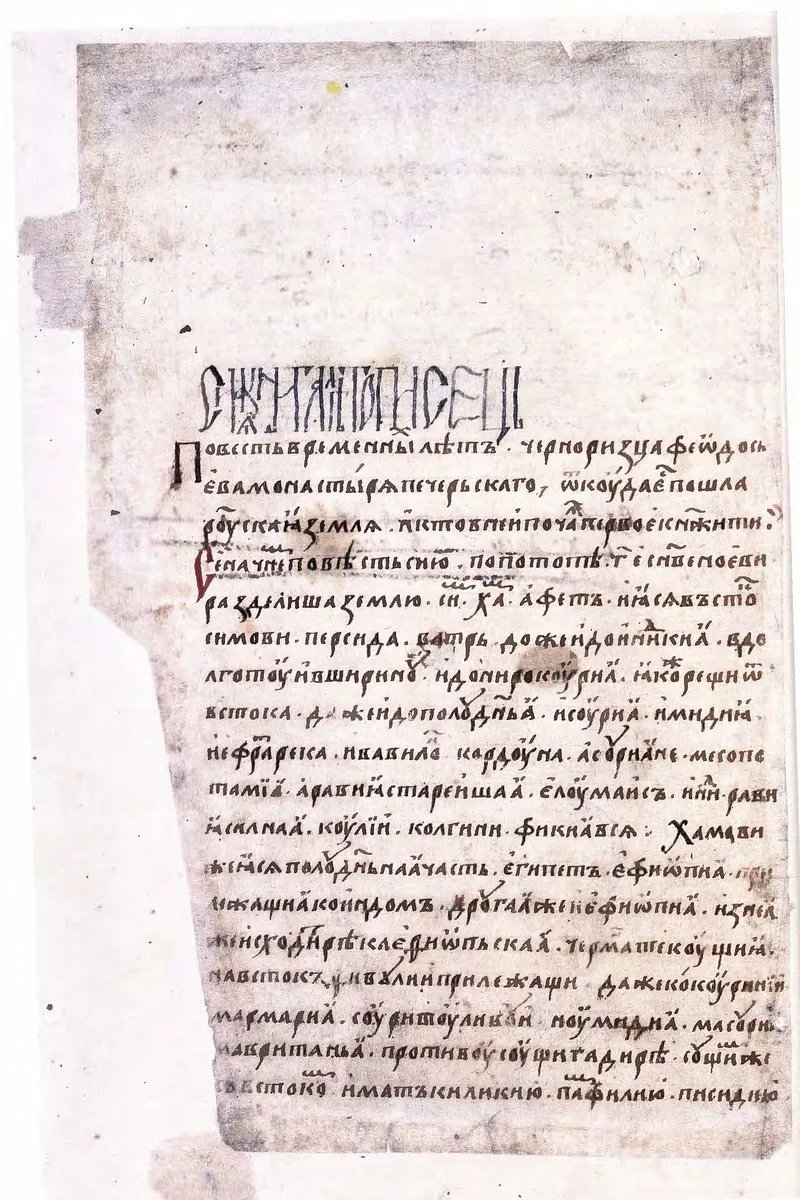
The Russian Primary Chronicle, in Russian the Povest’ vremennykh let, is a chronicle of the Rus. It counts its years from the creation of the world. The year 6473 of the chronicle is 965.[1] Several of its entries concern the Khazars.
Tribute
The chronicle says under the year 859 that the Khazars took tribute from the Polyane, the Severians and the Vyatichi, a white and a squirrel pelt from each hearth.[1] The prince Oleg later freed the Severians from this tribute. He told them not to pay the Khazars but him. The Radimichi had paid the Khazars until then.[1] When Sviatoslav asked the Vyatichi in 964 whom they paid, they answered that they gave the Khazars a shilling from each plough.[1]
The chronicle also tells of the Polyane, who gave the Khazars a sword from each hearth instead. The Khazar elders warned that this tribute was not good. They had won by the sabre, which has one edge. The swords of the Polyane have two. The Khazars said that these swords would one day take tribute from them and from other lands. The chronicle adds that the Rus princes rule the Khazars to this day.[1] The passage is a prophecy made after the event, and the chronicler wrote it in the twelfth century.
The campaign of 965
The entry for 6473, which is 965, records a campaign of Sviatoslav of Kiev against the Khazars.[2] The Khazars heard of it and went out against him with their prince, the khagan. They fought. Sviatoslav won, took their city Biela Vezha, and beat the Yasy and the Kasogs. Then he came to Kiev.[1] Biela Vezha is identified as Sarkel.[3] The Byzantine handbook glosses Sarkel as “white house”.[4] Whether the town of the entry is Sarkel is disputed.[5]
The entry does not name Atil or Samandar. It also does not say that the khaganate ended. Other sources fill the picture. Ibn Miskawayh puts an attack on Khazaria in 965 and has the Khazars call on Khwarazm for help.[6] Ibn Hawqal speaks of the sack of Khazaran, Samandar and Atil by the Rus in 358 AH, which is 968 or 969.[7] Two interpretations follow. One sees a single great campaign of 965, and the other sees two phases, with Sarkel taken in 965 by the Rus of Kiev and Atil and Samandar in 968 by others.[5] Another interpretation has the Rus, allied with elements of the Oghuz, overrun Atil and perhaps Sarkel.[8]
The Khazar Jews at Vladimir
Under the year 986 Khazar Jews come to Vladimir and urge him to take their faith.[1] He asks where their land is, and they answer in Jerusalem. They add that God was angry with their fathers and scattered them for their sins, and that their land was given to Christians. Vladimir replies that Jews who are rejected by God cannot teach others. If God had loved them, they would not be scattered over foreign lands.[1] Many critics hold the disputation scene to be an interpolation. The presence of Khazar Jews at Kiev is not in itself a problem.[9] The reply of Vladimir is an argument of the twelfth century and not a statement about Khazaria.
Reliability
The chronicle is late and composite. Its Khazar entries show how the Rus remembered the Khazars, and some of them are prophecy in hindsight. As an account of the campaign it is short. It says what Sviatoslav took and where he went, and the fall of the khaganate has to be reconstructed from other sources.
References
- ^ a b c d e f g h Russian Primary Chronicle
- ^ Russian Primary Chronicle
- ^ Dunlop 1954, p. 241
- ^ De administrando imperio; Porphyrogenitus 1967 (New Revised Edition; Greek text and English translation), p. 183
- ^ a b Dunlop 1954, p. 241–243
- ^ Dunlop 1954, p. 244
- ^ Dunlop 1954, p. 241–242
- ^ Golden 1992, p. 243
- ^ Dunlop 1954, p. 250–251
Sources
Literature
- Peter B. Golden, An Introduction to the History of the Turkic Peoples (1992)
- Douglas M. Dunlop, The History of the Jewish Khazars (1954)
- Constantine Porphyrogenitus; Gyula Moravcsik (ed.); R. J. H. Jenkins (trans.), De administrando imperio (1967 (New Revised Edition; Greek text and English translation))
Articles resting on this source 2
Fall of the Khazar Khaganate (about 965–969) · Khazar Customs and Tribute
What links here3
- Sources
- The Schechter letter
Cite this article
Yavuz, Emre-E. “Russian Primary Chronicle.” Turkic Atlas, revised 8 November 2026. https://turkicatlas.org/sources/russian-primary-chronicle/
Last revised: 8 November 2026


