
Syunnu–Han müharibələri Han imperiyası ilə syunnular (Xiongnu) konfederasiyası arasındakı müharibələr idi. Onlar e.ə. 200-cü ildəki Baideng mühasirəsindən eramızın 93-cü ilində şimal şanyunun sonuna qədər davam etdi.
Baideng və heqin
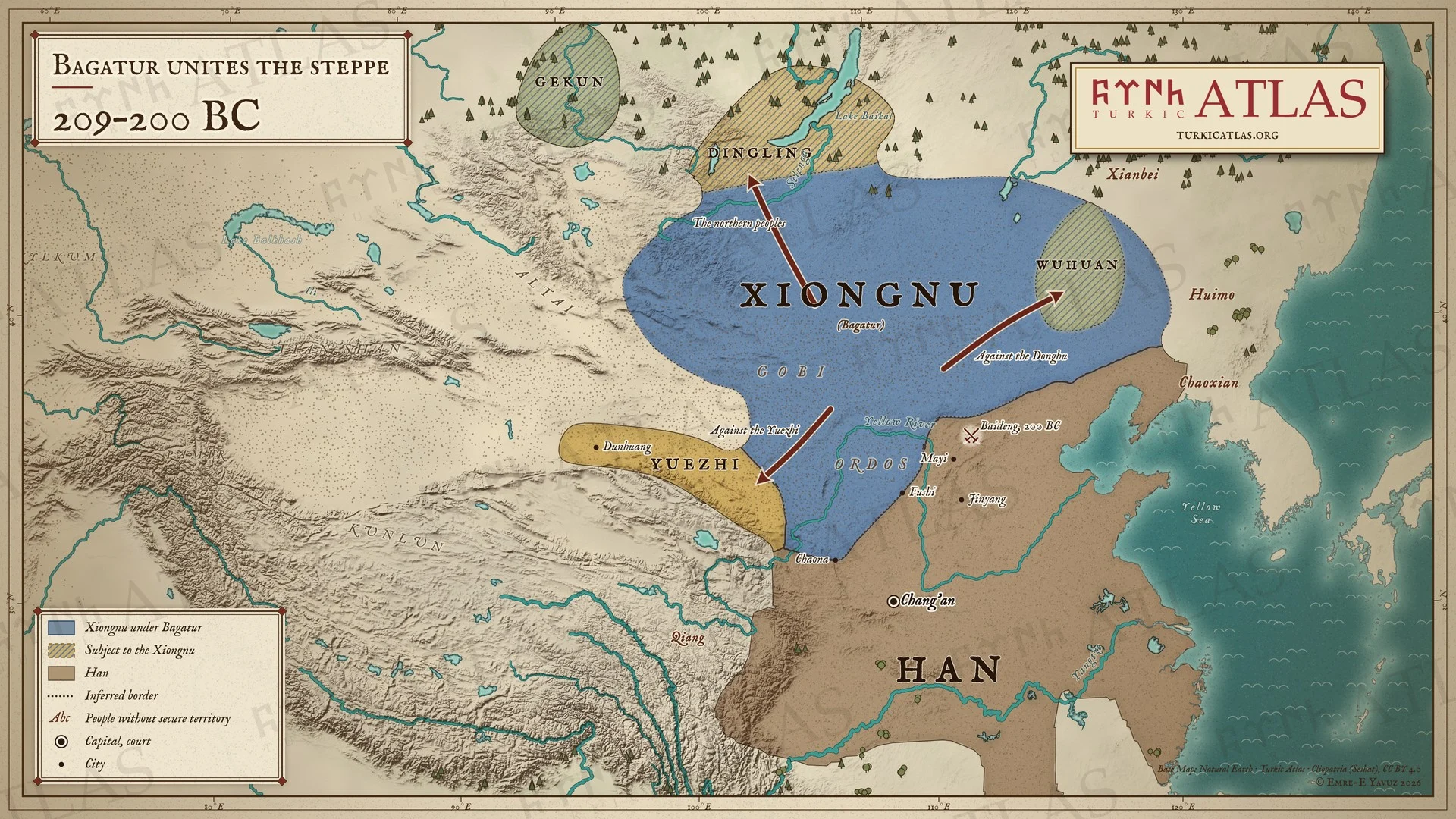
E.ə. 200-cü ilin qışında Bagatur ilk Han imperatorunu yeddi gün Baideng təpəsində qapalı saxladı. Onun 320,000 nəfərlik Han ordusuna qarşı 400,000 seçmə atlısı var idi.[1][2] Han Shu 300,000-dən çox seçmə atlı göstərir.[3][4] Hər iki rəqəm Han sarayının yuvarlaq rəqəmləridir, sayım deyil. Syunnu rəqəmi, ehtimal ki, silah götürməyə yararlı bütün kişiləri ifadə edir. İmperator oradan çıxdı. Ardınca heqin müqaviləsi gəldi: şanyu üçün bir Han şahzadəsi, illik hədiyyələr və qardaşlıq andı.[1] Wen və Jing dövründə Han müqaviləni hər basqından sonra yenilədi. O, e.ə. 133-cü ilə qədər davam etdi.[3] E.ə. 182-ci ilin baharında, imperatriça Lü dövründə, syunnular Didaoya hücum etdilər və Ayangı talan etdilər. 181-ci ilin birinci ayında onlar Didaonu yenidən talan etdilər və iki min adam apardılar.[5] E.ə. 177-ci ilin beşinci ayında Sağ müdrik padşah Sarı çayın cənubundakı torpağa girdi və Shang komandanlığının sərhəd postlarını qoruyan tayfaları talan etdi. İmperator Wen ona qarşı baş naziri Guan Yingi 85,000 döyüş arabası və atlı ilə göndərdi və padşah sərhədin o tayına çəkildi.[1][6] Bəzi alimlər basqını Hana keçmiş və sərhəd postlarını onlar üçün tutan syunnulara cavab kimi izah edirlər.[7]
İki müasir şərh müharibələri daha geniş çərçivəyə qoyur. Birincisi Çini aktiv tərəf sayır. O, hesab edir ki, sərhəd çölün böyük köçəriliyindən əvvəl gələn Çin böyüməsindən öz formasını aldı və divar köçəriləri kənarda saxlamaq qədər çinliləri içəridə saxlamağa da xidmət etdi.[8] İkincisi hesab edir ki, Hanın şimal sərhədindəki erkən müharibələri syunnulara qarşı yox, sərhəd komandanlarına qarşı aparılmışdı. Komandanlar sıxışdırılanda syunnulara keçirdilər. Bu halda, saray sərhəd valilərini yaxından saxlayan yerlərdə, ticarət və müharibə basqın və şantaj kimi birləşməyə meyilli idi.[9]
Wudi dövründə dönüş
E.ə. 133-cü ildə Han şanyunu tələyə salmaq üçün Mayi ətrafında 300,000 nəfəri gizlətdi. O, çobansız otlayan mal-qara gördüyündə geri döndü.[1] Pusqudan sonra syunnular heqini pozdular. Onlar sərhədə saysız basqınlar etdilər.[1] E.ə. 129-cu ildə dörd general hər biri 10,000 atlı ilə yola çıxdı. Yalnız Wei Qing Longchengə çatdı, Gongsun Ao isə 7,000 nəfər itirdi.[1] E.ə. 127-ci ildə Wei Qing Sarı çayın cənubundakı torpağı aldı və orada Shuofangı tikdi.[1] Bu torpaq Ordosdur.
Hücumlar, e.ə. 124-cü ildən 119-cu ilə qədər
E.ə. 124-cü ildə Wei Qing altı general və 100,000-dən çox nəfərlə Sağ müdrik padşahı gecə mühasirəyə aldı. Padşah sərxoş idi, çünki Hanın ona çata bilməyəcəyini düşünürdü. O, qaçdı və Han onun 15,000 adamını ələ keçirdi.[1]
E.ə. 121-ci ildə Huo Qubing qərbdəki syunnulara iki dəfə zərbə vurdu. O payızda Hunye kralı Xiutu kralını öldürdü və 40,000-dən çox adamla Hana keçdi. Shiji deyir ki, bu adamlar 100,000 kimi göstərilmişdi.[1] Wudi salnaməsi həmin il onların torpağından Wuwei və Jiuquan komandanlıqlarını yaradır. Eyni torpaqdan ayrılmış Zhangye və Dunhuangdan isə e.ə. 111-ci ildə komandanlıqlar yaradır. Digər mənbələr Hexinin dörd komandanlığını fərqli tarixləndirir.[10][11] Tan şərhçisi Zhang Shoujie, Xihe gushi-yə istinad edərək, syunnulara iki dağ üçün yas tutan bir mahnı aid edir: Qilian dağlarını itirdikləri üçün heyvanları artıq çoxalmır. Yanzhi dağlarını itirdikləri üçün qadınlarının sifətində rəng yoxdur.[1][12] Bəzi alimlər e.ə. 121 və 119-cu illərin yürüşlərinin iki davamlı nəticəsini sayırlar. Birincisi o otlaqların itirilməsidir. İkincisi Hexi dəhlizindən Lop Nora qədər olan torpağın itirilməsidir, burada Han sonra Jiuquan komandanlığını qurdu və syunnuları Qianglardan ayırdı.[13]
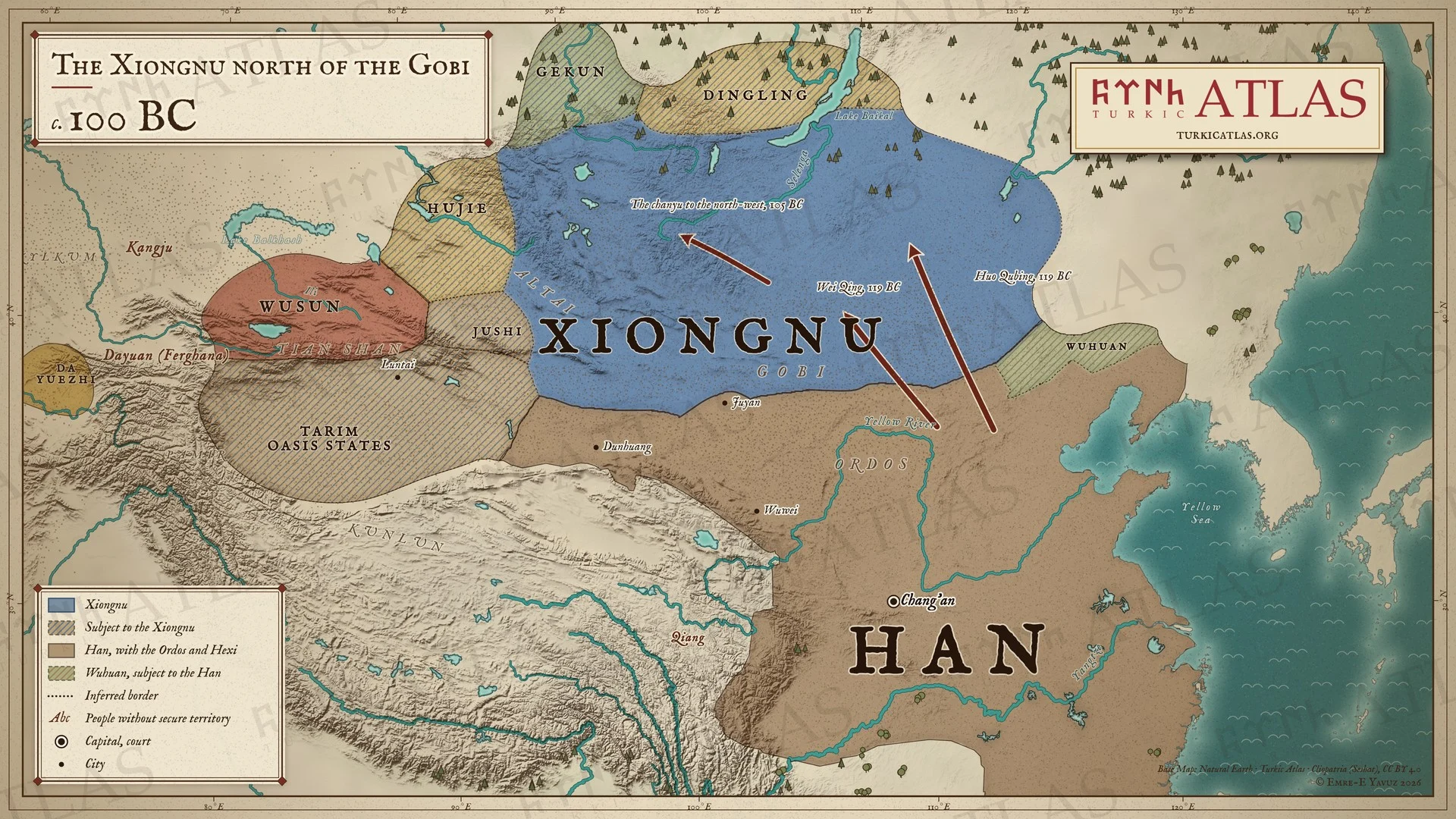
E.ə. 119-cu ildəki Mobei yürüşündə Han 100,000 atlı və 140,000 ehtiyat at çıxartdı.[1] Şanyu səhranın şimalında gözlədi. Alaqaranlıqda, tufan zamanı Han cinahları onun üzərinə qapandı. O, bir neçə yüz atlı ilə yarıb çıxdı.[1] Syunnuların bundan sonra Qobinin cənubunda padşah sarayı qalmadı. Lakin Han 100,000-dən çox at itirmişdi və yenidən gedə bilmədi.[1]
Yıpranma
E.ə. 103-cü ildə 80,000 syunnu atlısı Zhao Ponunun ordusunun yolunu kəsdi və ordu itirildi.[1] E.ə. 99-cu ildə Li Guangli mühasirəyə alındı və hər on nəfərdən altı-yeddisini itirdi.[1] E.ə. 90-cı ildə Li Guangli 70,000 nəfərlə yola çıxdı. Han Shuya görə, o, gecə hücumundan sonra təslim oldu.[3] Han artıq ordu göndərmədi. Wudi üç il sonra öldü.[3]
Syunnuların bölünməsi
E.ə. 72-ci ildə beş Han ordusu və 50,000 Wusun atlısı yola çıxdı. Syunnular onlardan qurtuldu.[3] Syunnular sonra qar fırtınasında və Dingling-lərin, Wuhuanların və Wusunların əlində xalqının onda üçünü və naxırlarının onda beşini itirdilər.[3] E.ə. 57-ci ildən rəqib şanyular bir-biri ilə vuruşdular. E.ə. 53-cü ildə Huhanye, qardaşından məğlub olaraq, nazirlərinin məsləhətinin əksinə Hana tabe oldu. Zhizhi qərbə getdi.[3] E.ə. 36-cı ildə Gan Yanshou və Chen Tang qoşun topladılar. Onlar Zhizhini Kangjuda öldürdülər.[3]
Şimalın sonu
Eramızın 89-cu ilindən 91-ci ilinə qədər Han və Cənubi syunnu orduları şimal sarayını sındırdı. Eramızın 93-cü ilində sonuncu iddiaçı sərhəddən o tərəfə aldadılaraq geri çağırıldı və başı kəsildi. Bu, Hanın Şimali syunnulara qarşı yürüşlərində danışılır.[14] Hou Han Shunun yekun hökmündə şanyu Wusunların ölkəsinə qaçdı. Səhranın şimalındakı ölkə boş idi.[14]
-
c. 215 BC Qin takes the Ordos
Around 215 BC the First Emperor of Qin sent Meng Tian north with a hundred thousand men. He took the land inside the great bend of the Yellow River, the Ordos, made the river the frontier and crossed it to hold the plain below the Yin mountains. According to the Shiji the Donghu north of Yan were strong at this time, and the Yuezhi flourished between Dunhuang and the Qilian mountains. The Xiongnu chanyu Duman could not withstand Qin and moved north. How far north, the source does not say. A second reading places the Qilian of this passage in the Tianshan; the hatched area shows it.
-
209–200 BC Modu unites the steppe
In 209 BC Modu killed his father Duman and became chanyu. Between the Xiongnu and the Donghu lay an empty strip more than a thousand li wide. When the Donghu demanded it, Modu struck east and destroyed their king. The Wuhuan held out at the Wuhuan mountain and paid the Xiongnu a yearly tribute of oxen, horses and sheepskins; the Xianbei withdrew far beyond the Liaodong frontier. Modu drove back the Yuezhi, took back the land Meng Tian had seized as far as Chaona and Fushi, and subjected the Hunyu, Qushe, Dingling, Gekun and Xinli in the north. In 200 BC he surrounded the Han emperor Gaozu for seven days on the hill of Baideng near Pingcheng.
-
176–c. 160 BC The height of the realm
In 176 BC Modu wrote to the Han court that the Wise King of the Right had destroyed the Yuezhi, and that Loulan, the Wusun, the Hujie and twenty-six states around them had all become Xiongnu: all the peoples who draw the bow were now one family. His son Laoshang killed the Yuezhi king and made a drinking cup of his skull. The Yuezhi left the Hexi and moved west into the land of the Saka. The Han Shu names a Xiongnu Commandant of Slaves who resided between Karashahr, Weixu and Weili and taxed the oasis states. In 162 BC the emperor Wendi confirmed the Long Wall as the line between the two realms. No source describes the northern edge of the realm in Tuva and beyond the Baikal.
-
127–121 BC The Han take the Ordos and the Hexi
In 127 BC the Han general Wei Qing drove the kings of the Loufan and the Baiyang out of the Ordos. Han founded Shuofang there and restored Meng Tian's wall along the river; in exchange it gave up the district of Zaoyang beyond Shanggu. In 123 BC the chanyu withdrew north across the Gobi on the advice of the defector Zhao Xin. In the spring and summer of 121 BC Huo Qubing struck into the Hexi corridor, and in the autumn the Hunye king killed the Xiutu king and went over to Han with more than forty thousand people. From then on, says the Shiji, the land from Jincheng and the Hexi west along the Southern Mountains to the Salt Marsh was empty of Xiongnu. By this time the Wusun held the land of the Saka, and the Yuezhi had moved on to the north bank of the Oxus.
-
119–c. 100 BC North of the Gobi
In 119 BC Wei Qing and Huo Qubing crossed the Gobi with separate armies. Huo Qubing marched more than two thousand li beyond Dai, sacrificed on Mount Langjuxu and turned back at the Hanhai. Afterwards, says the Shiji, there was no royal court south of the Gobi. Han settled soldiers and farmers from Shuofang west to Lingju and set up the commanderies of the Hexi, from Wuwei to Dunhuang; the Wuhuan were moved beyond the frontier of five eastern commanderies to watch the Xiongnu for Han. By 105 BC the chanyu had moved further north-west, his left wing facing Yunzhong and his right Jiuquan and Dunhuang. The southern edge of the realm ran somewhere in the Gobi.
-
60–51 BC The Western Regions lost, the realm divided
In 71 BC the Dingling struck the Xiongnu from the north, the Wuhuan from the east and the Wusun from the west, and the peoples bound to them fell away. In 60 BC the Rizhu king went over to Han. The Xiongnu Commandant of Slaves was abolished, and Zheng Ji became the first Protector-General of the Western Regions, with his seat at Wulei. In 57 BC five chanyus contended for the throne. In 54 BC Zhizhi took the royal court, and his younger brother Huhanye moved south to the Han frontier. In 51 BC Huhanye came before the emperor at Ganquan and was allowed to live below the Guanglu wall.
-
49–33 BC Zhizhi in the west, Huhanye in the north
Believing that Huhanye, weak and bound to Han, could not come back north, Zhizhi led his people west. He defeated the Wusun, received the surrender of the Wujie in the north, broke the Jiankun in the west and brought the Dingling under him, and made his seat in the land of the Jiankun. Around 44 BC he killed a Han envoy and went on to Kangju; of his people only three thousand arrived. In 36 BC the Protector-General Gan Yanshou and his deputy Chen Tang marched on Kangju and killed him. Huhanye meanwhile returned to the royal court in the north, and in 33 BC he received the palace lady Wang Zhaojun as his wife. From then on the land north of the Long Wall belonged to the Xiongnu again.
-
AD 48–50 Northern and Southern Xiongnu
Under Wang Mang the states of the Western Regions went over to the Xiongnu. In AD 48 the chiefs of eight southern tribes raised Bi, the Rizhu king, as chanyu under the name Huhanye; he came to the Wuyuan frontier and offered to shield Han against the northern Xiongnu for ever. The next year the northern chanyu fell back a thousand li. In AD 50 the southern court moved inside the frontier, first to Yunzhong and in the winter to Meiji in Xihe, and its chiefs were stationed along the frontier commanderies from Beidi to Dai. Beyond the Liaodong frontier the Xianbei sent their first envoys to Han in AD 49.
-
AD 87–93 The end of the Northern Xiongnu
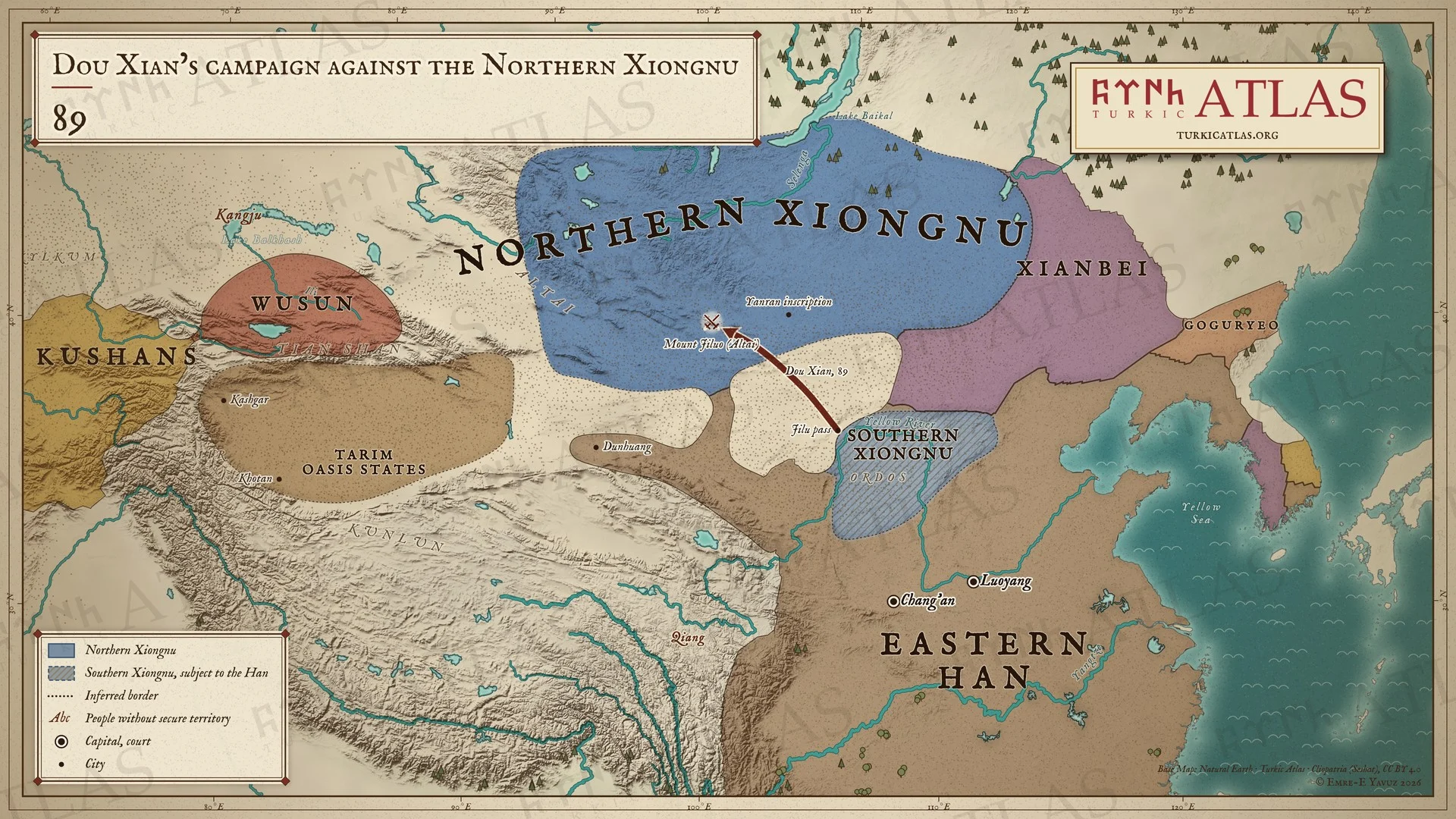
In AD 87 the Xianbei entered the eastern lands of the Northern Xiongnu and killed the chanyu Youliu; fifty-eight tribes, two hundred thousand people, came to the frontier to surrender. In 89 Dou Xian marched out with the southern chanyu, defeated the northern chanyu at Mount Jiluo and had an inscription cut on Mount Yanran, more than three thousand li beyond the frontier. A rock inscription in the Gobi of central Mongolia is identified with this text; it lies much closer to the frontier than the figure of the source. In 91 Geng Kui defeated the northern chanyu at the Jinwei mountains, and the chanyu fled to the land of the Wusun. The Xianbei moved into the empty land, and more than a hundred thousand Xiongnu tents that stayed behind called themselves Xianbei.
-
c. AD 155–180 The Xianbei in the old Xiongnu land
The Xianbei leader Tanshihuai set his court on the Chuochou river below Mount Tanhan, more than three hundred li north of Gaoliu. According to the Hou Han Shu he raided the Han frontier in the south, held off the Dingling in the north, drove back the Fuyu in the east and struck the Wusun in the west, and held all the old Xiongnu land, fourteen thousand li from east to west. He divided it into an eastern, a central and a western part; the western reached Dunhuang and the Wusun. The Southern Xiongnu remained inside the Han frontier. One reckoning puts the last defeat of the Northern Xiongnu by the Xianbei in 155, a second puts their move west around 158; the hatched area north of Kangju shows where the second places them.
- Place named in a source (position as commonly identified)
- Position disputed or approximate
- Zone drawn after the Han histories
- Second reading or entirely uncertain position (hatched)
- People subject to the Xiongnu, or under Han protection
- Oasis states taxed by the Xiongnu
- Border that no source describes (drawn uncertain)
- Movement named in a source (route drawn)
Qeydlər
- ^ a b c d e f g h i j k l m n o Shiji, juan 110
- ^ Ögel 2015, p. 281–286
- ^ a b c d e f g h Han Shu, juan 94
- ^ Ögel 2015, p. 285
- ^ Ögel 2015, p. 306
- ^ Ögel 2015, p. 307–309
- ^ Ögel 2015, p. 307
- ^ Lattimore 1951, p. 240, 460–461
- ^ Lattimore 1951, p. 467–468, 478–480
- ^ Han Shu, juan 6
- ^ Chavannes 1913, v–vi
- ^ Laufer 1919, p. 326
- ^ Sinor 1990, p. 130
- ^ a b Hou Han Shu, juan 89
Mənbələr
- Shiji, juan 110
- Han Shu, juan 6, 94 (after Shiji)
- Hou Han Shu, juan 89
Ədəbiyyat
- Denis Sinor (ed.), The Cambridge History of Early Inner Asia (1990)
- Berthold Laufer, Sino-Iranica. Chinese Contributions to the History of Civilization in Ancient Iran (1919)
- Édouard Chavannes, Les documents chinois découverts par Aurel Stein dans les sables du Turkestan oriental (1913)
- Bahaeddin Ögel, Büyük Hun İmparatorluğu Tarihi I (2015)
- Owen Lattimore, Inner Asian Frontiers of China (1951)
Bura keçid verənlər9
- Şəxslər
- Han imperatoru Wu · Hunye kralı · Li Ling · Meng Tian · Su Wu · Wei Qing · Yizhixie şanyu
- Places
- Yəşəm Qapısı
- Controversies
- Qırğızların Li Lingdən törəməsi
Məqaləyə istinad
Yavuz, Emre-E. “Syunnu–Han müharibələri.” Turkic Atlas, revised 20 November 2026. https://turkicatlas.org/conflicts/xiongnu-han-wars/
Last revised: 20 November 2026

