
The Xiongnu–Han Wars were the wars between the Han empire and the Xiongnu confederation. They lasted from the siege of Baideng in 200 BC to the end of the northern chanyu in AD 93.
Baideng and the heqin
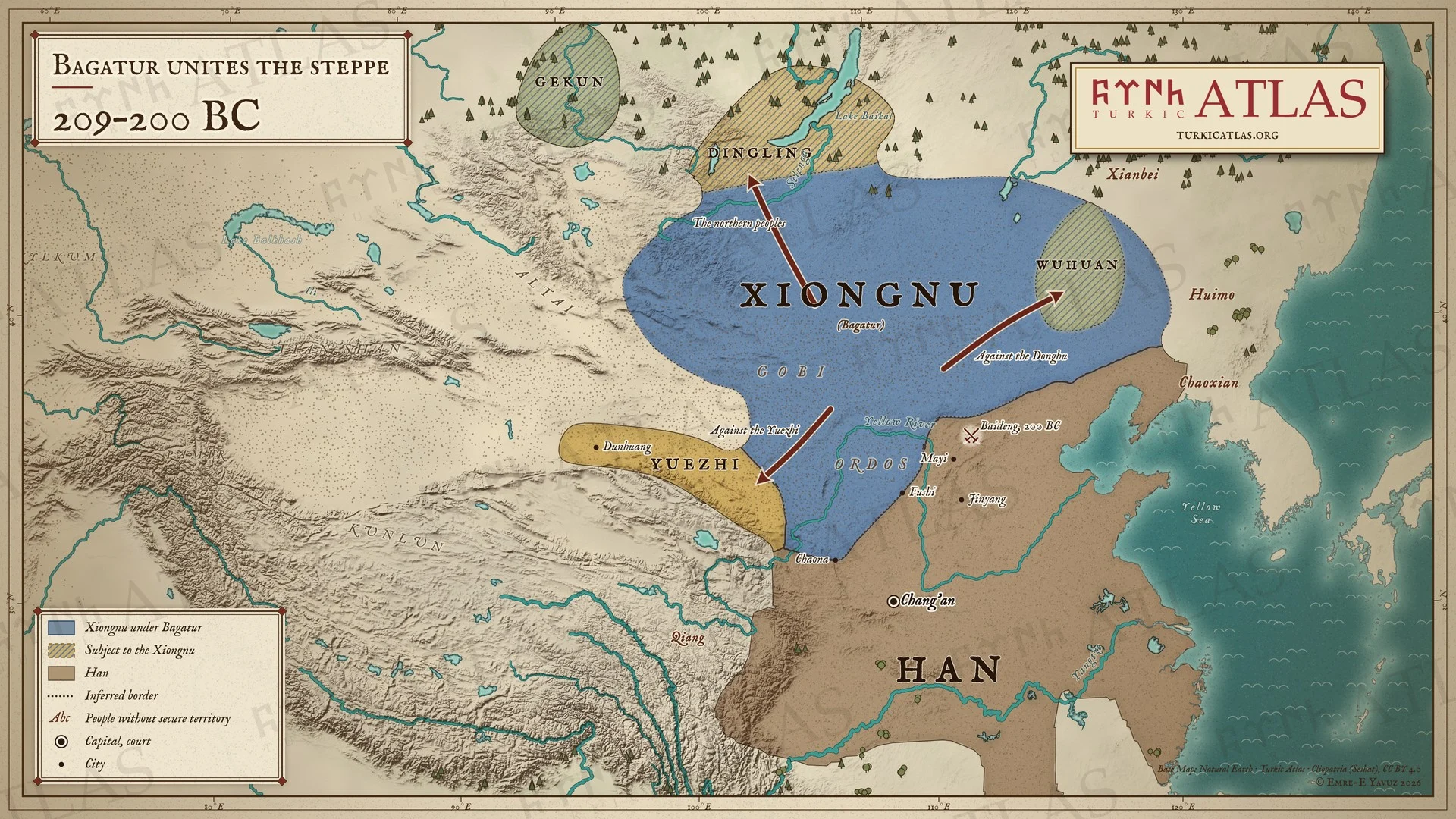
In the winter of 200 BC, Bagatur shut the first Han emperor up on the hill of Baideng for seven days. He had 400,000 picked horse against a Han army of 320,000.[1][2] The Han Shu has more than 300,000 picked horse.[3][4] Both figures are round numbers of the Han court, not counts. The Xiongnu figure probably stands for all the men fit to bear arms. The emperor got out. The heqin treaty followed: a Han princess for the chanyu, yearly gifts and an oath of brotherhood.[1] Under Wen and Jing, the Han renewed the treaty after each raid. It lasted until 133 BC.[3] In the spring of 182 BC, under the empress Lü, the Xiongnu struck at Didao and plundered Ayang. In the first month of 181 they plundered Didao again and carried off two thousand people.[5] In the fifth month of 177 BC the Right Worthy King entered the land south of the Yellow River and plundered the tribes that guarded the frontier posts of Shang commandery. Emperor Wen sent his chancellor Guan Ying against him with 85,000 chariots and horse, and the king withdrew beyond the frontier.[1][6] Some scholars explain the raid as an answer to Xiongnu who had gone over to the Han and held the border posts for them.[7]
Two modern interpretations put the wars in a wider frame. The first makes China the active partner. It holds that the frontier took its shape from Chinese growth, which came before the great nomadism of the steppe, and that the wall served to keep Chinese in as much as to keep nomads out.[8] The second holds that the early wars of the Han on the northern frontier were fought against the frontier commanders and not against the Xiongnu. The commanders went over to the Xiongnu when they were pressed. In that case where the court held its frontier governors closely, trade and war were likely to be combined as raiding and blackmail.[9]
The turn under Wudi
In 133 BC the Han hid 300,000 men round Mayi to trap the chanyu. He turned back when he saw cattle grazing without a herdsman.[1] After the ambush, the Xiongnu broke the heqin. They raided the frontier past counting.[1] In 129 BC four generals went out with 10,000 horse each. Only Wei Qing reached Longcheng, while Gongsun Ao lost 7,000 men.[1] In 127 BC Wei Qing took the land south of the Yellow River and built Shuofang on it.[1] This land is the Ordos.
The offensives, 124 to 119 BC
In 124 BC Wei Qing surrounded the Right Worthy King by night with six generals and more than 100,000 men. The king was drunk, because he thought the Han could not reach him. He escaped, and the Han took 15,000 of his people.[1]
In 121 BC Huo Qubing struck the Xiongnu of the west twice. That autumn the Hunye king killed the Xiutu king and came over to the Han with more than 40,000 people. The Shiji says that these people were given out as 100,000.[1] The annals of Wudi make Wuwei and Jiuquan commanderies of their land that year. They make Zhangye and Dunhuang, cut from the same land, commanderies in 111 BC. Other sources date the four commanderies of Hexi differently.[10][11] The Tang commentator Zhang Shoujie, citing the Xihe gushi, ascribes to the Xiongnu a song that mourns the two mountains: since they lost the Qilian mountains, their animals no longer multiply. Since they lost the Yanzhi mountains, their women have no colour in their faces.[1][12] Some scholars count two lasting consequences of the campaigns of 121 and 119 BC. The first is the loss of those pastures. The second is the loss of the land from the Hexi corridor to Lop Nor, where the Han then set up the Jiuquan commandery and cut the Xiongnu off from the Qiang.[13]
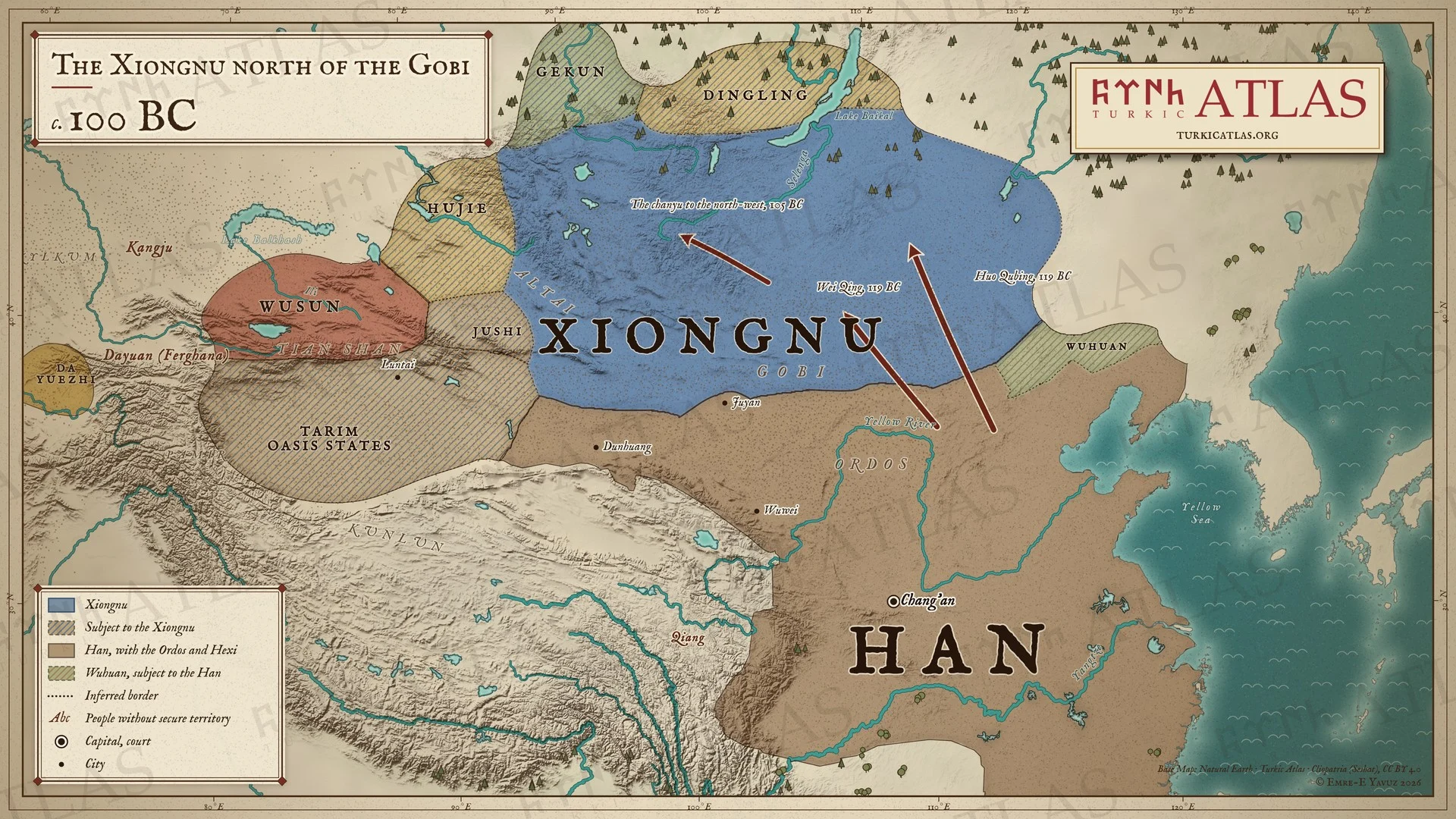
In the Mobei campaign of 119 BC, the Han put 100,000 horse and 140,000 spare mounts in the field.[1] The chanyu waited north of the desert. At dusk, in a gale, the Han wings closed on him. He broke out with a few hundred riders.[1] The Xiongnu then had no royal court south of the Gobi. However, the Han had lost more than 100,000 horses and could not go again.[1]
Attrition
In 103 BC, 80,000 Xiongnu horse cut off Zhao Ponu’s army, and the army was lost.[1] In 99 BC Li Guangli was surrounded and lost six or seven men in ten.[1] In 90 BC Li Guangli went out with 70,000 men. According to the Han Shu, he surrendered after a night attack.[3] The Han sent out no more armies. Wudi died three years later.[3]
The division of the Xiongnu
In 72 BC five Han armies and 50,000 Wusun horse went out. The Xiongnu escaped them.[3] The Xiongnu then lost three in ten of their people and five in ten of their herds to a snowstorm and to the Dingling, Wuhuan and Wusun.[3] From 57 BC rival chanyus fought each other. In 53 BC Huhanye, beaten by his brother, submitted to the Han against his ministers’ advice. Zhizhi went west.[3] In 36 BC Gan Yanshou and Chen Tang raised troops. They killed Zhizhi in Kangju.[3]
The end of the north
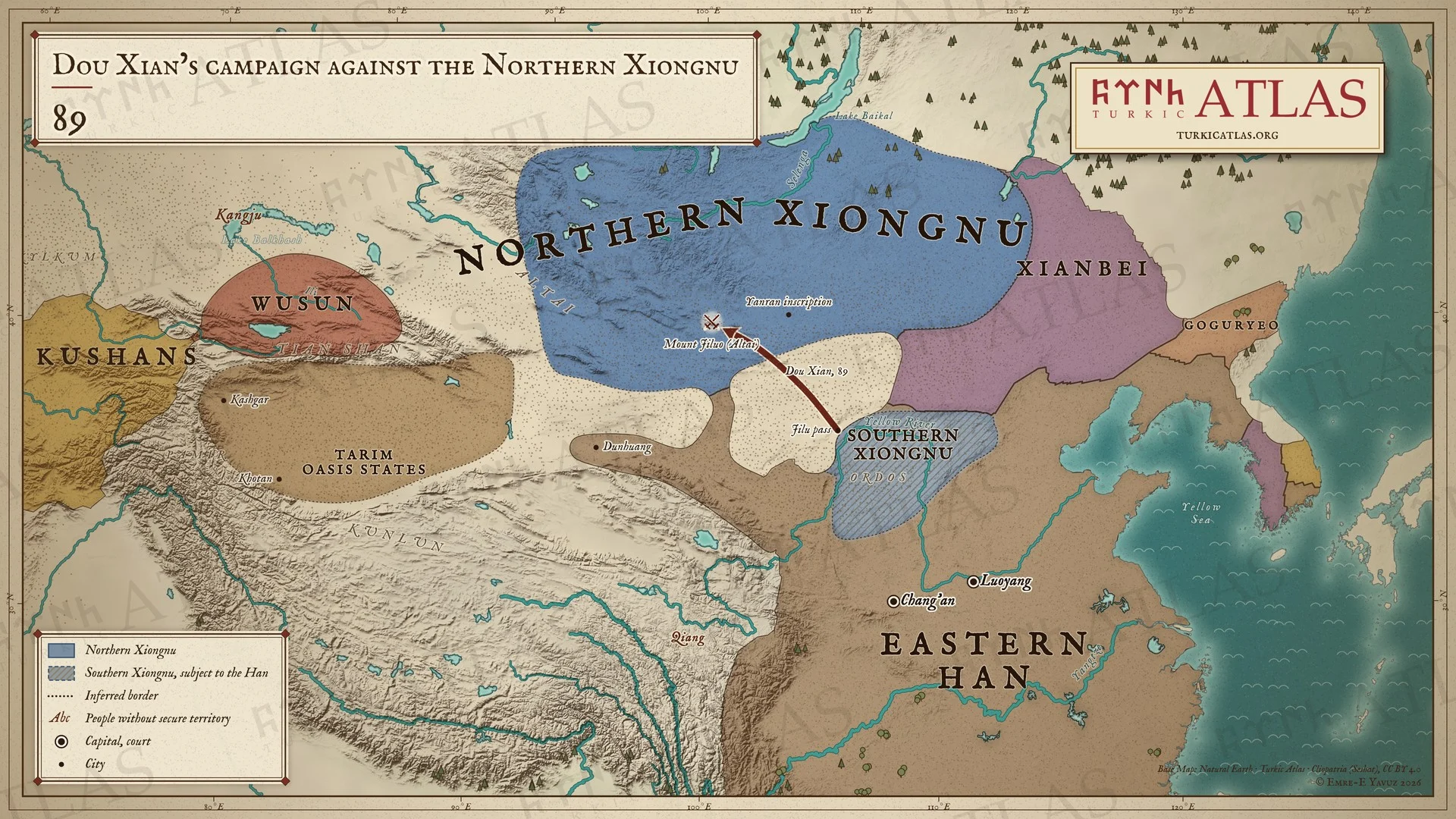
Between AD 89 and 91, Han and Southern Xiongnu armies broke the northern court. In AD 93 the last claimant was lured back across the frontier and beheaded. This is told in the Han campaigns against the Northern Xiongnu.[14] In the closing judgement of the Hou Han Shu, the chanyu fled to the land of the Wusun. The country north of the desert was empty.[14]
-
c. 215 BC Qin takes the Ordos
Around 215 BC the First Emperor of Qin sent Meng Tian north with a hundred thousand men. He took the land inside the great bend of the Yellow River, the Ordos, made the river the frontier and crossed it to hold the plain below the Yin mountains. According to the Shiji the Donghu north of Yan were strong at this time, and the Yuezhi flourished between Dunhuang and the Qilian mountains. The Xiongnu chanyu Duman could not withstand Qin and moved north. How far north, the source does not say. A second reading places the Qilian of this passage in the Tianshan; the hatched area shows it.
-
209–200 BC Modu unites the steppe
In 209 BC Modu killed his father Duman and became chanyu. Between the Xiongnu and the Donghu lay an empty strip more than a thousand li wide. When the Donghu demanded it, Modu struck east and destroyed their king. The Wuhuan held out at the Wuhuan mountain and paid the Xiongnu a yearly tribute of oxen, horses and sheepskins; the Xianbei withdrew far beyond the Liaodong frontier. Modu drove back the Yuezhi, took back the land Meng Tian had seized as far as Chaona and Fushi, and subjected the Hunyu, Qushe, Dingling, Gekun and Xinli in the north. In 200 BC he surrounded the Han emperor Gaozu for seven days on the hill of Baideng near Pingcheng.
-
176–c. 160 BC The height of the realm
In 176 BC Modu wrote to the Han court that the Wise King of the Right had destroyed the Yuezhi, and that Loulan, the Wusun, the Hujie and twenty-six states around them had all become Xiongnu: all the peoples who draw the bow were now one family. His son Laoshang killed the Yuezhi king and made a drinking cup of his skull. The Yuezhi left the Hexi and moved west into the land of the Saka. The Han Shu names a Xiongnu Commandant of Slaves who resided between Karashahr, Weixu and Weili and taxed the oasis states. In 162 BC the emperor Wendi confirmed the Long Wall as the line between the two realms. No source describes the northern edge of the realm in Tuva and beyond the Baikal.
-
127–121 BC The Han take the Ordos and the Hexi
In 127 BC the Han general Wei Qing drove the kings of the Loufan and the Baiyang out of the Ordos. Han founded Shuofang there and restored Meng Tian's wall along the river; in exchange it gave up the district of Zaoyang beyond Shanggu. In 123 BC the chanyu withdrew north across the Gobi on the advice of the defector Zhao Xin. In the spring and summer of 121 BC Huo Qubing struck into the Hexi corridor, and in the autumn the Hunye king killed the Xiutu king and went over to Han with more than forty thousand people. From then on, says the Shiji, the land from Jincheng and the Hexi west along the Southern Mountains to the Salt Marsh was empty of Xiongnu. By this time the Wusun held the land of the Saka, and the Yuezhi had moved on to the north bank of the Oxus.
-
119–c. 100 BC North of the Gobi
In 119 BC Wei Qing and Huo Qubing crossed the Gobi with separate armies. Huo Qubing marched more than two thousand li beyond Dai, sacrificed on Mount Langjuxu and turned back at the Hanhai. Afterwards, says the Shiji, there was no royal court south of the Gobi. Han settled soldiers and farmers from Shuofang west to Lingju and set up the commanderies of the Hexi, from Wuwei to Dunhuang; the Wuhuan were moved beyond the frontier of five eastern commanderies to watch the Xiongnu for Han. By 105 BC the chanyu had moved further north-west, his left wing facing Yunzhong and his right Jiuquan and Dunhuang. The southern edge of the realm ran somewhere in the Gobi.
-
60–51 BC The Western Regions lost, the realm divided
In 71 BC the Dingling struck the Xiongnu from the north, the Wuhuan from the east and the Wusun from the west, and the peoples bound to them fell away. In 60 BC the Rizhu king went over to Han. The Xiongnu Commandant of Slaves was abolished, and Zheng Ji became the first Protector-General of the Western Regions, with his seat at Wulei. In 57 BC five chanyus contended for the throne. In 54 BC Zhizhi took the royal court, and his younger brother Huhanye moved south to the Han frontier. In 51 BC Huhanye came before the emperor at Ganquan and was allowed to live below the Guanglu wall.
-
49–33 BC Zhizhi in the west, Huhanye in the north
Believing that Huhanye, weak and bound to Han, could not come back north, Zhizhi led his people west. He defeated the Wusun, received the surrender of the Wujie in the north, broke the Jiankun in the west and brought the Dingling under him, and made his seat in the land of the Jiankun. Around 44 BC he killed a Han envoy and went on to Kangju; of his people only three thousand arrived. In 36 BC the Protector-General Gan Yanshou and his deputy Chen Tang marched on Kangju and killed him. Huhanye meanwhile returned to the royal court in the north, and in 33 BC he received the palace lady Wang Zhaojun as his wife. From then on the land north of the Long Wall belonged to the Xiongnu again.
-
AD 48–50 Northern and Southern Xiongnu
Under Wang Mang the states of the Western Regions went over to the Xiongnu. In AD 48 the chiefs of eight southern tribes raised Bi, the Rizhu king, as chanyu under the name Huhanye; he came to the Wuyuan frontier and offered to shield Han against the northern Xiongnu for ever. The next year the northern chanyu fell back a thousand li. In AD 50 the southern court moved inside the frontier, first to Yunzhong and in the winter to Meiji in Xihe, and its chiefs were stationed along the frontier commanderies from Beidi to Dai. Beyond the Liaodong frontier the Xianbei sent their first envoys to Han in AD 49.
-
AD 87–93 The end of the Northern Xiongnu
In AD 87 the Xianbei entered the eastern lands of the Northern Xiongnu and killed the chanyu Youliu; fifty-eight tribes, two hundred thousand people, came to the frontier to surrender. In 89 Dou Xian marched out with the southern chanyu, defeated the northern chanyu at Mount Jiluo and had an inscription cut on Mount Yanran, more than three thousand li beyond the frontier. A rock inscription in the Gobi of central Mongolia is identified with this text; it lies much closer to the frontier than the figure of the source. In 91 Geng Kui defeated the northern chanyu at the Jinwei mountains, and the chanyu fled to the land of the Wusun. The Xianbei moved into the empty land, and more than a hundred thousand Xiongnu tents that stayed behind called themselves Xianbei.
-
c. AD 155–180 The Xianbei in the old Xiongnu land
The Xianbei leader Tanshihuai set his court on the Chuochou river below Mount Tanhan, more than three hundred li north of Gaoliu. According to the Hou Han Shu he raided the Han frontier in the south, held off the Dingling in the north, drove back the Fuyu in the east and struck the Wusun in the west, and held all the old Xiongnu land, fourteen thousand li from east to west. He divided it into an eastern, a central and a western part; the western reached Dunhuang and the Wusun. The Southern Xiongnu remained inside the Han frontier. One reckoning puts the last defeat of the Northern Xiongnu by the Xianbei in 155, a second puts their move west around 158; the hatched area north of Kangju shows where the second places them.
- Place named in a source (position as commonly identified)
- Position disputed or approximate
- Zone drawn after the Han histories
- Second reading or entirely uncertain position (hatched)
- People subject to the Xiongnu, or under Han protection
- Oasis states taxed by the Xiongnu
- Border that no source describes (drawn uncertain)
- Movement named in a source (route drawn)
References
- ^ a b c d e f g h i j k l m n o Shiji, juan 110
- ^ Ögel 2015, p. 281–286
- ^ a b c d e f g h Han Shu, juan 94
- ^ Ögel 2015, p. 285
- ^ Ögel 2015, p. 306
- ^ Ögel 2015, p. 307–309
- ^ Ögel 2015, p. 307
- ^ Lattimore 1951, p. 240, 460–461
- ^ Lattimore 1951, p. 467–468, 478–480
- ^ Han Shu, juan 6
- ^ Chavannes 1913, v–vi
- ^ Laufer 1919, p. 326
- ^ Sinor 1990, p. 130
- ^ a b Hou Han Shu, juan 89
Sources
- Shiji, juan 110
- Han Shu, juan 6, 94 (after Shiji)
- Hou Han Shu, juan 89
Literature
- Denis Sinor (ed.), The Cambridge History of Early Inner Asia (1990)
- Berthold Laufer, Sino-Iranica. Chinese Contributions to the History of Civilization in Ancient Iran (1919)
- Édouard Chavannes, Les documents chinois découverts par Aurel Stein dans les sables du Turkestan oriental (1913)
- Bahaeddin Ögel, Büyük Hun İmparatorluğu Tarihi I (2015)
- Owen Lattimore, Inner Asian Frontiers of China (1951)
What links here9
- Persons
- Emperor Wu of Han · Hunye King · Li Ling · Meng Tian · Su Wu · Wei Qing · Yizhixie Chanyu
- Places
- Jade Gate
- Controversies
- The Kirghiz descent from Li Ling
Cite this article
Yavuz, Emre-E. “The Xiongnu–Han Wars.” Turkic Atlas, revised 8 November 2026. https://turkicatlas.org/conflicts/xiongnu-han-wars/
Last revised: 8 November 2026

