
Сюннуско-ханьские войны — это войны между империей Хань и конфедерацией сюнну. Они длились от осады Байдэна в 200 году до н. э. до конца северного шаньюя в 93 году н. э.
Байдэн и хэцинь
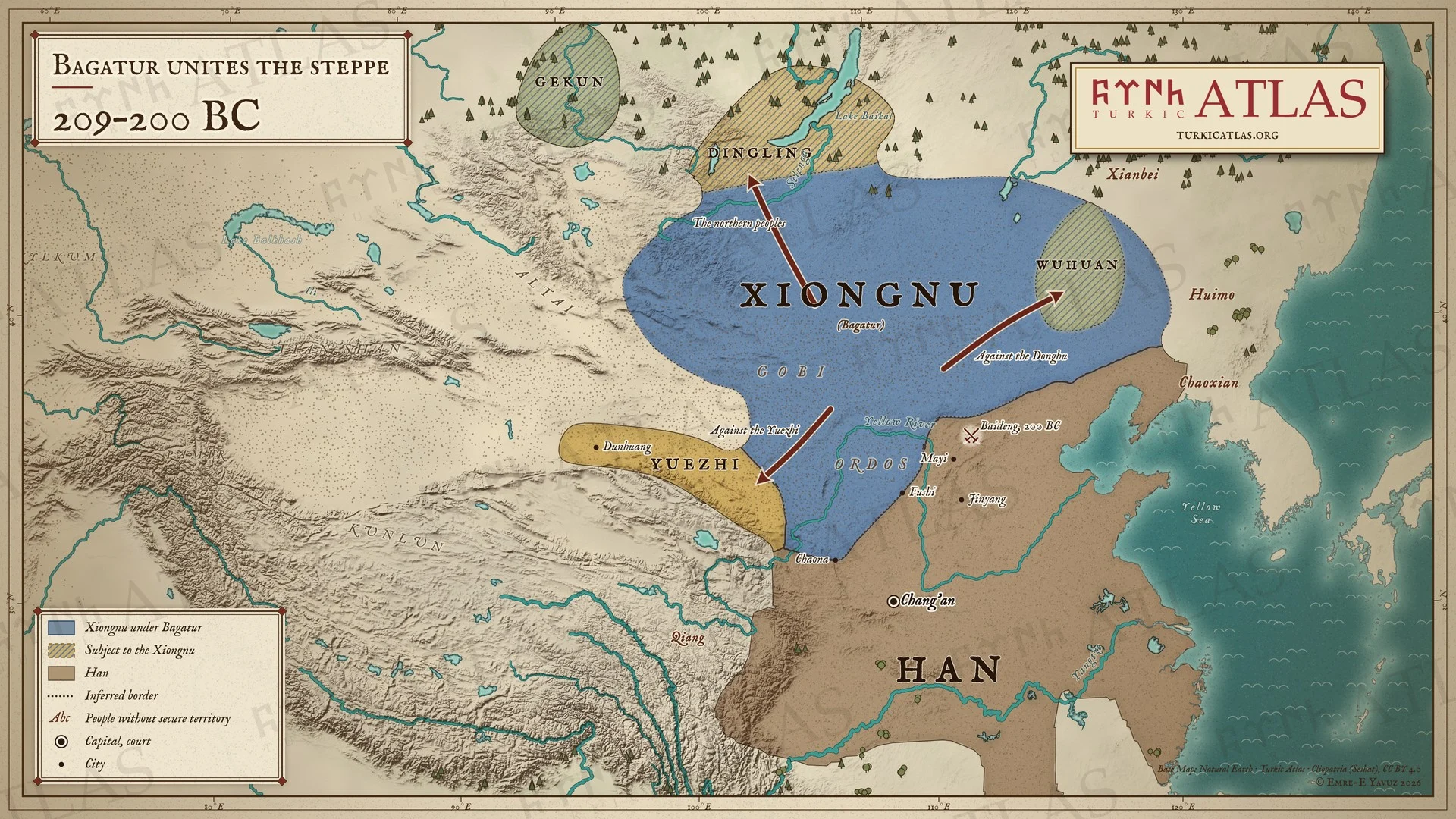
Зимой 200 года до н. э. Багатур запер первого ханьского императора на холме Байдэн на семь дней. У него было 400 000 отборных всадников против ханьской армии в 320 000.[1][2] «Хань шу» даёт более 300 000 отборных всадников.[3][4] Обе цифры — круглые числа ханьского двора, а не результат подсчёта. Цифра сюнну, вероятно, обозначает всех мужчин, способных носить оружие. Император выбрался. Затем последовал договор хэцинь: ханьская принцесса для шаньюя, ежегодные дары и клятва братства.[1] При императорах Вэне и Цзине Хань возобновляла договор после каждого набега. Он действовал до 133 года до н. э.[3] Весной 182 года до н. э., при императрице Люй (Lü), сюнну ударили по Дидао (Didao) и разграбили Аян (Ayang). В первом месяце 181 года они снова разграбили Дидао и увели две тысячи человек.[5] В пятом месяце 177 года до н. э. Мудрый ван правой стороны вошёл в землю к югу от Жёлтой реки и разграбил племена, охранявшие пограничные посты округа Шан (Shang). Император Вэнь послал против него своего канцлера Гуань Ина (Guan Ying) с 85 000 колесниц и всадников, и ван отошёл за границу.[1][6] Некоторые учёные объясняют набег ответом тем сюнну, которые перешли к Хань и держали для неё пограничные посты.[7]
Два современных толкования помещают войны в более широкую рамку. Первое делает активным партнёром Китай. Оно считает, что граница приняла свой вид из-за роста Китая, который предшествовал великому кочевничеству степи, и что стена служила тому, чтобы удерживать китайцев внутри, не меньше, чем тому, чтобы не пускать кочевников.[8] Второе считает, что ранние войны Хань на северной границе велись против пограничных военачальников, а не против сюнну. Военачальники переходили к сюнну, когда их теснили. В том случае, когда двор держал своих пограничных наместников под строгим надзором, торговля и война, вероятно, сочетались в виде набегов и шантажа.[9]
Перелом при У-ди
В 133 году до н. э. Хань укрыла 300 000 человек вокруг Маи, чтобы поймать шаньюя в ловушку. Он повернул назад, увидев скот, пасущийся без пастуха.[1] После засады сюнну порвали хэцинь. Они совершали набеги на границу без счёта.[1] В 129 году до н. э. четыре полководца вышли в поход, у каждого было по 10 000 всадников. Только Вэй Цин (Wei Qing) дошёл до Лунчэна (Longcheng), а Гунсунь Ао (Gongsun Ao) потерял 7 000 человек.[1] В 127 году до н. э. Вэй Цин занял землю к югу от Жёлтой реки и построил на ней Шофан (Shuofang).[1] Эта земля — Ордос.
Наступления 124–119 годов до н. э.
В 124 году до н. э. Вэй Цин окружил Мудрого вана правой стороны ночью, с шестью полководцами и более чем 100 000 человек. Ван был пьян, потому что считал, что ханьцы не смогут до него добраться. Он ускользнул, а ханьцы взяли 15 000 его людей.[1]
В 121 году до н. э. Хо Цюйбин (Huo Qubing) дважды ударил по сюнну запада. Той осенью ван Хунье (Hunye) убил вана Сюту (Xiutu) и перешёл к Хань с более чем 40 000 человек. «Ши цзи» говорит, что этих людей выдавали за 100 000.[1] Анналы У-ди делают Увэй (Wuwei) и Цзюцюань (Jiuquan) округами из их земли в тот же год. Чжанъе (Zhangye) и Дуньхуан, вырезанные из той же земли, они делают округами в 111 году до н. э. Другие источники датируют четыре округа Хэси (Hexi) иначе.[10][11] Танский комментатор Чжан Шоуцзе (Zhang Shoujie), ссылаясь на «Сихэ гуши» (Xihe gushi), приписывает сюнну песню, оплакивающую две горы: с тех пор как они потеряли горы Цилянь, их скот больше не размножается. С тех пор как они потеряли горы Яньчжи, у их женщин нет цвета на лицах.[1][12] Некоторые учёные насчитывают два долговременных последствия походов 121 и 119 годов до н. э. Первое — потеря этих пастбищ. Второе — потеря земли от коридора Хэси до Лобнора, где Хань затем учредила округ Цзюцюань и отрезала сюнну от цянов.[13]
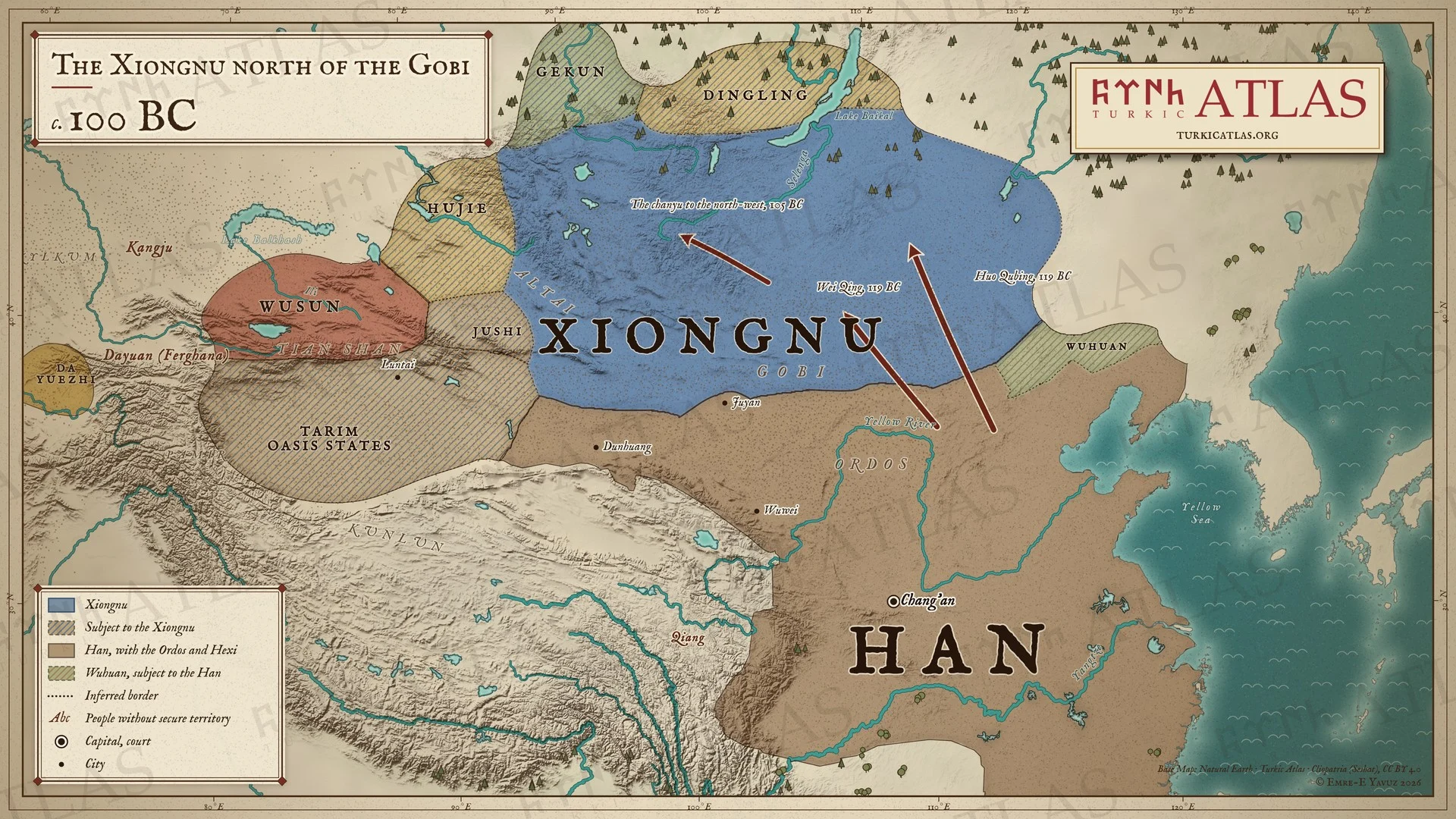
В Мобэйском походе 119 года до н. э. Хань выставила 100 000 всадников и 140 000 запасных коней.[1] Шаньюй ждал к северу от пустыни. В сумерках, в бурю, ханьские крылья сомкнулись на нём. Он прорвался с несколькими сотнями всадников.[1] После этого у сюнну не осталось царского двора к югу от Гоби. Однако Хань потеряла более 100 000 лошадей и не смогла выступить снова.[1]
Изнурение
В 103 году до н. э. 80 000 всадников сюнну отрезали армию Чжао Пону (Zhao Ponu), и армия была потеряна.[1] В 99 году до н. э. Ли Гуанли (Li Guangli) был окружён и потерял шесть или семь человек из десяти.[1] В 90 году до н. э. Ли Гуанли вышел в поход с 70 000 человек. По «Хань шу», он сдался после ночного нападения.[3] Хань больше не посылала армий. У-ди умер три года спустя.[3]
Раскол сюнну
В 72 году до н. э. вышли пять ханьских армий и 50 000 всадников усуней. Сюнну ушли от них.[3] Затем сюнну потеряли три десятых своих людей и пять десятых своих стад из-за снежной бури и из-за динлинов, ухуаней и усуней.[3] С 57 года до н. э. соперничающие шаньюи сражались друг с другом. В 53 году до н. э. Хуханье, побеждённый своим братом, подчинился Хань вопреки совету своих министров. Чжичжи ушёл на запад.[3] В 36 году до н. э. Гань Яньшоу (Gan Yanshou) и Чэнь Тан (Chen Tang) подняли войска. Они убили Чжичжи в Кангюе.[3]
Конец севера
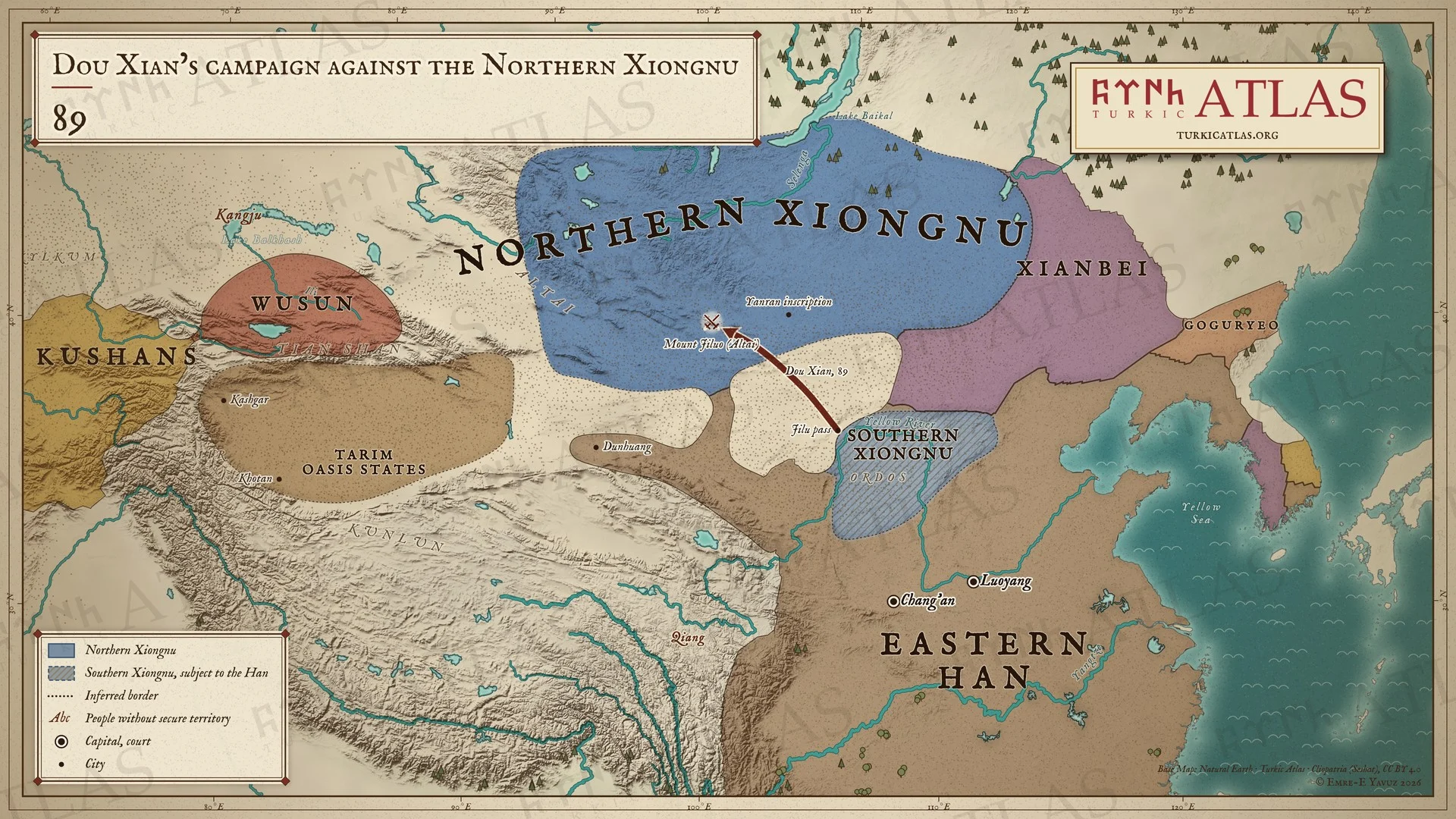
Между 89 и 91 годами н. э. армии Хань и Южных сюнну сокрушили северный двор. В 93 году н. э. последний претендент был заманен обратно через границу и обезглавлен. Об этом рассказывается в Ханьских походах против северных сюнну.[14] В заключительной оценке «Хоу Хань шу» шаньюй бежал в землю усуней. Страна к северу от пустыни была пуста.[14]
-
c. 215 BC Qin takes the Ordos
Around 215 BC the First Emperor of Qin sent Meng Tian north with a hundred thousand men. He took the land inside the great bend of the Yellow River, the Ordos, made the river the frontier and crossed it to hold the plain below the Yin mountains. According to the Shiji the Donghu north of Yan were strong at this time, and the Yuezhi flourished between Dunhuang and the Qilian mountains. The Xiongnu chanyu Duman could not withstand Qin and moved north. How far north, the source does not say. A second reading places the Qilian of this passage in the Tianshan; the hatched area shows it.
-
209–200 BC Modu unites the steppe
In 209 BC Modu killed his father Duman and became chanyu. Between the Xiongnu and the Donghu lay an empty strip more than a thousand li wide. When the Donghu demanded it, Modu struck east and destroyed their king. The Wuhuan held out at the Wuhuan mountain and paid the Xiongnu a yearly tribute of oxen, horses and sheepskins; the Xianbei withdrew far beyond the Liaodong frontier. Modu drove back the Yuezhi, took back the land Meng Tian had seized as far as Chaona and Fushi, and subjected the Hunyu, Qushe, Dingling, Gekun and Xinli in the north. In 200 BC he surrounded the Han emperor Gaozu for seven days on the hill of Baideng near Pingcheng.
-
176–c. 160 BC The height of the realm
In 176 BC Modu wrote to the Han court that the Wise King of the Right had destroyed the Yuezhi, and that Loulan, the Wusun, the Hujie and twenty-six states around them had all become Xiongnu: all the peoples who draw the bow were now one family. His son Laoshang killed the Yuezhi king and made a drinking cup of his skull. The Yuezhi left the Hexi and moved west into the land of the Saka. The Han Shu names a Xiongnu Commandant of Slaves who resided between Karashahr, Weixu and Weili and taxed the oasis states. In 162 BC the emperor Wendi confirmed the Long Wall as the line between the two realms. No source describes the northern edge of the realm in Tuva and beyond the Baikal.
-
127–121 BC The Han take the Ordos and the Hexi
In 127 BC the Han general Wei Qing drove the kings of the Loufan and the Baiyang out of the Ordos. Han founded Shuofang there and restored Meng Tian's wall along the river; in exchange it gave up the district of Zaoyang beyond Shanggu. In 123 BC the chanyu withdrew north across the Gobi on the advice of the defector Zhao Xin. In the spring and summer of 121 BC Huo Qubing struck into the Hexi corridor, and in the autumn the Hunye king killed the Xiutu king and went over to Han with more than forty thousand people. From then on, says the Shiji, the land from Jincheng and the Hexi west along the Southern Mountains to the Salt Marsh was empty of Xiongnu. By this time the Wusun held the land of the Saka, and the Yuezhi had moved on to the north bank of the Oxus.
-
119–c. 100 BC North of the Gobi
In 119 BC Wei Qing and Huo Qubing crossed the Gobi with separate armies. Huo Qubing marched more than two thousand li beyond Dai, sacrificed on Mount Langjuxu and turned back at the Hanhai. Afterwards, says the Shiji, there was no royal court south of the Gobi. Han settled soldiers and farmers from Shuofang west to Lingju and set up the commanderies of the Hexi, from Wuwei to Dunhuang; the Wuhuan were moved beyond the frontier of five eastern commanderies to watch the Xiongnu for Han. By 105 BC the chanyu had moved further north-west, his left wing facing Yunzhong and his right Jiuquan and Dunhuang. The southern edge of the realm ran somewhere in the Gobi.
-
60–51 BC The Western Regions lost, the realm divided
In 71 BC the Dingling struck the Xiongnu from the north, the Wuhuan from the east and the Wusun from the west, and the peoples bound to them fell away. In 60 BC the Rizhu king went over to Han. The Xiongnu Commandant of Slaves was abolished, and Zheng Ji became the first Protector-General of the Western Regions, with his seat at Wulei. In 57 BC five chanyus contended for the throne. In 54 BC Zhizhi took the royal court, and his younger brother Huhanye moved south to the Han frontier. In 51 BC Huhanye came before the emperor at Ganquan and was allowed to live below the Guanglu wall.
-
49–33 BC Zhizhi in the west, Huhanye in the north
Believing that Huhanye, weak and bound to Han, could not come back north, Zhizhi led his people west. He defeated the Wusun, received the surrender of the Wujie in the north, broke the Jiankun in the west and brought the Dingling under him, and made his seat in the land of the Jiankun. Around 44 BC he killed a Han envoy and went on to Kangju; of his people only three thousand arrived. In 36 BC the Protector-General Gan Yanshou and his deputy Chen Tang marched on Kangju and killed him. Huhanye meanwhile returned to the royal court in the north, and in 33 BC he received the palace lady Wang Zhaojun as his wife. From then on the land north of the Long Wall belonged to the Xiongnu again.
-
AD 48–50 Northern and Southern Xiongnu
Under Wang Mang the states of the Western Regions went over to the Xiongnu. In AD 48 the chiefs of eight southern tribes raised Bi, the Rizhu king, as chanyu under the name Huhanye; he came to the Wuyuan frontier and offered to shield Han against the northern Xiongnu for ever. The next year the northern chanyu fell back a thousand li. In AD 50 the southern court moved inside the frontier, first to Yunzhong and in the winter to Meiji in Xihe, and its chiefs were stationed along the frontier commanderies from Beidi to Dai. Beyond the Liaodong frontier the Xianbei sent their first envoys to Han in AD 49.
-
AD 87–93 The end of the Northern Xiongnu
In AD 87 the Xianbei entered the eastern lands of the Northern Xiongnu and killed the chanyu Youliu; fifty-eight tribes, two hundred thousand people, came to the frontier to surrender. In 89 Dou Xian marched out with the southern chanyu, defeated the northern chanyu at Mount Jiluo and had an inscription cut on Mount Yanran, more than three thousand li beyond the frontier. A rock inscription in the Gobi of central Mongolia is identified with this text; it lies much closer to the frontier than the figure of the source. In 91 Geng Kui defeated the northern chanyu at the Jinwei mountains, and the chanyu fled to the land of the Wusun. The Xianbei moved into the empty land, and more than a hundred thousand Xiongnu tents that stayed behind called themselves Xianbei.
-
c. AD 155–180 The Xianbei in the old Xiongnu land
The Xianbei leader Tanshihuai set his court on the Chuochou river below Mount Tanhan, more than three hundred li north of Gaoliu. According to the Hou Han Shu he raided the Han frontier in the south, held off the Dingling in the north, drove back the Fuyu in the east and struck the Wusun in the west, and held all the old Xiongnu land, fourteen thousand li from east to west. He divided it into an eastern, a central and a western part; the western reached Dunhuang and the Wusun. The Southern Xiongnu remained inside the Han frontier. One reckoning puts the last defeat of the Northern Xiongnu by the Xianbei in 155, a second puts their move west around 158; the hatched area north of Kangju shows where the second places them.
- Place named in a source (position as commonly identified)
- Position disputed or approximate
- Zone drawn after the Han histories
- Second reading or entirely uncertain position (hatched)
- People subject to the Xiongnu, or under Han protection
- Oasis states taxed by the Xiongnu
- Border that no source describes (drawn uncertain)
- Movement named in a source (route drawn)
Примечания
- ^ a b c d e f g h i j k l m n o Shiji, juan 110
- ^ Ögel 2015, p. 281–286
- ^ a b c d e f g h Han Shu, juan 94
- ^ Ögel 2015, p. 285
- ^ Ögel 2015, p. 306
- ^ Ögel 2015, p. 307–309
- ^ Ögel 2015, p. 307
- ^ Lattimore 1951, p. 240, 460–461
- ^ Lattimore 1951, p. 467–468, 478–480
- ^ Han Shu, juan 6
- ^ Chavannes 1913, v–vi
- ^ Laufer 1919, p. 326
- ^ Sinor 1990, p. 130
- ^ a b Hou Han Shu, juan 89
Источники
- Shiji, juan 110
- Han Shu, juan 6, 94 (after Shiji)
- Hou Han Shu, juan 89
Литература
- Denis Sinor (ed.), The Cambridge History of Early Inner Asia (1990)
- Berthold Laufer, Sino-Iranica. Chinese Contributions to the History of Civilization in Ancient Iran (1919)
- Édouard Chavannes, Les documents chinois découverts par Aurel Stein dans les sables du Turkestan oriental (1913)
- Bahaeddin Ögel, Büyük Hun İmparatorluğu Tarihi I (2015)
- Owen Lattimore, Inner Asian Frontiers of China (1951)
Ссылки сюда9
- Личности
- Emperor Wu of Han · Hunye King · Li Ling · Meng Tian · Su Wu · Wei Qing · Yizhixie Chanyu
- Places
- Jade Gate
- Controversies
- The Kirghiz descent from Li Ling
Процитировать статью
Yavuz, Emre-E. “Сюннуско-ханьские войны.” Turkic Atlas, revised 20 November 2026. https://turkicatlas.org/conflicts/xiongnu-han-wars/
Last revised: 20 November 2026

