
Хунн-Хань согуштары Хань империясы менен хунндар (сюнну) конфедерациясынын ортосундагы согуштар болгон. Алар б.з.ч. 200-жылдагы Байдэн курчоосунан б.з. 93-жылы түндүк шаньюйдун аякташына чейин созулду.
Байдэн жана хэцинь
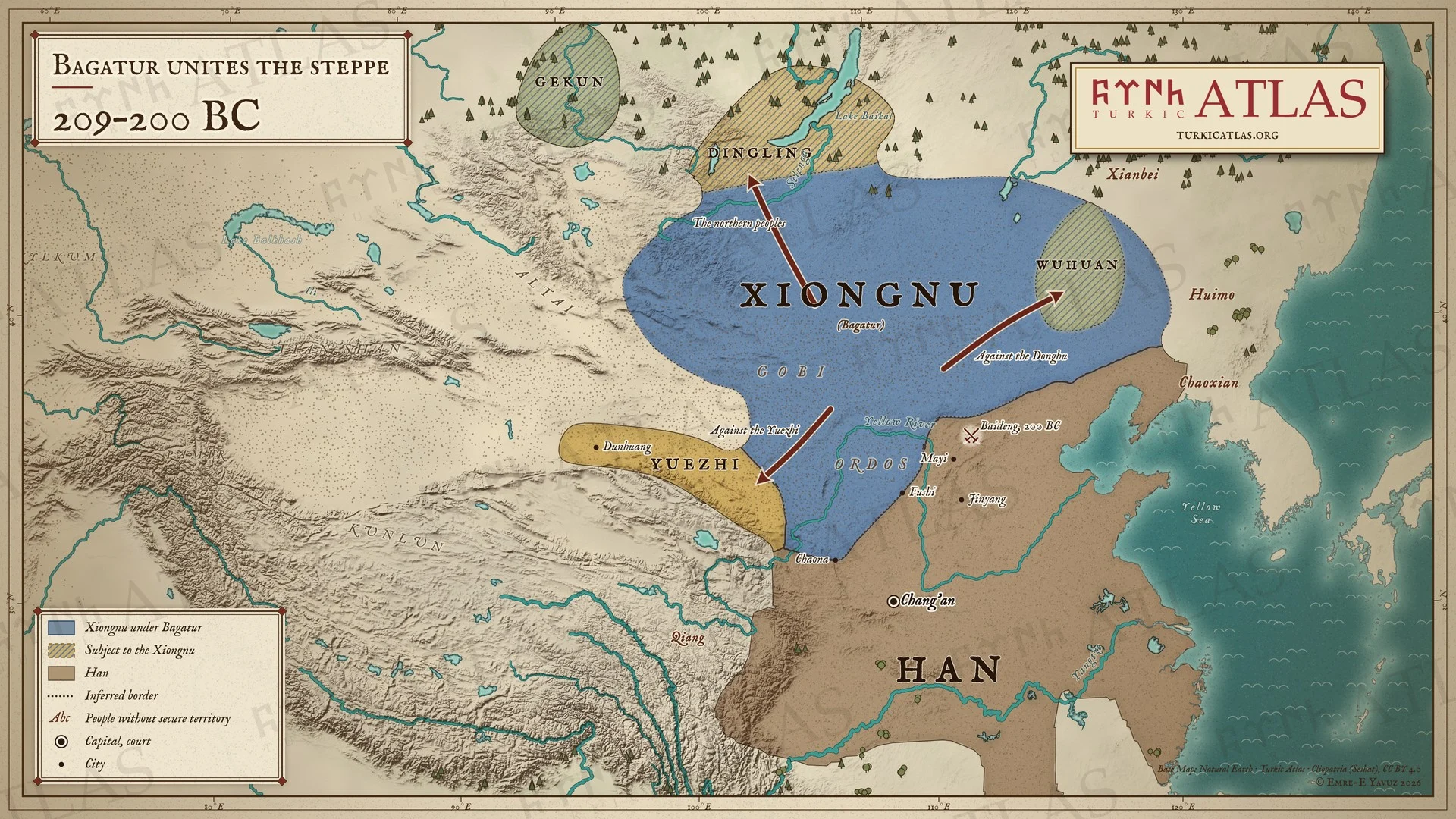
Б.з.ч. 200-жылдын кышында Багатур биринчи Хань императорун Байдэн дөбөсүндө жети күн камап койду. Анын 320 000 кишилик Хань аскерине каршы 400 000 тандалма атчаны болгон.[1][2] Хань шуда 300 000ден ашык тандалма атчан бар.[3][4] Эки сан тең Хань сарайынын тегерек сандары, саноо эмес. Хунн саны, балким, курал көтөрүүгө жарамдуу бардык эркектерди билдирет. Император чыгып кетти. Андан кийин хэцинь келишими болду: шаньюйга Хань ханбийкеси, жыл сайынкы белектер жана бир туугандык анты.[1] Вэнь менен Цзин тушунда Хань ар бир чабуулдан кийин келишимди жаңыртып турду. Ал б.з.ч. 133-жылга чейин созулду.[3] Б.з.ч. 182-жылдын жазында, императрица Люй тушунда, хунндар Дидаого сокку уруп, Аянды тоноду. 181-жылдын биринчи айында алар Дидаону кайра тоноп, эки миң адамды айдап кетти.[5] Б.з.ч. 177-жылдын бешинчи айында Оң Татыктуу Падыша Сары дарыянын түштүгүндөгү жерге кирип, Шан округунун чек ара посттарын сакташкан тоболорду тоноду. Император Вэнь ага каршы канцлери Гуань Инди 85 000 арба жана атчан менен жиберди, ал эми падыша чек арадан ары чегинди.[1][6] Бир окуу чабуулду Ханьга өткөн жана алар үчүн чек ара посттарын кармаган хунндарга жооп катары түшүндүрөт.[7]
Эки заманбап окуу согуштарды кененирээк рамкага коёт. Биринчиси Кытайды активдүү өнөктөш кылат. Ал чек ара кытайлардын өсүшүнөн форма алган деп эсептейт, ал өсүш талаанын улуу көчмөнчүлүгүнөн мурун болгон, ал эми дубал көчмөндөрдү сыртта кармаганчалык эле кытайларды ичте кармоого кызмат кылган.[8] Экинчиси Ханьдын түндүк чек арадагы алгачкы согуштары хунндарга каршы эмес, чек ара колбашчыларына каршы жүргүзүлгөн деп эсептейт. Колбашчылар кысылганда хунндарга өтүшкөн. Бул окууда сарай чек ара губернаторлорун жакындан кармаган жерде соода менен согуш чабуул жана шантаж катары айкалышып кетчү.[9]
У-ди тушундагы бурулуш
Б.з.ч. 133-жылы Хань шаньюйду тузакка түшүрүү үчүн Маи тегерегине 300 000 кишини жашырды. Ал жайылып жүргөн малды малчысыз көргөндө артка бурулду.[1] Буктурмадан кийин хунндар хэциньди үзүштү. Алар чек араны эсепсиз тоноду.[1] Б.з.ч. 129-жылы төрт генерал ар бири 10 000 атчан менен чыкты. Лунчэнге жалгыз Вэй Цин жетти, ал эми Гунсунь Ао 7 000 кишисин жоготту.[1] Б.з.ч. 127-жылы Вэй Цин Сары дарыянын түштүгүндөгү жерди алып, ага Шофанды курду.[1] Бул жер Ордос.
Чабуулдар, б.з.ч. 124-жылдан 119-жылга чейин
Б.з.ч. 124-жылы Вэй Цин алты генерал жана 100 000ден ашык киши менен Оң Татыктуу Падышаны түнкүсүн курчады. Падыша мас болгон, анткени ал Хань ага жетпейт деп ойлогон. Ал качып кетти, ал эми Хань анын 15 000 кишисин алды.[1]
Б.з.ч. 121-жылы Хо Цюйбин батыштагы хунндарга эки жолу сокку урду. Ошол күздө Хунье падышасы Сюту падышасын өлтүрүп, 40 000ден ашык киши менен Ханьга өттү. Шицзи бул кишилер 100 000 деп чыгарылганын айтат.[1] У-динин жылнаамасы ошол жылы алардын жеринен Увэй менен Цзюцюань округдарын түзөт. Ал бир эле жерден кесилген Чжанье менен Дуньхуанды б.з.ч. 111-жылы округ кылат. Башка булактар Хэсинин төрт округун башкача даталайт.[10][11] Таң комментатору Чжан Шоуцзе, Сихэ гушини келтирип, хунндарга эки тоону кайгырган ырды таандык кылат: Цилянь тоолорун жоготкондон бери малдары мындан ары көбөйбөйт. Яньчжи тоолорун жоготкондон бери аялдарынын жүзүндө түс жок.[1][12] Бир окуу б.з.ч. 121 жана 119-жылдардагы жүрүштөрдүн эки туруктуу кесепетин санайт. Биринчиси ошол жайыттардын жоголушу. Экинчиси Хэси коридорунан Лобнорго чейинки жердин жоголушу, ал жерде Хань Цзюцюань округун түзүп, хунндарды цяндардан ажыратты.[13]
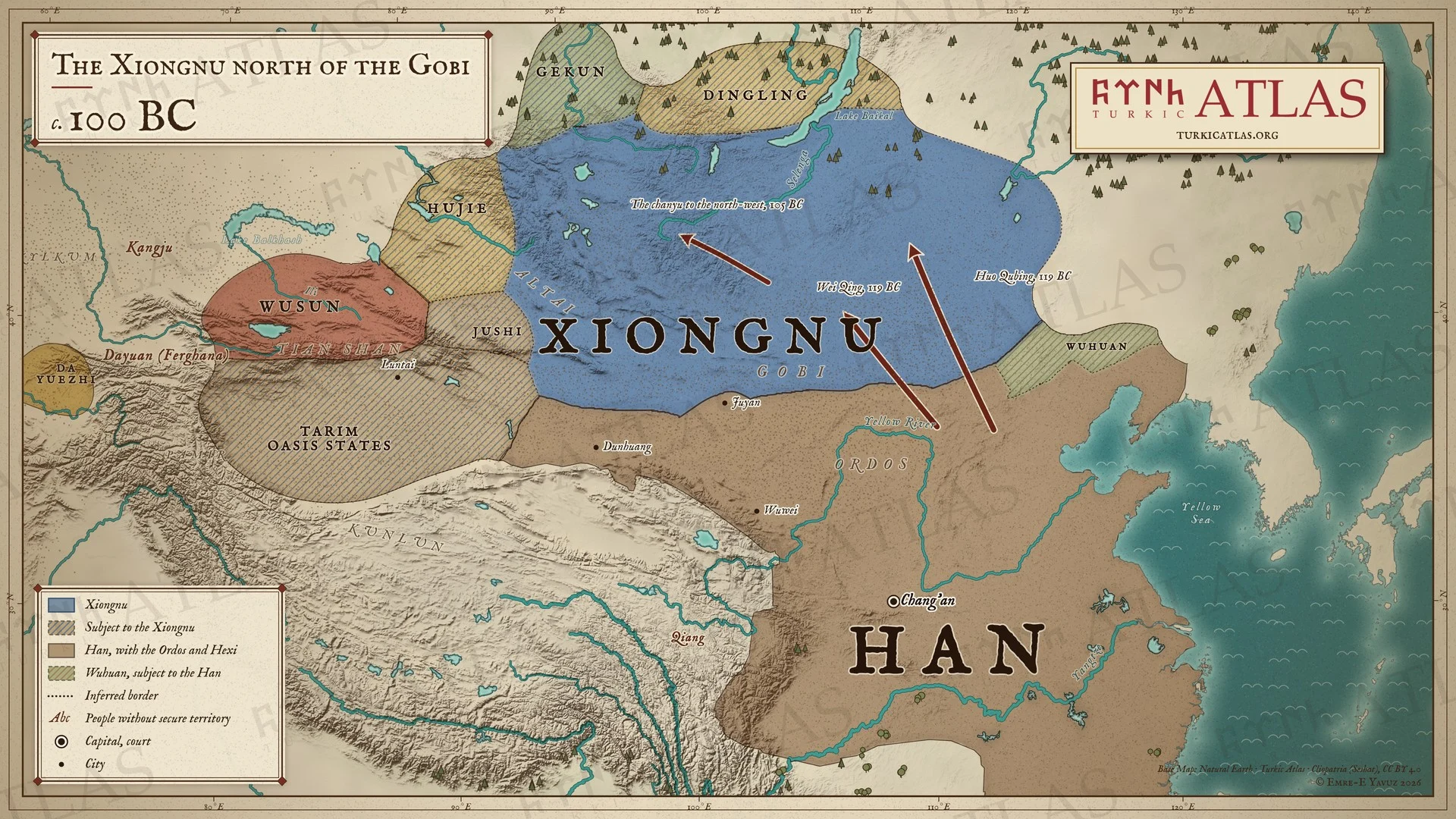
Б.з.ч. 119-жылдагы Мобэй жүрүшүндө Хань талаага 100 000 атчан жана 140 000 запас ат чыгарды.[1] Шаньюй чөлдүн түндүгүндө күттү. Кечки жарыкта, бороондо Хань канаттары ага жабылды. Ал бир нече жүз атчан менен жарып чыкты.[1] Андан кийин хунндардын Гобинин түштүгүндө падышалык сарайы калган жок. Бирок Хань 100 000ден ашык жылкы жоготкон жана кайра чыга алган жок.[1]
Тозуу
Б.з.ч. 103-жылы 80 000 хунн атчаны Чжао Понунун аскерин кесип өттү жана аскер жок болду.[1] Б.з.ч. 99-жылы Ли Гуанли курчалып, ондон алты же жети кишисин жоготту.[1] Б.з.ч. 90-жылы Ли Гуанли 70 000 киши менен чыкты. Хань шу боюнча ал түнкү чабуулдан кийин багынды.[3] Хань мындан ары аскер жиберген жок. У-ди үч жылдан кийин өлдү.[3]
Хунндардын бөлүнүшү
Б.з.ч. 72-жылы беш Хань аскери жана 50 000 усун атчаны чыкты. Хунндар алардан кутулуп кетти.[3] Андан кийин хунндар элинин ондон үчүн жана малынын ондон бешин кар бороонуна жана динлиндерге, ухуандарга жана усундарга жоготту.[3] Б.з.ч. 57-жылдан атаандаш шаньюйлар бири-бири менен согушту. Б.з.ч. 53-жылы иниси жеңген Хуханье министрлеринин кеңешине каршы Ханьга багынды. Чжичжи батышка кетти.[3] Б.з.ч. 36-жылы Гань Яньшоу менен Чэнь Тан аскер чогултушту. Алар Чжичжини Кангюйда өлтүрүштү.[3]
Түндүктүн аякташы
Б.з. 89-жылдан 91-жылга чейин Хань жана Түштүк хунндар аскерлери түндүк сарайды талкалады. Б.з. 93-жылы акыркы дооматчы чек арадан кайра азгырылып, башы кесилди. Бул Ханьдын түндүк хунндарга каршы жүрүштөрүндө баяндалат.[14] Хоу Хань шунун жыйынтык баасында шаньюй усундардын жерине качты. Чөлдүн түндүгүндөгү өлкө бош болчу.[14]
-
c. 215 BC Qin takes the Ordos
Around 215 BC the First Emperor of Qin sent Meng Tian north with a hundred thousand men. He took the land inside the great bend of the Yellow River, the Ordos, made the river the frontier and crossed it to hold the plain below the Yin mountains. According to the Shiji the Donghu north of Yan were strong at this time, and the Yuezhi flourished between Dunhuang and the Qilian mountains. The Xiongnu chanyu Duman could not withstand Qin and moved north. How far north, the source does not say. A second reading places the Qilian of this passage in the Tianshan; the hatched area shows it.
-
209–200 BC Modu unites the steppe
In 209 BC Modu killed his father Duman and became chanyu. Between the Xiongnu and the Donghu lay an empty strip more than a thousand li wide. When the Donghu demanded it, Modu struck east and destroyed their king. The Wuhuan held out at the Wuhuan mountain and paid the Xiongnu a yearly tribute of oxen, horses and sheepskins; the Xianbei withdrew far beyond the Liaodong frontier. Modu drove back the Yuezhi, took back the land Meng Tian had seized as far as Chaona and Fushi, and subjected the Hunyu, Qushe, Dingling, Gekun and Xinli in the north. In 200 BC he surrounded the Han emperor Gaozu for seven days on the hill of Baideng near Pingcheng.
-
176–c. 160 BC The height of the realm
In 176 BC Modu wrote to the Han court that the Wise King of the Right had destroyed the Yuezhi, and that Loulan, the Wusun, the Hujie and twenty-six states around them had all become Xiongnu: all the peoples who draw the bow were now one family. His son Laoshang killed the Yuezhi king and made a drinking cup of his skull. The Yuezhi left the Hexi and moved west into the land of the Saka. The Han Shu names a Xiongnu Commandant of Slaves who resided between Karashahr, Weixu and Weili and taxed the oasis states. In 162 BC the emperor Wendi confirmed the Long Wall as the line between the two realms. No source describes the northern edge of the realm in Tuva and beyond the Baikal.
-
127–121 BC The Han take the Ordos and the Hexi
In 127 BC the Han general Wei Qing drove the kings of the Loufan and the Baiyang out of the Ordos. Han founded Shuofang there and restored Meng Tian's wall along the river; in exchange it gave up the district of Zaoyang beyond Shanggu. In 123 BC the chanyu withdrew north across the Gobi on the advice of the defector Zhao Xin. In the spring and summer of 121 BC Huo Qubing struck into the Hexi corridor, and in the autumn the Hunye king killed the Xiutu king and went over to Han with more than forty thousand people. From then on, says the Shiji, the land from Jincheng and the Hexi west along the Southern Mountains to the Salt Marsh was empty of Xiongnu. By this time the Wusun held the land of the Saka, and the Yuezhi had moved on to the north bank of the Oxus.
-
119–c. 100 BC North of the Gobi
In 119 BC Wei Qing and Huo Qubing crossed the Gobi with separate armies. Huo Qubing marched more than two thousand li beyond Dai, sacrificed on Mount Langjuxu and turned back at the Hanhai. Afterwards, says the Shiji, there was no royal court south of the Gobi. Han settled soldiers and farmers from Shuofang west to Lingju and set up the commanderies of the Hexi, from Wuwei to Dunhuang; the Wuhuan were moved beyond the frontier of five eastern commanderies to watch the Xiongnu for Han. By 105 BC the chanyu had moved further north-west, his left wing facing Yunzhong and his right Jiuquan and Dunhuang. The southern edge of the realm ran somewhere in the Gobi.
-
60–51 BC The Western Regions lost, the realm divided
In 71 BC the Dingling struck the Xiongnu from the north, the Wuhuan from the east and the Wusun from the west, and the peoples bound to them fell away. In 60 BC the Rizhu king went over to Han. The Xiongnu Commandant of Slaves was abolished, and Zheng Ji became the first Protector-General of the Western Regions, with his seat at Wulei. In 57 BC five chanyus contended for the throne. In 54 BC Zhizhi took the royal court, and his younger brother Huhanye moved south to the Han frontier. In 51 BC Huhanye came before the emperor at Ganquan and was allowed to live below the Guanglu wall.
-
49–33 BC Zhizhi in the west, Huhanye in the north
Believing that Huhanye, weak and bound to Han, could not come back north, Zhizhi led his people west. He defeated the Wusun, received the surrender of the Wujie in the north, broke the Jiankun in the west and brought the Dingling under him, and made his seat in the land of the Jiankun. Around 44 BC he killed a Han envoy and went on to Kangju; of his people only three thousand arrived. In 36 BC the Protector-General Gan Yanshou and his deputy Chen Tang marched on Kangju and killed him. Huhanye meanwhile returned to the royal court in the north, and in 33 BC he received the palace lady Wang Zhaojun as his wife. From then on the land north of the Long Wall belonged to the Xiongnu again.
-
AD 48–50 Northern and Southern Xiongnu
Under Wang Mang the states of the Western Regions went over to the Xiongnu. In AD 48 the chiefs of eight southern tribes raised Bi, the Rizhu king, as chanyu under the name Huhanye; he came to the Wuyuan frontier and offered to shield Han against the northern Xiongnu for ever. The next year the northern chanyu fell back a thousand li. In AD 50 the southern court moved inside the frontier, first to Yunzhong and in the winter to Meiji in Xihe, and its chiefs were stationed along the frontier commanderies from Beidi to Dai. Beyond the Liaodong frontier the Xianbei sent their first envoys to Han in AD 49.
-
AD 87–93 The end of the Northern Xiongnu
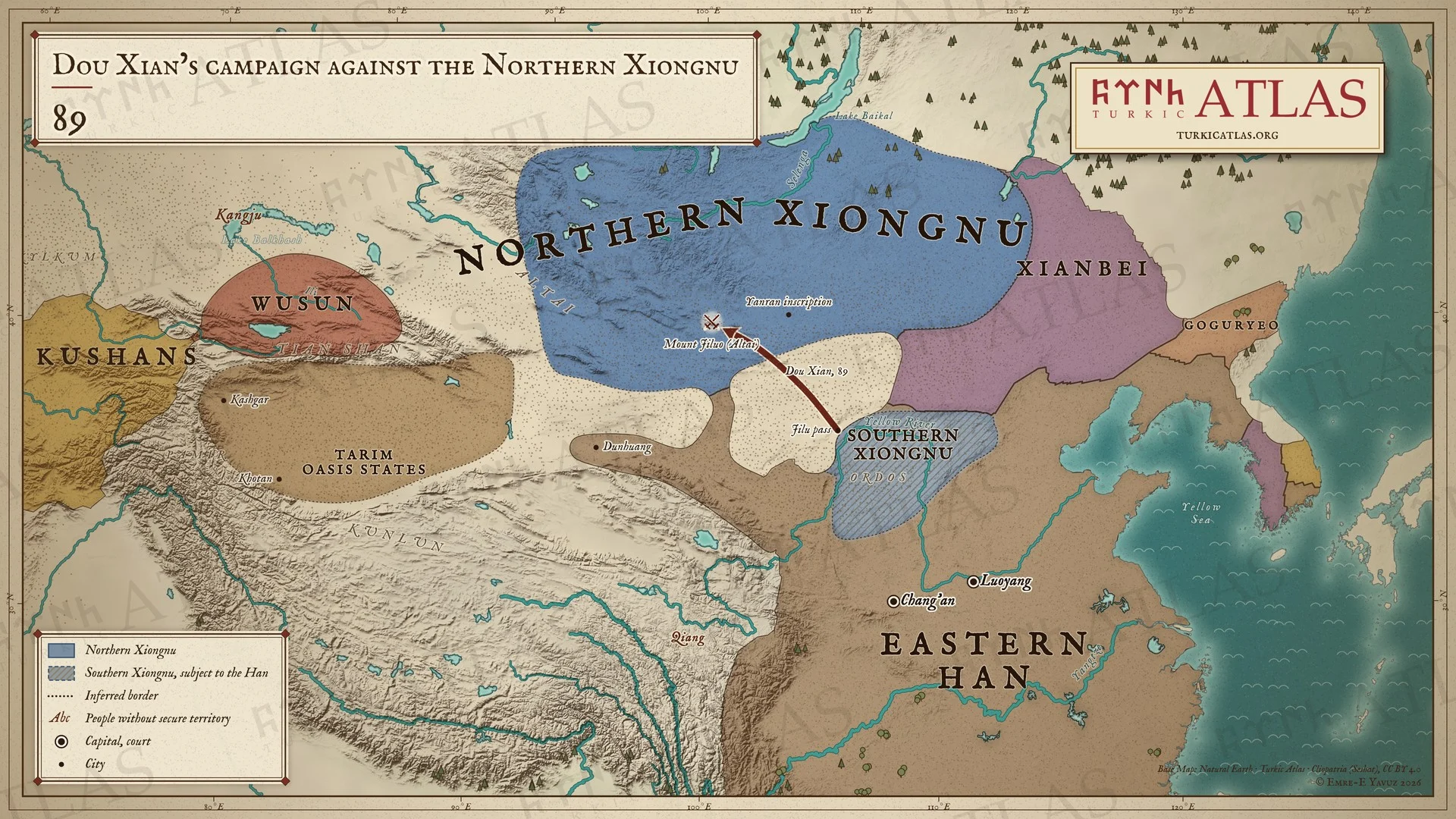
In AD 87 the Xianbei entered the eastern lands of the Northern Xiongnu and killed the chanyu Youliu; fifty-eight tribes, two hundred thousand people, came to the frontier to surrender. In 89 Dou Xian marched out with the southern chanyu, defeated the northern chanyu at Mount Jiluo and had an inscription cut on Mount Yanran, more than three thousand li beyond the frontier. A rock inscription in the Gobi of central Mongolia is identified with this text; it lies much closer to the frontier than the figure of the source. In 91 Geng Kui defeated the northern chanyu at the Jinwei mountains, and the chanyu fled to the land of the Wusun. The Xianbei moved into the empty land, and more than a hundred thousand Xiongnu tents that stayed behind called themselves Xianbei.
-
c. AD 155–180 The Xianbei in the old Xiongnu land
The Xianbei leader Tanshihuai set his court on the Chuochou river below Mount Tanhan, more than three hundred li north of Gaoliu. According to the Hou Han Shu he raided the Han frontier in the south, held off the Dingling in the north, drove back the Fuyu in the east and struck the Wusun in the west, and held all the old Xiongnu land, fourteen thousand li from east to west. He divided it into an eastern, a central and a western part; the western reached Dunhuang and the Wusun. The Southern Xiongnu remained inside the Han frontier. One reckoning puts the last defeat of the Northern Xiongnu by the Xianbei in 155, a second puts their move west around 158; the hatched area north of Kangju shows where the second places them.
- Place named in a source (position as commonly identified)
- Position disputed or approximate
- Zone drawn after the Han histories
- Second reading or entirely uncertain position (hatched)
- People subject to the Xiongnu, or under Han protection
- Oasis states taxed by the Xiongnu
- Border that no source describes (drawn uncertain)
- Movement named in a source (route drawn)
Эскертүүлөр
- ^ a b c d e f g h i j k l m n o Shiji, juan 110
- ^ Ögel 2015, p. 281–286
- ^ a b c d e f g h Han Shu, juan 94
- ^ Ögel 2015, p. 285
- ^ Ögel 2015, p. 306
- ^ Ögel 2015, p. 307–309
- ^ Ögel 2015, p. 307
- ^ Lattimore 1951, p. 240, 460–461
- ^ Lattimore 1951, p. 467–468, 478–480
- ^ Han Shu, juan 6
- ^ Chavannes 1913, v–vi
- ^ Laufer 1919, p. 326
- ^ Sinor 1990, p. 130
- ^ a b Hou Han Shu, juan 89
Булактар
- Shiji, juan 110
- Han Shu, juan 6, 94 (after Shiji)
- Hou Han Shu, juan 89
Адабият
- Denis Sinor (ed.), The Cambridge History of Early Inner Asia (1990)
- Berthold Laufer, Sino-Iranica. Chinese Contributions to the History of Civilization in Ancient Iran (1919)
- Édouard Chavannes, Les documents chinois découverts par Aurel Stein dans les sables du Turkestan oriental (1913)
- Bahaeddin Ögel, Büyük Hun İmparatorluğu Tarihi I (2015)
- Owen Lattimore, Inner Asian Frontiers of China (1951)
What links here9
- Persons
- Emperor Wu of Han · Hunye King · Li Ling · Meng Tian · Su Wu · Wei Qing · Yizhixie Chanyu
- Places
- Jade Gate
- Controversies
- The Kirghiz descent from Li Ling
Cite this article
Yavuz, Emre-E. “Хунн-Хань согуштары.” Turkic Atlas, revised 8 November 2026. https://turkicatlas.org/conflicts/xiongnu-han-wars/
Last revised: 8 November 2026

