
Les guerres entre les Xiongnu et les Han furent les guerres entre l’empire des Han et la confédération des Xiongnu. Elles durèrent du siège de Baideng en 200 av. J.-C. à la fin du chanyu du nord en 93 apr. J.-C.
Baideng et le heqin
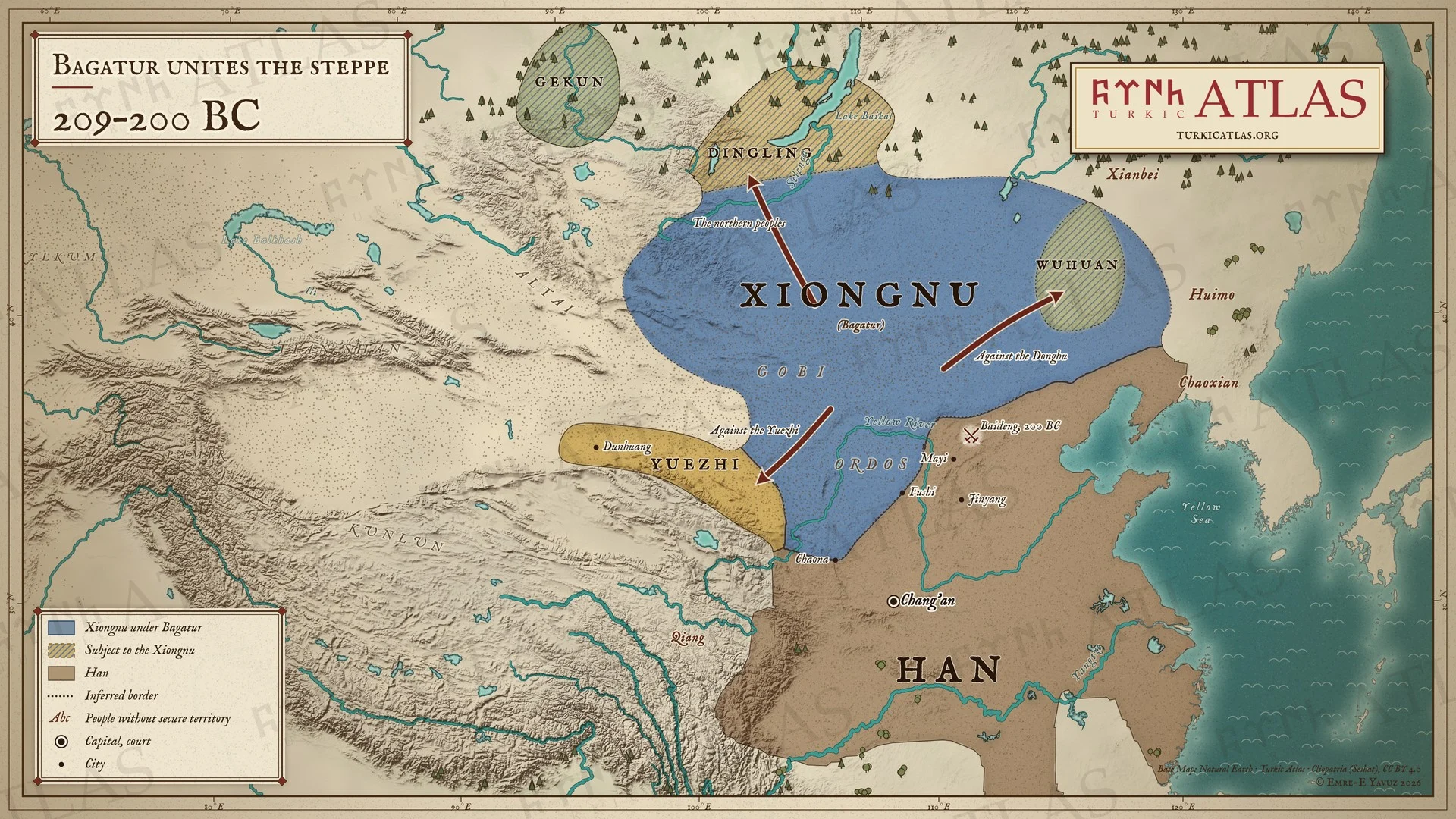
À l’hiver de 200 av. J.-C., Bagatur enferma le premier empereur han sur la colline de Baideng pendant sept jours. Il avait 400 000 cavaliers d’élite contre une armée han de 320 000 hommes.[1][2] Le Han Shu donne plus de 300 000 cavaliers d’élite.[3][4] Les deux chiffres sont des chiffres ronds de la cour des Han, non des dénombrements. Le chiffre xiongnu représente probablement tous les hommes aptes à porter les armes. L’empereur s’en sortit. Le traité de heqin suivit : une princesse han pour le chanyu, des présents annuels et un serment de fraternité.[1] Sous Wen et Jing, les Han renouvelèrent le traité après chaque raid. Il dura jusqu’en 133 av. J.-C.[3] Au printemps de 182 av. J.-C., sous l’impératrice Lü, les Xiongnu frappèrent Didao et pillèrent Ayang. Au premier mois de 181, ils pillèrent de nouveau Didao et emmenèrent deux mille personnes.[5] Au cinquième mois de 177 av. J.-C., le roi sage de droite entra dans la terre au sud du fleuve Jaune et pilla les tribus qui gardaient les postes frontières de la commanderie de Shang. L’empereur Wen envoya contre lui son chancelier Guan Ying avec 85 000 chars et cavaliers, et le roi se retira au-delà de la frontière.[1][6] Certains savants expliquent le raid comme une réponse à des Xiongnu passés aux Han et qui tenaient pour eux les postes frontières.[7]
Deux interprétations modernes placent les guerres dans un cadre plus large. La première fait de la Chine le partenaire actif. Elle tient que la frontière prit sa forme de la croissance chinoise, qui précéda le grand nomadisme de la steppe, et que la muraille servait autant à retenir les Chinois à l’intérieur qu’à tenir les nomades dehors.[8] La seconde tient que les premières guerres des Han sur la frontière nord furent menées contre les commandants frontaliers et non contre les Xiongnu. Les commandants passaient aux Xiongnu quand ils étaient pressés. Dans ce cas, là où la cour tenait de près ses gouverneurs frontaliers, le commerce et la guerre avaient des chances de se combiner en raids et en chantage.[9]
Le tournant sous Wudi
En 133 av. J.-C., les Han cachèrent 300 000 hommes autour de Mayi pour prendre le chanyu au piège. Il fit demi-tour quand il vit du bétail paître sans gardien.[1] Après l’embuscade, les Xiongnu rompirent le heqin. Ils pillèrent la frontière sans que l’on pût compter les raids.[1] En 129 av. J.-C., quatre généraux sortirent avec 10 000 cavaliers chacun. Seul Wei Qing atteignit Longcheng, tandis que Gongsun Ao perdit 7 000 hommes.[1] En 127 av. J.-C., Wei Qing prit la terre au sud du fleuve Jaune et y bâtit Shuofang.[1] Cette terre est l’Ordos.
Les offensives, de 124 à 119 av. J.-C.
En 124 av. J.-C., Wei Qing encercla de nuit le roi sage de droite avec six généraux et plus de 100 000 hommes. Le roi était ivre, parce qu’il pensait que les Han ne pouvaient l’atteindre. Il s’échappa, et les Han prirent 15 000 de ses gens.[1]
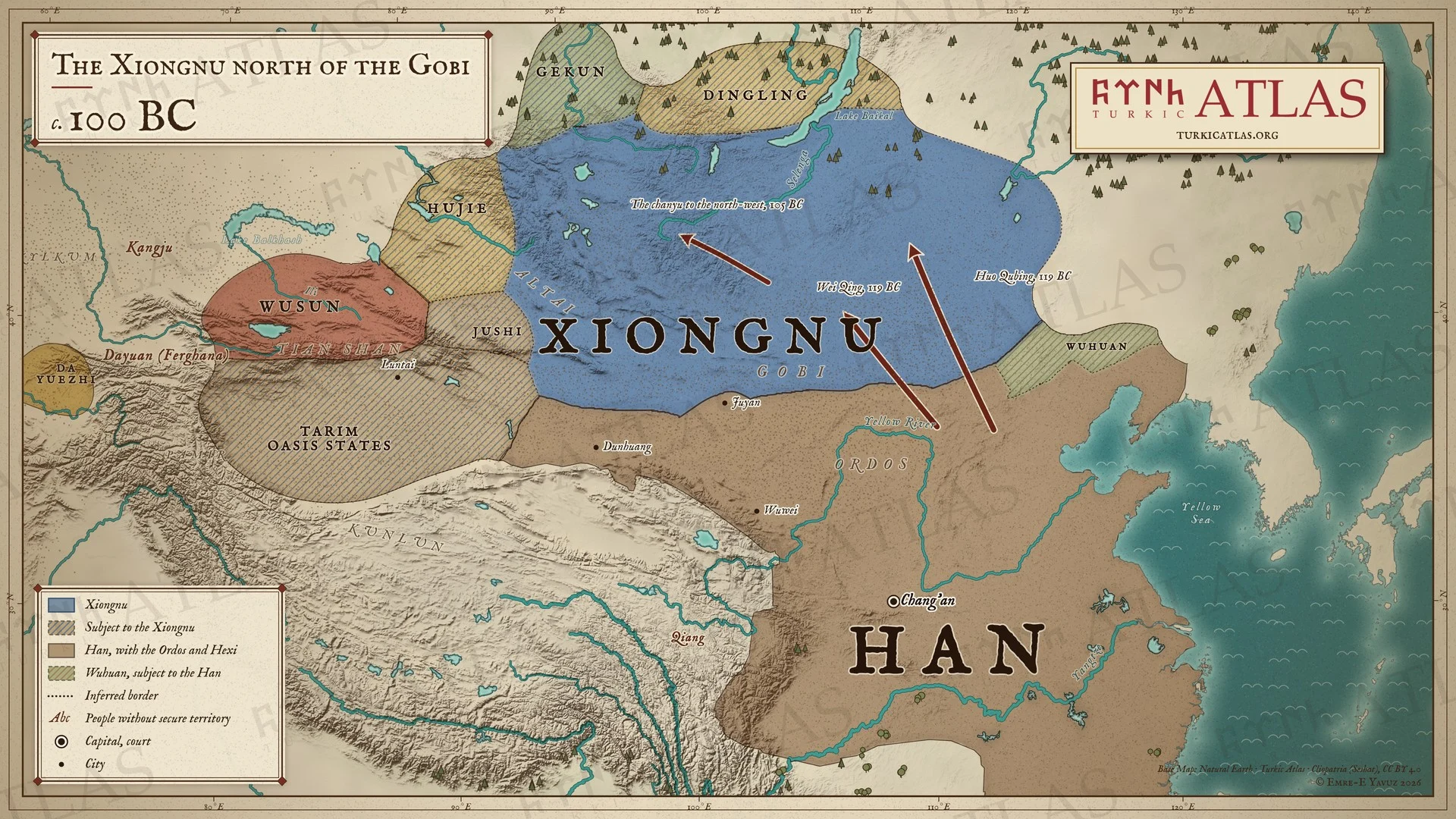
En 121 av. J.-C., Huo Qubing frappa deux fois les Xiongnu de l’ouest. Cet automne-là, le roi de Hunye tua le roi de Xiutu et passa aux Han avec plus de 40 000 personnes. Le Shiji dit que ces gens furent donnés pour 100 000.[1] Les annales de Wudi font de Wuwei et de Jiuquan des commanderies de leur terre cette année-là. Elles font de Zhangye et de Dunhuang, taillées dans la même terre, des commanderies en 111 av. J.-C. D’autres sources datent autrement les quatre commanderies du Hexi.[10][11] Le commentateur des Tang Zhang Shoujie, citant le Xihe gushi, attribue aux Xiongnu un chant qui pleure les deux montagnes : depuis qu’ils ont perdu les monts Qilian, leurs bêtes ne se multiplient plus. Depuis qu’ils ont perdu les monts Yanzhi, leurs femmes n’ont plus de couleur au visage.[1][12] Certains savants comptent deux conséquences durables des campagnes de 121 et de 119 av. J.-C. La première est la perte de ces pâturages. La seconde est la perte de la terre allant du couloir du Hexi au Lop Nor, où les Han établirent ensuite la commanderie de Jiuquan et coupèrent les Xiongnu des Qiang.[13]
Lors de la campagne de Mobei de 119 av. J.-C., les Han mirent en campagne 100 000 cavaliers et 140 000 montures de rechange.[1] Le chanyu attendait au nord du désert. Au crépuscule, dans une tempête, les ailes des Han se refermèrent sur lui. Il s’échappa avec quelques centaines de cavaliers.[1] Les Xiongnu n’eurent alors plus de cour royale au sud du Gobi. Mais les Han avaient perdu plus de 100 000 chevaux et ne pouvaient pas repartir.[1]
Usure
En 103 av. J.-C., 80 000 cavaliers xiongnu coupèrent l’armée de Zhao Ponu, et l’armée fut perdue.[1] En 99 av. J.-C., Li Guangli fut encerclé et perdit six ou sept hommes sur dix.[1] En 90 av. J.-C., Li Guangli sortit avec 70 000 hommes. Selon le Han Shu, il se rendit après une attaque de nuit.[3] Les Han n’envoyèrent plus d’armées. Wudi mourut trois ans plus tard.[3]
La division des Xiongnu
En 72 av. J.-C., cinq armées han et 50 000 cavaliers wusun sortirent. Les Xiongnu leur échappèrent.[3] Les Xiongnu perdirent alors trois dixièmes de leur population et cinq dixièmes de leurs troupeaux, à cause d’une tempête de neige et des Dingling, des Wuhuan et des Wusun.[3] À partir de 57 av. J.-C., des chanyus rivaux se combattirent. En 53 av. J.-C., Huhanye, battu par son frère, se soumit aux Han contre l’avis de ses ministres. Zhizhi partit vers l’ouest.[3] En 36 av. J.-C., Gan Yanshou et Chen Tang levèrent des troupes. Ils tuèrent Zhizhi à Kangju.[3]
La fin du nord
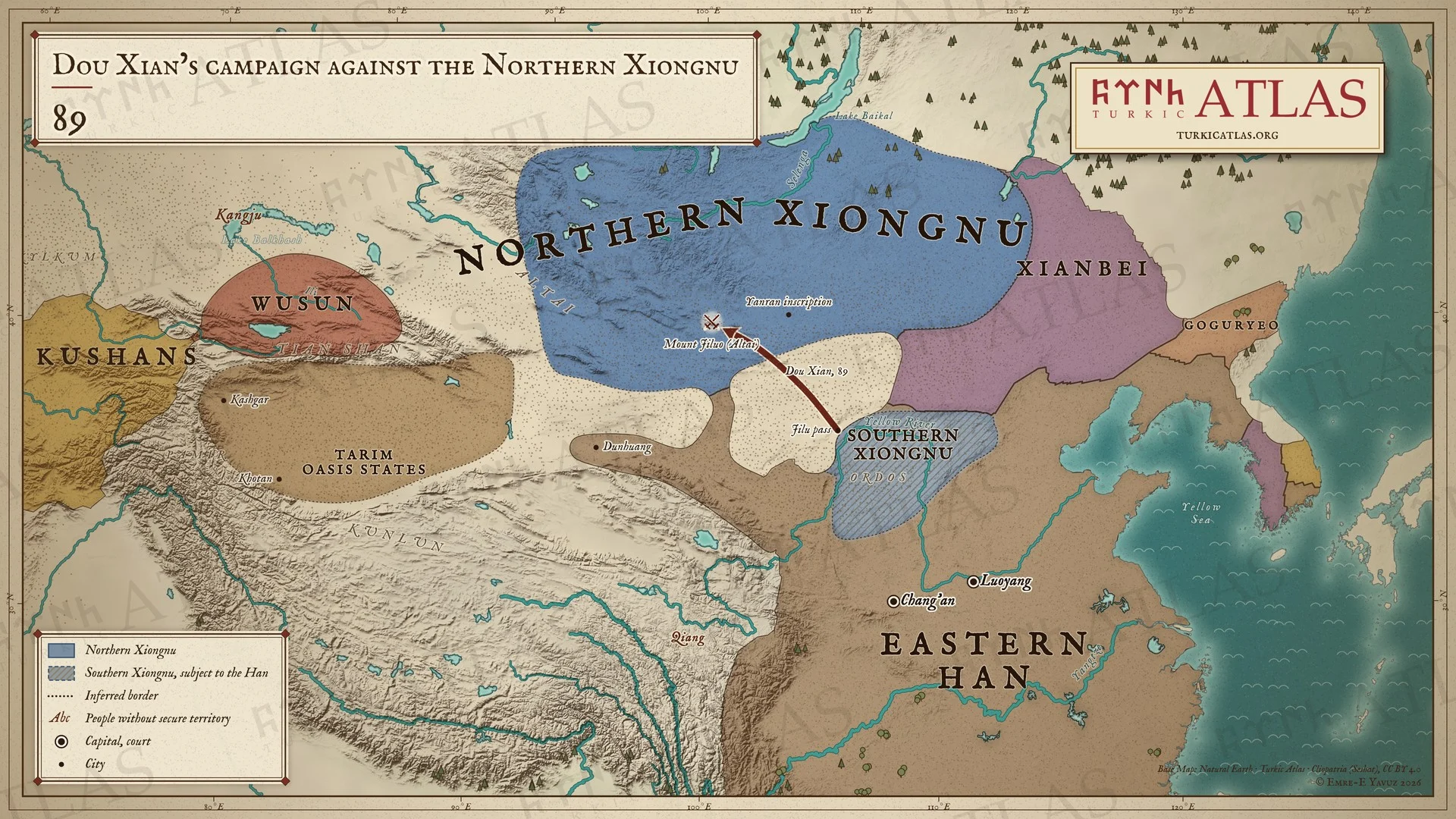
Entre 89 et 91 apr. J.-C., des armées des Han et des Xiongnu du Sud brisèrent la cour du nord. En 93 apr. J.-C., le dernier prétendant fut attiré de nouveau de l’autre côté de la frontière et décapité. Cela est raconté dans les campagnes des Han contre les Xiongnu du Nord.[14] Dans le jugement final du Hou Han Shu, le chanyu s’enfuit au pays des Wusun. Le pays au nord du désert était vide.[14]
-
c. 215 BC Qin takes the Ordos
Around 215 BC the First Emperor of Qin sent Meng Tian north with a hundred thousand men. He took the land inside the great bend of the Yellow River, the Ordos, made the river the frontier and crossed it to hold the plain below the Yin mountains. According to the Shiji the Donghu north of Yan were strong at this time, and the Yuezhi flourished between Dunhuang and the Qilian mountains. The Xiongnu chanyu Duman could not withstand Qin and moved north. How far north, the source does not say. A second reading places the Qilian of this passage in the Tianshan; the hatched area shows it.
-
209–200 BC Modu unites the steppe
In 209 BC Modu killed his father Duman and became chanyu. Between the Xiongnu and the Donghu lay an empty strip more than a thousand li wide. When the Donghu demanded it, Modu struck east and destroyed their king. The Wuhuan held out at the Wuhuan mountain and paid the Xiongnu a yearly tribute of oxen, horses and sheepskins; the Xianbei withdrew far beyond the Liaodong frontier. Modu drove back the Yuezhi, took back the land Meng Tian had seized as far as Chaona and Fushi, and subjected the Hunyu, Qushe, Dingling, Gekun and Xinli in the north. In 200 BC he surrounded the Han emperor Gaozu for seven days on the hill of Baideng near Pingcheng.
-
176–c. 160 BC The height of the realm
In 176 BC Modu wrote to the Han court that the Wise King of the Right had destroyed the Yuezhi, and that Loulan, the Wusun, the Hujie and twenty-six states around them had all become Xiongnu: all the peoples who draw the bow were now one family. His son Laoshang killed the Yuezhi king and made a drinking cup of his skull. The Yuezhi left the Hexi and moved west into the land of the Saka. The Han Shu names a Xiongnu Commandant of Slaves who resided between Karashahr, Weixu and Weili and taxed the oasis states. In 162 BC the emperor Wendi confirmed the Long Wall as the line between the two realms. No source describes the northern edge of the realm in Tuva and beyond the Baikal.
-
127–121 BC The Han take the Ordos and the Hexi
In 127 BC the Han general Wei Qing drove the kings of the Loufan and the Baiyang out of the Ordos. Han founded Shuofang there and restored Meng Tian's wall along the river; in exchange it gave up the district of Zaoyang beyond Shanggu. In 123 BC the chanyu withdrew north across the Gobi on the advice of the defector Zhao Xin. In the spring and summer of 121 BC Huo Qubing struck into the Hexi corridor, and in the autumn the Hunye king killed the Xiutu king and went over to Han with more than forty thousand people. From then on, says the Shiji, the land from Jincheng and the Hexi west along the Southern Mountains to the Salt Marsh was empty of Xiongnu. By this time the Wusun held the land of the Saka, and the Yuezhi had moved on to the north bank of the Oxus.
-
119–c. 100 BC North of the Gobi
In 119 BC Wei Qing and Huo Qubing crossed the Gobi with separate armies. Huo Qubing marched more than two thousand li beyond Dai, sacrificed on Mount Langjuxu and turned back at the Hanhai. Afterwards, says the Shiji, there was no royal court south of the Gobi. Han settled soldiers and farmers from Shuofang west to Lingju and set up the commanderies of the Hexi, from Wuwei to Dunhuang; the Wuhuan were moved beyond the frontier of five eastern commanderies to watch the Xiongnu for Han. By 105 BC the chanyu had moved further north-west, his left wing facing Yunzhong and his right Jiuquan and Dunhuang. The southern edge of the realm ran somewhere in the Gobi.
-
60–51 BC The Western Regions lost, the realm divided
In 71 BC the Dingling struck the Xiongnu from the north, the Wuhuan from the east and the Wusun from the west, and the peoples bound to them fell away. In 60 BC the Rizhu king went over to Han. The Xiongnu Commandant of Slaves was abolished, and Zheng Ji became the first Protector-General of the Western Regions, with his seat at Wulei. In 57 BC five chanyus contended for the throne. In 54 BC Zhizhi took the royal court, and his younger brother Huhanye moved south to the Han frontier. In 51 BC Huhanye came before the emperor at Ganquan and was allowed to live below the Guanglu wall.
-
49–33 BC Zhizhi in the west, Huhanye in the north
Believing that Huhanye, weak and bound to Han, could not come back north, Zhizhi led his people west. He defeated the Wusun, received the surrender of the Wujie in the north, broke the Jiankun in the west and brought the Dingling under him, and made his seat in the land of the Jiankun. Around 44 BC he killed a Han envoy and went on to Kangju; of his people only three thousand arrived. In 36 BC the Protector-General Gan Yanshou and his deputy Chen Tang marched on Kangju and killed him. Huhanye meanwhile returned to the royal court in the north, and in 33 BC he received the palace lady Wang Zhaojun as his wife. From then on the land north of the Long Wall belonged to the Xiongnu again.
-
AD 48–50 Northern and Southern Xiongnu
Under Wang Mang the states of the Western Regions went over to the Xiongnu. In AD 48 the chiefs of eight southern tribes raised Bi, the Rizhu king, as chanyu under the name Huhanye; he came to the Wuyuan frontier and offered to shield Han against the northern Xiongnu for ever. The next year the northern chanyu fell back a thousand li. In AD 50 the southern court moved inside the frontier, first to Yunzhong and in the winter to Meiji in Xihe, and its chiefs were stationed along the frontier commanderies from Beidi to Dai. Beyond the Liaodong frontier the Xianbei sent their first envoys to Han in AD 49.
-
AD 87–93 The end of the Northern Xiongnu
In AD 87 the Xianbei entered the eastern lands of the Northern Xiongnu and killed the chanyu Youliu; fifty-eight tribes, two hundred thousand people, came to the frontier to surrender. In 89 Dou Xian marched out with the southern chanyu, defeated the northern chanyu at Mount Jiluo and had an inscription cut on Mount Yanran, more than three thousand li beyond the frontier. A rock inscription in the Gobi of central Mongolia is identified with this text; it lies much closer to the frontier than the figure of the source. In 91 Geng Kui defeated the northern chanyu at the Jinwei mountains, and the chanyu fled to the land of the Wusun. The Xianbei moved into the empty land, and more than a hundred thousand Xiongnu tents that stayed behind called themselves Xianbei.
-
c. AD 155–180 The Xianbei in the old Xiongnu land
The Xianbei leader Tanshihuai set his court on the Chuochou river below Mount Tanhan, more than three hundred li north of Gaoliu. According to the Hou Han Shu he raided the Han frontier in the south, held off the Dingling in the north, drove back the Fuyu in the east and struck the Wusun in the west, and held all the old Xiongnu land, fourteen thousand li from east to west. He divided it into an eastern, a central and a western part; the western reached Dunhuang and the Wusun. The Southern Xiongnu remained inside the Han frontier. One reckoning puts the last defeat of the Northern Xiongnu by the Xianbei in 155, a second puts their move west around 158; the hatched area north of Kangju shows where the second places them.
- Place named in a source (position as commonly identified)
- Position disputed or approximate
- Zone drawn after the Han histories
- Second reading or entirely uncertain position (hatched)
- People subject to the Xiongnu, or under Han protection
- Oasis states taxed by the Xiongnu
- Border that no source describes (drawn uncertain)
- Movement named in a source (route drawn)
Notes
- ^ a b c d e f g h i j k l m n o Shiji, juan 110
- ^ Ögel 2015, p. 281–286
- ^ a b c d e f g h Han Shu, juan 94
- ^ Ögel 2015, p. 285
- ^ Ögel 2015, p. 306
- ^ Ögel 2015, p. 307–309
- ^ Ögel 2015, p. 307
- ^ Lattimore 1951, p. 240, 460–461
- ^ Lattimore 1951, p. 467–468, 478–480
- ^ Han Shu, juan 6
- ^ Chavannes 1913, v–vi
- ^ Laufer 1919, p. 326
- ^ Sinor 1990, p. 130
- ^ a b Hou Han Shu, juan 89
Sources
- Shiji, juan 110
- Han Shu, juan 6, 94 (after Shiji)
- Hou Han Shu, juan 89
Bibliographie
- Denis Sinor (ed.), The Cambridge History of Early Inner Asia (1990)
- Berthold Laufer, Sino-Iranica. Chinese Contributions to the History of Civilization in Ancient Iran (1919)
- Édouard Chavannes, Les documents chinois découverts par Aurel Stein dans les sables du Turkestan oriental (1913)
- Bahaeddin Ögel, Büyük Hun İmparatorluğu Tarihi I (2015)
- Owen Lattimore, Inner Asian Frontiers of China (1951)
Pages qui renvoient ici9
- Personnalités
- Emperor Wu of Han · Hunye King · Li Ling · Meng Tian · Su Wu · Wei Qing · Yizhixie Chanyu
- Places
- Jade Gate
- Controversies
- The Kirghiz descent from Li Ling
Citer cet article
Yavuz, Emre-E. “Les guerres entre les Xiongnu et les Han.” Turkic Atlas, revised 20 November 2026. https://turkicatlas.org/conflicts/xiongnu-han-wars/
Last revised: 20 November 2026

