
Sýunnu–Han uruşlary Han imperiýasy bilen sýunnular (Xiongnu) konfederasiýasynyň arasyndaky uruşlardy. Olar b.e.öň 200-nji ýyldaky Baideng gabawyndan b.e. 93-nji ýylda demirgazyk çanýunyň gutarmagyna çenli dowam etdi.
Baideng we heqin
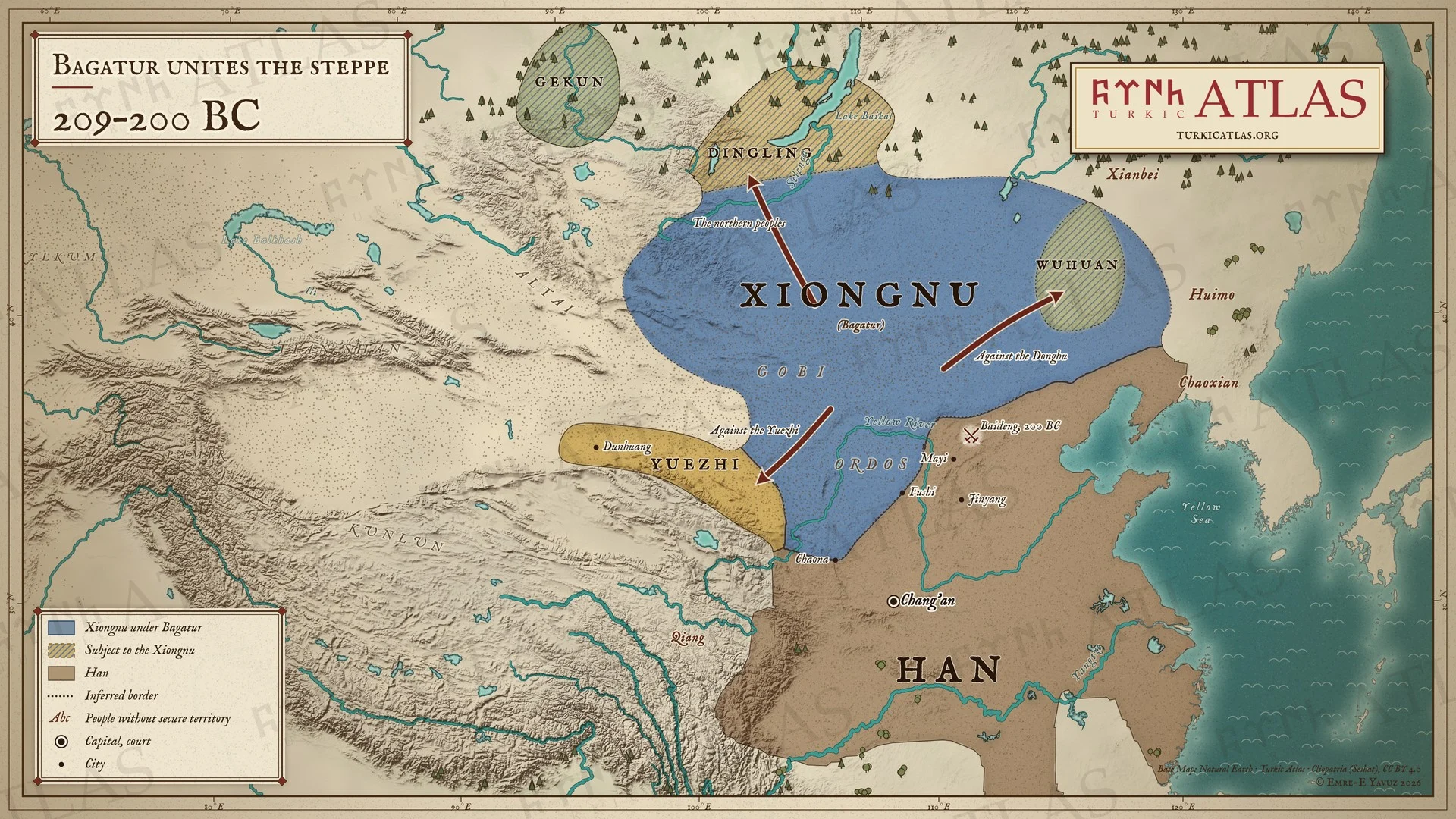
B.e.öň 200-nji ýylyň gyşynda Bagatur Hanyň ilkinji imperatoryny ýedi gün Baideng depesinde gabady. Onuň Hanyň 320,000 adamlyk goşunyna garşy 400,000 saýlama atlysy bardy.[1][2] Han Shu 300,000-den gowrak saýlama atly berýär.[3][4] Iki san hem Han köşgüniň tegelek sanlarydyr, hasaplama däl. Sýunnu sany ähtimal ýaraglanmaga ukyply ähli erkekleriň ornuna durýar. Imperator sypdy. Heqin şertnamasy yzyna geldi: çanýu üçin Han şazadasy, ýyllyk sowgatlar we doganlyk kasamy.[1] Wen bilen Jingiň döwründe Han her çozuşdan soň şertnamany täzeledi. Ol b.e.öň 133-nji ýyla çenli dowam etdi.[3] B.e.öň 182-nji ýylyň ýazynda imperatriça Lüniň döwründe sýunnular Didaoa çozdy we Ayangy talady. 181-nji ýylyň birinji aýynda olar Didaony ýene talady we iki müň adamy äkitdi.[5] B.e.öň 177-nji ýylyň bäşinji aýynda Sag akylly patyşa Sary derýanyň günortasyndaky ýurda girdi we Shang komanderliginiň serhet postlaryny goraýan taýpalary talady. Imperator Wen oňa garşy öz kansleri Guan Yingi 85,000 arabaly we atly bilen iberdi we patyşa serhediň aňyrsyna çekildi.[1][6] Käbir alymlar çozuşy Hana geçen we serhet postlaryny onuň üçin saklaýan sýunnulara jogap hökmünde düşündirýärler.[7]
Iki häzirki zaman düşündirişi uruşlary has giň çarçuwa goýýar. Birinjisi Hytaýy işjeň tarap edýär. Ol serhediň şeklini düzlügiň uly göçewiliginden öň gelen hytaý ösüşinden alandygyny we diwaryň göçüp ýörenleri daşda saklamak bilen bir hatarda hytaýlylary içerde saklamaga hyzmat edendigini aýdýar.[8] Ikinjisi Hanyň demirgazyk serhetdäki ilkinji uruşlarynyň sýunnulara garşy däl-de, serhet serkerdelerine garşy alnyp barlandygyny aýdýar. Serkerdeler gysylanda sýunnulara geçýärdiler. Şeýle bolsa köşk serhet häkimlerini ýakyndan saklanda, söwda we uruş çozuş we gorkuzmak hökmünde utgaşdyrylyp bilinerdi.[9]
Wudiniň döwründäki öwrülişik
B.e.öň 133-nji ýylda Han çanýuny duzaga düşürmek üçin Mayiniň töwereginde 300,000 adamy gizledi. Ol çopansyz otlaýan mal görende yzyna öwrüldi.[1] Pusgudan soň sýunnular heqini bozdular. Olar serhede sanap bolmajak derejede çozdular.[1] B.e.öň 129-njy ýylda dört general her biri 10,000 atly bilen ýola çykdy. Longchenge diňe Wei Qing ýetdi, Gongsun Ao bolsa 7,000 adamyny ýitirdi.[1] B.e.öň 127-nji ýylda Wei Qing Sary derýanyň günortasyndaky ýeri aldy we onuň üstünde Shuofangy gurdy.[1] Bu ýer Ordosdyr.
Çozuşlar, b.e.öň 124-nji ýyldan 119-njy ýyla çenli
B.e.öň 124-nji ýylda Wei Qing alty general we 100,000-den gowrak adam bilen Sag akylly patyşany gije gabady. Patyşa serhoşdy, sebäbi Hanyň oňa ýetip bilmejekdigini pikir edipdi. Ol gaçyp gutuldy we Han onuň 15,000 adamyny aldy.[1]
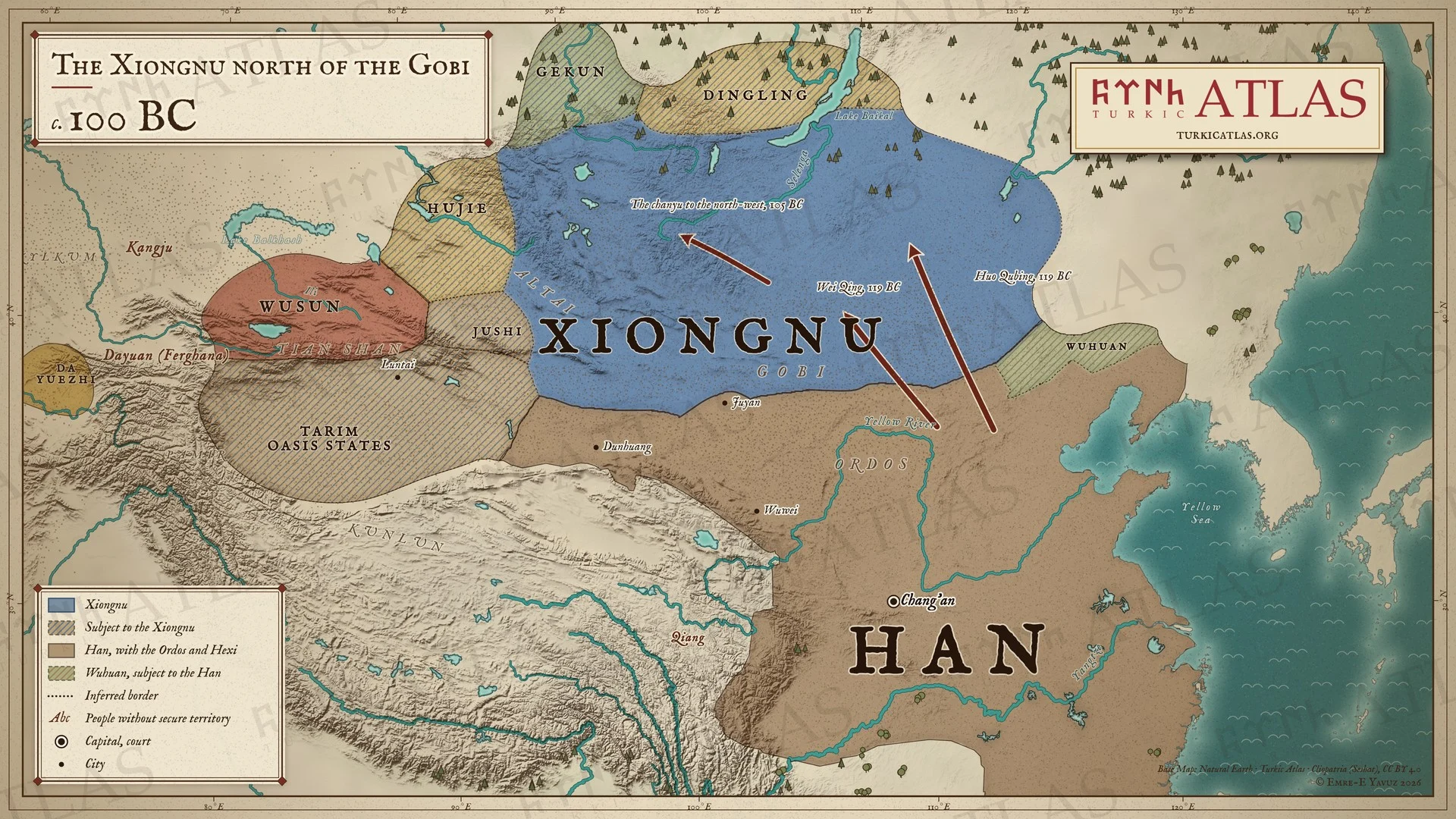
B.e.öň 121-nji ýylda Huo Qubing günbatardaky sýunnulara iki gezek urdy. Şol güýz Hunye patyşasy Xiutu patyşasyny öldürdi we 40,000-den gowrak adam bilen Hana geçdi. Shiji bu adamlaryň 100,000 diýlip yglan edilendigini aýdýar.[1] Wudiniň ýyllyklary şol ýyl olaryň ýurdundan Wuwei we Jiuquan komanderliklerini döredýär. Şol bir ýerden kesilen Zhangye we Dunhuang komanderliklerini b.e.öň 111-nji ýylda döredýär. Beýleki çeşmeler Hexiniň dört komanderligini başgaça senelendirýär.[10][11] Tan düşündirijisi Zhang Shoujie Xihe gushini getirip, sýunnulara iki dag üçin aglaýan bir aýdymy degişli edýär: Qilian daglaryny ýitirenlerinden bäri olaryň mallary köpelmeýär. Yanzhi daglaryny ýitirenlerinden bäri olaryň aýallarynyň ýüzünde reňk ýok.[1][12] Käbir alymlar b.e.öň 121 we 119-njy ýyllaryň ýörişleriniň iki dowamly netijesini sanaýarlar. Birinjisi şol öri meýdanlarynyň ýitirilmegi. Ikinjisi Hexi geçelgesinden Lop Nora çenli ýeriň ýitirilmegi, şol ýerde Han soň Jiuquan komanderligini döretdi we sýunnulary Qianglardan kesdi.[13]
B.e.öň 119-njy ýyldaky Mobei ýörişinde Han meýdana 100,000 atly we 140,000 ätiýaç at çykardy.[1] Çanýu çölüň demirgazygynda garaşdy. Agşam, güýçli ýel turanda, Hanyň ganatlary onuň üstüne ýapyldy. Ol birnäçe ýüz atly bilen çykyp gaçdy.[1] Sýunnularyň şondan soň Gobiniň günortasynda şa köşgi galmady. Emma Han 100,000-den gowrak atyny ýitirdi we ýene ýola çykyp bilmedi.[1]
Ýadadyjy uruşlar
B.e.öň 103-nji ýylda 80,000 sýunnu atlysy Zhao Ponuň goşunyny kesdi we goşun ýitdi.[1] B.e.öň 99-njy ýylda Li Guangli gabaldy we her on adamdan alty ýa-da ýedisini ýitirdi.[1] B.e.öň 90-njy ýylda Li Guangli 70,000 adam bilen ýola çykdy. Han Shu eserine görä, ol gije çozuşyndan soň boýun egdi.[3] Han başga goşun ibermedi. Wudi üç ýyldan soň aradan çykdy.[3]
Sýunnularyň bölünişi
B.e.öň 72-nji ýylda Hanyň bäş goşuny we 50,000 wusun atlysy ýola çykdy. Sýunnular olardan gaçdy.[3] Sýunnular soň halkynyň onda üçüsini we mallarynyň onda bäşisini gar boranyna we Dinglinglere, Wuhuanlara hem Wusunlara ýitirdiler.[3] B.e.öň 57-nji ýyldan bäsdeş çanýular biri-biri bilen söweşdiler. B.e.öň 53-nji ýylda Huhanye dogany tarapyndan ýeňilip, ministrleriniň maslahatyna garşy Hana boýun egdi. Zhizhi günbatara gitdi.[3] B.e.öň 36-njy ýylda Gan Yanshou bilen Chen Tang goşun ýygnadylar. Olar Zhizhini Kangjuda öldürdiler.[3]
Demirgazygyň gutarmagy
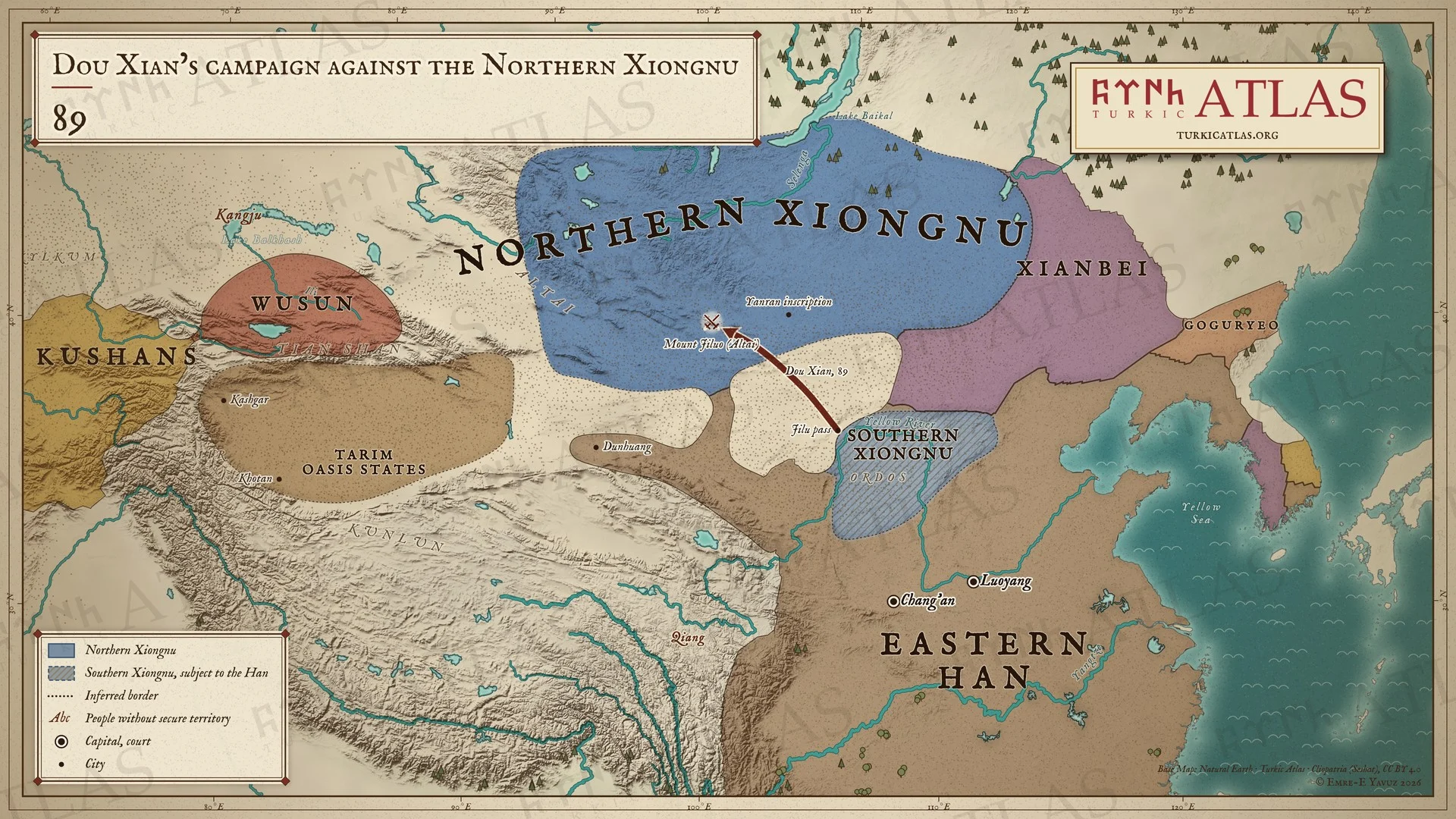
B.e. 89-njy bilen 91-nji ýyllaryň arasynda Han we Günorta sýunnu goşunlary demirgazyk köşgi döwdi. B.e. 93-nji ýylda soňky dawa ediji serhet arkaly yzyna aldanyp getirildi we kellesi kesildi. Bu Hanyň demirgazyk sýunnulara garşy ýörişlerinde gürrüň berilýär.[14] Hou Han Shu eserindäki jemleýji hökümde çanýu Wusunlaryň ýurduna gaçdy. Çölüň demirgazygyndaky ýurt boşdy.[14]
-
c. 215 BC Qin takes the Ordos
Around 215 BC the First Emperor of Qin sent Meng Tian north with a hundred thousand men. He took the land inside the great bend of the Yellow River, the Ordos, made the river the frontier and crossed it to hold the plain below the Yin mountains. According to the Shiji the Donghu north of Yan were strong at this time, and the Yuezhi flourished between Dunhuang and the Qilian mountains. The Xiongnu chanyu Duman could not withstand Qin and moved north. How far north, the source does not say. A second reading places the Qilian of this passage in the Tianshan; the hatched area shows it.
-
209–200 BC Modu unites the steppe
In 209 BC Modu killed his father Duman and became chanyu. Between the Xiongnu and the Donghu lay an empty strip more than a thousand li wide. When the Donghu demanded it, Modu struck east and destroyed their king. The Wuhuan held out at the Wuhuan mountain and paid the Xiongnu a yearly tribute of oxen, horses and sheepskins; the Xianbei withdrew far beyond the Liaodong frontier. Modu drove back the Yuezhi, took back the land Meng Tian had seized as far as Chaona and Fushi, and subjected the Hunyu, Qushe, Dingling, Gekun and Xinli in the north. In 200 BC he surrounded the Han emperor Gaozu for seven days on the hill of Baideng near Pingcheng.
-
176–c. 160 BC The height of the realm
In 176 BC Modu wrote to the Han court that the Wise King of the Right had destroyed the Yuezhi, and that Loulan, the Wusun, the Hujie and twenty-six states around them had all become Xiongnu: all the peoples who draw the bow were now one family. His son Laoshang killed the Yuezhi king and made a drinking cup of his skull. The Yuezhi left the Hexi and moved west into the land of the Saka. The Han Shu names a Xiongnu Commandant of Slaves who resided between Karashahr, Weixu and Weili and taxed the oasis states. In 162 BC the emperor Wendi confirmed the Long Wall as the line between the two realms. No source describes the northern edge of the realm in Tuva and beyond the Baikal.
-
127–121 BC The Han take the Ordos and the Hexi
In 127 BC the Han general Wei Qing drove the kings of the Loufan and the Baiyang out of the Ordos. Han founded Shuofang there and restored Meng Tian's wall along the river; in exchange it gave up the district of Zaoyang beyond Shanggu. In 123 BC the chanyu withdrew north across the Gobi on the advice of the defector Zhao Xin. In the spring and summer of 121 BC Huo Qubing struck into the Hexi corridor, and in the autumn the Hunye king killed the Xiutu king and went over to Han with more than forty thousand people. From then on, says the Shiji, the land from Jincheng and the Hexi west along the Southern Mountains to the Salt Marsh was empty of Xiongnu. By this time the Wusun held the land of the Saka, and the Yuezhi had moved on to the north bank of the Oxus.
-
119–c. 100 BC North of the Gobi
In 119 BC Wei Qing and Huo Qubing crossed the Gobi with separate armies. Huo Qubing marched more than two thousand li beyond Dai, sacrificed on Mount Langjuxu and turned back at the Hanhai. Afterwards, says the Shiji, there was no royal court south of the Gobi. Han settled soldiers and farmers from Shuofang west to Lingju and set up the commanderies of the Hexi, from Wuwei to Dunhuang; the Wuhuan were moved beyond the frontier of five eastern commanderies to watch the Xiongnu for Han. By 105 BC the chanyu had moved further north-west, his left wing facing Yunzhong and his right Jiuquan and Dunhuang. The southern edge of the realm ran somewhere in the Gobi.
-
60–51 BC The Western Regions lost, the realm divided
In 71 BC the Dingling struck the Xiongnu from the north, the Wuhuan from the east and the Wusun from the west, and the peoples bound to them fell away. In 60 BC the Rizhu king went over to Han. The Xiongnu Commandant of Slaves was abolished, and Zheng Ji became the first Protector-General of the Western Regions, with his seat at Wulei. In 57 BC five chanyus contended for the throne. In 54 BC Zhizhi took the royal court, and his younger brother Huhanye moved south to the Han frontier. In 51 BC Huhanye came before the emperor at Ganquan and was allowed to live below the Guanglu wall.
-
49–33 BC Zhizhi in the west, Huhanye in the north
Believing that Huhanye, weak and bound to Han, could not come back north, Zhizhi led his people west. He defeated the Wusun, received the surrender of the Wujie in the north, broke the Jiankun in the west and brought the Dingling under him, and made his seat in the land of the Jiankun. Around 44 BC he killed a Han envoy and went on to Kangju; of his people only three thousand arrived. In 36 BC the Protector-General Gan Yanshou and his deputy Chen Tang marched on Kangju and killed him. Huhanye meanwhile returned to the royal court in the north, and in 33 BC he received the palace lady Wang Zhaojun as his wife. From then on the land north of the Long Wall belonged to the Xiongnu again.
-
AD 48–50 Northern and Southern Xiongnu
Under Wang Mang the states of the Western Regions went over to the Xiongnu. In AD 48 the chiefs of eight southern tribes raised Bi, the Rizhu king, as chanyu under the name Huhanye; he came to the Wuyuan frontier and offered to shield Han against the northern Xiongnu for ever. The next year the northern chanyu fell back a thousand li. In AD 50 the southern court moved inside the frontier, first to Yunzhong and in the winter to Meiji in Xihe, and its chiefs were stationed along the frontier commanderies from Beidi to Dai. Beyond the Liaodong frontier the Xianbei sent their first envoys to Han in AD 49.
-
AD 87–93 The end of the Northern Xiongnu
In AD 87 the Xianbei entered the eastern lands of the Northern Xiongnu and killed the chanyu Youliu; fifty-eight tribes, two hundred thousand people, came to the frontier to surrender. In 89 Dou Xian marched out with the southern chanyu, defeated the northern chanyu at Mount Jiluo and had an inscription cut on Mount Yanran, more than three thousand li beyond the frontier. A rock inscription in the Gobi of central Mongolia is identified with this text; it lies much closer to the frontier than the figure of the source. In 91 Geng Kui defeated the northern chanyu at the Jinwei mountains, and the chanyu fled to the land of the Wusun. The Xianbei moved into the empty land, and more than a hundred thousand Xiongnu tents that stayed behind called themselves Xianbei.
-
c. AD 155–180 The Xianbei in the old Xiongnu land
The Xianbei leader Tanshihuai set his court on the Chuochou river below Mount Tanhan, more than three hundred li north of Gaoliu. According to the Hou Han Shu he raided the Han frontier in the south, held off the Dingling in the north, drove back the Fuyu in the east and struck the Wusun in the west, and held all the old Xiongnu land, fourteen thousand li from east to west. He divided it into an eastern, a central and a western part; the western reached Dunhuang and the Wusun. The Southern Xiongnu remained inside the Han frontier. One reckoning puts the last defeat of the Northern Xiongnu by the Xianbei in 155, a second puts their move west around 158; the hatched area north of Kangju shows where the second places them.
- Place named in a source (position as commonly identified)
- Position disputed or approximate
- Zone drawn after the Han histories
- Second reading or entirely uncertain position (hatched)
- People subject to the Xiongnu, or under Han protection
- Oasis states taxed by the Xiongnu
- Border that no source describes (drawn uncertain)
- Movement named in a source (route drawn)
Bellikler
- ^ a b c d e f g h i j k l m n o Shiji, juan 110
- ^ Ögel 2015, p. 281–286
- ^ a b c d e f g h Han Shu, juan 94
- ^ Ögel 2015, p. 285
- ^ Ögel 2015, p. 306
- ^ Ögel 2015, p. 307–309
- ^ Ögel 2015, p. 307
- ^ Lattimore 1951, p. 240, 460–461
- ^ Lattimore 1951, p. 467–468, 478–480
- ^ Han Shu, juan 6
- ^ Chavannes 1913, v–vi
- ^ Laufer 1919, p. 326
- ^ Sinor 1990, p. 130
- ^ a b Hou Han Shu, juan 89
Çeşmeler
- Shiji, juan 110
- Han Shu, juan 6, 94 (after Shiji)
- Hou Han Shu, juan 89
Edebiýat
- Denis Sinor (ed.), The Cambridge History of Early Inner Asia (1990)
- Berthold Laufer, Sino-Iranica. Chinese Contributions to the History of Civilization in Ancient Iran (1919)
- Édouard Chavannes, Les documents chinois découverts par Aurel Stein dans les sables du Turkestan oriental (1913)
- Bahaeddin Ögel, Büyük Hun İmparatorluğu Tarihi I (2015)
- Owen Lattimore, Inner Asian Frontiers of China (1951)
Şu sahypa salgylananlar9
- Şahsyýetler
- Han imperatory Wu · Hunye patyşasy · Li Ling · Meng Tian · Su Wu · Wei Qing · Yizhixie Çanýu
- Places
- Nefrit derwezesi
- Controversies
- Gyrgyzlaryň Li Lingden gelip çykyşy
Makalany sitata almak
Yavuz, Emre-E. “Sýunnu–Han uruşlary.” Turkic Atlas, revised 20 November 2026. https://turkicatlas.org/conflicts/xiongnu-han-wars/
Last revised: 20 November 2026

