
흉노와 한의 전쟁은 한(漢) 제국과 흉노(匈奴) 연합체 사이의 전쟁이었다. 기원전 200년 백등 포위에서 시작하여 기원후 93년 북쪽 선우의 종말까지 이어졌다.
백등과 화친
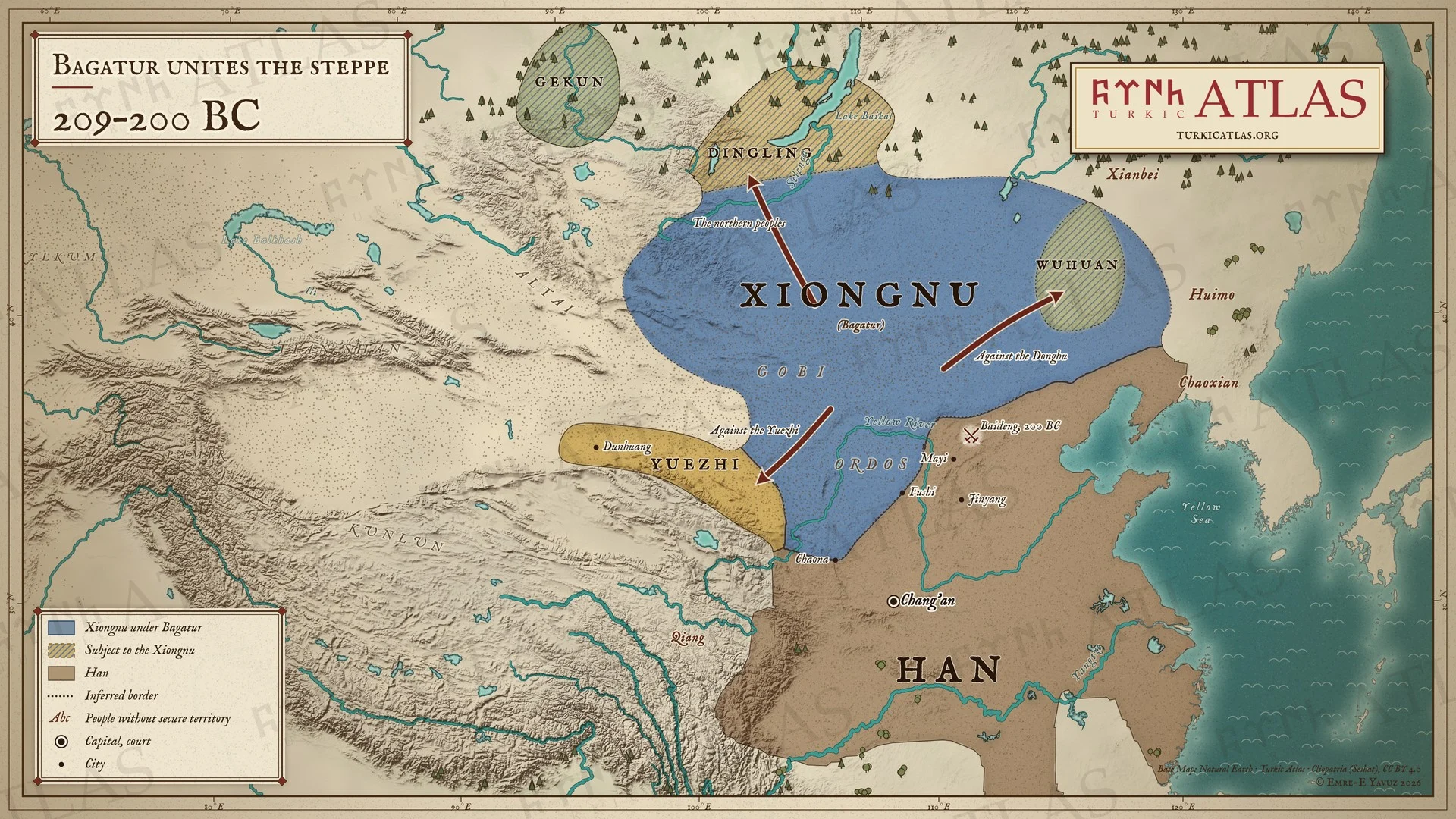
기원전 200년 겨울 바가투르는 한의 첫 황제를 백등 언덕에 7일 동안 가두었다. 그는 정예 기병 400,000을 거느렸고, 맞선 한군은 320,000이었다.[1][2] 『한서』(漢書)는 정예 기병을 300,000이 넘는다고 적는다.[3][4] 두 수치 모두 한 조정의 어림수이지 헤아린 수가 아니다. 흉노의 수치는 아마 무기를 들 수 있는 모든 남자를 뜻할 것이다. 황제는 빠져나왔다. 이어 화친(和親) 조약이 맺어졌다. 선우에게 한의 공주를 보내고, 해마다 선물을 주고, 형제의 맹세를 하는 것이었다.[1] 문제(文帝)와 경제(景帝) 때 한은 습격이 있을 때마다 조약을 갱신했다. 조약은 기원전 133년까지 이어졌다.[3] 기원전 182년 봄 여후(呂后) 때 흉노는 적도(狄道)를 치고 아양(阿陽)을 약탈했다. 기원전 181년 첫째 달에는 적도를 다시 약탈하고 2천 명을 끌고 갔다.[5] 기원전 177년 다섯째 달 우현왕(右賢王)은 황하 남쪽 땅에 들어와 상군(上郡)의 변경 초소를 지키던 부족들을 약탈했다. 문제는 승상 관영(灌嬰)을 수레와 기병 85,000과 함께 보내 맞서게 했고, 왕은 변경 밖으로 물러났다.[1][6] 일부 학자는 이 습격을 한에 넘어와 한을 위해 변경 초소를 지키던 흉노 사람들에 대한 응답으로 설명한다.[7]
현대의 두 해석은 이 전쟁을 더 넓은 틀 안에 놓는다. 첫째는 중국을 능동적인 쪽으로 본다. 이 견해에서 변경은 초원의 대유목에 앞서 있던 중국의 성장에서 모양을 얻었고, 장성은 유목민을 막는 만큼 중국인을 가두는 구실을 했다.[8] 둘째는 한이 북쪽 변경에서 치른 초기의 전쟁이 흉노가 아니라 변경의 지휘관들을 상대로 치러졌다고 본다. 지휘관들은 몰리면 흉노에게 넘어갔다. 그렇다면 조정이 변경의 장관들을 바짝 쥐고 있던 곳에서는 교역과 전쟁이 습격과 협박으로 합쳐지기 쉬웠다.[9]
무제 때의 전환
기원전 133년 한은 선우를 함정에 빠뜨리려고 마읍(馬邑) 둘레에 300,000명을 숨겼다. 선우는 목동 없이 소가 풀을 뜯는 것을 보고 되돌아갔다.[1] 매복 뒤 흉노는 화친을 깼다. 이들은 변경을 셀 수 없이 약탈했다.[1] 기원전 129년 장군 넷이 각기 기병 10,000을 이끌고 출정했다. 용성(龍城)에 이른 것은 위청(衛青)뿐이었고, 공손오(公孫敖)는 7,000명을 잃었다.[1] 기원전 127년 위청은 황하 남쪽 땅을 차지하고 그 위에 삭방(朔方)을 쌓았다.[1] 이 땅이 오르도스이다.
공세, 기원전 124년에서 119년
기원전 124년 위청은 장군 여섯과 100,000이 넘는 병력으로 밤에 우현왕을 포위했다. 왕은 한이 자신에게 닿을 수 없다고 여겨 취해 있었다. 그는 달아났고, 한은 그의 백성 15,000명을 잡았다.[1]
기원전 121년 곽거병(霍去病)은 서쪽의 흉노를 두 차례 쳤다. 그해 가을 혼야왕(渾邪王)은 휴도왕(休屠王)을 죽이고 40,000이 넘는 백성과 함께 한에 넘어왔다. [shiji|『사기』]는 이 백성이 100,000으로 불렸다고 한다.[1] 무제 본기는 그해 그들의 땅을 무위(武威)와 주천(酒泉) 두 군으로 삼는다. 같은 땅에서 떼어 낸 장액(張掖)과 돈황(敦煌)은 기원전 111년에 군이 된다. 다른 사료는 하서(河西)의 네 군을 다르게 연대 잡는다.[10][11] 당(唐)의 주석가 장수절(張守節)은 『서하구사』(西河舊事)를 인용하여 흉노의 것이라는 노래를 전한다. 두 산을 애도하는 노래이다. 기련산(祁連山)을 잃은 뒤로 가축이 더 불지 않는다. 연지산(焉支山)을 잃은 뒤로 여자들의 얼굴에 빛이 없다.[1][12] 일부 학자는 기원전 121년과 119년 원정의 지속적인 결과를 둘로 꼽는다. 첫째는 그 목초지를 잃은 것이다. 둘째는 하서 회랑에서 롭노르에 이르는 땅을 잃은 것으로, 한은 그곳에 주천군을 두고 흉노를 강(羌)에서 떼어 놓았다.[13]
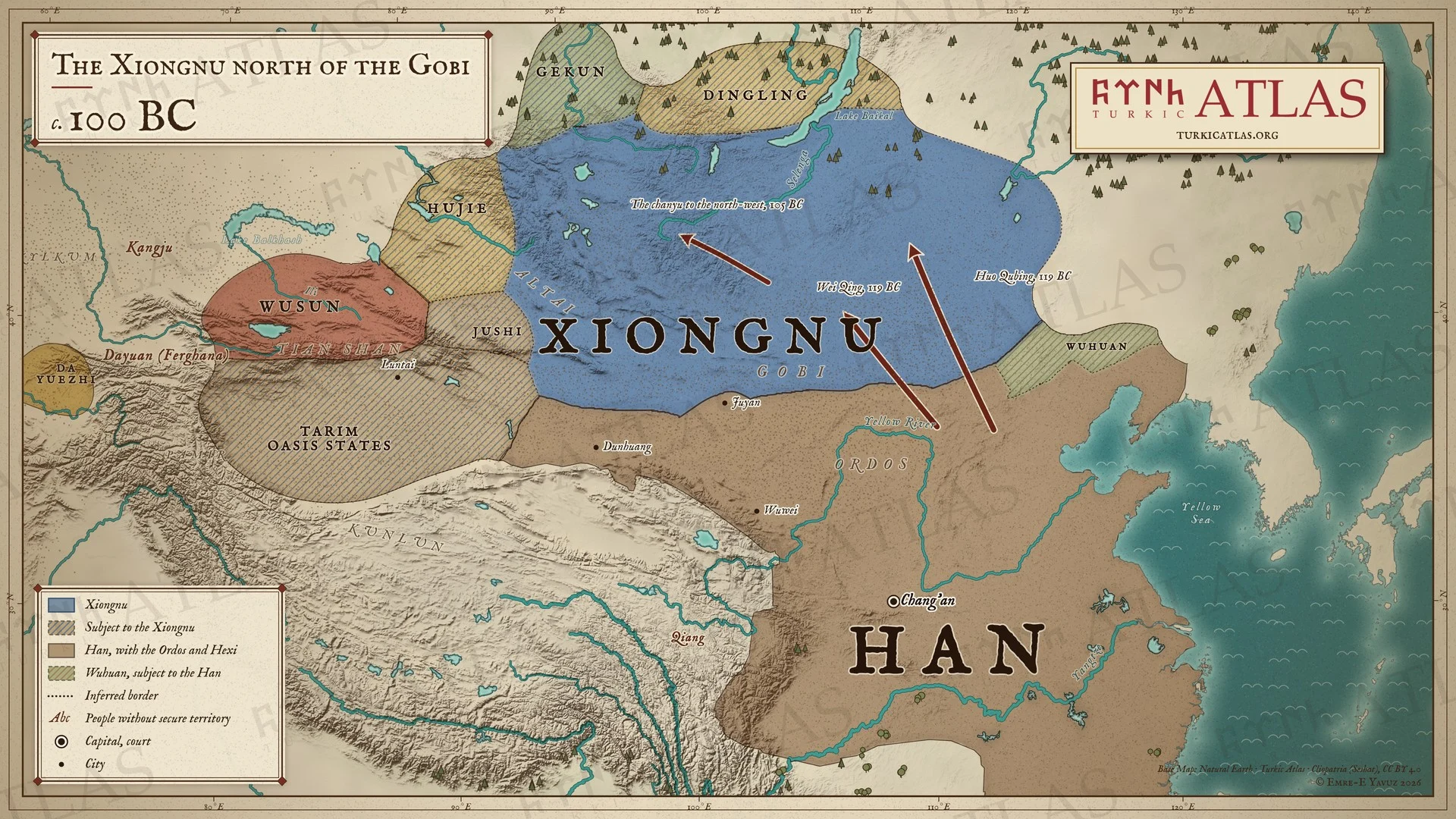
기원전 119년 막북 원정에서 한은 기병 100,000과 예비 말 140,000을 들판에 내보냈다.[1] 선우는 사막 북쪽에서 기다렸다. 해 질 녘 강풍 속에서 한의 날개가 그를 조여 왔다. 그는 기병 수백 명과 함께 뚫고 나갔다.[1] 그 뒤 흉노에게는 고비 남쪽에 왕정이 없었다. 그러나 한은 말 100,000필이 넘게 잃어 다시 출정할 수 없었다.[1]
소모
기원전 103년 흉노 기병 80,000이 조파노(趙破奴)의 군대를 끊었고, 군대는 사라졌다.[1] 기원전 99년 이광리(李廣利)는 포위되어 열 명 가운데 예닐곱을 잃었다.[1] 기원전 90년 이광리는 70,000을 이끌고 출정했다. 『한서』에 따르면 그는 야습 뒤 항복했다.[3] 한은 더 이상 군대를 내보내지 않았다. 무제는 3년 뒤 죽었다.[3]
흉노의 분열
기원전 72년 한의 다섯 군대와 오손 기병 50,000이 출정했다. 흉노는 그들을 피했다.[3] 흉노는 그 뒤 눈보라와 정령, 오환, 오손 때문에 백성의 열에 셋, 가축의 열에 다섯을 잃었다.[3] 기원전 57년부터 경쟁하는 선우들이 서로 싸웠다. 기원전 53년 호한야는 형제에게 패하여 신하들의 충고를 물리치고 한에 복속했다. 질지는 서쪽으로 갔다.[3] 기원전 36년 감연수(甘延壽)와 진탕(陳湯)이 군대를 일으켰다. 이들은 강거(康居)에서 질지를 죽였다.[3]
북쪽의 끝
기원후 89년에서 91년 사이 한과 남흉노의 군대가 북쪽 조정을 깨뜨렸다. 기원후 93년 마지막으로 선우를 자처한 자가 변경 너머에서 꾀어 들여져 목이 베였다. 이 일은 북흉노에 대한 한의 원정에서 이야기한다.[14] [hou-hanshu|『후한서』]의 맺음 평에서 선우는 오손의 땅으로 달아났다. 사막 북쪽의 나라는 비었다.[14]
-
c. 215 BC Qin takes the Ordos
Around 215 BC the First Emperor of Qin sent Meng Tian north with a hundred thousand men. He took the land inside the great bend of the Yellow River, the Ordos, made the river the frontier and crossed it to hold the plain below the Yin mountains. According to the Shiji the Donghu north of Yan were strong at this time, and the Yuezhi flourished between Dunhuang and the Qilian mountains. The Xiongnu chanyu Duman could not withstand Qin and moved north. How far north, the source does not say. A second reading places the Qilian of this passage in the Tianshan; the hatched area shows it.
-
209–200 BC Modu unites the steppe
In 209 BC Modu killed his father Duman and became chanyu. Between the Xiongnu and the Donghu lay an empty strip more than a thousand li wide. When the Donghu demanded it, Modu struck east and destroyed their king. The Wuhuan held out at the Wuhuan mountain and paid the Xiongnu a yearly tribute of oxen, horses and sheepskins; the Xianbei withdrew far beyond the Liaodong frontier. Modu drove back the Yuezhi, took back the land Meng Tian had seized as far as Chaona and Fushi, and subjected the Hunyu, Qushe, Dingling, Gekun and Xinli in the north. In 200 BC he surrounded the Han emperor Gaozu for seven days on the hill of Baideng near Pingcheng.
-
176–c. 160 BC The height of the realm
In 176 BC Modu wrote to the Han court that the Wise King of the Right had destroyed the Yuezhi, and that Loulan, the Wusun, the Hujie and twenty-six states around them had all become Xiongnu: all the peoples who draw the bow were now one family. His son Laoshang killed the Yuezhi king and made a drinking cup of his skull. The Yuezhi left the Hexi and moved west into the land of the Saka. The Han Shu names a Xiongnu Commandant of Slaves who resided between Karashahr, Weixu and Weili and taxed the oasis states. In 162 BC the emperor Wendi confirmed the Long Wall as the line between the two realms. No source describes the northern edge of the realm in Tuva and beyond the Baikal.
-
127–121 BC The Han take the Ordos and the Hexi
In 127 BC the Han general Wei Qing drove the kings of the Loufan and the Baiyang out of the Ordos. Han founded Shuofang there and restored Meng Tian's wall along the river; in exchange it gave up the district of Zaoyang beyond Shanggu. In 123 BC the chanyu withdrew north across the Gobi on the advice of the defector Zhao Xin. In the spring and summer of 121 BC Huo Qubing struck into the Hexi corridor, and in the autumn the Hunye king killed the Xiutu king and went over to Han with more than forty thousand people. From then on, says the Shiji, the land from Jincheng and the Hexi west along the Southern Mountains to the Salt Marsh was empty of Xiongnu. By this time the Wusun held the land of the Saka, and the Yuezhi had moved on to the north bank of the Oxus.
-
119–c. 100 BC North of the Gobi
In 119 BC Wei Qing and Huo Qubing crossed the Gobi with separate armies. Huo Qubing marched more than two thousand li beyond Dai, sacrificed on Mount Langjuxu and turned back at the Hanhai. Afterwards, says the Shiji, there was no royal court south of the Gobi. Han settled soldiers and farmers from Shuofang west to Lingju and set up the commanderies of the Hexi, from Wuwei to Dunhuang; the Wuhuan were moved beyond the frontier of five eastern commanderies to watch the Xiongnu for Han. By 105 BC the chanyu had moved further north-west, his left wing facing Yunzhong and his right Jiuquan and Dunhuang. The southern edge of the realm ran somewhere in the Gobi.
-
60–51 BC The Western Regions lost, the realm divided
In 71 BC the Dingling struck the Xiongnu from the north, the Wuhuan from the east and the Wusun from the west, and the peoples bound to them fell away. In 60 BC the Rizhu king went over to Han. The Xiongnu Commandant of Slaves was abolished, and Zheng Ji became the first Protector-General of the Western Regions, with his seat at Wulei. In 57 BC five chanyus contended for the throne. In 54 BC Zhizhi took the royal court, and his younger brother Huhanye moved south to the Han frontier. In 51 BC Huhanye came before the emperor at Ganquan and was allowed to live below the Guanglu wall.
-
49–33 BC Zhizhi in the west, Huhanye in the north
Believing that Huhanye, weak and bound to Han, could not come back north, Zhizhi led his people west. He defeated the Wusun, received the surrender of the Wujie in the north, broke the Jiankun in the west and brought the Dingling under him, and made his seat in the land of the Jiankun. Around 44 BC he killed a Han envoy and went on to Kangju; of his people only three thousand arrived. In 36 BC the Protector-General Gan Yanshou and his deputy Chen Tang marched on Kangju and killed him. Huhanye meanwhile returned to the royal court in the north, and in 33 BC he received the palace lady Wang Zhaojun as his wife. From then on the land north of the Long Wall belonged to the Xiongnu again.
-
AD 48–50 Northern and Southern Xiongnu
Under Wang Mang the states of the Western Regions went over to the Xiongnu. In AD 48 the chiefs of eight southern tribes raised Bi, the Rizhu king, as chanyu under the name Huhanye; he came to the Wuyuan frontier and offered to shield Han against the northern Xiongnu for ever. The next year the northern chanyu fell back a thousand li. In AD 50 the southern court moved inside the frontier, first to Yunzhong and in the winter to Meiji in Xihe, and its chiefs were stationed along the frontier commanderies from Beidi to Dai. Beyond the Liaodong frontier the Xianbei sent their first envoys to Han in AD 49.
-
AD 87–93 The end of the Northern Xiongnu
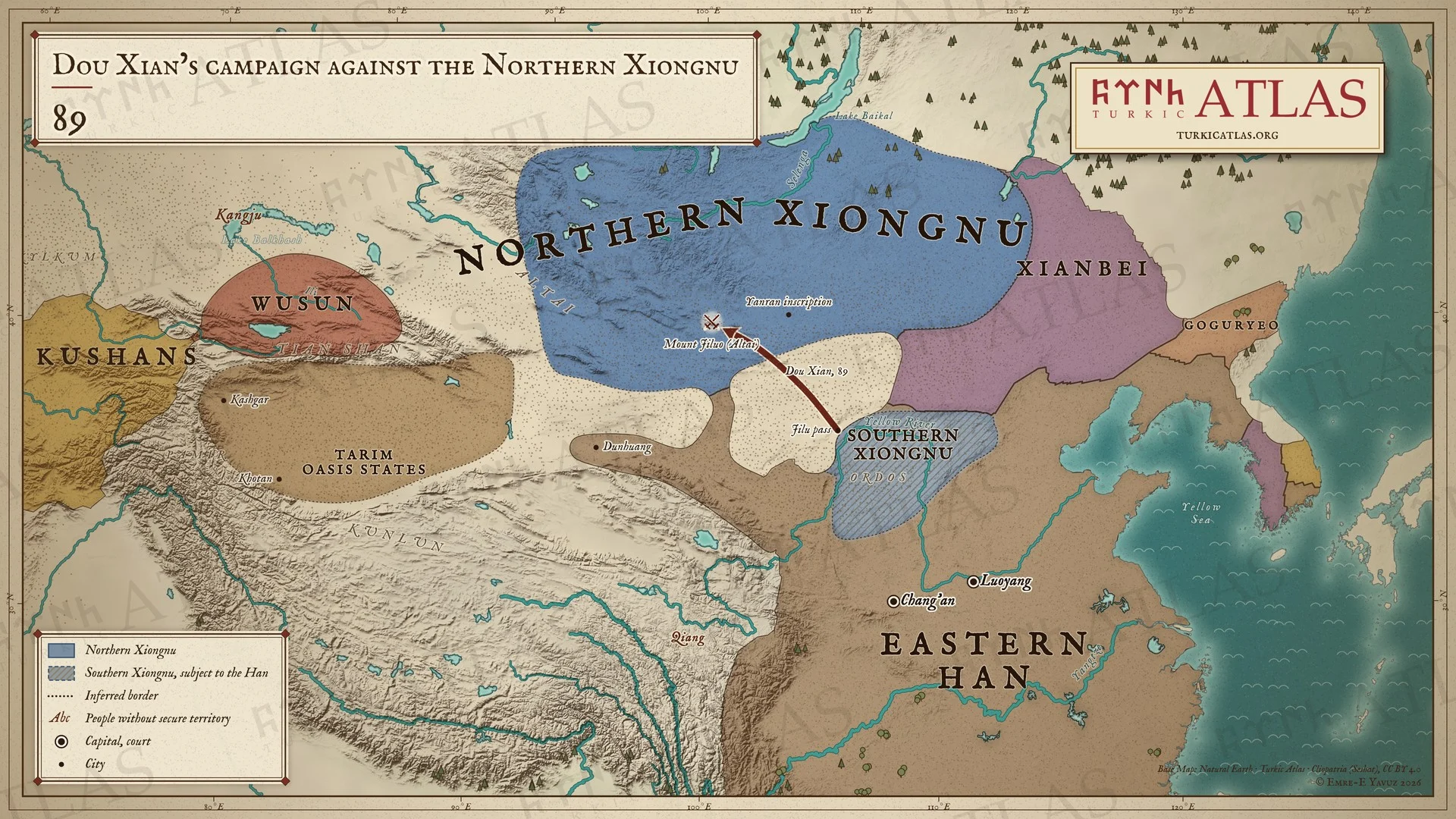
In AD 87 the Xianbei entered the eastern lands of the Northern Xiongnu and killed the chanyu Youliu; fifty-eight tribes, two hundred thousand people, came to the frontier to surrender. In 89 Dou Xian marched out with the southern chanyu, defeated the northern chanyu at Mount Jiluo and had an inscription cut on Mount Yanran, more than three thousand li beyond the frontier. A rock inscription in the Gobi of central Mongolia is identified with this text; it lies much closer to the frontier than the figure of the source. In 91 Geng Kui defeated the northern chanyu at the Jinwei mountains, and the chanyu fled to the land of the Wusun. The Xianbei moved into the empty land, and more than a hundred thousand Xiongnu tents that stayed behind called themselves Xianbei.
-
c. AD 155–180 The Xianbei in the old Xiongnu land
The Xianbei leader Tanshihuai set his court on the Chuochou river below Mount Tanhan, more than three hundred li north of Gaoliu. According to the Hou Han Shu he raided the Han frontier in the south, held off the Dingling in the north, drove back the Fuyu in the east and struck the Wusun in the west, and held all the old Xiongnu land, fourteen thousand li from east to west. He divided it into an eastern, a central and a western part; the western reached Dunhuang and the Wusun. The Southern Xiongnu remained inside the Han frontier. One reckoning puts the last defeat of the Northern Xiongnu by the Xianbei in 155, a second puts their move west around 158; the hatched area north of Kangju shows where the second places them.
- Place named in a source (position as commonly identified)
- Position disputed or approximate
- Zone drawn after the Han histories
- Second reading or entirely uncertain position (hatched)
- People subject to the Xiongnu, or under Han protection
- Oasis states taxed by the Xiongnu
- Border that no source describes (drawn uncertain)
- Movement named in a source (route drawn)
각주
- ^ a b c d e f g h i j k l m n o Shiji, juan 110
- ^ Ögel 2015, p. 281–286
- ^ a b c d e f g h Han Shu, juan 94
- ^ Ögel 2015, p. 285
- ^ Ögel 2015, p. 306
- ^ Ögel 2015, p. 307–309
- ^ Ögel 2015, p. 307
- ^ Lattimore 1951, p. 240, 460–461
- ^ Lattimore 1951, p. 467–468, 478–480
- ^ Han Shu, juan 6
- ^ Chavannes 1913, v–vi
- ^ Laufer 1919, p. 326
- ^ Sinor 1990, p. 130
- ^ a b Hou Han Shu, juan 89
사료
- Shiji, juan 110
- Han Shu, juan 6, 94 (after Shiji)
- Hou Han Shu, juan 89
문헌
- Denis Sinor (ed.), The Cambridge History of Early Inner Asia (1990)
- Berthold Laufer, Sino-Iranica. Chinese Contributions to the History of Civilization in Ancient Iran (1919)
- Édouard Chavannes, Les documents chinois découverts par Aurel Stein dans les sables du Turkestan oriental (1913)
- Bahaeddin Ögel, Büyük Hun İmparatorluğu Tarihi I (2015)
- Owen Lattimore, Inner Asian Frontiers of China (1951)
여기를 가리키는 항목9
- 인물
- Emperor Wu of Han · Hunye King · Li Ling · Meng Tian · Su Wu · Wei Qing · Yizhixie Chanyu
- Places
- Jade Gate
- Controversies
- The Kirghiz descent from Li Ling
이 항목 인용하기
Yavuz, Emre-E. “흉노와 한의 전쟁.” Turkic Atlas, revised 20 November 2026. https://turkicatlas.org/conflicts/xiongnu-han-wars/
Last revised: 20 November 2026

