
Ғұн-хань соғыстары Хань империясы мен ғұндар (сюнну) одағы арасындағы соғыстар болды. Олар б.з.д. 200 жылғы Байдэнді қоршаудан б.з. 93 жылы солтүстік шаньюйдің аяқталуына дейін созылды.
Байдэн және хэцин
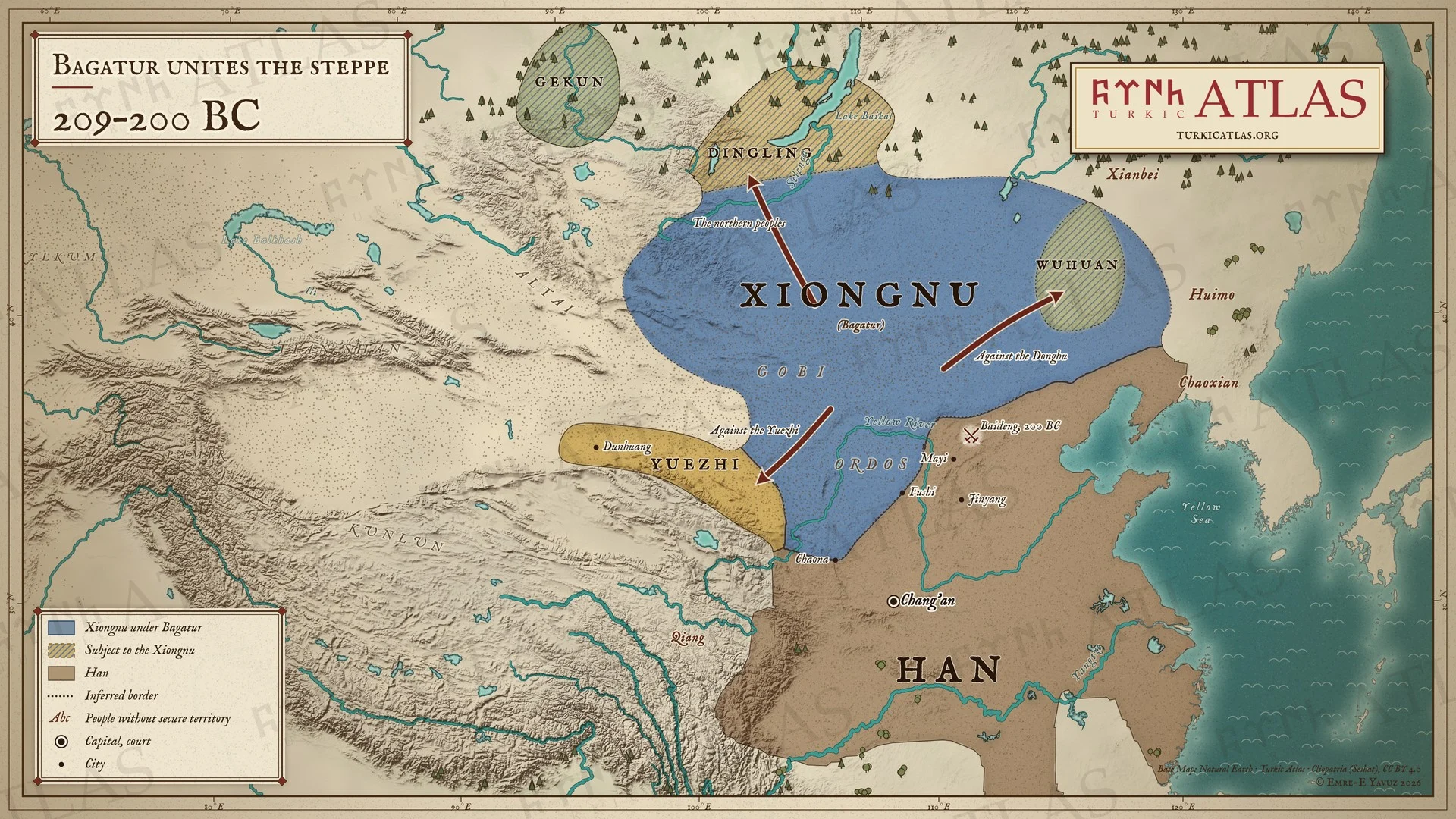
Б.з.д. 200 жылғы қыста Бағатұр бірінші хань императорын Байдэн төбесіне жеті күн қамап қойды. Оның 320 000 хань әскеріне қарсы 400 000 таңдаулы атты әскері болды.[1][2] «Хань шуда» 300 000-нан астам таңдаулы атты бар.[3][4] Екі сан да хань сарайының дөңгелек сандары, санақ емес. Ғұндардың саны, ықтимал, қару көтеруге жарамды барлық ерлерді білдіреді. Император шығып кетті. Содан кейін хэцин келісімі жасалды: шаньюйге хань ханшайымы, жыл сайынғы сыйлықтар және ағайындық анты.[1] Вэнь мен Цзин тұсында хань келісімді әр шабуылдан кейін жаңартып отырды. Ол б.з.д. 133 жылға дейін созылды.[3] Императрица Люй тұсында, б.з.д. 182 жылдың көктемінде ғұндар Дидаоға соққы беріп, Аянды тонады. 181 жылдың бірінші айында олар Дидаоны қайтадан тонап, екі мың адамды айдап әкетті.[5] Б.з.д. 177 жылдың бесінші айында Оң жақ ізгі патша Сары өзеннің оңтүстігіндегі жерге кіріп, Шан округінің шекара бекеттерін күзеткен тайпаларды тонады. Император Вэнь оған қарсы канцлер Гуань Инді 85 000 арба мен атпен жіберді, ал патша шекарадан тыс шегінді.[1][6] Бір оқылым бұл шабуылды ханьға өтіп, шекара бекеттерін оларға ұстап тұрған ғұндарға жауап ретінде түсіндіреді.[7]
Екі заманауи оқылым соғыстарды кеңірек шеңберге қояды. Біріншісі Қытайды белсенді серіктес етеді. Ол шекараның түрін қытайдың өсуі қалыптастырды деп санайды, ал бұл өсу даланың ұлы көшпенділігінен бұрын болған, және қабырға көшпенділерді сыртқа шығармау үшін қанша қызмет етсе, қытайларды ішке ұстау үшін де сонша қызмет етті.[8] Екіншісі ханьның солтүстік шекарадағы алғашқы соғыстары ғұндарға қарсы емес, шекара қолбасшыларына қарсы жүргізілді деп санайды. Қолбасшылар қысым көргенде ғұндардың жағына өтті. Бұл оқылым бойынша, сарай өзінің шекара әкімдерін тығыз ұстаған жерде сауда мен соғыс шабуыл және қорқытып ақша алу түрінде араласып кетуі мүмкін еді.[9]
У-ди тұсындағы бетбұрыс
Б.з.д. 133 жылы хань шаньюйді тұзаққа түсіру үшін Маи айналасына 300 000 адам жасырды. Ол малшысыз жайылған малды көргенде кері бұрылды.[1] Буктырмадан кейін ғұндар хэцинді бұзды. Олар шекараны санап болмастай шапты.[1] Б.з.д. 129 жылы әрқайсысы 10 000 аттылы төрт қолбасшы аттанды. Лунчэнге тек Вэй Цин жетті, ал Гунсунь Ао 7 000 адамынан айырылды.[1] Б.з.д. 127 жылы Вэй Цин Сары өзеннің оңтүстігіндегі жерді алып, оған Шофаңды салды.[1] Бұл жер — Ордос.
Шабуылдар, б.з.д. 124–119
Б.з.д. 124 жылы Вэй Цин алты қолбасшымен және 100 000-нан астам адаммен Оң жақ ізгі патшаны түнде қоршады. Патша мас болды, себебі хань оған жете алмайды деп ойлаған еді. Ол құтылып кетті, ал хань оның 15 000 адамын алды.[1]
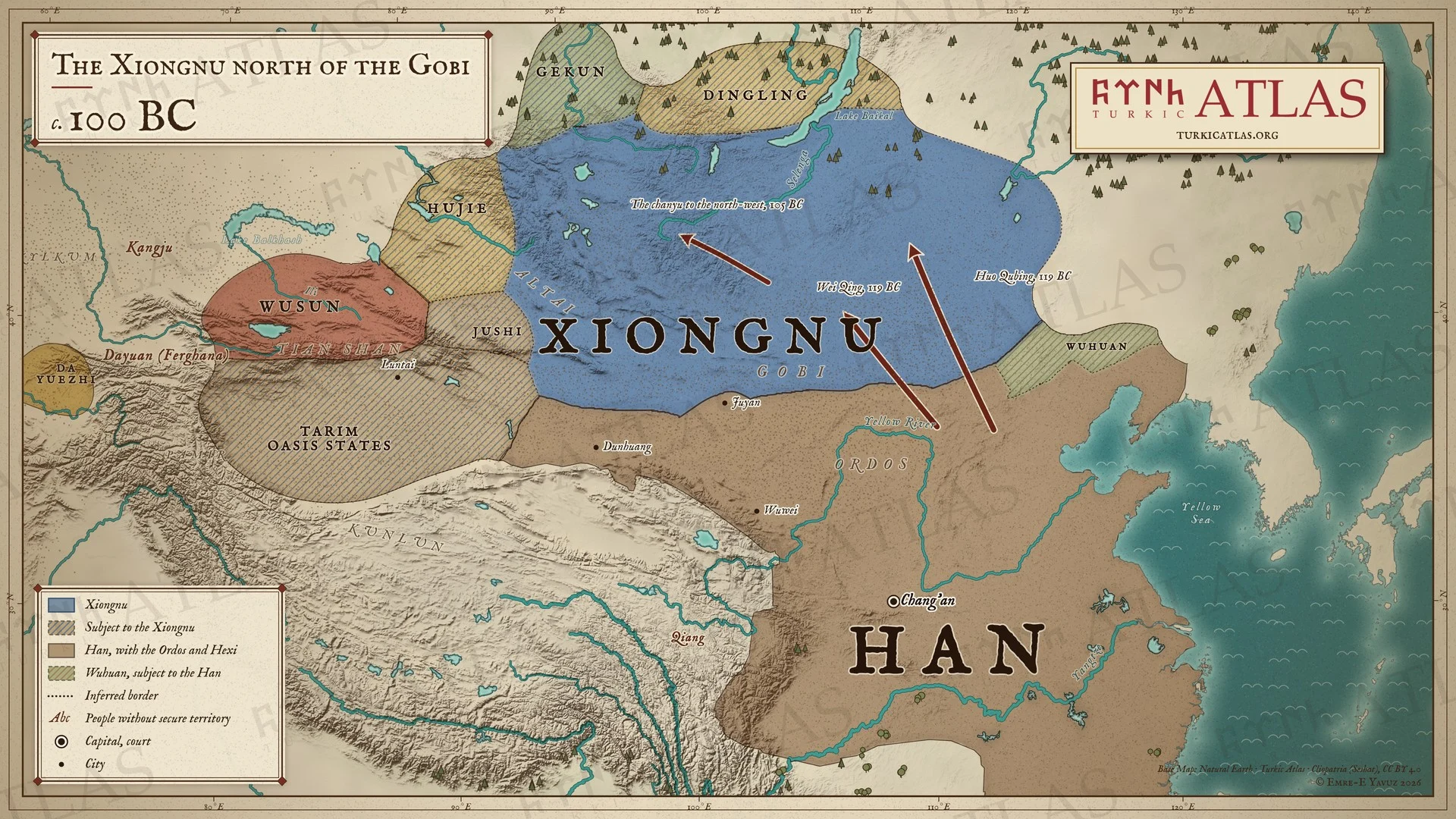
Б.з.д. 121 жылы Хо Цюйбин батыстағы ғұндарға екі рет соққы берді. Сол күзде Хунье патшасы Сюту патшасын өлтіріп, 40 000-нан астам адаммен ханьға өтті. «Шицзи» бұл адамдардың 100 000 деп жарияланғанын айтады.[1] У-дидің шежірелері сол жылы олардың жерінен Увэй мен Цзюцюань округтерін жасайды. Сол жерден бөлінген Чжанъе мен Дуньхуанды б.з.д. 111 жылы округ етеді. Басқа деректер Хэсидің төрт округін әртүрлі күндейді.[10][11] Таң комментаторы Чжан Шоуцзе «Сихэ гуши» деректеріне сүйеніп, ғұндарға екі тауды жоқтайтын әнді жатқызады: олар Цилянь тауларынан айырылғалы, малдары енді көбеймейді. Олар Яньчжи тауларынан айырылғалы, әйелдерінің жүзінде өң жоқ.[1][12] Бір оқылым б.з.д. 121 және 119 жылғы жорықтардың екі тұрақты салдарын санайды. Біріншісі — сол жайылымдардан айырылу. Екіншісі — Хэси дәлізінен Лобнорға дейінгі жерден айырылу, онда хань Цзюцюань округін құрып, ғұндарды цяндардан қиып тастады.[13]
Б.з.д. 119 жылғы Мобэй жорығында хань даласқа 100 000 атты және 140 000 қосалқы жылқы шығарды.[1] Шаньюй шөлдің солтүстігінде күтіп тұрды. Ымыртта, дауылда хань қанаттары оған қарай жабылды. Ол бірнеше жүз шабандозбен жарып шықты.[1] Сонда ғұндардың Гоби оңтүстігінде хан сарайы болмады. Алайда хань 100 000-нан астам жылқыдан айырылып, қайта аттана алмады.[1]
Қажу
Б.з.д. 103 жылы 80 000 ғұн атты әскері Чжао Понуның әскерін қиып тастады, және әскер жойылды.[1] Б.з.д. 99 жылы Ли Гуанли қоршауға түсіп, он адамның алты-жетеуінен айырылды.[1] Б.з.д. 90 жылы Ли Гуанли 70 000 адаммен аттанды. «Хань шу» бойынша, ол түнгі шабуылдан кейін берілді.[3] Хань енді әскер жібермеді. У-ди үш жылдан кейін қайтыс болды.[3]
Ғұндардың бөлінуі
Б.з.д. 72 жылы бес хань әскері және 50 000 усун атты әскері аттанды. Ғұндар олардан құтылды.[3] Содан кейін ғұндар боран мен динлиндерден, үхуандар мен усундерден өз халқының он адамнан үшеуінен және малының онның бесінен айырылды.[3] Б.з.д. 57 жылдан бәсекелес шаньюйлер бір-бірімен соғысты. Б.з.д. 53 жылы ағасынан жеңілген Хуханье министрлерінің кеңесіне қарсы ханьға бағынды. Чжичжи батысқа кетті.[3] Б.з.д. 36 жылы Гань Яньшоу мен Чэнь Тан әскер жинады. Олар Чжичжиді Кангюйде өлтірді.[3]
Солтүстіктің соңы
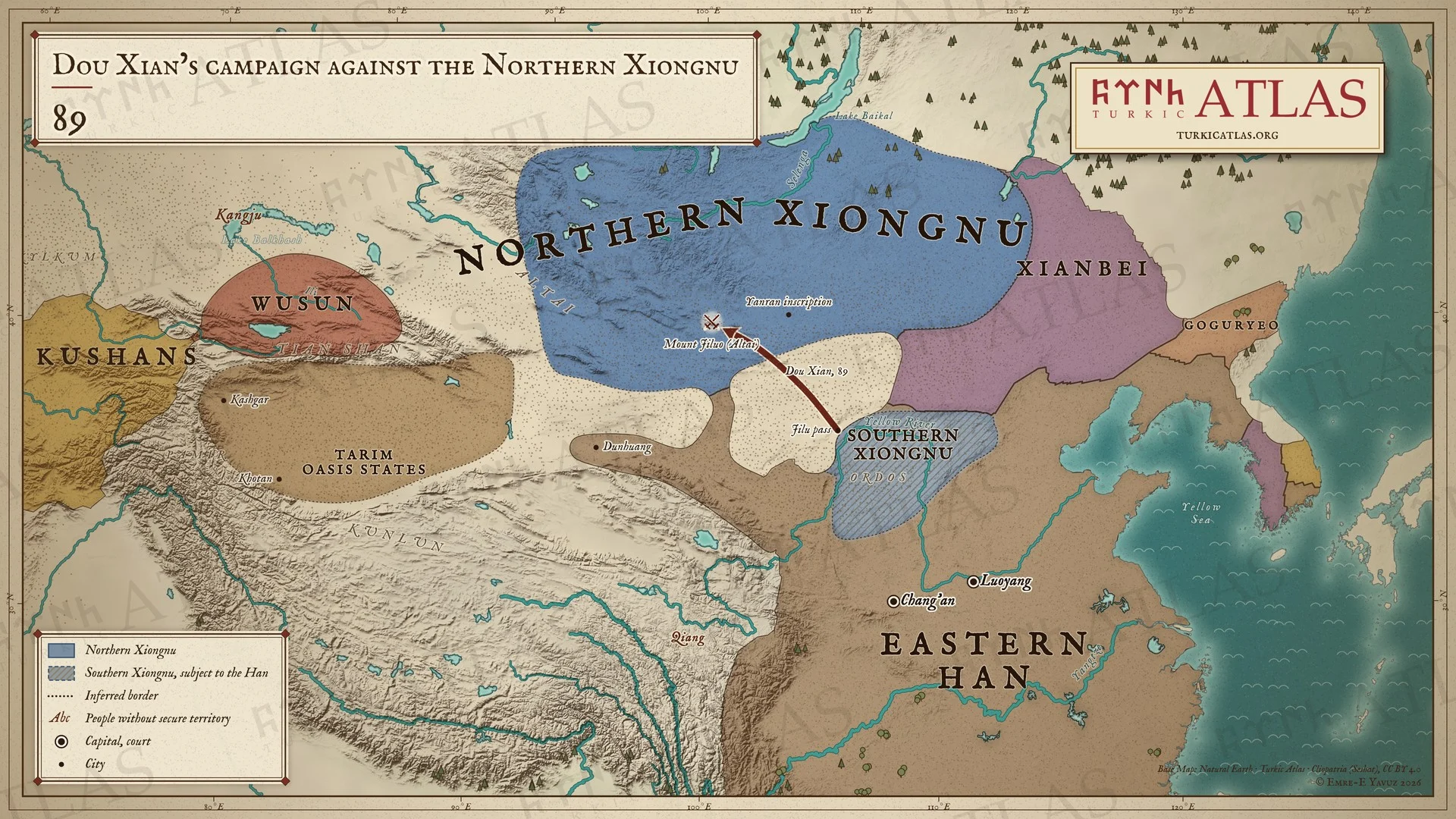
Б.з. 89 бен 91 жылдар аралығында хань мен Оңтүстік ғұндардың әскерлері солтүстік сарайды жойды. Б.з. 93 жылы соңғы таққа үміткер шекарадан қайта алдап шақырылып, басы алынды. Бұл туралы Ханьның Солтүстік ғұндарға қарсы жорықтарында айтылады.[14] «Хоу Хань шу» қорытынды бағасында шаньюй усундер еліне қашты делінеді. Шөлдің солтүстігіндегі ел бос қалды.[14]
-
c. 215 BC Qin takes the Ordos
Around 215 BC the First Emperor of Qin sent Meng Tian north with a hundred thousand men. He took the land inside the great bend of the Yellow River, the Ordos, made the river the frontier and crossed it to hold the plain below the Yin mountains. According to the Shiji the Donghu north of Yan were strong at this time, and the Yuezhi flourished between Dunhuang and the Qilian mountains. The Xiongnu chanyu Duman could not withstand Qin and moved north. How far north, the source does not say. A second reading places the Qilian of this passage in the Tianshan; the hatched area shows it.
-
209–200 BC Modu unites the steppe
In 209 BC Modu killed his father Duman and became chanyu. Between the Xiongnu and the Donghu lay an empty strip more than a thousand li wide. When the Donghu demanded it, Modu struck east and destroyed their king. The Wuhuan held out at the Wuhuan mountain and paid the Xiongnu a yearly tribute of oxen, horses and sheepskins; the Xianbei withdrew far beyond the Liaodong frontier. Modu drove back the Yuezhi, took back the land Meng Tian had seized as far as Chaona and Fushi, and subjected the Hunyu, Qushe, Dingling, Gekun and Xinli in the north. In 200 BC he surrounded the Han emperor Gaozu for seven days on the hill of Baideng near Pingcheng.
-
176–c. 160 BC The height of the realm
In 176 BC Modu wrote to the Han court that the Wise King of the Right had destroyed the Yuezhi, and that Loulan, the Wusun, the Hujie and twenty-six states around them had all become Xiongnu: all the peoples who draw the bow were now one family. His son Laoshang killed the Yuezhi king and made a drinking cup of his skull. The Yuezhi left the Hexi and moved west into the land of the Saka. The Han Shu names a Xiongnu Commandant of Slaves who resided between Karashahr, Weixu and Weili and taxed the oasis states. In 162 BC the emperor Wendi confirmed the Long Wall as the line between the two realms. No source describes the northern edge of the realm in Tuva and beyond the Baikal.
-
127–121 BC The Han take the Ordos and the Hexi
In 127 BC the Han general Wei Qing drove the kings of the Loufan and the Baiyang out of the Ordos. Han founded Shuofang there and restored Meng Tian's wall along the river; in exchange it gave up the district of Zaoyang beyond Shanggu. In 123 BC the chanyu withdrew north across the Gobi on the advice of the defector Zhao Xin. In the spring and summer of 121 BC Huo Qubing struck into the Hexi corridor, and in the autumn the Hunye king killed the Xiutu king and went over to Han with more than forty thousand people. From then on, says the Shiji, the land from Jincheng and the Hexi west along the Southern Mountains to the Salt Marsh was empty of Xiongnu. By this time the Wusun held the land of the Saka, and the Yuezhi had moved on to the north bank of the Oxus.
-
119–c. 100 BC North of the Gobi
In 119 BC Wei Qing and Huo Qubing crossed the Gobi with separate armies. Huo Qubing marched more than two thousand li beyond Dai, sacrificed on Mount Langjuxu and turned back at the Hanhai. Afterwards, says the Shiji, there was no royal court south of the Gobi. Han settled soldiers and farmers from Shuofang west to Lingju and set up the commanderies of the Hexi, from Wuwei to Dunhuang; the Wuhuan were moved beyond the frontier of five eastern commanderies to watch the Xiongnu for Han. By 105 BC the chanyu had moved further north-west, his left wing facing Yunzhong and his right Jiuquan and Dunhuang. The southern edge of the realm ran somewhere in the Gobi.
-
60–51 BC The Western Regions lost, the realm divided
In 71 BC the Dingling struck the Xiongnu from the north, the Wuhuan from the east and the Wusun from the west, and the peoples bound to them fell away. In 60 BC the Rizhu king went over to Han. The Xiongnu Commandant of Slaves was abolished, and Zheng Ji became the first Protector-General of the Western Regions, with his seat at Wulei. In 57 BC five chanyus contended for the throne. In 54 BC Zhizhi took the royal court, and his younger brother Huhanye moved south to the Han frontier. In 51 BC Huhanye came before the emperor at Ganquan and was allowed to live below the Guanglu wall.
-
49–33 BC Zhizhi in the west, Huhanye in the north
Believing that Huhanye, weak and bound to Han, could not come back north, Zhizhi led his people west. He defeated the Wusun, received the surrender of the Wujie in the north, broke the Jiankun in the west and brought the Dingling under him, and made his seat in the land of the Jiankun. Around 44 BC he killed a Han envoy and went on to Kangju; of his people only three thousand arrived. In 36 BC the Protector-General Gan Yanshou and his deputy Chen Tang marched on Kangju and killed him. Huhanye meanwhile returned to the royal court in the north, and in 33 BC he received the palace lady Wang Zhaojun as his wife. From then on the land north of the Long Wall belonged to the Xiongnu again.
-
AD 48–50 Northern and Southern Xiongnu
Under Wang Mang the states of the Western Regions went over to the Xiongnu. In AD 48 the chiefs of eight southern tribes raised Bi, the Rizhu king, as chanyu under the name Huhanye; he came to the Wuyuan frontier and offered to shield Han against the northern Xiongnu for ever. The next year the northern chanyu fell back a thousand li. In AD 50 the southern court moved inside the frontier, first to Yunzhong and in the winter to Meiji in Xihe, and its chiefs were stationed along the frontier commanderies from Beidi to Dai. Beyond the Liaodong frontier the Xianbei sent their first envoys to Han in AD 49.
-
AD 87–93 The end of the Northern Xiongnu
In AD 87 the Xianbei entered the eastern lands of the Northern Xiongnu and killed the chanyu Youliu; fifty-eight tribes, two hundred thousand people, came to the frontier to surrender. In 89 Dou Xian marched out with the southern chanyu, defeated the northern chanyu at Mount Jiluo and had an inscription cut on Mount Yanran, more than three thousand li beyond the frontier. A rock inscription in the Gobi of central Mongolia is identified with this text; it lies much closer to the frontier than the figure of the source. In 91 Geng Kui defeated the northern chanyu at the Jinwei mountains, and the chanyu fled to the land of the Wusun. The Xianbei moved into the empty land, and more than a hundred thousand Xiongnu tents that stayed behind called themselves Xianbei.
-
c. AD 155–180 The Xianbei in the old Xiongnu land
The Xianbei leader Tanshihuai set his court on the Chuochou river below Mount Tanhan, more than three hundred li north of Gaoliu. According to the Hou Han Shu he raided the Han frontier in the south, held off the Dingling in the north, drove back the Fuyu in the east and struck the Wusun in the west, and held all the old Xiongnu land, fourteen thousand li from east to west. He divided it into an eastern, a central and a western part; the western reached Dunhuang and the Wusun. The Southern Xiongnu remained inside the Han frontier. One reckoning puts the last defeat of the Northern Xiongnu by the Xianbei in 155, a second puts their move west around 158; the hatched area north of Kangju shows where the second places them.
- Place named in a source (position as commonly identified)
- Position disputed or approximate
- Zone drawn after the Han histories
- Second reading or entirely uncertain position (hatched)
- People subject to the Xiongnu, or under Han protection
- Oasis states taxed by the Xiongnu
- Border that no source describes (drawn uncertain)
- Movement named in a source (route drawn)
Ескертпелер
- ^ a b c d e f g h i j k l m n o Shiji, juan 110
- ^ Ögel 2015, p. 281–286
- ^ a b c d e f g h Han Shu, juan 94
- ^ Ögel 2015, p. 285
- ^ Ögel 2015, p. 306
- ^ Ögel 2015, p. 307–309
- ^ Ögel 2015, p. 307
- ^ Lattimore 1951, p. 240, 460–461
- ^ Lattimore 1951, p. 467–468, 478–480
- ^ Han Shu, juan 6
- ^ Chavannes 1913, v–vi
- ^ Laufer 1919, p. 326
- ^ Sinor 1990, p. 130
- ^ a b Hou Han Shu, juan 89
Дерек көздері
- Shiji, juan 110
- Han Shu, juan 6, 94 (after Shiji)
- Hou Han Shu, juan 89
Әдебиет
- Denis Sinor (ed.), The Cambridge History of Early Inner Asia (1990)
- Berthold Laufer, Sino-Iranica. Chinese Contributions to the History of Civilization in Ancient Iran (1919)
- Édouard Chavannes, Les documents chinois découverts par Aurel Stein dans les sables du Turkestan oriental (1913)
- Bahaeddin Ögel, Büyük Hun İmparatorluğu Tarihi I (2015)
- Owen Lattimore, Inner Asian Frontiers of China (1951)
What links here9
- Persons
- Emperor Wu of Han · Hunye King · Li Ling · Meng Tian · Su Wu · Wei Qing · Yizhixie Chanyu
- Places
- Jade Gate
- Controversies
- The Kirghiz descent from Li Ling
Cite this article
Yavuz, Emre-E. “Ғұн-хань соғыстары.” Turkic Atlas, revised 8 November 2026. https://turkicatlas.org/conflicts/xiongnu-han-wars/
Last revised: 8 November 2026

