
Xunn–Xan urushlari Xan imperiyasi bilan Xunnlar (Xiongnu) konfederatsiyasi oʻrtasidagi urushlar edi. Ular miloddan avvalgi 200-yildagi Baideng qamalidan milodiy 93-yilda shimoliy chanyuning tugashigacha davom etdi.
Baideng va heqin
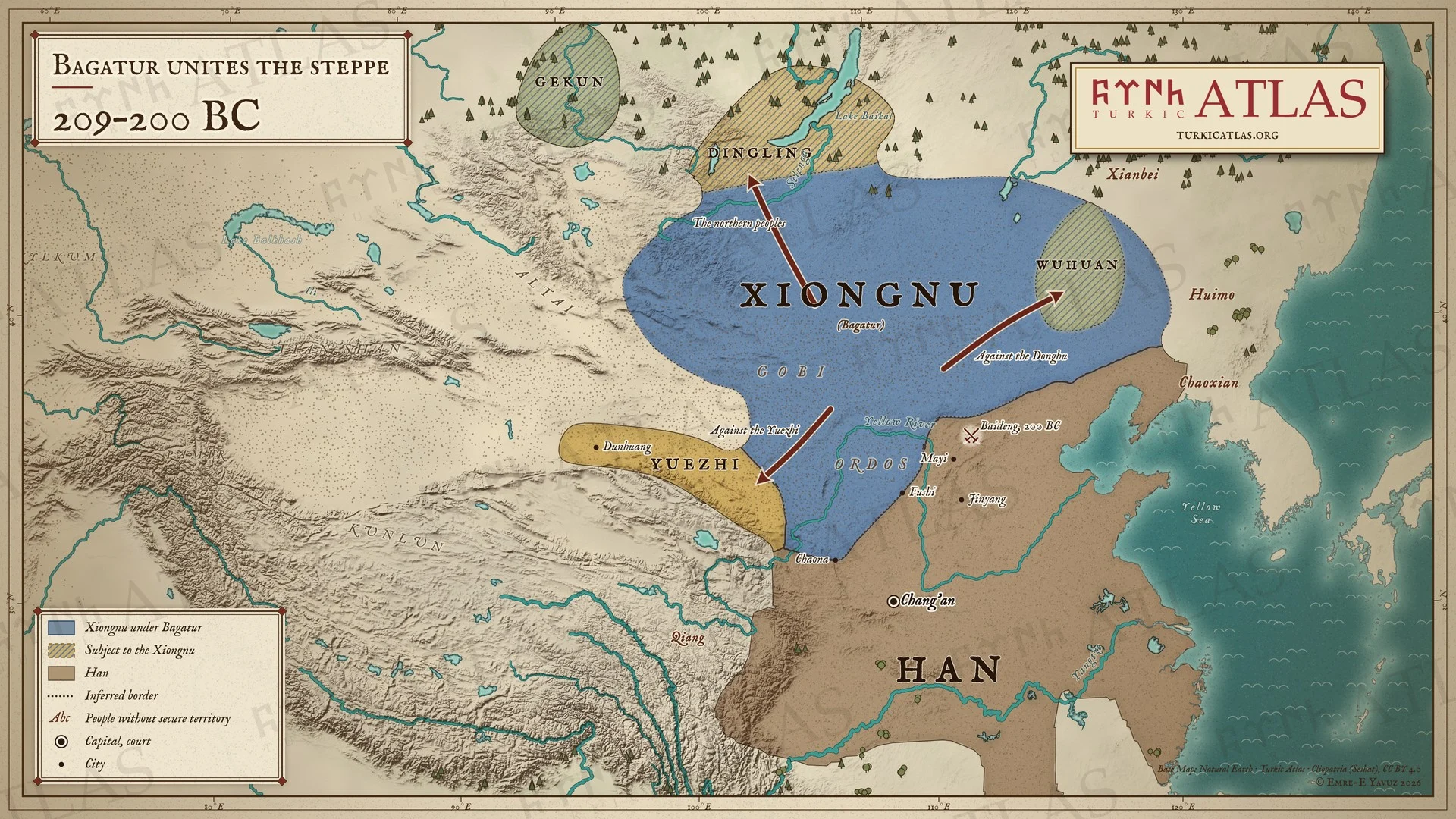
Miloddan avvalgi 200-yil qishida Bagatur birinchi Xan imperatorini Baideng tepaligida yetti kun qamab qoʻydi. Uning 320 000 kishilik Xan qoʻshiniga qarshi 400 000 saralangan otligʻi bor edi.[1][2] Han Shuda 300 000 dan ortiq saralangan otliq keltirilgan.[3][4] Ikkala son ham Xan saroyining yumaloq sonlari, sanoq emas. Xunn soni, ehtimol, qurol koʻtarishga yaroqli barcha erkaklarni bildiradi. Imperator chiqib ketdi. Heqin shartnomasi keldi: chanyuga Xan malikasi, yillik sovgʻalar va birodarlik qasami.[1] Wen va Jing davrida xanlar har bir bosqindan keyin shartnomani yangiladi. U miloddan avvalgi 133-yilgacha davom etdi.[3] Miloddan avvalgi 182-yil bahorida, imperatritsa Lü davrida, xunnlar Didaoga zarba berdi va Ayangni talon-taroj qildi. 181-yilning birinchi oyida ular Didaoni yana talon-taroj qildi va ikki ming kishini olib ketdi.[5] Miloddan avvalgi 177-yilning beshinchi oyida Oʻng Donishmand Shoh Sariq daryoning janubidagi yurtga kirdi va Shang qoʻmondonligining chegara postlarini qoʻriqlagan qabilalarni talon-taroj qildi. Imperator Wen unga qarshi kantsler Guan Yingni 85 000 jang aravasi va otliq bilan yubordi va shoh chegaradan narida chekindi.[1][6] Bir talqin bosqinni Xanga oʻtib, ular uchun chegara postlarini ushlab turgan xunnlarga javob deb tushuntiradi.[7]
Ikki zamonaviy talqin urushlarni kengroq doiraga qoʻyadi. Birinchisi Xitoyni faol sherik qiladi. U chegara dashtning buyuk koʻchmanchiligidan oldin kelgan xitoy oʻsishidan shakl olgan va devor koʻchmanchilarni tashqarida ushlab turishga qanchalik xizmat qilgan boʻlsa, xitoyliklarni ichkarida ushlab turishga ham shunchalik xizmat qilgan, deb hisoblaydi.[8] Ikkinchisi Xanlarning shimoliy chegaradagi dastlabki urushlari xunnlarga qarshi emas, chegara qoʻmondonlariga qarshi olib borilgan, deb hisoblaydi. Qoʻmondonlar qisilganda xunnlar tomoniga oʻtardi. Bu talqinda saroy chegara hokimlarini yaqindan ushlab turgan joyda savdo va urush bosqin va shantaj sifatida birlashishi ehtimol edi.[9]
Wudi davridagi burilish
Miloddan avvalgi 133-yilda xanlar chanyuni tuzoqqa tushirish uchun Mayi atrofiga 300 000 kishini yashirdi. U choʻponsiz oʻtlayotgan qoramollarni koʻrib, ortga qaytdi.[1] Pistirmadan keyin xunnlar heqinni uzdi. Ular chegarani sanoqsiz marta bosib kirdi.[1] Miloddan avvalgi 129-yilda toʻrt sarkarda har biri 10 000 otliq bilan chiqdi. Faqat Wei Qing Longchengga yetdi, Gongsun Ao esa 7 000 kishidan ayrildi.[1] Miloddan avvalgi 127-yilda Wei Qing Sariq daryoning janubidagi yerni oldi va unda Shuofangni qurdi.[1] Bu yer Ordosdir.
Hujumlar, miloddan avvalgi 124–119-yillar
Miloddan avvalgi 124-yilda Wei Qing Oʻng Donishmand Shohni olti sarkarda va 100 000 dan ortiq kishi bilan tunda qamal qildi. Shoh mast edi, chunki xanlar unga yeta olmaydi, deb oʻylagan edi. U qochib qutuldi va xanlar uning 15 000 kishisini oldi.[1]
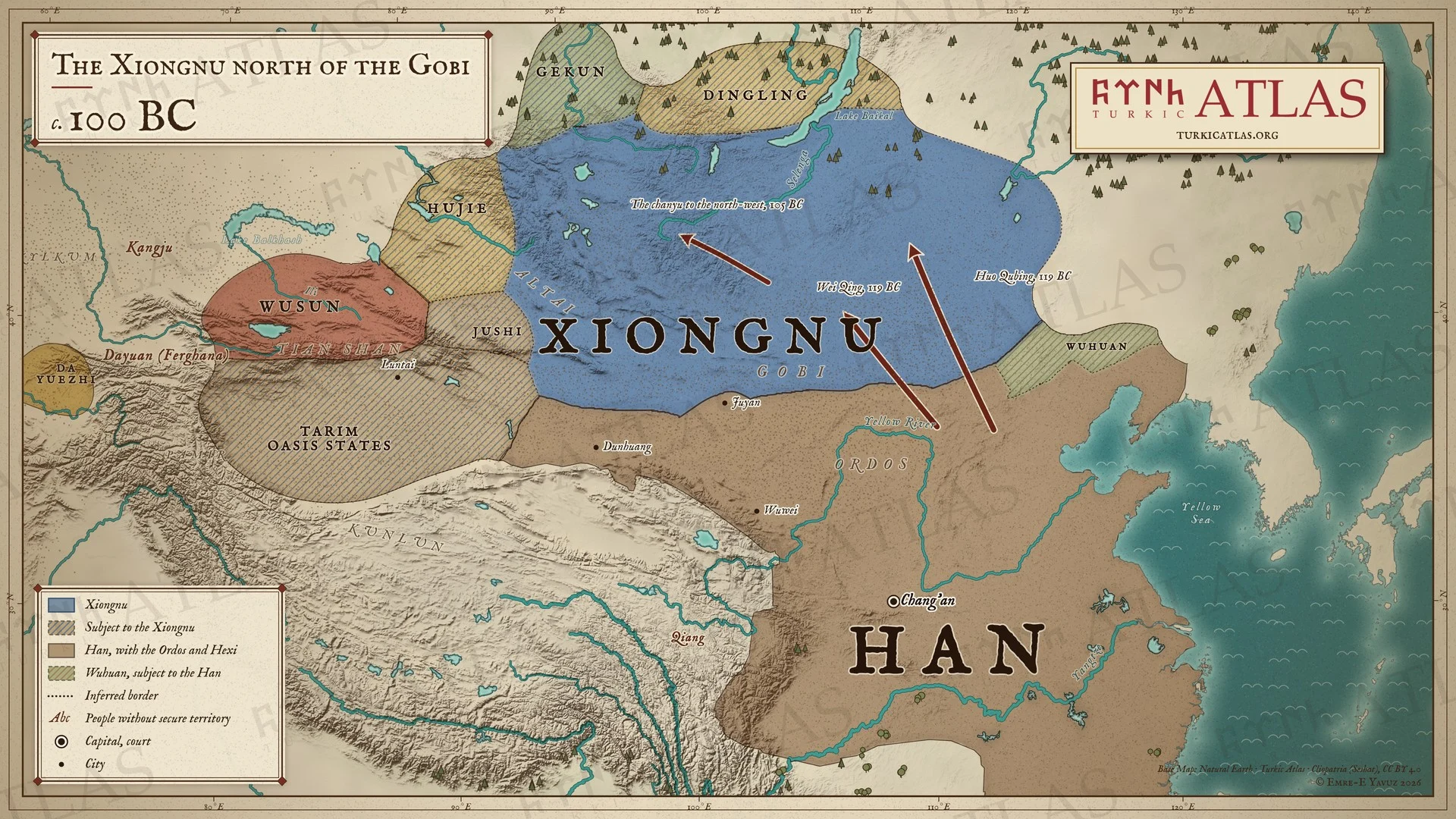
Miloddan avvalgi 121-yilda Huo Qubing gʻarbdagi xunnlarga ikki marta zarba berdi. Oʻsha kuzda Hunye shohi Xiutu shohini oʻldirdi va 40 000 dan ortiq odam bilan Xan tomoniga oʻtdi. Shiji bu odamlar 100 000 deb eʼlon qilinganini aytadi.[1] Wudi yilnomalari oʻsha yili ularning yerlaridan Wuwei va Jiuquan qoʻmondonliklar qilib belgilaydi. Xuddi shu yerdan ajratilgan Zhangye va Dunhuangni miloddan avvalgi 111-yilda qoʻmondonliklar qilib belgilaydi. Boshqa manbalar Hexining toʻrt qoʻmondonligini boshqacha sanalaydi.[10][11] Tan sharhlovchisi Zhang Shoujie Xihe gushiga tayanib, xunnlarga ikki togʻ uchun yigʻlab aytiladigan qoʻshiqni nisbat beradi: Qilian togʻlarini yoʻqotgandan beri hayvonlari koʻpaymaydi. Yanzhi togʻlarini yoʻqotgandan beri xotinlarining yuzida rang yoʻq.[1][12] Bir talqin miloddan avvalgi 121 va 119-yillar yurishlarining ikki uzoq oqibatini sanaydi. Birinchisi oʻsha yaylovlarning yoʻqotilishi. Ikkinchisi Hexi yoʻlagidan Lobnorgacha boʻlgan yerning yoʻqotilishi, u yerda xanlar keyin Jiuquan qoʻmondonligini tuzdi va xunnlarni qianglardan ajratdi.[13]
Miloddan avvalgi 119-yildagi Mobei yurishida xanlar 100 000 otliq va 140 000 zaxira otni maydonga qoʻydi.[1] Chanyu choʻlning shimolida kutdi. Shom payti, boʻron paytida, Xan qanotlari unga yopildi. U bir necha yuz chavandoz bilan yorib chiqdi.[1] Shundan keyin xunnlarning Gobidan janubda shohona saroyi qolmadi. Biroq xanlar 100 000 dan ortiq otni yoʻqotgan edi va yana yurisha olmasdi.[1]
Charchash
Miloddan avvalgi 103-yilda 80 000 xunn otligʻi Zhao Ponuning qoʻshinini ajratib tashladi va qoʻshin yoʻq boʻldi.[1] Miloddan avvalgi 99-yilda Li Guangli qamal qilindi va oʻn kishidan oltitasini yoki yettitasini yoʻqotdi.[1] Miloddan avvalgi 90-yilda Li Guangli 70 000 kishi bilan chiqdi. Han Shuga koʻra, u tungi hujumdan keyin taslim boʻldi.[3] Xanlar boshqa qoʻshin yubormadi. Wudi uch yildan keyin vafot etdi.[3]
Xunnlarning boʻlinishi
Miloddan avvalgi 72-yilda beshta Xan qoʻshini va 50 000 wusun otliqi chiqdi. Xunnlar ulardan qutuldi.[3] Keyin xunnlar qor boʻroni tufayli va dinglinglar, wuhuanlar va wusunlar tufayli xalqining oʻn kishidan uchtasini va podalarining oʻndan beshtasini yoʻqotdi.[3] Miloddan avvalgi 57-yildan raqib chanyular bir-biri bilan jang qildi. Miloddan avvalgi 53-yilda akasidan magʻlub boʻlgan Huhanye vazirlarining maslahatiga qarshi Xanga boʻysundi. Zhizhi gʻarbga ketdi.[3] Miloddan avvalgi 36-yilda Gan Yanshou va Chen Tang qoʻshin yigʻdi. Ular Zhizhini Kangjuda oʻldirdi.[3]
Shimolning oxiri
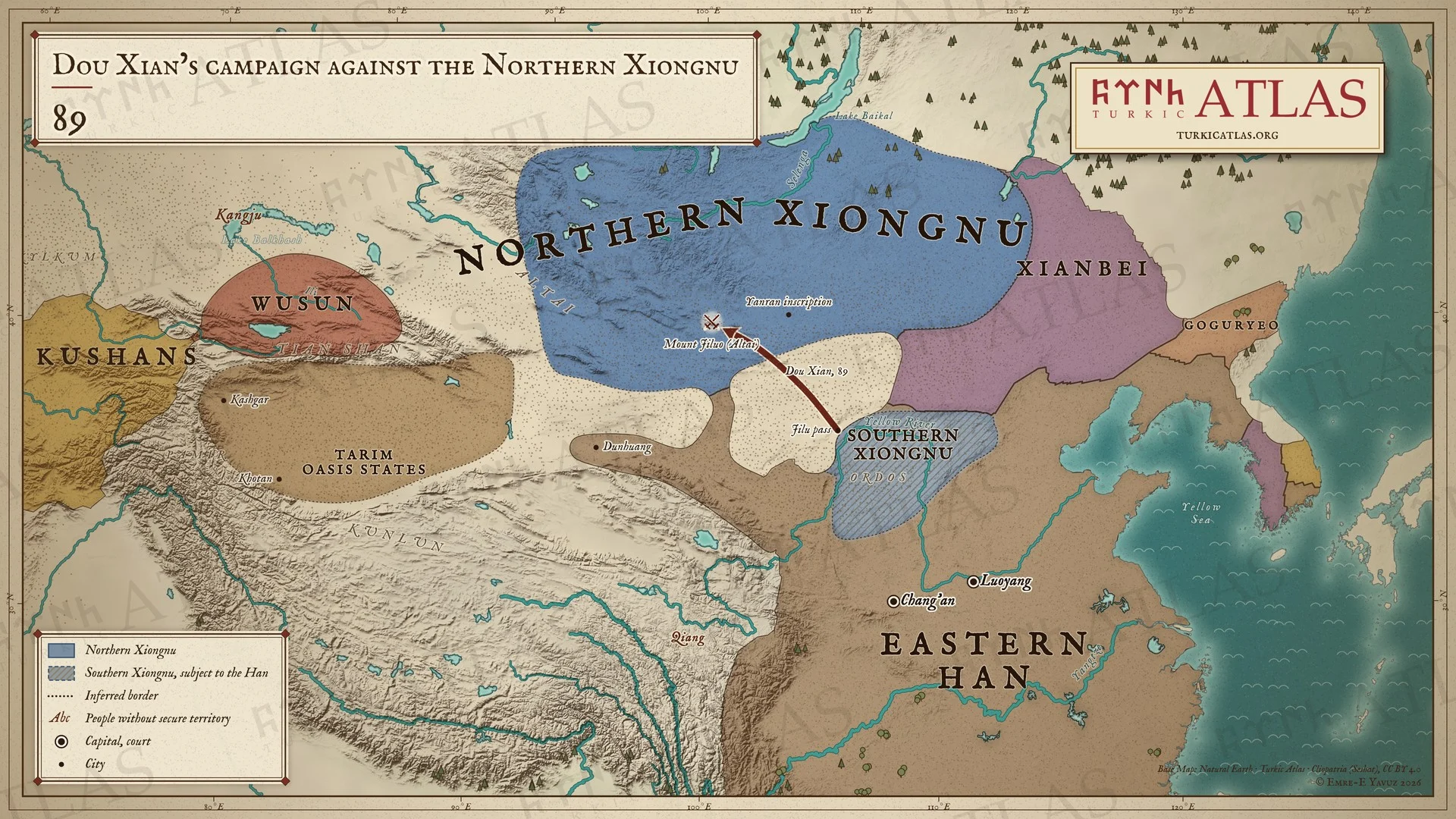
Milodiy 89 va 91-yillar oraligʻida Xan va Janubiy xunn qoʻshinlari shimoliy saroyni tor-mor qildi. Milodiy 93-yilda oxirgi daʼvogar chegara orqali qaytarib aldab olinib, boshi kesildi. Bu Xanlarning shimoliy xunnlarga qarshi yurishlarida hikoya qilinadi.[14] Hou Han Shuning yakuniy hukmida chanyu wusunlar yurtiga qochdi. Choʻldan shimoldagi yurt boʻsh edi.[14]
-
c. 215 BC Qin takes the Ordos
Around 215 BC the First Emperor of Qin sent Meng Tian north with a hundred thousand men. He took the land inside the great bend of the Yellow River, the Ordos, made the river the frontier and crossed it to hold the plain below the Yin mountains. According to the Shiji the Donghu north of Yan were strong at this time, and the Yuezhi flourished between Dunhuang and the Qilian mountains. The Xiongnu chanyu Duman could not withstand Qin and moved north. How far north, the source does not say. A second reading places the Qilian of this passage in the Tianshan; the hatched area shows it.
-
209–200 BC Modu unites the steppe
In 209 BC Modu killed his father Duman and became chanyu. Between the Xiongnu and the Donghu lay an empty strip more than a thousand li wide. When the Donghu demanded it, Modu struck east and destroyed their king. The Wuhuan held out at the Wuhuan mountain and paid the Xiongnu a yearly tribute of oxen, horses and sheepskins; the Xianbei withdrew far beyond the Liaodong frontier. Modu drove back the Yuezhi, took back the land Meng Tian had seized as far as Chaona and Fushi, and subjected the Hunyu, Qushe, Dingling, Gekun and Xinli in the north. In 200 BC he surrounded the Han emperor Gaozu for seven days on the hill of Baideng near Pingcheng.
-
176–c. 160 BC The height of the realm
In 176 BC Modu wrote to the Han court that the Wise King of the Right had destroyed the Yuezhi, and that Loulan, the Wusun, the Hujie and twenty-six states around them had all become Xiongnu: all the peoples who draw the bow were now one family. His son Laoshang killed the Yuezhi king and made a drinking cup of his skull. The Yuezhi left the Hexi and moved west into the land of the Saka. The Han Shu names a Xiongnu Commandant of Slaves who resided between Karashahr, Weixu and Weili and taxed the oasis states. In 162 BC the emperor Wendi confirmed the Long Wall as the line between the two realms. No source describes the northern edge of the realm in Tuva and beyond the Baikal.
-
127–121 BC The Han take the Ordos and the Hexi
In 127 BC the Han general Wei Qing drove the kings of the Loufan and the Baiyang out of the Ordos. Han founded Shuofang there and restored Meng Tian's wall along the river; in exchange it gave up the district of Zaoyang beyond Shanggu. In 123 BC the chanyu withdrew north across the Gobi on the advice of the defector Zhao Xin. In the spring and summer of 121 BC Huo Qubing struck into the Hexi corridor, and in the autumn the Hunye king killed the Xiutu king and went over to Han with more than forty thousand people. From then on, says the Shiji, the land from Jincheng and the Hexi west along the Southern Mountains to the Salt Marsh was empty of Xiongnu. By this time the Wusun held the land of the Saka, and the Yuezhi had moved on to the north bank of the Oxus.
-
119–c. 100 BC North of the Gobi
In 119 BC Wei Qing and Huo Qubing crossed the Gobi with separate armies. Huo Qubing marched more than two thousand li beyond Dai, sacrificed on Mount Langjuxu and turned back at the Hanhai. Afterwards, says the Shiji, there was no royal court south of the Gobi. Han settled soldiers and farmers from Shuofang west to Lingju and set up the commanderies of the Hexi, from Wuwei to Dunhuang; the Wuhuan were moved beyond the frontier of five eastern commanderies to watch the Xiongnu for Han. By 105 BC the chanyu had moved further north-west, his left wing facing Yunzhong and his right Jiuquan and Dunhuang. The southern edge of the realm ran somewhere in the Gobi.
-
60–51 BC The Western Regions lost, the realm divided
In 71 BC the Dingling struck the Xiongnu from the north, the Wuhuan from the east and the Wusun from the west, and the peoples bound to them fell away. In 60 BC the Rizhu king went over to Han. The Xiongnu Commandant of Slaves was abolished, and Zheng Ji became the first Protector-General of the Western Regions, with his seat at Wulei. In 57 BC five chanyus contended for the throne. In 54 BC Zhizhi took the royal court, and his younger brother Huhanye moved south to the Han frontier. In 51 BC Huhanye came before the emperor at Ganquan and was allowed to live below the Guanglu wall.
-
49–33 BC Zhizhi in the west, Huhanye in the north
Believing that Huhanye, weak and bound to Han, could not come back north, Zhizhi led his people west. He defeated the Wusun, received the surrender of the Wujie in the north, broke the Jiankun in the west and brought the Dingling under him, and made his seat in the land of the Jiankun. Around 44 BC he killed a Han envoy and went on to Kangju; of his people only three thousand arrived. In 36 BC the Protector-General Gan Yanshou and his deputy Chen Tang marched on Kangju and killed him. Huhanye meanwhile returned to the royal court in the north, and in 33 BC he received the palace lady Wang Zhaojun as his wife. From then on the land north of the Long Wall belonged to the Xiongnu again.
-
AD 48–50 Northern and Southern Xiongnu
Under Wang Mang the states of the Western Regions went over to the Xiongnu. In AD 48 the chiefs of eight southern tribes raised Bi, the Rizhu king, as chanyu under the name Huhanye; he came to the Wuyuan frontier and offered to shield Han against the northern Xiongnu for ever. The next year the northern chanyu fell back a thousand li. In AD 50 the southern court moved inside the frontier, first to Yunzhong and in the winter to Meiji in Xihe, and its chiefs were stationed along the frontier commanderies from Beidi to Dai. Beyond the Liaodong frontier the Xianbei sent their first envoys to Han in AD 49.
-
AD 87–93 The end of the Northern Xiongnu
In AD 87 the Xianbei entered the eastern lands of the Northern Xiongnu and killed the chanyu Youliu; fifty-eight tribes, two hundred thousand people, came to the frontier to surrender. In 89 Dou Xian marched out with the southern chanyu, defeated the northern chanyu at Mount Jiluo and had an inscription cut on Mount Yanran, more than three thousand li beyond the frontier. A rock inscription in the Gobi of central Mongolia is identified with this text; it lies much closer to the frontier than the figure of the source. In 91 Geng Kui defeated the northern chanyu at the Jinwei mountains, and the chanyu fled to the land of the Wusun. The Xianbei moved into the empty land, and more than a hundred thousand Xiongnu tents that stayed behind called themselves Xianbei.
-
c. AD 155–180 The Xianbei in the old Xiongnu land
The Xianbei leader Tanshihuai set his court on the Chuochou river below Mount Tanhan, more than three hundred li north of Gaoliu. According to the Hou Han Shu he raided the Han frontier in the south, held off the Dingling in the north, drove back the Fuyu in the east and struck the Wusun in the west, and held all the old Xiongnu land, fourteen thousand li from east to west. He divided it into an eastern, a central and a western part; the western reached Dunhuang and the Wusun. The Southern Xiongnu remained inside the Han frontier. One reckoning puts the last defeat of the Northern Xiongnu by the Xianbei in 155, a second puts their move west around 158; the hatched area north of Kangju shows where the second places them.
- Place named in a source (position as commonly identified)
- Position disputed or approximate
- Zone drawn after the Han histories
- Second reading or entirely uncertain position (hatched)
- People subject to the Xiongnu, or under Han protection
- Oasis states taxed by the Xiongnu
- Border that no source describes (drawn uncertain)
- Movement named in a source (route drawn)
Izohlar
- ^ a b c d e f g h i j k l m n o Shiji, juan 110
- ^ Ögel 2015, p. 281–286
- ^ a b c d e f g h Han Shu, juan 94
- ^ Ögel 2015, p. 285
- ^ Ögel 2015, p. 306
- ^ Ögel 2015, p. 307–309
- ^ Ögel 2015, p. 307
- ^ Lattimore 1951, p. 240, 460–461
- ^ Lattimore 1951, p. 467–468, 478–480
- ^ Han Shu, juan 6
- ^ Chavannes 1913, v–vi
- ^ Laufer 1919, p. 326
- ^ Sinor 1990, p. 130
- ^ a b Hou Han Shu, juan 89
Manbalar
- Shiji, juan 110
- Han Shu, juan 6, 94 (after Shiji)
- Hou Han Shu, juan 89
Adabiyot
- Denis Sinor (ed.), The Cambridge History of Early Inner Asia (1990)
- Berthold Laufer, Sino-Iranica. Chinese Contributions to the History of Civilization in Ancient Iran (1919)
- Édouard Chavannes, Les documents chinois découverts par Aurel Stein dans les sables du Turkestan oriental (1913)
- Bahaeddin Ögel, Büyük Hun İmparatorluğu Tarihi I (2015)
- Owen Lattimore, Inner Asian Frontiers of China (1951)
What links here9
- Persons
- Emperor Wu of Han · Hunye King · Li Ling · Meng Tian · Su Wu · Wei Qing · Yizhixie Chanyu
- Places
- Jade Gate
- Controversies
- The Kirghiz descent from Li Ling
Cite this article
Yavuz, Emre-E. “Xunn–Xan urushlari.” Turkic Atlas, revised 8 November 2026. https://turkicatlas.org/conflicts/xiongnu-han-wars/
Last revised: 8 November 2026

