
- 400
- 500
- 600
- 700
- 800
- 900
- Rouran 400–554
- First Göktürk 552–630
- Tang rule 630–682
- Second Göktürk 682–744
- Uyghur 744–840
- Kirghiz 840–924
- Huns 370–469
- Western Göktürk 552–659
- Türgesh 699–766
- Karluk 766–800
- Khazar 650–969
The revolt of the Six Garrisons was the rising in which the Northern Wei lost its northern frontier. It began at Woye under Poliuhan Baling and spread along the line of garrisons. In 525 the Rouran khan Anagui, fighting for the Wei, broke it in the north.[1] The war went on in Hebei. The armies it raised produced Gao Huan and Yuwen Tai, who divided the empire between them ten years later.
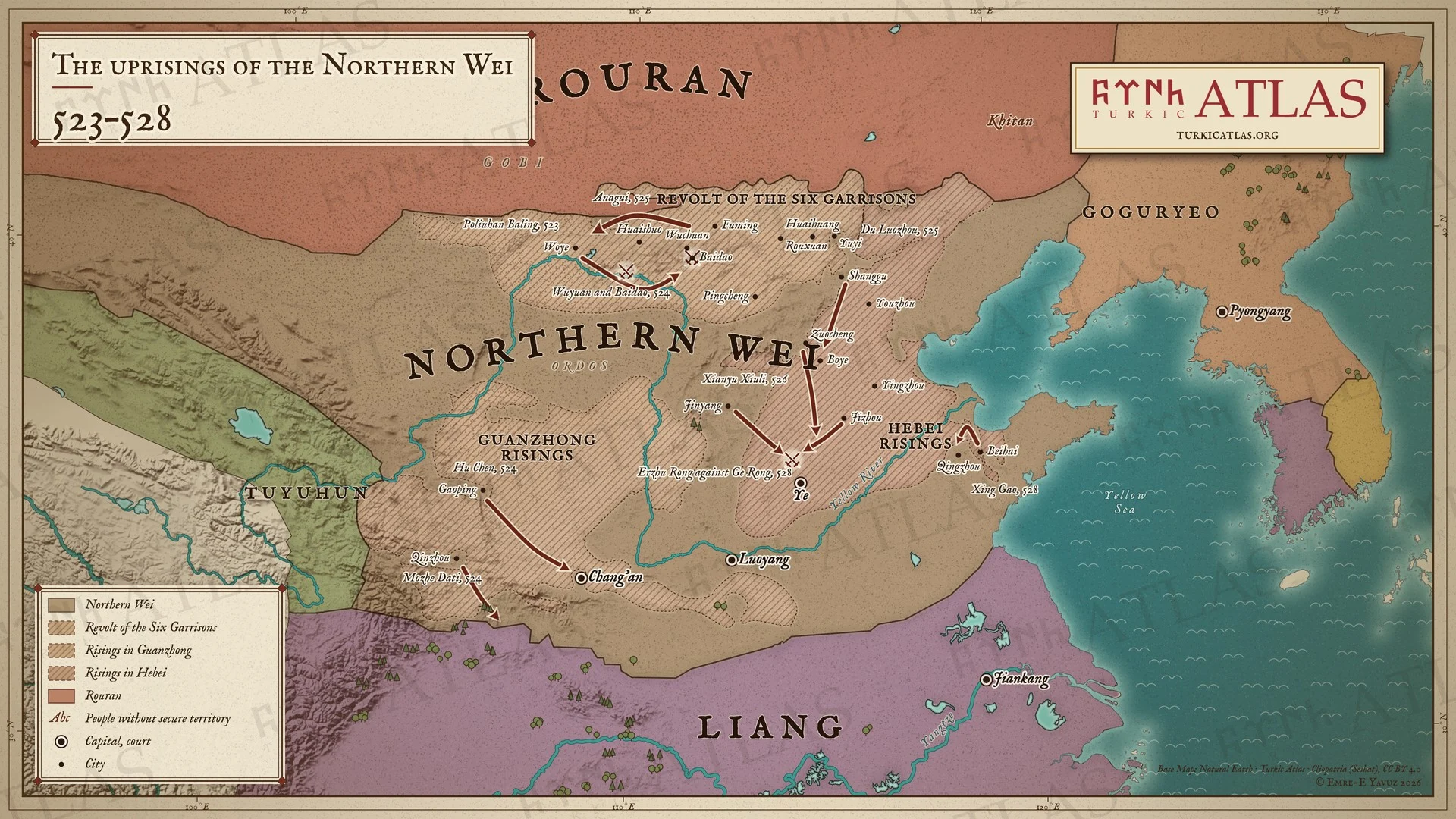
Outbreak (523–524)
The first garrison to rise was Huaihuang. When the Rouran raided in a year of hunger, the people of Huaihuang asked their commander Yu Jing for grain. He refused. They seized him and killed him.[2] Soon afterwards Poliuhan Baling, a man of Woye, gathered followers. He killed the commander of his garrison and proclaimed the era True King. The Chinese and non-Chinese people of the other garrisons answered him.[2] The Zizhi Tongjian tells this under 523. The annals of the Wei Shu, by contrast, put Baling’s rising in the third month of 524.[3] Baling sent his commander Wei Kegu to besiege Wuchuan. Baling also attacked Huaishuo.[2]
The Wei defeats (524)
The Wei armies sent north failed one after another. Prince Yuan Yu of Linhuai was beaten by Baling at Wuyuan in the fifth month of 524 and stripped of his offices. Li Shuren and then Cui Xian were beaten at Baidao. Li Chong fell back on Yunzhong.[1] In Gaoping the Tiele chief Hu Chen rose in support of Baling.[1] The eastern and western Tiele left the Wei and went over to him.[1] According to the Zizhi Tongjian, the court remembered the warnings of Li Chong and of Yuan Shen, Prince of Guangyang, only at this point. It freed the garrison soldiers from their hereditary status and turned the garrisons into provinces. By then, however, all six had risen.[1]
The Rouran intervention (525)
The Wei turned to the Rouran. Early in 525 Anagui marched west from Wuchuan towards Woye with a hundred thousand men. He beat Baling’s forces again and again.[4] According to the annals, he crushed Baling in the sixth month and beheaded his general Kongque.[5] The Bei Qi Shu gives a Kongque of Baling’s house a different end. Its biography of Kongque’s son Poliuhan Chang says that Baling made Kongque grand commander and king pacifying the south. Kongque went over to Erzhu Rong with ten thousand of his men and died later with Wei titles.[6] If the two are one man, the two accounts cannot both be true. The sources do not say which one is wrong. Baling withdrew south across the Yellow River to escape the Rouran.[1] In the same months the chief of the western Tiele, Mieliehe, went over to Yuan Shen with more than thirty thousand households.[1]
The victory made Anagui strong. His tribes were united again and his horses were many. He took the title Chiliantoubingdoufa Khan.[4]
Aftermath
Two hundred thousand rebels surrendered to Yuan Shen. He asked that they be settled in new districts north of Hengzhou. The court refused and distributed them over the provinces of Ji, Ding and Ying to be fed.[1] In the eighth month of 525 Du Luozhou of the Rouxuan garrison rose at Shanggu, also under the era name True King. Gao Huan was among the men who joined him.[1] The risings in Hebei lasted until Erzhu Rong ended them in 528. The last of the rebels in the west were put down in 530. The generals of that war divided the Wei in 534.
References
- ^ a b c d e f g h i Zizhi tongjian (Comprehensive Mirror in Aid of Governance), juan 150
- ^ a b c Zizhi tongjian (Comprehensive Mirror in Aid of Governance), juan 149
- ^ Wei Shu, juan 9; Zizhi tongjian (Comprehensive Mirror in Aid of Governance), juan 149
- ^ a b Wei Shu, juan 103
- ^ Wei Shu, juan 9
- ^ Bei Qi Shu (Book of Northern Qi), juan 27
Sources
- Wei Shu, juan 9, 103
- Bei Shi (History of the Northern Dynasties), juan 98 (after Wei Shu, Zhou Shu and Sui Shu)
- Zizhi tongjian (Comprehensive Mirror in Aid of Governance), juan 149, 150 (after Wei Shu, Zhou Shu, Sui Shu and Bei Shi)
- Bei Qi Shu (Book of Northern Qi), juan 27 (after Bei Shi)
What links here6
- Persons
- Anagui · Poliuhan Baling
- Battles & Events
- Rise of Anagui Khan
- Places
- Woye
- Customs & Pastimes
- The Chile Song
Cite this article
Yavuz, Emre-E. “Revolt of the Six Garrisons.” Turkic Atlas, revised 20 October 2026. https://turkicatlas.org/conflicts/six-garrisons-rebellion/
Last revised: 20 October 2026

