
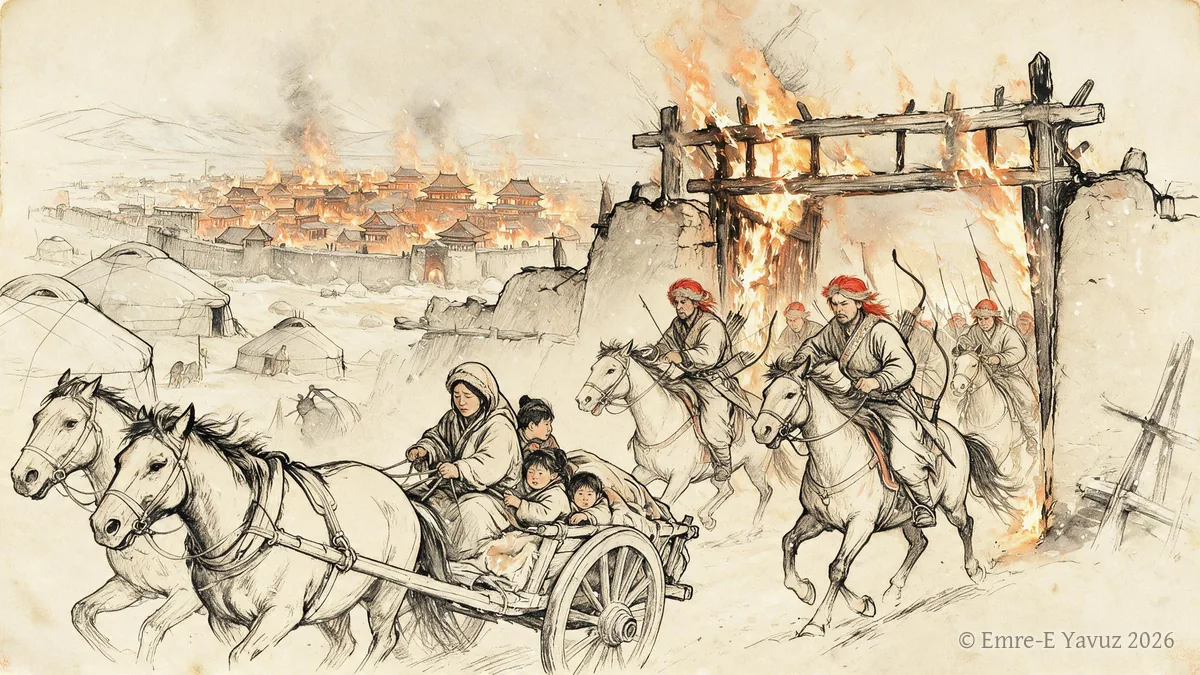
In 840 the Kirghiz came down from the upper Yenisei and took the Uyghur capital on the Orkhon. They killed the khan and burned the city. The Uyghur khaganate, which had held the steppe since 744, ceased to exist as a state.
The year before
The Uyghur lands had a bad year in 839. There was famine, an epidemic among the people and heavy snow that killed sheep and horses in numbers.[1] The snow came at the end of a drought that had lasted, with few breaks, since 783.[2] Some scholars see the winter as a dzud, the frost and snow that empty the herds and are the harder the drier the years before them. Others see it as the last blow to a pastoral economy already worn down. The tree rings reflect only the summers and cannot confirm it.[3] At the same time the court was in a struggle over the throne. A commander who lost it is reported to have gone to the Kirghiz and brought them in.
Twenty years of war with the Kirghiz had preceded all of this. What 840 decided had been contested since the 820s. In 816 the Tibetans had come close to attacking the Uyghur capital. The war with the Kirghiz, which broke out about 820, went on intermittently from then on.[4] The Chinese records of the horse and silk trade, detailed for the 820s, break off in 830.[5] The Kirghiz entered the weakened state at the invitation of a rebel Uyghur chief. They killed the khan and took the capital, and the Uyghurs were forced to disperse.[6] According to the Xin Tang Shu, the Kirghiz khan Are had announced beforehand that he would take the Uyghur khan’s golden tent, race his horses in front of it and plant his banner there.[1][7]
The city
Ordu-Balık on the Orkhon was the first walled capital a steppe empire built for itself. It was a city with a citadel, quarters, workshops and a stele in three scripts, raised with Sogdian and Chinese labour. It was burned in 840 and not rebuilt.
What the Kirghiz took was the Uyghurs’ treasure and the Tang princess Taihe.[1] They burned the Uyghur court and the golden tent in which the khan used to sit.[1] According to one account, they burned the Uyghur banners as well.[8] They did not move into the city.[9] They stayed focused on their homeland on the upper Yenisei.[9]
The dispersal of the Uyghurs
The khaganate dispersed in three directions. One body went south to the Tang frontier and was destroyed or absorbed there. The Uyghur refugees pressed against the frontier in the autumn of 840, fleeing famine as well as the Kirghiz. Some of them began a long period of hostilities with China.[5] A second body went west into the Tarim. It founded the kingdom of Qocho, which lasted four centuries and left the largest body of Old Turkic manuscripts. A third went to Gansu.
The end of the Orkhon centre
Since 552 the Orkhon valley had been the seat of whoever ruled the eastern steppe. Its holders were the first and second Göktürk khaganates, then the Uyghurs. After 840 nobody held it in that sense for three hundred years.
The line of steppe empires with their centre in the Ötüken country breaks here. The Turkic history that follows is written in the Tarim, in Transoxiana and in the west, in cities and among settled subjects. The Kirghiz took no seat on the Orkhon. Their hold on the plateau lasted only a few years.[10] On an older account their victory produced no strong confederation and no new empire, and they went back to the north and to their traditional way of life.[11] A second explanation looks to the valley itself. The drought and the killing winter may have ruined its economy so far that it could no longer carry the seat of a new empire. It did not become a political centre again until the Mongols founded Karakorum there.[12]
References
- ^ a b c d Xin Tangshu (New Book of Tang), juan 217
- ^ Cosmo 2018, p. 448
- ^ Cosmo 2018, p. 457,461–462
- ^ Sinor 1990, p. 342
- ^ a b Cosmo 2018, p. 457
- ^ Sinor 1990, p. 319–320
- ^ Ögel 2000, p. 235
- ^ Drompp 2005, p. 37
- ^ a b Drompp 2005, p. 38
- ^ Drompp 2005, p. 200
- ^ Kwanten 1979, p. 53
- ^ Cosmo 2018, p. 457,462
Sources
- Xin Tangshu (New Book of Tang), juan 217 (after Jiu Tangshu)
Literature
- Colin Mackerras, The Uighur Empire According to the T'ang Dynastic Histories (1972)
- Peter B. Golden, An Introduction to the History of the Turkic Peoples (1992)
- Emre-E. Yavuz, The Gokturk Empire: 2nd Edition (2025)
- Michael R. Drompp, Tang China and the Collapse of the Uighur Empire: A Documentary History (2005)
- Denis Sinor (ed.), The Cambridge History of Early Inner Asia (1990)
- Nicola Di Cosmo; Amy Hessl; Caroline Leland; Oyunsanaa Byambasuren; Hanqin Tian; Baatarbileg Nachin; Neil Pederson; Laia Andreu-Hayles; Edward R. Cook, Environmental Stress and Steppe Nomads: Rethinking the History of the Uyghur Empire (744–840) with Paleoclimate Data (2018)
- Bahaeddin Ögel, Türk Kültür Tarihine Giriş VII: Türklerde ordu, ordugah ve otağ (2000)
- Luc Kwanten, Imperial Nomads. A History of Central Asia, 500–1500 (1979)
What links here9
- Persons
- Are Khan · Külüg Bagha · Princess Taihe
- Conflicts
- Uyghur–Kirghiz War
- Battles & Events
- Kirghiz Embassies to the Tang (842–848)
- Places
- Ordu-Balık
- Institutions and Titles
- Livestock Losses in the Annals
- Controversies
- The Kirghiz descent from Li Ling
Cite this article
Yavuz, Emre-E. “The fall of Ordu-Balık, 840.” Turkic Atlas, revised 8 November 2026. https://turkicatlas.org/events/fall-of-ordu-baliq-840/
Last revised: 8 November 2026

