
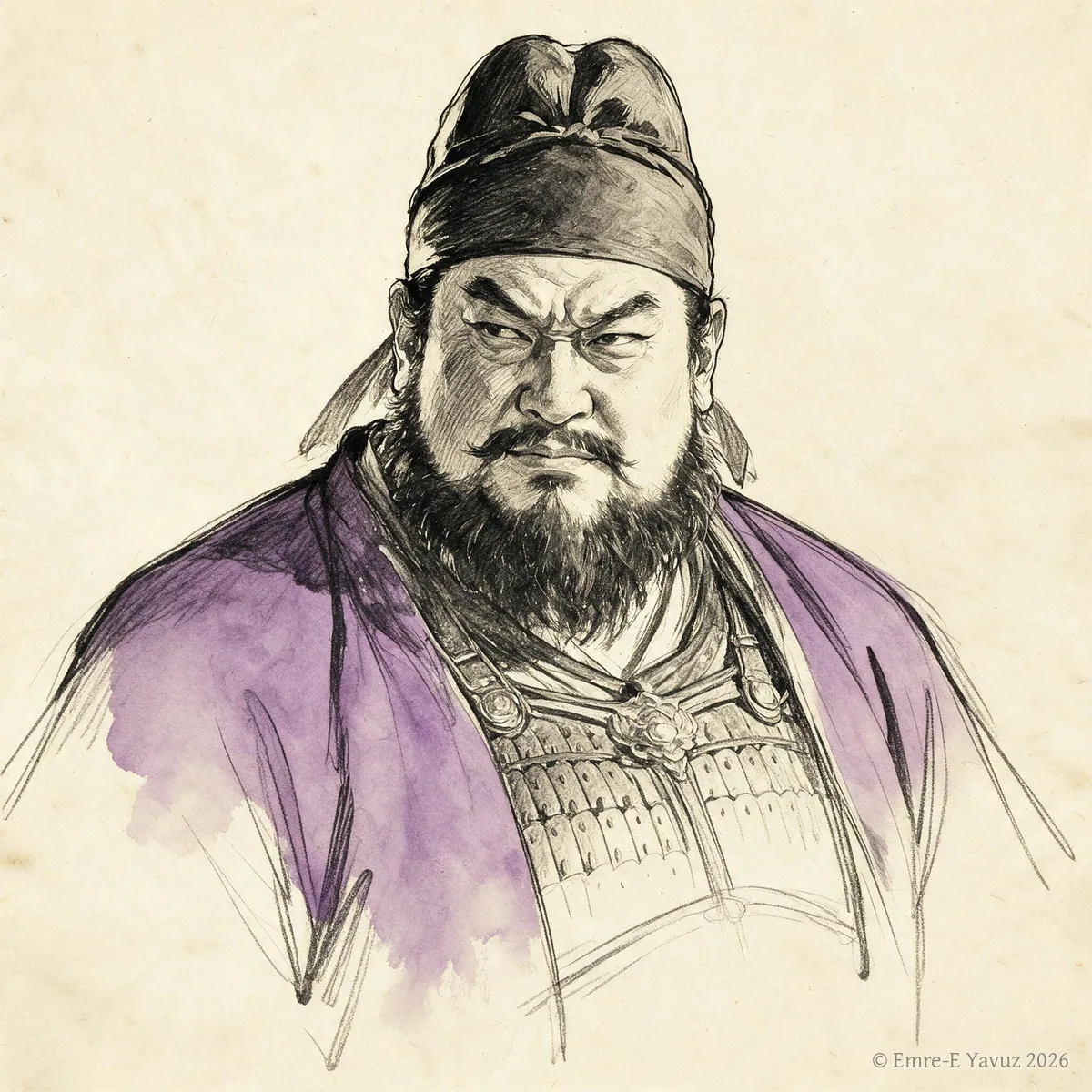
An Lushan was born in 703 to a Sogdian father and a Göktürk mother. His father, An Yanyan, was a Sogdian officer in the Göktürk armies. His mother belonged to the great Göktürk clan of the Ashide. His name is a good transcription of the Sogdian Rōxšan, “the luminous”. Other Sogdians in China also bore this name. The family probably fled to China after Kül Tegin took power in 716. His uncle An Bozhu adopted him. He worked in the markets of the military towns of the Chinese north-east, and is said to have served there as a commercial interpreter.[1] Whether he did so is less important than two other facts. A Chinese writer thought the trade of market interpreter the perfect Sogdian occupation, and several sources remark on his knowledge of languages.[1] He won renown as a soldier in the wars against the Khitan. In 742 he became governor of the military province of Pinglu on the Korean and Khitan frontier. He rose in the shadow of the chief minister Li Linfu, who preferred barbarian generals to Chinese aristocrats. Before his revolt he commanded all the armies of the north-east. These armies kept a cult of him long after his death. He spent his youth at Yingzhou, the chief Chinese stronghold on the Korean frontier. The government had settled western merchants there when the town was refounded in 717. That was no coincidence.[1]
Rebellion (755–763)
He revolted in December 755. In July 756 he took the capital. His son An Qingxu murdered him and succeeded him in January 757. The imperial armies were organised from Gansu, with troops recalled from the Tarim. With the help of the Uyghurs, they retook Chang’an in November and Luoyang in December. In October 759, Luoyang fell again, to Shi Siming, one of An Lushan’s generals. Shi Siming had killed An Qingxu and proclaimed himself emperor. The rebellion was finally put down in January 763. Seven years of revolt ruined Tang China. The dynasty never again imposed a centralised state. The provincial governors took their autonomy. The most distant provinces, the Tarim and Turkistan, were lost outright when their armies were recalled. The Tibetans and the Uyghurs divided the old possessions between them. At the height of his power, An Lushan held only a third of the country. He hardly tried to conquer the west, where the Sogdian communities were richest.
Character of the rebellion
The rebellion had a precise cultural identity.[1] Its officers were hu of mixed Iranian and Göktürk parentage. They included An Lushan, his family and Shi Siming. In February 753, An Lushan made this point himself to the governor Geshu Han. Geshu Han’s father was a Göktürk and his mother hu. An Lushan said to him: “My father was hu, my mother a Göktürk woman; your father was a Göktürk and your mother hu; our families are altogether identical, how can we not be friends?” The History of An Lushan was written some fifty years after the events. It describes western merchants who set up markets in secret in the districts and brought him foreign goods worth a million every year. The text also describes how he sat in hu dress on a double bed while incense burned and the crowd of hu prostrated themselves and sorceresses beat drums. It further describes how he sent the hu out into the districts to sell silks, red and violet robes, gilded purses with fish-shaped insignia and belts by the million. This was meant to build a reserve for the revolt for eight or nine years. Modern accounts conclude that the rebellion began in mixed Irano-Göktürk milieux. It had a military and commercial background, not a peasant one. It also made use of the Sogdian merchant networks of the whole north. In 756, the Sogdians of the six hu counties of the Ordos tried to seize Shaanxi for him. In 757, his son fled Luoyang with hu of the same counties. The same year, a revolt broke out at Liangzhou under An Menwu. His cavalry bore the Sogdian title čākar. A recently found tomb of Shi Siming shows him styling himself Zhaowu Huangdi, Emperor Jamūk (“the jewel”). The title joins the title of the Sogdian princes to that of the emperors of China.
Aftermath
The reaction fell on the hu as a people. As the imperial troops retook the cities, they ordered the hu killed. At Beijing, Gao Juren offered rewards for every hu slain. The Jie hu were exterminated. Small children were thrown in the air and caught on spear-points. Many large-nosed men were killed in error. Tang poetry turned from xenophile to xenophobe. In 756 the Baoyu family changed its name from An to Li, out of shame at sharing his surname. Sogdians claimed descent from the far south. Within a generation they vanish from the sources. The conversion of the Uyghur khan to Manichaeism at Luoyang in 762 and 763 checked the reaction. In this step, the Sogdians of China placed themselves under the protection of the one military power the Tang could not refuse.[1] An Lushan was a prominent Chinese military and political figure of Sogdian and Turkic origin. The disturbances he began outlasted his assassination in early 757.[2]
The reconstruction of An Lushan’s origins and career rests on the Chinese sources at second hand.
References
Sources
- Jiu Tangshu (Old Book of Tang), juan 195
Literature
- Étienne de la Vaissière, Sogdian Traders: A History (2005)
- Peter B. Golden, An Introduction to the History of the Turkic Peoples (1992)
What links here19
- Persons
- Bayanchur Khan · Bögü Khan
- States
- Second Göktürk Khaganate · Tang · The Abbasid Caliphate · The Tibetan Empire · Uyghur Khaganate
- Battles & Events
- Plunder of Luoyang and the Silk Payment (757) · The Uyghur Demand for the Prince's Dance (762)
- Places
- Ordos
- Institutions and Titles
- Chakar · The Economy of the Steppe Empires · Uyghur Horse-Silk Trade
- Religions
- Manichaeism · Shamanism · Turkic Mythology
- Controversies
- Turkic-Sogdian Synthesis
Cite this article
Yavuz, Emre-E. “An Lushan.” Turkic Atlas, revised 8 November 2026. https://turkicatlas.org/persons/an-lushan/
Last revised: 8 November 2026

