
- 400
- 500
- 600
- 700
- 800
- 900
- Rouran 400–554
- First Göktürk 552–630
- Tang rule 630–682
- Second Göktürk 682–744
- Uyghur 744–840
- Kirghiz 840–924
- Huns 370–469
- Western Göktürk 552–659
- Türgesh 699–766
- Karluk 766–800
- Khazar 650–969
The Uyghurs were the leading tribe of a confederation of nine Turkic peoples, the Nine Oguz of the inscriptions. For ninety-six years they held the Orkhon country that had been the seat of both Göktürk khaganates.
Before the empire
For about a century and a half from around 400 the whole region from northern Korea to Karashahr was dominated by the Rouran. The ancestors of the Uyghurs, the Gaoche, lived under them as subjects. When the Göktürks broke the Rouran in the middle of the sixth century, they in turn used the Tiele tribes to govern the northern country.
After the split of 582 the western Göktürks tried to keep the Tiele under them. Early in the seventh century the Tiele got free. Over the hundred years that followed they helped the Chinese in campaigns against a long list of peoples, the eastern and western Göktürks among them. In 647 the Tiele tribes were placed under Chinese protection.
That matters for what came later. The Uyghurs had a tradition of alliance with China before they had an empire. The usual target of that alliance was the Göktürks whom they eventually replaced.
Under the Second Khaganate
Towards the end of the seventh century the Uyghurs came under Göktürk domination again. They stayed there until the end of Kapgan’s reign. Then they turned on their masters and had a hand in the khan’s death and in the weakening of his state. From that point, the Old Tang History says, they were independent and gradually became powerful.[1]
The empire
In 744 Kutlug Bilge Kül overthrew the Second Göktürk Khaganate with help from the Basmïl and the Karluks. He then subjected both of them.[1] The khaganate that followed lasted until the Kirghiz took the capital in 840.
The core of the khaganate was a union of nine Turkic tribes, the Nine Oguz or Nine Surnames. The Uyghurs themselves, the ruling tribe, were divided into ten clans, the On Uyghur, of which the Yaglakar was the leading one. Neither list was fixed. The Chinese text of the Karabalghasun stele, written after 808, still calls the khan khagan of the Nine Surnames. By then the division had become political rather than ethnic.[2]
Settlement and livelihood
What separates the Uyghurs from the steppe peoples before them is not the empire but what they did with it. Before 744 they had no fixed dwellings. They moved in search of water and pasture and were excellent riders and archers. This was the formula the Chinese used for every nomad people on their frontier.[3] Within a generation of taking the Orkhon they were building.
Bayanchur raised a capital at Ordu-Balık on the Orkhon and a second city on the Selenga.[3] The work on the second city began in 757.[4] The Arab envoy Tamīm ibn Baḥr reached the first of them. He describes a royal castle and twelve iron gates of huge size, a town populous and thickly crowded, with markets and trades, and around it villages lying close together and cultivated ground.[3] What has been excavated there since agrees with what he saw: metalworkers, potters, engravers, smiths, sculptors, stonemasons, weavers and jewellers, mines for iron, copper, gold and silver, irrigation channels and millstones.[3]
None of that made them a settled people. It made them a people with cities, which is a different thing and a rarer one on the steppe. The herds and the ride remained, and the towns sat in the middle of them as markets, workshops and a seat. The Göktürks had held Ötüken and built nothing there.
Religion and writing
The second difference follows from the first. In 763 the khan took up Manichaeism. The Uyghur khaganate thus became the one steppe empire of these centuries to adopt a scriptural religion from outside. The religion came with the Sogdians who were already at the Uyghur court. With it came their script and the habits of a literate administration. What the Uyghurs later made in writing and in painting rests on that adoption.[3]
The dispersal of 840
The end was quick, and the Old Tang History tells it without ornament. A general who had quarrelled with the court fled. He came back at the head of 100,000 Kirghiz horse and stormed the Uyghur forts. He killed the khan, beheaded his enemy and burned the court to the ground. The Uyghurs scattered and fled all over the barbarian country.[5]
They did not disappear. They moved south and west, into country where the cities they had learned to build already stood.
The later Uyghur states
Two centres came out of the flight. Both outlasted the khaganate that produced them.
In the Tarim the Uyghurs took Qočo and the Turfan oases. Their ruler adopted a title that had belonged to the Basmïl: iduq qut, the sacred fortune, heaven-sent Kut.[6] There they absorbed the Tokharian and the eastern Iranian townspeople among whom they settled. The Turkicisation of the Tarim dates from that settlement.[6]
The second centre was at Ganzhou in the Gansu corridor, under the Yaglakar by 902. Smaller polities stood at Etsin-gol and Dunhuang.[6] The Ganzhou Uyghurs could no longer reach into Chinese politics as their fathers had. They took hold of the caravan roads west instead.[6] They dealt with the Khitan Liao and, after 960, with the Song, giving horses, camels, jade, amber, woollen goods and curiosities for silk.[7]
One exchange says what had changed. When the founder of the Khitan empire had taken Mongolia, he sent to the Uyghurs and invited them to come back to their old country. They declined.[7] The Uyghurs had a place among the Khitan themselves: the Xiao clan, from which the Khitan emperors took their empresses, was of Uyghur descent.[8]
The Sogdians went with them. After 840 the Sogdian trade network gave way to a regional Uyghur network from China to the eastern Tianshan, built on Sogdian foundations. One of the rare Uyghur merchant letters from Dunhuang, probably of the tenth century, asks a Sogdian relative for commercial instructions.[9] Of 53 Uyghur envoys to China between 907 and 960 whose names are known, 14 bear Sogdian family names, 16 Turkic and 19 Chinese.[10] The turkicised descendants of the Sogdians kept their place in the diplomacy of Gansu long after Sogdian culture itself had gone.[10] The Hudud al-Alam gives Qočo its Sogdian name Chinanchkath, town of the Chinese. It gives Beshbalik its Sogdian translation Panjikath, five towns. It also records five villages of Sogdians in the Uyghur land with Christians, Zoroastrians and heathens among them.[11]
Painted donors of the oasis
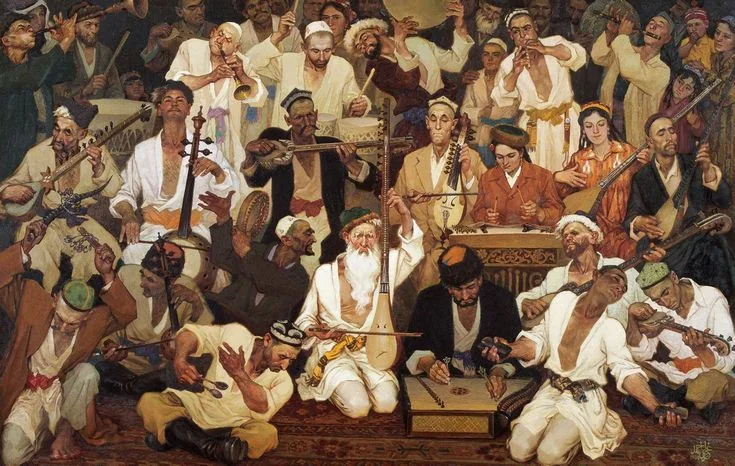
The Buddhist temples of Bezeklik and Qocho keep portraits of Uyghur donors, men and women, each beside a name tablet in Old Uyghur.[12] The men of the group from temple 1 wear long coats whose left side always closes over the right.[13] Those at the door of the cella of temple 9 wear a long red coat with a green lining and high dark boots. A belt with daggers, cloths and a whetstone hangs from the waist, and a golden tiara is tied under the chin with red bands.[14] The women wear a long gold-coloured robe with a broad collar of tendril pattern and a red cloth falling from the headdress. Their hair carries ornaments of clouds and flying birds.[14] On the plinth of a Buddha statue in temple 12 a donor lady wears a large crown with a golden phoenix.[13] In the scenes of devotion of temple 9 small kneeling donors appear in the dress of the land. One is a man in a green cap and a green coat with his wife in a red dress. Others are an older man and a youth in the green Turkic coat, the chapan.[15] The date of the paintings is uncertain. Under the kingdom of Qocho, Turkic Atlas reads the titles on their tablets.
References
- ^ a b Jiu Tangshu (Old Book of Tang), juan 195
- ^ Sinor 1990, p. 320
- ^ a b c d e Mackerras 1972, p. 14
- ^ Sinor 1990, p. 337
- ^ Mackerras 1972, p. 124
- ^ a b c d Golden 1992, p. 165
- ^ a b Golden 1992, p. 166
- ^ Sinor 1990, p. 404
- ^ de la Vaissière 2005a, p. 325
- ^ a b de la Vaissière 2005a, p. 326
- ^ Ḥudūd al-ʿĀlam; de la Vaissière 2005a, p. 318
- ^ von Le Coq 1913, pl. 12, pl. 30, pl. 38
- ^ a b von Le Coq 1913, pl. 38
- ^ a b von Le Coq 1913, pl. 30
- ^ von Le Coq 1913, pl. 25, pl. 26
Sources
- Jiu Tangshu (Old Book of Tang), juan 195
- Xin Tangshu (New Book of Tang), juan 217 (after Jiu Tangshu)
- Ḥudūd al-ʿĀlam
Literature
- Colin Mackerras, The Uighur Empire According to the T'ang Dynastic Histories (1972)
- Peter B. Golden, An Introduction to the History of the Turkic Peoples (1992)
- Emre-E. Yavuz, The Gokturk Empire: 2nd Edition (2025)
- Étienne de la Vaissière, Sogdian Traders: A History (2005)
- Denis Sinor (ed.), The Cambridge History of Early Inner Asia (1990)
- Albert von Le Coq, Chotscho. Facsimile-Wiedergaben der wichtigeren Funde der ersten Königlich Preussischen Expedition nach Turfan in Ost-Turkistan (1913)
- Albert Grünwedel, Alt-Kutscha. Archäologische und religionsgeschichtliche Forschungen an Tempera-Gemälden aus buddhistischen Höhlen der ersten acht Jahrhunderte nach Christi Geburt (1920)
What links here19
- Persons
- Gao Kan · Yukuk Shad
- Battles & Events
- Banquet of the Wine Fountain (647) · Revolt of the Tiele (627)
- Places
- Anbei Protectorate · Yinshan
- Peoples
- Ogurs
- Institutions and Titles
- Furs and Musk among the Turkic Peoples · Irkin · Uyghur Farming · Wagons of the Steppe Peoples
- Languages
- The Turkic languages
- Customs & Pastimes
- Mounted Archery · Seating at the Feast · The New Year on the Steppe · Turkic Songs at the Tang Court
- Sources
- Bilge Khan inscription
Cite this article
Yavuz, Emre-E. “Uyghurs.” Turkic Atlas, revised 7 November 2026. https://turkicatlas.org/ethnicities/uyghur/
Last revised: 7 November 2026

