
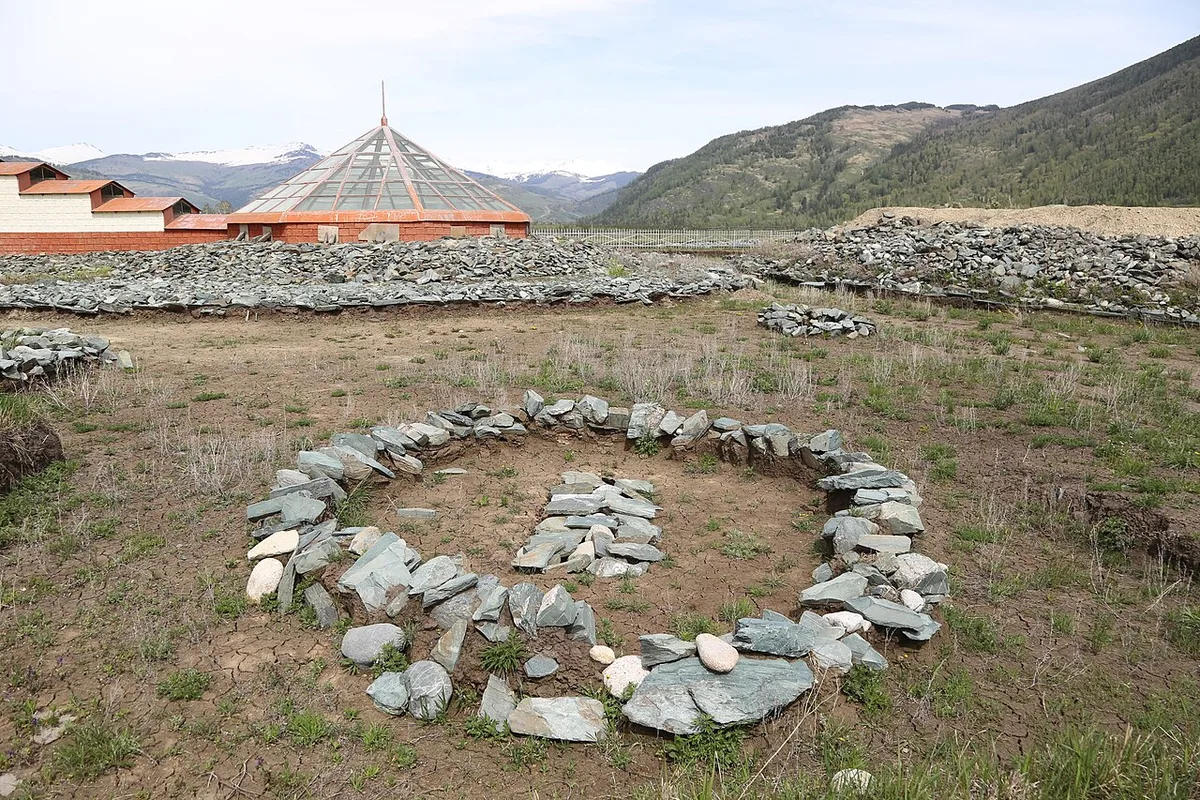
Berel is a burial ground in the valley of the Bukhtarma, in the south-western Altai. It lies in the Katon-Karagay district of East Kazakhstan, a few kilometres from the village of Berel, on a triangular terrace about seventy-five metres above the river and some 1,120 metres above sea level.[1] The Ukok plateau, the best-known country of the frozen mounds of the Altai, lies about eighty-five kilometres away in a straight line.[2] The mounds stand in four main groups, and the count has risen with the excavations: about thirty in 1999, more than seventy in 2015 and more than a hundred in the most recent count.[3]
Most of the large mounds belong to the Pazyryk culture of the fourth and third centuries BC.[4] An older view dated the Pazyryk mounds to the second century BC and the mounds of Berel to the centuries after Christ, shortly before the empire of Attila. It took them for the late features of Hunnic art.[5] Around and beside them lie smaller graves of later periods, among them a few of the Göktürk period.[6] Two things can therefore be read side by side at Berel. One is what the steppe aristocracy of the Altai buried with its dead a thousand years before the Göktürks. The other is what its successors put into the ground beside them.
Excavations
Wilhelm Radloff opened the first mounds in 1865. He worked from 12 July to 9 August on a small plateau about six versts below the mouth of the Berel river. It lies thirty to forty fathoms above the Berel steppe. About twenty large stone mounds stood on it, most of them more than eight fathoms across.[7] One mound near the river, between two and a half and three fathoms high and more than fourteen fathoms across, showed no trace of an earlier opening. Local people said that a princess sat buried in it on a golden chair.[7] It is the mound that later work numbers kurgan 1.[8] Radloff had the whole mound taken apart, which took until 23 July. The stones lay in regular layers, a layer of flat stones and then a layer of round ones with river pebbles in the gaps. Between them he found the skeleton of a horse with an iron bit and two iron stirrups.[7] Stirrups are not known among the nomads before the early seventh century AD. Therefore this horse was put into the mound long after it was built.[9] Iron stirrups are reported from Göktürk-period graves of the Altai and the Tian Shan.[10]
At ground level the pit lay in the middle of the mound. It was filled with sand and loam and frozen so hard that the diggers got on only with fire. When the floor of the chamber was cleared on 29 July, the northern half was covered with birch bark. Under the bark lay sixteen horses, all with their heads to the east, in four rows of four.[11] The first two rows had iron bits. Eight horses were covered with ornaments carved from birch bark and wood, most of them laid with thin gold leaf. The first row had the most. Radloff could not fix their position exactly, because melting snow ran down the walls and the pit filled with thin mud.[12] In the southern half he found a hollowed half trunk of larch, covered with birch bark, with four cast copper birds at its corners, two with raised wings and two with hanging ones.[12] Below lay a decayed horse skeleton, the seventeenth of the grave. At a depth of about ten arshin, some seven metres, he found human arm and leg bones, lying across the grave and falling to dust at a touch.[13] He took the actual grave for robbed. He stopped on 8 August because of rain. He thought the robbing might date from the building of the grave.[14] The bones and most of what lay with them could not be saved.[15]
In the smaller mounds of the Berel plateau Radloff found horses in every grave, in one of them five, always about one and a half arshin higher than the human burial. He also found silver ornaments, knives and daggers of the old bronze forms but made of iron, and pieces of an iron plate armour.[14] He placed the graves in the early Iron Age and took the people who made them for Turkic.[16] The iron armour is more likely to come from the graves of the later Xiongnu and Xianbei period.[17]
The cemetery was dug again in 1959. From 1998 a Kazakh expedition under Zainolla Samashev has worked there on a large scale, in 1998 and 1999 together with a French mission and an Italian research centre.[18] Kurgan 11 was excavated in those years.[19]
The frozen mounds
Under the stone cover of the great mounds the ground stayed frozen. The stone heaps are porous, and no lasting snow settles on them. The rock, a Lower Palaeozoic metamorphic stone and siltstone, conducts heat well. The cold therefore goes deep and reaches the floor of the chamber.[20] A mound has to be two to two and a half metres high and thirty metres across for this at an altitude of a thousand to fifteen hundred metres.[21] The expedition’s own report speaks of artificial permafrost made by the builders.[22] The frozen ground preserved clothing, wooden harness and decoration, saddles, textiles, wooden dishes and leather and felt, and the horses with their skin. This is why Berel is the only monument in Kazakhstan with organic material of this kind.[22]
Kurgan 11 was a mound about thirty-three metres across over a pit about five metres deep, dug into the permafrost.[19] It held a chamber of planks covered with birch bark and shrub branches. In the chamber was a coffin hollowed from a larch trunk with the remains of a man of about forty and an old woman.[23] A radiocarbon date puts the mound at about 322 BC, within 355 to 280 BC at 95 per cent probability. The tree rings put Kurgan 11 at 297 BC and Kurgan 1 at 363 BC.[24] Outside the chamber, on the north side, lay thirteen harnessed and saddled horses.[23] Six lay in an upper level, in two groups of three, and seven in a lower one, all with their heads east or north-east.[25] Some wore masks with false ibex horns of gilded wood, one a carved wooden griffin on the forehead. The horses carried ornaments in the shape of felines, deer, mountain sheep and griffin heads, plated with gold or tin.[23] The trimmings show no wear and seem to have been made for the funeral.[26]
The horses were stallions, mostly of ten to twelve or of eighteen to nineteen years, and between 141 and 152 centimetres high.[27] Each was killed by a blow with a pointed tool to the middle of the forehead.[28] The tomb was robbed long ago. The robbers came while the carcasses were still in fair condition, because the joints of the bones they disturbed were still connected.[29] They took the gold and the silver, and what remains is mostly wood and horn with gold leaf.[30] By the excavators’ count, more than eighty horses had been found in twenty tombs by 2015. The group of the richest burials, with eight horses or more, consists of Kurgan 10, 11, 16 and the large mound opened in 1865.[22] That mound had seventeen horses, against fourteen in the largest of the other mounds of the Pazyryk culture that are named in the comparison.[31]
From the first stage of the cemetery thirteen individuals could be determined by sex and age.[32] Bones from the large mounds show cuts and perforations after death, which are taken as traces of the artificial preservation of the bodies of people of high rank.[33] Which people the mounds belong to is disputed. Berel may be a branch of the Scythian and Saka world, which spread from the Altai to the northern Black Sea.[34] According to others, the people who left the Pazyryk mounds and the later graves are the Dingling of the Chinese sources, a proto-Turkic people.[35]
Graves of the first millennium AD
The graves of the later periods differ from the great mounds in size, in construction and in finds. They are smaller and poorer, and most are deep pits within low stone fences covered with grass.[36] The excavators distinguish a group of the Xiongnu and Xianbei age, which the literature calls Hun and Xianbei, from the third century BC to the fifth century AD, and a Göktürk group of the fifth to the eighth.[6] The first lies mostly to the east and south of the Pazyryk mounds. It includes burials with the bone fittings of composite bows of the type that the literature names for the Xiongnu, three-bladed iron arrowheads and a Chinese mirror of the Han period.[37] In 2019 fifty-eight mounds and grave fences were excavated, with thirty burials, fifteen of them in stone cists and fifteen in pits.[37] Another summary has only two main periods, the Pazyryk one and a pre-Turkic one of the third to the fifth century AD that it calls Xianbei and Rouran.[2]
The Göktürk group is divided into an early Turkic part of the fifth and sixth century and the part of the sixth to the eighth century that shows the character of the period.[38] Four mounds of it were excavated between 1998 and 2011: 16C, 25, 37 and 38.[39] They are of middle or small size, with a sturdy stone fence in the shape of an irregular rectangle or an oval. Mound 25 is about twelve metres across and oval, and mound 38 is nearly square, about 4.6 by 4.3 metres.[39] In general the dead lie in cists of slate slabs or in the bare ground and not in wooden chambers.[39] Mound 25 held metal spear points, whistling arrowheads, buckles and bridle bits that identify it as Göktürk by type.[39] In mound 37 a man lay on his back, with his head to the east, in a grave a metre deep. Two low balbals stood to the south-east and a standing stone, 1.30 metres high, to the west of the pit.[39] The horses of the Göktürk graves are stallions of the same size as those of the Pazyryk burials.[40] Elsewhere in the Altai, large graves of the Göktürk period at Kuray, Tuyahta and Katanda held silver cups with a runiform inscription under the base. A belt fitting from Kuray carries the title shad.[41] The summary lists further numbers, 68, 90, 105 and 108, under both periods. The assignment of those is left open here.[38]
The Göktürk graves cluster densely around the largest of the Saka mounds. This may show a wish to lie near the graves of forebears and a claim to kinship with them.[39] The same account explains the modest later graves in two ways. First, Berel lay far from the centres of the Xiongnu, of the eastern Göktürks at Ötüken and of the western Göktürks in the south of Kazakhstan. Second, small mounds had no permafrost under them, so that organic finds rotted.[42]
Continuity of custom
The burial customs of Berel have common traits across the periods: the dead lie on their backs with the head to the east, they are armed, and the horses buried with them are harnessed and look east. Balbals stand to the east of mounds of the Pazyryk and of the Göktürk period.[43] The same account takes this for a sign of cultural continuity from the Scythian to the Göktürk age. It ties the cemetery to the Dingling.[35]
Other work sets limits to that view. The rows of balbals at the Pazyryk mounds are of the fifth to the third century BC. They are larger than the Göktürk ones and also run east. They cease at the end of the Hunno-Sarmatian age, when only single upright stones are found.[44] Between the two lie several centuries without such rows. The burial of a rider with his horse is an Altai custom that goes back to the eighth century BC and continues through almost every period.[45] The horses at Berel therefore need not point to one people. Excavators in Semirechye also warn against calling every grave with a horse and every enclosure with a statue Turkic, since the tribal attribution of such monuments in the Altai itself is disputed.[46] The enclosures with stone figures belong to a different kind of monument, which has no counterpart in the graves of Berel.
No report ties the Göktürk-period graves of Berel to the Ashina or to any named person.[47] The Zhou Shu places the Ashina on the south side of the Golden Mountain, the Chinese name of the Altai, where they worked iron for the Rouran.[48] The mounds of Berel lie at the south-western end of that range.[49]
Name
- БерелRussian
- Big Berel KurganEnglish
The place takes its name from the river and the village of Berel. The old reports write Berel and call the plateau the Berel steppe. French and English articles write Berel’.[50] Radloff’s mound, the largest of the cemetery, is called the Big Berel Kurgan or kurgan 1 in later work.[8]
Reliability of the evidence
Berel supplies two bodies of evidence of very different weight. The Pazyryk mounds are excavated with modern methods and dated by the tree rings and by radiocarbon. They have preserved organic material that has rotted away elsewhere in the steppe. The graves of the Göktürk period are few, small and robbed. What is known of them here comes from a summary of the excavation report and not from the report. They add the picture of a modest burial of armed men with horses, with a balbal or two beside them, in the Altai of the sixth to the eighth century. The question of who the people were stays with the larger debate on the origin of the Göktürks, which Berel can inform but cannot decide.
References
- ^ Kitov 2023, p. 297; 774; Kutlu 2021, p. 297; 774
- ^ a b Kitov 2023, p. 298
- ^ Lepetz 2013, p. 310; 243–244; 774; Zhumatayev 2015, p. 310; 243–244; 774; Kutlu 2021, p. 310; 243–244; 774
- ^ Kutlu 2021, p. 775
- ^ Ögel 1984, p. 62–72
- ^ a b Kutlu 2021, p. 775–777
- ^ a b c Radloff 1893 (zweite Ausgabe), p. 110
- ^ a b Zhumatayev 2015, p. 244; 775; Kutlu 2021, p. 244; 775
- ^ Šer 1966, p. 40
- ^ Ögel 1984, p. 138, 162–163
- ^ Radloff 1893 (zweite Ausgabe), p. 110–111
- ^ a b Radloff 1893 (zweite Ausgabe), p. 111
- ^ Radloff 1893 (zweite Ausgabe), p. 111–112
- ^ a b Radloff 1893 (zweite Ausgabe), p. 112
- ^ Kutlu 2021, p. 771–772
- ^ Kutlu 2021, p. 778
- ^ Kutlu 2021, p. 786
- ^ Kitov 2023, p. 298; 310; Lepetz 2013, p. 298; 310
- ^ a b Lepetz 2013, p. 310–311
- ^ Kutlu 2021, p. 780
- ^ Kutlu 2021, p. 781
- ^ a b c Zhumatayev 2015, p. 244
- ^ a b c Lepetz 2013, p. 311
- ^ Kutlu 2021, p. 779
- ^ Lepetz 2013, p. 312–314
- ^ Kutlu 2021, p. 789
- ^ Kutlu 2021, p. 791–792
- ^ Kutlu 2021, p. 791
- ^ Lepetz 2013, p. 312
- ^ Kutlu 2021, p. 787–788
- ^ Kutlu 2021, p. 790
- ^ Kitov 2023, p. 298–299
- ^ Kitov 2023, p. 297
- ^ Kutlu 2021, p. 784–785
- ^ a b Kutlu 2021, p. 774, 783
- ^ Kutlu 2021, p. 773
- ^ a b Kutlu 2021, p. 776
- ^ a b Kutlu 2021, p. 776–777
- ^ a b c d e f Kutlu 2021, p. 777
- ^ Kutlu 2021, p. 792
- ^ Ögel 1984, p. 146, 155, 199
- ^ Kutlu 2021, p. 783
- ^ Kutlu 2021, p. 773–774, 793
- ^ Konstantinov 2018, p. 17
- ^ Konstantinov 2018, p. 18
- ^ Nuskabai 2023, p. 83
- ^ Kutlu 2021, p. 773–777
- ^ Zhou Shu (Book of Zhou), juan 50
- ^ Kutlu 2021, p. 771
- ^ Radloff 1893 (zweite Ausgabe), p. 110; 310; Lepetz 2013, p. 110; 310
Sources
- Zhou Shu (Book of Zhou), juan 50
Literature
- Mehmet Kutlu, Leila Kutlu, Ölü Gömme Gelenekleri Bağlamında Berel Kurganları (2021)
- Sébastien Lepetz, Horse sacrifice in a Pazyryk culture kurgan: the princely tomb of Berel' (Kazakhstan). Selection criteria and slaughter procedures (2013)
- Zainolla S. Samashev, Rinat S. Zhumatayev, A horse in a burial-memorial ceremony of ancient nomads in Kazakh Altay region (2015)
- Egor P. Kitov, Антропологические особенности населения пазырыкской культуры (по материалам могильника Берел) (Anthropological Features of the Population of the Pazyryk Culture, Berel Burial Mound) (2023)
- Wilhelm Radloff, Aus Sibirien. Lose Blätter aus meinem Tagebuche. Zweiter Band (1893 (zweite Ausgabe))
- Nikita Konstantinov; Vasilii Soenov; Synaru Trifanova; Svetlana Svyatko, History and culture of the early Türkic period. A review of archaeological monuments in the Russian Altai from the 4th–6th century AD (2018)
- Gleb V. Kubarev, Aibolat Nuskabai, Раннесредневековые поминальные оградки Семиречья: новые данные (Early Medieval Memorial Enclosures in Semirechye: new data) (2023)
- Ja. A. Šer (Ya. A. Sher), Каменные изваяния Семиречья (Kamennye izvaniya Semirech'ya) (1966)
- Bahaeddin Ögel, İslâmiyetten Önce Türk Kültür Tarihi. Orta Asya Kaynak ve Buluntularına Göre (1984)
What links here1
- Religions
- Stone Figures
Cite this article
Yavuz, Emre-E. “Berel.” Turkic Atlas, revised 8 November 2026. https://turkicatlas.org/places/berel/
Last revised: 8 November 2026


