
Of all Göktürk practice, the funeral is the best documented. The Chinese describe it twice. The inscriptions give a funeral from the inside with its dates. The graves themselves are in the ground.[1]
The rite in the Chinese accounts
The Zhou Shu sets it out in order.[1] The body was laid out in a tent. The sons, grandsons and kin of both sexes each killed sheep and horses and set them before it as an offering.[1] They rode seven circuits round the tent. At each coming to the door they cut their faces with a knife and wept, so that blood and tears ran together. They did this seven times and stopped.[1]
A day was then chosen. The horse the dead man had ridden and the things he had used were burnt with the body. The remaining ashes were gathered.[1] The burial then waited for the season. Those who died in spring or summer were buried when the grass and leaves turned yellow. Those who died in autumn or winter were buried when the flowers and leaves came out.[1] On the day of the burial the kin made the offering again and rode and cut their faces as at the first death.[1] A Roman envoy saw the face-cutting in 576, at the mourning for Istemi. Menander preserves the Göktürks’ own name for these rites, dochia.[2]
After the burial a stone was set up at the grave and a marker raised. The number of the stones followed the number of men the dead man had killed in his life. The heads of the sacrificed sheep and horses were hung on the marker.[1] On that day men and women came to the burial place in their best clothes. A man who found a woman he liked sent to ask for her afterwards, and her parents seldom refused.[1] A funeral was the occasion on which the scattered came together, and marriages were made at it.
The Sui Shu agrees in outline. It differs in the grave.[3] There the body lies in the tent. The kin kill oxen and horses and offer them. They go round the tent crying out, and they cut their faces so that blood and tears fall together, seven times and no more.[3] Then on a chosen day the body is set on a horse and burnt, and the ashes are buried.[3] The grave is marked with wood. A house is built within it, and in the house are painted the likeness of the dead man and the battles he passed through in his life.[3] For every man he had killed one stone was set up, and some graves had a hundred or a thousand.[3] The Bei Shi gives the Zhou Shu’s wording for the rite and the Sui Shu’s for the grave, painted house included. It is no witness of its own.[4] The Tongdian of 801 shortens the Zhou Shu and leaves out the riding and the burning.[5]
The painted house is the detail the Zhou Shu does not have. It is the one that matches what excavation of Göktürk-period tombs has produced. The clause stands between the pit for the ashes and the stones, where it interrupts the sequence of the rite.[6] The texts do not say whether it reports the rite of the Göktürks before 581 or what Chinese observers learned in the Sui years and the first decades of the Tang.[6] The Tang histories use the same words for the battles of the dead man in their account of the monument of Kül Tegin. On the four walls of that monument his battles were drawn. Craftsmen sent from China built it.[7]
The balbal in the inscriptions
The Göktürks use the word themselves.[8] When İltiriš Khan flew away, the Kül Tegin inscription says that a balbal was set up for him. The line can be understood in two ways.[9] In the first, baš balbal means “the first balbal”, and the first stone of his line is set up at his grave. In the second, a name is read: for his father the khan they set up Baz Khan as balbal, the Baz Khan of the Nine Oguz whom the inscription names among the enemies in the passage before.[9][10][11] This Baz Khan has been identified with the khan of the Nine Oguz at the time of İltiriš’s rise, who may have fallen at the Tola.[12] A third possibility is that baz in that passage is a common word, “subject, vassal”, and not a name.[13][14] Elsewhere the khan says that he set up the Kirghiz khan as balbal.[8] If the second is right, the two lines are built alike: bašlayu, “at first”, then the enemy khan in the accusative, then balbal.[15] The German translation of Vilhelm Thomsen has the line with Baz Khan as the object and “the first balbal” as what was made of him: “for my father the khan we set up Baz Khan as first balbal”.[16] The verb takes the person in the accusative and balbal in the nominative, as in “I set up the Kirghiz khan as balbal”. The phrase may by then have been a fixed one.[17] The Bilge Khan inscription has the word as well, in a line in which a stele is made for someone.[18] In Thomsen’s translation the line stands on the south face. After the khan’s eldest son died of illness, the khan had a general set up as balbal. The general was Quy säŋün, whom he had beaten and whose army he had cut down by thirty thousand men.[19][20]
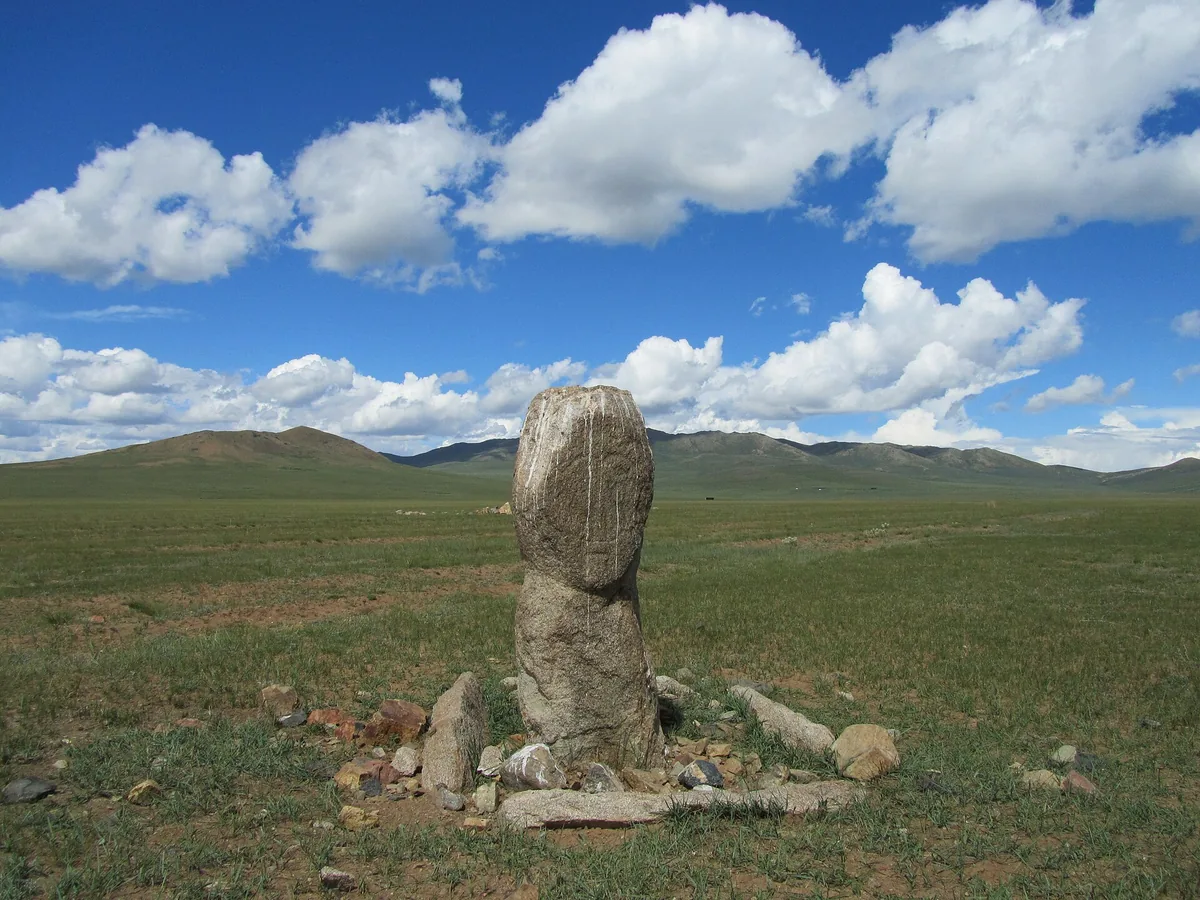
The stones themselves are rough, unworked or barely worked. They stand in a line running east from the grave, in some cases for a great distance.[21] At the monument of Kül Tegin the line began outside the entrance to the burial ground and ran in a straight line for about four and a half kilometres.[22] The stones stood ten to twelve metres apart, roughly shaped as human figures with their faces to the east.[22] The Czechoslovak-Mongolian expedition of 1958 measured a line of more than three kilometres. It began in the east, south of the Zaidam salt lakes, and the stones stood in places only about 2.6 metres apart. Of the roughly shaped blocks 169 remained, most of them fallen.[11] The leader of the expedition took each stone for an enemy whom Kül Tegin had killed. At the far end he saw stones for defeated commanders and khans.[11] A stone lying near the monument of Bilge Khan carries a short runic line that names it a stone balbal. One rendering of the line is “this is the stone balbal of the shad of the Tölis”.[11] Another edition prints it as “Tölös qadın, stone balbal” and leaves qadın untranslated.[23] What they represent is argued. Each stone is most often taken to be a man the dead had killed, set there to serve him. The inscription’s own usage, in which a named enemy khan is himself the balbal, speaks for this.[8] The reason offered is that whoever was killed, or killed for someone, would serve his killer in the other world.[24] In this explanation the balbal is a shapeless stone and, at the same time, the slain enemy whose soul was thought to dwell in it. It is not a memorial stone set up for the dead.[25] A second inscription, the Ongin stone, also speaks of making men into balbals.[24] Others have taken them for followers, gifts from followers, or ancestral figures. The etymology of the word is contested too.[26] Balbal has also been derived from Chinese.[27] Another derives it from a Mongolian verb meaning to cut into pieces, which would allow a Proto-Mongolian origin, and a third proposal connects it with a word for flame.[25] A study of Kazakh words notes that the word came back into Kazakh through twentieth-century scholarship, and it links the word with a Mongolian verb balbalah, “to stand firm”.[28]
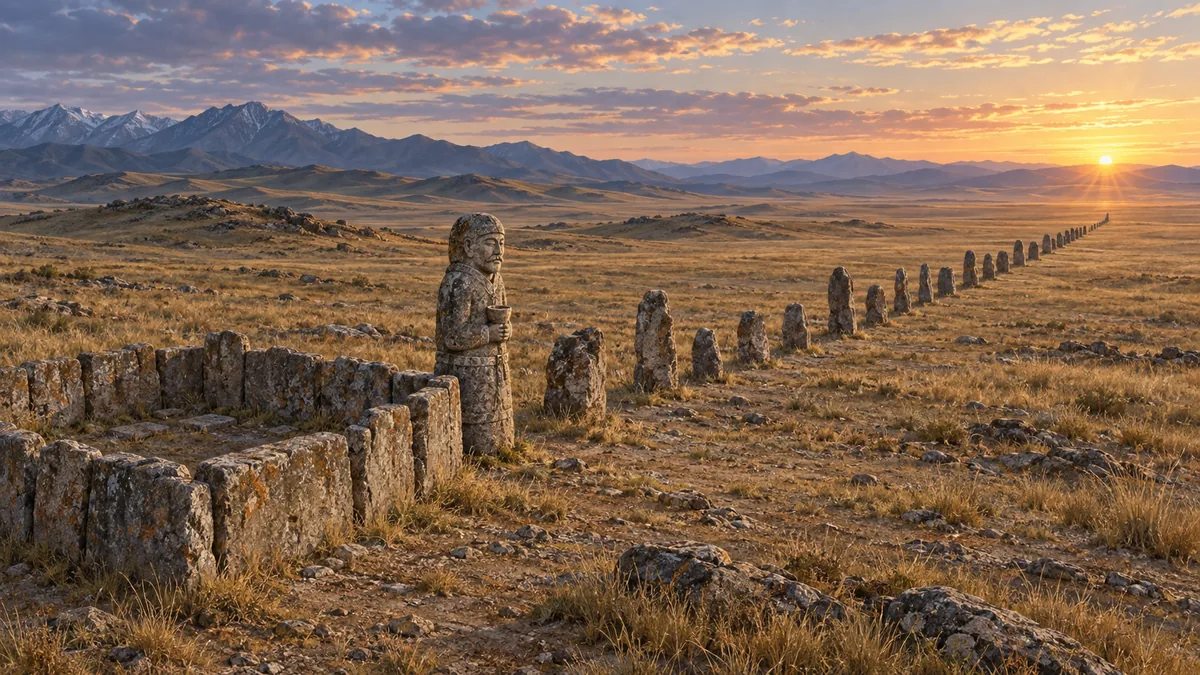
The Chinese accounts point the same way and add a number. The Zhou Shu says that the stones follow the count of the slain. The Sui Shu says that there was one stone for each man killed, and some graves had a hundred or a thousand.[1] An early survey says that the Orkhon inscriptions bear out the Chinese reports in full.[27] Two independent traditions of description, the Chinese and the runiform, give the same explanation. That is the strongest ground for it. The two were put together from the first. Vilhelm Thomsen’s introduction to the Orkhon monuments equates the stones that the Chinese count at the grave with what the Turkic texts call balbal.[29]
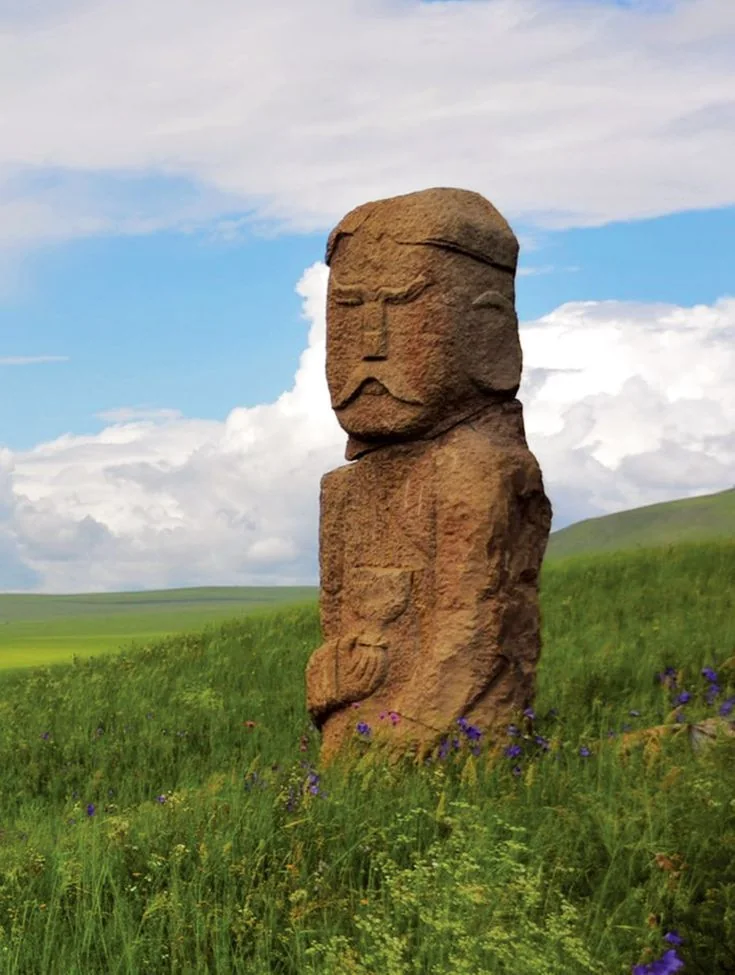
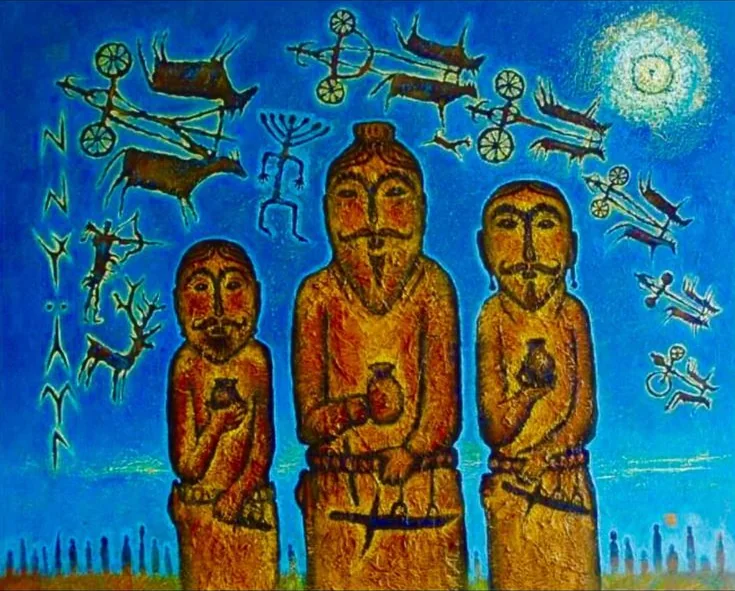
Distinct from the balbals are the carved stone figures with a face, a cup held at the chest and a belt with its fittings, which stand at the enclosure rather than in the line.[30][31] Figures that hold a drinking cup are found across the whole of Central Asia and eastern Europe, and southern Siberia is full of them.[32] The two are often confused and belong to different parts of the same monument.[33] On the Altai grave mounds figures and standing stones stand side by side, and so the figures need not be balbals.[34] Not every account keeps them apart. The balbals of the eighth century, one survey finds, are in outward form the same as the stone figures that the Russians call kamennaya baba and that stand over long distances from the south Russian steppe. It regards the Turkic origin of those figures as beyond doubt since the Yenisei inscriptions were read, and so sets aside the earlier view that they were raised long before the Turks came.[35] The same survey cites the traveller William of Rubruck, who saw such figures on the graves of the Cumans. Rubruck writes that over the dead they raised a great mound and set up a statue, its face to the east, holding a cup in its hand at the height of the navel.[36]
The funeral of Kül Tegin
The inscription gives a complete funeral with its dates. Kül Tegin flew away on the seventeenth day of the Year of the Sheep. The funeral was held on the twenty-seventh of the ninth month.[37] The grave building, the carving and the inscribed stone were all finished on the twenty-seventh day of the seventh month of the Year of the Monkey.[37][38] He was forty-seven.[37] The month of his death is not given. Thomsen’s translation supposes the first month of the year 731. It dates the finishing of the monument, the twenty-seventh day of the seventh month, to 21 August 732.[39]
The mourners are listed by people. The list names the peoples known to the Göktürks in the eighth century. To the founders’ funeral came, from the sunrise, the Bökli, the Chinese, the Tibetans, the Apar, the Purum, the Kirghiz, the Üč Kurıkan, the Otuz Tatar, the Kitañ and the Tatabı. They wept and made the funeral.[8] At Kül Tegin’s own funeral the Kitañ and Tatabı came at the head. The Chinese emperor sent ten thousand rolls of silk and gold and silver past counting. The Tibetans sent a minister. The Sogdians and the men of Bukhara sent their own envoys. The Kirghiz sent Tardush Inanču Čor.[8] Another rendering of the passage has no silk in the emperor’s gift, only treasures in immeasurable quantity, gold and silver.[40]
The men who built the monument came from the Tang court.[41] To make the grave building, to do the carving and to cut the inscribed stone, the Chinese emperor sent his nephew Čaŋ Seŋün and his craftsmen.[37] The 1958 expedition took the whole complex for Chinese work. It named as proof the form, the material and the technique, and measures that are whole multiples of the Chinese building unit of 86 centimetres. Only the balbals, the stone figures and the Turkic inscriptions it counted as Turkic.[42] The figures of polished white marble also resemble Tang statues, though they cannot be tied wholly to China.[34] Bilge Khan says he had them build an extraordinary tomb and had extraordinary carving cut on it inside and out.[43] The tomb of a man whose life was spent destroying Chinese armies was built by Chinese hands. The inscription records both facts without reconciling them.
The killing at a funeral is attested once in plain terms. At the funeral feast of Toŋa Tegin, Kül Tegin killed ten champions of the Toŋra clan.[44] Whether that is a rite or the settling of a score in a ceremonial setting is the sort of distinction these sources do not draw.
Bilge Khan’s own funeral, in 735, is described on the south face of his monument. The delegation under Lisün tai-säŋün, five hundred men, brought perfumes, gold and silver, funeral candles(?) and sandalwood.[45] All these people, it says, sheared their hair and tore their ears and cheeks. They brought good riding horses, black sables and blue squirrels in countless numbers and sacrificed them all.[45]
The words for dying
The corpus keeps two registers apart. The difference is a statement about where the dead go. A khan or a prince flies, uç- or uça bar-. Or he becomes necessary, kergek bol-.[8] The editions of Tekin and Orkun render the phrase plainly as “died”, and Tekin’s glossary gives kergek as “needed, absent”.[46][47] Plain öl-, to die, is used of horses, of relations of the ruling house, and of subordinate rulers who betrayed their allegiance. The Türgesh khan dies, the İzgil die, and Kül Tegin’s horses die.[8] The euphemisms for dying in Old Turkic also include, for Orkhon Turkic, teŋri bol-, “to become divine”, and yok bol-, “to perish”, beside kergek bol-, and for the Uyghur texts ätöz kod-, “to lay down one’s body”.[48]
The flight is not a decorative phrase. The khan whom Heaven took by the crown of the head and lifted up at his installation goes the same direction at his end. The two images belong to one conception.[8] The verb to fly may be linked with a belief that the soul takes the shape of a bird or an insect after death.[49] Among the Western Turks, even after their conversion to Islam, “he became a falcon”, şonkar boldu, was said where one would say “he died”.[49] It is also noted that uça bar-, to go flying, stands in the Turkic and Uyghur inscriptions only for the khan and his brother Kül Tegin. Except for Kül Tegin, the speaker is always a son or a younger brother.[50] The monuments do not give a destination. They name no place the dead arrive at, no power that receives them, and no judgement.[8]
Grief itself has no separate verb. Bilge Khan mourns with sakın-, to think, to brood. His seeing eyes became as though they did not see, and his knowing mind as though it did not know. He held back the tears that came to his eyes and turned back the weeping that rose in his heart. He grieved hard.[44] The word is repeated four times in six lines. The repetition expresses the grief that the man refuses to show.
Two words of mourning live on in the Kutadgu Bilig of 1069–1070. Yoğ aşı is the funeral feast held for a dead man. Sığıt is the lament, which the wise men of the book tell the bereaved to leave off.[51] The book knows none of the rites of the Chinese accounts. It has no ride round the tent, no cut face and no stones.[52]
Departures from the account
A few reports of single funerals differ from the general account of the Zhou Shu and the Sui Shu.[53]
At the mourning for Istemi in 576, Türk-shad had four Hunnic prisoners of war brought out in bonds among his father’s horses. He told them, in their own tongue, to go to his father and tell him how great …; the sentence breaks off there.[2] The preserved text does not say that the prisoners were killed.[2] The errand may have been a human sacrifice. If so, the prisoners were killed to carry the message to the dead man and buried with his horses. This is a rite for a ruler that the Chinese accounts do not know and that has no burning of the body in it.[54] The cutting of faces at that mourning belongs with the Chinese descriptions, and the sacrifice stands apart from them.[55]
In 582, after the battle of Zhoupan, the Göktürks burned their dead on the field and wailed for them.[56] This may have been a cremation forced by the need to leave the field, or equally the ordinary rite done in haste.[55]
In a speech that the Xin Tang Shu gives to the emperor Taizong, the Göktürks burned their dead by custom, and now they raised grave mounds, against the word of their fathers and grandfathers.[57][58] The speech lists the faults that will bring the khanate down. The remark on the mounds may be an argument of the moment, in the manner of the classics, rather than a report of a changed rite.[59] Burning and a mound did not exclude each other. When Ilig Khan died at Chang’an in 634, his people burned his body east of the Ba river and raised a mound over it.[7]
The monument of Kül Tegin is another case again. The Tang histories describe a temple with a stone image of the dead man and his battles on the walls, built by Chinese craftsmen.[7] In the excavated building the image was found and the remains were not. Seven marble statues of Chinese work stood beside the building. They showed Göktürks, one of them probably the dead man, all with the heads struck off. Of a grave there was no trace, though the prince was thought to lie there or near.[22][60] The heads were struck off so that the damage could not be repaired.[61] The wrecking of the monument has been dated to 745, when Uyghur rule replaced Göktürk rule, and this is considered likelier than the Kirghiz raid of 840.[61] West of the building stood a granite block with a cylindrical hollow, taken for a sacrificial stone. Below it lay a hearth of charcoal and ash without any bone.[62] Before the west side of the plinth, three bag-shaped pits held burnt earth and plant remains, with sherds of incised vessels at the bottom.[63] On a hill four kilometres away the expedition found a burial mound not known before. Its leader supposed that Kül Tegin and Bilge Khan lie there, a supposition that the expedition did not test.[64]
Whether the great monuments of the Orkhon mark graves or are memorial halls is argued. Some take the stone chests of the lesser sites for real coffins. For others the sites are memorial places set at some distance from the graves, with the balbals and statues standing directly before them. A third notes that a body burned after six months leaves no bone, so that the absence of bones proves nothing.[65] If the remains were burned, as the accounts say, they lie elsewhere. The monument would then be a memorial of Chinese type and no example of the Göktürk grave.[66]
Other peoples of the steppe buried their dead in other ways. The Tongdian has the Gaoche set their dead seated in an open pit. It has the Kirghiz burn the body and raise the grave mound after a year (see Riding Round the Dead).[67] The Bei Shi gives the same for the Gaoche: the dead are buried seated in an open pit.[68] Ibn Fadlan describes the Oguz burying the dead seated in a chamber like a room, with clothes, weapons and a cup of drink in the hand. The dead man’s horses were then killed and eaten at the funeral feast, and their heads, feet and hides were hung on poles over the grave. For each man he had killed, a carved wooden figure was put on the grave.[69][70] These figures have been regarded as the same custom as the balbal.[70] Taken together, the reports leave the burial customs of the Göktürk realm less uniform than the Zhou Shu makes them.[71]
The texts against the excavations
On one point the Chinese description and the archaeology disagree. Both the Zhou Shu and the Sui Shu have the body burnt with the horse and the ashes buried. The graves that have been excavated contain inhumations, and horses buried whole beside their riders.[1] Cremation is attested among Turkic-speaking peoples of the Yenisei and in some periods of the steppe. The two rites may have coexisted or succeeded one another. The Chinese accounts may equally be describing one practice they saw and generalising it. An early survey noted that the excavations at the burial places of the khans had so far brought no grave to light. It held that the Chinese reports of burning should not be rejected for the time being.[49] An early comparison of the Chinese funeral notices on the Tujue, the Uyghurs and the Khakas with Iron Age graves of the Altai and the Yenisei was made in the 1880s. It found the sacrifice of horses and the laying of the dead man’s gear confirmed. It knew of no urns with burnt human bones there. It took the Chinese report of rows of stone images at the grave for a confusion with much older stone figures.[72] The Altaians of the nineteenth century buried their dead in the earth in hidden places on the mountain slopes, in full dress and with a bag of food for the road. Rich men are said to have had the riding horse buried beside them. Burial on a platform of four posts was found only among the Soyons.[73]
At Berel in the Altai, the graves of the Göktürk period are inhumations in stone cists or in the bare ground, the dead man on his back with his head to the east and a harnessed stallion beside or above him. At kurgan 37, two low balbals stood to the southeast and a standing stone to the west of the grave.[74]
At Döge-Baarı near Kyzyl in Tuva, a stele flanked on the east by a row of balbals stood beside a mound of the ninth or tenth century that is called Kirghiz.[75] Excavation showed the stele to be an overturned deer stone, buried head down in the time of the Kirghiz.[75] The report of the find doubts that the first line of its inscription is Turkic.[75]
The memorial enclosures of the Altai, Tuva and Semirečʹe are square or rectangular settings of stone slabs, often with a figure and with the line of balbals running east. They are the physical form of what the texts describe. They are the part of Göktürk religion that can still be visited on the ground.
References
- ^ a b c d e f g h i j k Zhou Shu (Book of Zhou), juan 50
- ^ a b c Menander Protector
- ^ a b c d e Sui Shu (Book of Sui), juan 84
- ^ Bei Shi (History of the Northern Dynasties), juan 99; Zhou Shu (Book of Zhou), juan 50; Sui Shu (Book of Sui), juan 84
- ^ Tongdian, juan 197
- ^ a b Ecsedy 1984, p. 280–281
- ^ a b c Jiu Tangshu (Old Book of Tang), juan 194; Xin Tangshu (New Book of Tang), juan 215
- ^ a b c d e f g h i Kül Tegin inscription
- ^ a b Kül Tegin inscription; Erdal 2004, p. 223
- ^ Orkun 1994, p. 35, 37
- ^ a b c d Jisl 1963, p. 390
- ^ Sümer 1972, p. 6, 14
- ^ Tekin 1968, p. 310
- ^ Tekin o. J., p. 43
- ^ Erdal 2004, p. 223
- ^ Thomsen 1924, p. 147
- ^ Erdal 2004, p. 363
- ^ Erdal 2004, p. 261
- ^ Tekin o. J., p. 78–79
- ^ Orkun 1994, p. 70
- ^ Kutlu 2021, p. 774, 793; 517; Çikolar 2026, p. 774, 793; 517
- ^ a b c Thomsen 1924, p. 138
- ^ Orkun 1994, p. 189, 190
- ^ a b Roux 1994, p. 217
- ^ a b Roux 1994, p. 216
- ^ Çikolar 2026, p. 517–518
- ^ a b Barthold 2004, p. 19
- ^ Elmira 2013, p. 243
- ^ Thomsen 1924, p. 132
- ^ Potanin 1881, p. 64–67
- ^ Ögel 1978, p. 160, 177
- ^ Ögel 1978, p. 160
- ^ Ögel 1984, p. 165–166
- ^ a b Ögel 1984, p. 166
- ^ Barthold 2004, p. 20
- ^ Rockhill 1900, p. 82
- ^ a b c d Kül Tegin inscription; Tekin 1968, p. 272
- ^ Ögel 1978, p. 5
- ^ Thomsen 1924, p. 157–158
- ^ Tekin 1968, p. 272
- ^ Kül Tegin inscription; Tekin 1968, p. 272, 281
- ^ Jisl 1963, p. 398–399
- ^ Kül Tegin inscription; Tekin 1968, p. 281
- ^ a b Kül Tegin inscription; Tekin 1968, p. 271
- ^ a b Thomsen 1924, p. 158
- ^ Tekin o. J., p. 38–39, 46–47, 52–53, 105
- ^ Orkun 1994, p. 50
- ^ Erdal 2004, p. 532
- ^ a b c Barthold 2004, p. 21
- ^ Roux 1994, p. 214
- ^ Kutadgu Bilig; Dankoff 1983, couplets 1233–1234, 4577
- ^ Kutadgu Bilig
- ^ Ecsedy 1984, p. 263–264
- ^ Ecsedy 1984, p. 264–267
- ^ a b Ecsedy 1984, p. 265
- ^ Mau-tsai 1958, Turkish edition, p. 131
- ^ Xin Tangshu (New Book of Tang), juan 215
- ^ Ögel 1995, p. 522–523
- ^ Ecsedy 1984, p. 276–277, 282
- ^ Jisl 1963, p. 396, 401
- ^ a b Jisl 1963, p. 398
- ^ Jisl 1963, p. 389–390, 396
- ^ Jisl 1963, p. 394–395
- ^ Jisl 1963, p. 401
- ^ Jisl 1963, p. 399–402
- ^ Ecsedy 1984, p. 278, 283
- ^ Tongdian, juan 197; Tongdian, juan 200
- ^ Pulleyblank 1990, p. 23–25
- ^ Ibn Fadlan
- ^ a b Sümer 1972, p. 45
- ^ Ecsedy 1984, p. 282–284
- ^ Radloff 1893 (zweite Ausgabe), p. 121–122
- ^ Radloff 1884, p. 320–321
- ^ Kutlu 2021, p. 777, 792
- ^ a b c V. 2000, p. 261
Sources
- Zhou Shu (Book of Zhou), juan 50
- Sui Shu (Book of Sui), juan 84
- Bei Shi (History of the Northern Dynasties), juan 99 (after Wei Shu, Zhou Shu and Sui Shu)
- Kül Tegin inscription
- Bilge Khan inscription
- Menander Protector
- Kutadgu Bilig
- Tongdian, juan 197, 200 (after Sui Shu and Zhou Shu)
- Jiu Tangshu (Old Book of Tang), juan 194
- Xin Tangshu (New Book of Tang), juan 215 (after Jiu Tangshu)
- Ibn Fadlan
Literature
- Emre-E. Yavuz, The Gokturk Empire: 2nd Edition (2025)
- Uno Harva, Die religiösen Vorstellungen der altaischen Völker (1938)
- Abdülkadir İnan, Tarihte ve Bugün Şamanizm: Materyaller ve Araştırmalar (2017; first edition 1954)
- Marcel Erdal, A Grammar of Old Turkic (2004)
- Ildikó Ecsedy, Ancient Turk (T'u-chüeh) Burial Customs (1984)
- Liu Mau-tsai, Çin Kaynaklarına Göre Doğu Türkleri (1958, Turkish edition)
- Vilhelm Thomsen, Alttürkische Inschriften aus der Mongolei, in Übersetzung und mit Einleitung (1924)
- Mehmet Kutlu, Leila Kutlu, Ölü Gömme Gelenekleri Bağlamında Berel Kurganları (2021)
- Eyüp Çikolar, Türk Ölüm Adetleri ve Balbal Taş Geleneğinin Şahideler Üzerindeki Manevi İzleri (2026)
- Grigorii Nikolaevich Potanin, Очерки Северо-западной Монголии. Вып. 2. Материалы этнографические (Ocherki severo-zapadnoi Mongolii, Bd. 2) (1881)
- Wilhelm Radloff, Aus Sibirien. Lose Blätter aus meinem Tagebuche. Zweiter Band (1893 (zweite Ausgabe))
- Wilhelm Radloff, Aus Sibirien. Lose Blätter aus meinem Tagebuche. Erster Band (1884)
- Talât Tekin, A Grammar of Orkhon Turkic (1968)
- V. V. Barthold, Orta Asya Türk Tarihi Dersleri (Orta Asya Türk Tarihi Hakkında Dersler) (2004)
- Lumír Jisl, Kül-Tegin anıtında 1958'de yapılan arkeoloji araştırmalarının sonuçları (1963)
- Bahaeddin Ögel, Türk Kültür Tarihine Giriş III: Türklerde ev kültürü (1978)
- Bahaeddin Ögel, Türk Kültür Tarihine Giriş IV: Türklerde yemek kültürü (1978)
- Bahaeddin Ögel, İslâmiyetten Önce Türk Kültür Tarihi. Orta Asya Kaynak ve Buluntularına Göre (1984)
- Bahaeddin Ögel, Türk Mitolojisi (Kaynakları ve açıklamaları ile destanlar) II (1995)
- Hüseyin Namık Orkun, Eski Türk Yazıtları (1994)
- Edwin G. Pulleyblank, The 'High Carts': A Turkish-Speaking People Before the Türks (1990)
- Jean-Paul Roux, Türklerin ve Moğolların Eski Dini (1994)
- Faruk Sümer, Oğuzlar (Türkmenler). Tarihleri, boy teşkilâtı, destanları (1972)
- William Woodville Rockhill (trans. and ed.), The Journey of William of Rubruck to the Eastern Parts of the World, 1253–55, as narrated by himself, with two accounts of the earlier journey of John of Pian de Carpine (1900)
- Talât Tekin, Orhon Yazıtları. Kül Tigin, Bilge Kağan, Tunyukuk (o. J.)
- Kormuşin, İgor V., Kuzey Tuva Öğök-Turan Vadisindeki Göktürk Anıtlarının Bazı Özellikleri (2000)
- Kaljanova, Elmira, Eski Türk Yazıtları ve Kazakçadaki Ortak Kelimeler (2013)
What links here24
- Battles & Events
- Taizong's Speech on the Signs of Ruin (628)
- Places
- Berel · Khöshöö Tsaidam · Shiveet Ulaan
- Institutions and Titles
- Captives and the Unfree · Deer stones · Honour of Death in Battle · Warfare of the Steppe Empires · Women among the Turkic Peoples
- Religions
- Ancestor Cult · Animism · Dochia · Göktürk Face-Cutting · Horse Sacrifice · Iye · Riding Round the Dead · Sacrifice and the year · Stone Figures
- Customs & Pastimes
- Culture of the Turkic Peoples
- Controversies
- The making of Tengrism
Cite this article
Yavuz, Emre-E. “Burial and the balbal.” Turkic Atlas, revised 8 November 2026. https://turkicatlas.org/religions/burial-and-balbal/
Last revised: 8 November 2026


