
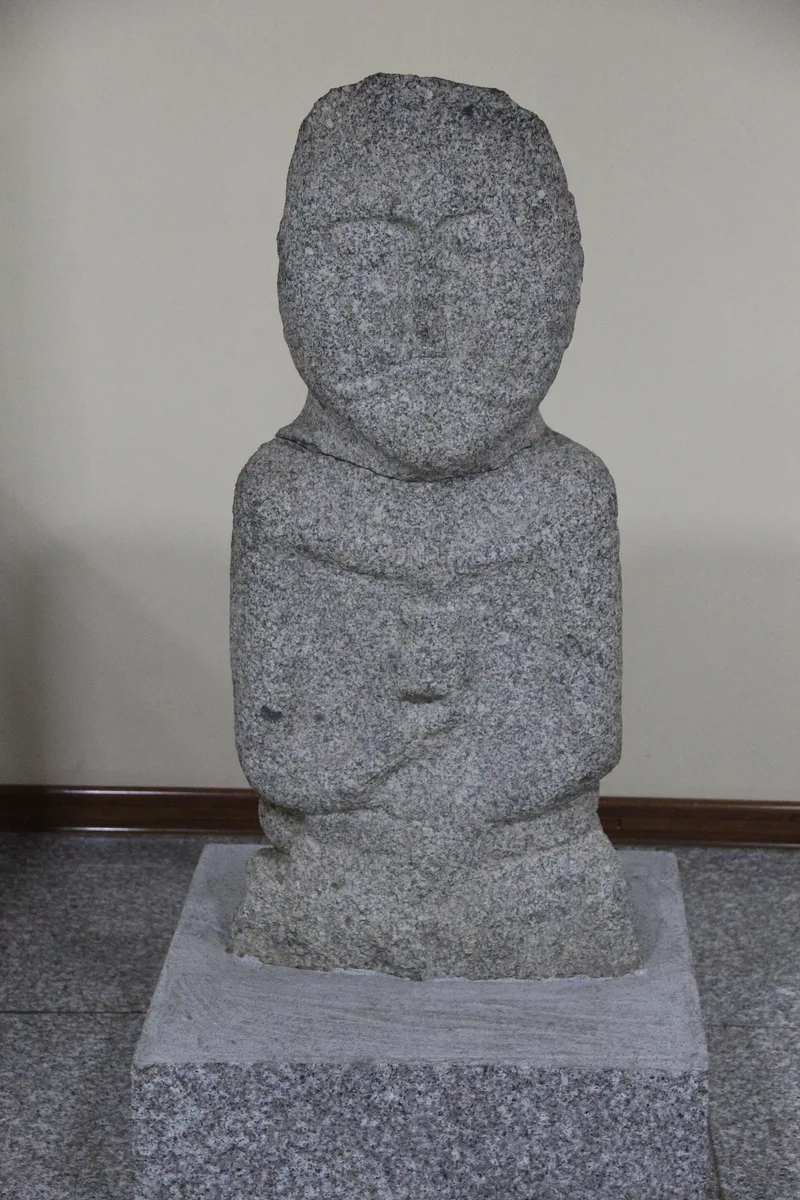
The nomads of the early Middle Ages cut statues of people from slabs and blocks of stone. They set them up over a belt of steppe that runs from the southern Urals to eastern Mongolia.[1] The commonest figure is a standing man. He holds a cup at the chest in his right hand, a belt is cut round his waist, and a sword, a sabre or a dagger hangs at his side.[2][3][4] He stands at the east side of a rectangular enclosure of stone slabs, with his back to the enclosure and his face to the east. A line of rough stones, the balbals, runs away from him to the east.[5]
The older literature calls the carved figures balbals as well. The word is Old Turkic, and the inscriptions use it for stones. In the Kül Tegin inscription, the khan says he set up an enemy ruler as balbal.[6] No text says that a balbal is a statue. Some scholars think the dictionary gloss “statue” came from the archaeologists and not from a text.[7][8] On the Altai grave mounds, statues and standing stones stand side by side, and so the statues need not be balbals.[9] An early survey takes the balbals of the eighth century, in outward form, for the same as the stone figures that the Russians call kamennaya baba. It holds their Turkic origin beyond doubt since the Yenisei inscriptions were read, and so sets aside the older view that they were raised long before the Turks came.[10] The same survey cites William of Rubruck, who saw such figures on the graves of the Cumans in the thirteenth century. Rubruck writes that over the dead they raised a great mound and set up a statue, its face to the east, holding a cup in its hand at the height of the navel.[11] The figure is therefore treated here as a part of the monument with its own questions: how it was made, where it stood, how old it is and whom it shows. More than a thousand are known. Only a few can be tied to a named person. They are the figures of the great monuments at Khöshöö-Tsaidam, those with inscriptions at Bain Tsokto, Ongi and Küli-chor, and the figure of Xiao Hongnahai with its Sogdian text.[12]
Appearance of the figures
The masons chose long, narrow stones and trimmed them more or less closely to the shape of a body. Where a rounded boulder was used, its smooth surface was set against the chipped one.[13] The relief is low. The mason cut the stone back around a feature, or drew it as an outline, and often did both on one figure. A figure in nearly full sculpture is rare.[14]
Most figures show a man with a moustache and a small beard. The brows are cut as a wavy line, or brows and nose together as one T-shaped ridge.[15] The hair hangs down the back in a single braid or in five to eight thin plaits. Some men wear earrings or a neck ring.[16] The dress is a close kaftan with triangular lapels and narrow sleeves, held at the waist by a narrow belt that is often hung with plaques and buckles. A dagger or a sabre hangs from the belt, sometimes both, and beside it a whetstone and a pouch can be made out.[13] On another account the figures of the Altai, Tuva, Mongolia and the Issyk-Kul wear a long kaftan with a turned-over collar, a narrow belt hung with metal plaques and straps, a pouch with flint and tinder, one or two braids and earrings. Four kinds of cap can be told apart.[17] The vessel is carried in the right hand or in both hands. Its forms differ: footed goblets, cups with a loop handle, bowls and tall cylindrical vessels. In five known cases a bird sits on the right hand.[14] Many stones show only a face or a head.[14]
One of the first field descriptions comes from a Russian expedition through north-western Mongolia in 1876–77. It sorted the stones into hewn and unhewn ones. It called the unhewn innumerable and the hewn rare.[18] At the foot of the granite ridge of Torkhula it recorded a standing figure that faced east, with brows, eyes and mouth cut in lines. A groove divided the head from the body, and a cap sat above the forehead. Below the beard, two hands, each drawn as two parallel lines, held a vessel with a round belly and a narrow neck, and under them a cut band marked the belt. A second figure lay beside it with its head to the east and its face to the ground.[19] The expedition met such stones only north of the Gobi.[18]
Some figures are women. They have no moustache, no beard and no weapon, many wear a headdress with three horns, and the right hand holds a vessel.[20] In one count of the figures from Semirechye, about a third of the 145 known by the middle of the 1960s could not be given a sex.[20] Women are more frequent in Semirechye than in South Siberia and Mongolia, and the further west the stones lie, the more of them there are.[21][22]
Distribution
A count of 1966 had 332 figures in Semirechye and Kazakhstan and 165 in South Siberia, Tuva and Mongolia.[21] A later count puts the whole at more than a thousand: about 260 in the Russian Altai, 110 in Tuva and Khakassia, 330 in Mongolia, 17 in Inner Mongolia, 150 in Semirechye, that is south-eastern Kazakhstan and Kyrgyzstan, and 200 in Xinjiang.[12] The two counts differ in area and in year and cannot be added. Tuva has more than any other part of the Sayan and Altai uplands. The National Museum of Tuva alone keeps 33 figures of the sixth to eighth centuries.[23]
Many no longer stand where they were set up. Farming and building led to their removal to museums. With the place of the figure, the enclosure beside it can then no longer be found.[24] At Karakystak in Semirechye, an excavated enclosure had no figure. At Ulken Kakpak, a stele stood at the north wall of the enclosures where a statue would be expected.[25]
In the province of Uvs in north-western Mongolia, a survey of 1989 recorded 86 figures, and a paper of 2000 lists 90 in fourteen villages.[4] The figures there fall into three groups: full figures with their weapons, partial figures, and rough shapes with head and body only.[26] Five of them wear pendants shaped like a pointed triangle, a heart or a circle, and similar figures are known from Kyrgyzstan and from Bayan-Ölgii.[27] One figure is cut from a smooth river stone and shows only the face.[27] At Hyargas a long rock carries a figure at each end.[27] The rock may be a stone used again at another time.[27] We do not know which of the two figures is older.[27]
Figures of riders and animals of the seventh and eighth centuries have also been found in the Crimean steppe, on the Sea of Azov and on the lower Dnieper.[28] At Chernozemnoye in the Zaporozhye region, eight limestone figures stood in a ditch round a kurgan, four riders and four animals.[29] A stele in the shape of a man probably stood at the centre of the mound.[29] The central figure wears a conical cap of the kind worn in the seventh and eighth centuries by the Turkic peoples of the Altai and southern Siberia.[30] The excavator sees the ditch as a sign of the sun and the bones in it as the remains of sacrifices to Tengri.[28] He takes the figures for a custom that came to the steppe in the time of the Göktürk khaganate and spread among the Proto-Bulgars of the Western Khaganate.[30]
The memorial enclosure
The setting of a figure follows a plan. At the centre of the enclosure lies an offering place. It is a pit with ash, burnt bones and potsherds, or a small box of stones with the same contents. A passage runs between it and the wall, and the figure stands at the east wall. The balbals run on to the east, in some cases turning left at the end.[31] In the Altai, the enclosures are square settings of slabs on edge, filled with stones. They often show the post hole of a wooden pillar at the centre.[32] Several of the earlier ones held a buried horse.[33] No trace of cremation has been found in the enclosures or beside them. On that ground, scholars understand them as memorials built apart from the graves.[34] Balbals also stood at graves. At Berel in the Kazakh Altai, a grave of the Göktürk period had two low balbals to the south-east and a standing stone to the west of the pit. No figure is reported.[35]
The great monuments of the Orkhon show the plan in a grander form. A Czechoslovak-Mongolian expedition excavated the monument of Kül Tegin in 1958.[36] It had a temple of ten metres square on a plinth, a walled courtyard with two rams at the gate, a marble tortoise that carried the inscribed stele, and statues of dignitaries in two rows along the way to the shrine.[37][38][39] The temple stood in a rectangular pit about six metres wide at the top and two metres deep, whose walls were held by timbers. An earthen wall inside the pit, tiled, whitewashed and painted red, closed off the sacred ground.[40] A hollow just inside the gate and a clay pipe leading from it to the pit have been interpreted as a rain trap with a religious purpose, to keep evil spirits out of the building.[41] Inside the central room lay the fragments of statues of the prince and his wife. In front of the places where they had stood were plastered pits with broken pots, and in one of them lay the head of the prince’s statue.[42][43] In the court the expedition found, all without heads, a standing man with a long staff, a woman with a cloth, two kneeling men and the torso of a man with a round disc on the chest. Inside it found the lower parts of two seated statues, one taken for Kül Tegin and the other for a woman of the upper class.[44] In another pit lay the five-pointed crown that had been torn from the head, with a bird of prey at the front, perhaps an eagle, and a fragment of a smaller crown that probably belonged to the woman.[45] The balbals ran from the east wall for more than three kilometres in one account and about four and a half in another.[46][47] In 1958 the line counted 169 stones, in places only about 2.6 metres apart.[47] Seven marble statues stood beside the building. They are of Chinese workmanship and evidently show Göktürks, one of them probably the dead man. Their heads had been struck off.[48] West of the building stood a granite block with a cylindrical hollow, taken for a sacrificial stone. Below it lay a hearth of charcoal and ash without any bone.[49] Painted plaster was found in the temple, but none of the surviving fragments shows the battle scenes that the Tang histories report on its walls.[50] The building had been repaired at some earlier time. The floor was laid anew and the plaster renewed, and treasure hunters had already dug at the sacrificial stone.[51] At the monument of Bilge Khan, a kilometre to the south, the finds included four headless statues.[52] Five monuments stand in the group at Khöshöö Tsaidam. Three of them are small and were raised for people whose names are unknown.[53] Some of the figures there are carved sitting cross-legged and carry no weapon.[54] A diadem from the hoard found at that complex repeats the bird tiara of the Kül Tegin statue. It is described in Bilge Khan’s Golden Crown.[55] The monument of Tonyukuk at Bain Tsokto has the same plan. It has an enclosure of 40 by 30 metres, a stone chest of four slabs 2.60 metres square and 1.50 metres high with a hole for the inscription or for a figure, the foundation of a small building, statues and balbals.[56]
The Chinese histories say how the monument of Kül Tegin came about. When the prince died, the emperor sent envoys with a letter of condolence. He had a stele cut with an inscription that he composed himself. He also ordered an ancestral temple, a likeness cut in stone and battle scenes painted on its four walls.[57] The New Tang History adds that six skilled painters were sent.[58] The inscription says that the Chinese emperor sent his court artists. It says that Bilge Khan had an extraordinary building put up and extraordinary carving cut on it, inside and out.[6] The Tang histories thus attest a statue of the dead prince at the Orkhon, made on the emperor’s order.[45] The Chinese inscription on the stele of Bilge Khan was composed by the court historian Li Rong and cut in 735. It records that the emperor’s envoy Li Quan set up a statue of the khan in his funerary temple, as one had been set up for Kül Tegin. The Tang histories do not say so.[59] One study takes the line tabgaç kaganda bedizçi kelürtüm to say that a sculptor was brought from the Chinese emperor. It finds the figures of polished white marble comparable to Tang statues, but it holds that they cannot be tied wholly to China, and it thinks that the tortoises at the graves were very probably a gift of the emperor.[60] The 1958 expedition took the whole complex for Chinese work, a memorial place after the Chinese pattern, in which only the balbals, the stone figures and the Turkic inscriptions were Turkic. It found no grave.[61]
The enclosures with figures repeat this plan on a small scale. The many small enclosures may be miniature copies of the great complexes of khans and commanders.[34] In Semirechye the rows of balbals are extremely rare or unknown, and a stone stele stands in the middle where the Altai enclosures have the pit of the central post. The stelae there may have been painted or dressed in clothes and may have stood for the dead.[62]
Dating
Stones of this kind have a long prehistory. The figures of the early Middle Ages, however, appear in Semirechye and the Tian Shan not before the sixth century.[63] The early enclosures of Ak-Dag in Tuva are dated to the second half of the fifth and the sixth century. They have no figures, neither faced nor realistic, and the excavators take that for a sign of an early date.[64] In the Altai, the enclosures at first held a stele. In the second half of the sixth century, anthropomorphic sculptures took the place of the stelae.[33] Two figures at enclosures of the Kudyrge type on the middle Chuya, each with a man’s face above a woman’s, are dated by radiocarbon to the late sixth or early seventh century.[65]
The firmest anchor lies far to the west, in the Tekes valley in Xinjiang. A standing figure at Xiao Hongnahai, of dark red granite, faces east. It wears a crown of three round ornaments, long braids and earrings. It holds a goblet in the right hand and grasps the hilt of a short sword with the left. The belt is two cut lines, and below it, where legs and boots would be, runs a Sogdian inscription of twenty or twenty-one lines.[12] The text names a Pāy Nirī Qaγan, grandson of Mūxān Qaγan. Scholars take him for Niri Khan of the Chinese histories, grandson of Mukan Khan, and the figure for his.[66] Some date the inscription to his death in 599, when his son Heshana Khan, whom the Chinese call Chuluo, took over. It concludes that figures of this kind existed in the last quarter of the sixth century.[12] The year of Niri’s death is itself argued, and the Chinese sources point to dates from before 600 to 604.[12] One report gives the height as 1.83 metres, and another as 230 centimetres.[67] No balbals stand east of it.[12]
For the mass of figures, the dating works through the objects shown on them. A sabre appears in the steppe not before the early seventh century, together with the stirrup. An older account lists the sites of the curved sabre of the Altai in a row from Berel I through Koska I, Yako-Nur and Katanda I to Kudyrge and Srostki, with the oldest at Kudyrge, and notes that the statues of the Altai, Tuva, Mongolia and the Issyk-Kul carry it on two straps. The order is the account’s own and is not dated.[68] Before that, the rider’s weapon was the sword. Three figures with clear swords therefore belong to the sixth century, and the pommels of the sabres on many others put them in the seventh.[69] A one-edged riding blade with a straight edge is older than that. The graves of the Hunnic age, in the first half of the fifth century, already hold a slender blade of this kind beside the long sword. Graves in Korea of the second to the fifth century hold such blades too.[70] Goblets, earrings and loop-handled cups fit the sixth to the eighth century.[71] The largest number of the figures with a vessel in the right hand can be put in the seventh century.[72] The upper limit is less certain. In the tenth century Islam took hold in Semirechye, and many figures have their faces chipped off in a way that suggests intent. The same account lets the figures end by the eleventh century.[73] The excavators of Ulken Kakpak put its enclosures between the eighth and the tenth century. They follow a scheme for the Tian Shan. In that scheme, the early enclosures of the sixth and seventh centuries have the figure on the east side and a row of balbals. The later ones have the figure on the west or north side and no balbals.[62]
Two types are distinguished by what the hands hold. In the first, the vessel is held in the right hand at the chest, with or without a weapon. In the second, it is held in both hands and no weapon is shown.[74] The second type is harder to date, because few datable objects appear on it. Part of it is contemporary with the first. Part is later, dated in Tuva to the eighth and ninth centuries, and it continues in the stone figures of the Volga and the South Russian steppes.[75] One summary gives the first group to the sixth to eighth century and the second to the ninth to twelfth.[12]
Cup, belt and sword
Scholars take the vessels on the figures for metal ones. The footed goblets are variants of a form that some trace to Persian models. They are far commoner in Semirechye, where 57 of 136 figures with vessels show one, than in South Siberia, where 9 of 79 do.[76] The difference is taken as a sign of closer ties between Semirechye and the settled population of Central Asia.[77] On another account, goblets, caftans with triangular collars and gold and silver vessels came from eastern Iran, Sogdiana and the Sogdian settlements at the oases of the Tarim basin. The object on a figure can therefore be older than the figure.[12]
The pose has older roots. A man with a drinking vessel in the right hand and the left on the hilt of a sword is already the canon of the stone figures of the Scythian age.[78] Scholars have in some cases interpreted the deer stones of the same age as schematic warrior chiefs.[79] A gap of centuries lies between these figures and the Göktürk ones. The figures of the Bronze Age in the Minusinsk basin are held to have no connection with them. Wooden figures that would not have survived may fill the gap.[80]
What the cup means is argued. The cup may be a sign that the dead man shares in the funeral feast held in his honour.[81] According to the same line, the kin addressed the figure, offered it food and burnt the food in an offering fire.[82] The form of the cup on many figures is that of the ceramic cups used until recently in Central Asia for water, ayran, kumis and cream.[81] One account asks for what thought the figures that hold cups were raised for the dead, and leaves the question open.[83]
Identity of the figures
Two explanations have governed the study of the figures since the Orkhon inscriptions were deciphered. The first holds that the figures are the enemies whom the dead man had killed or beaten, set up at his grave to serve him in the other world. The second holds that they are the Göktürks themselves, set up at graves or at the places where the ashes were burnt.[84]
The first explanation rests on the inscriptions. The Kül Tegin inscription says that the khan set up the Kirghiz khan as balbal. On one reading of another line, Baz Khan was set up as the first balbal for the khan’s father.[6] A runic text on a stone itself reads “This is the stone balbal of the shad of the Tölis”.[85][47] The stone lies near the monument of Bilge Khan. Another edition prints the line as “Tölös qadın, stone balbal” and leaves qadın untranslated.[86] A series of arguments about Tuva carried the explanation further: the hairstyle, the shape of the dagger, folk epics in which a stone figure is a target for the arrow, and an Arab traveller’s report of wooden images of the slain set on an Oghuz grave. Each of them was answered in turn.[87]
The second explanation rests on two things. The Zhou Shu says that a stone was set up at the grave, as many as the men the dead man had killed. The Sui Shu adds a building in which the likeness of the dead man was painted together with the battles of his life.[88] The Old Tang History names a likeness of Kül Tegin cut in stone.[57] The excavation found the head of a statue in a pit before the shrine.[89] The Xiao Hongnahai figure is taken to support the second explanation as well. Its inscription names the person in whose honour it was made, and it stood at an enclosure of about forty metres, as large as the sites of the eastern khans. It was therefore set up for the dead man and was not one balbal among many.[12]
A classification of 1966 holds that both explanations are partly right. The balbals are the enemies, and some of them may have the shape of crude human stelae. The armed figures are the tallest, average 145 centimetres and most often have balbals. They are taken as members of the military nobility. The figures with wide sleeves and no weapon have balbals half as often. They are understood as officials. The stelae with a face only count as ordinary warriors where they stand at an enclosure and as enemies where they stand in the row.[90] This is a proposal about social rank, and the figures themselves do not state it.
The women raise a separate question. The three-horned headdress may be the sign of the goddess Umay or of a shamaness. A different explanation is that the women are noble Göktürk women, wives of the men shown beside them. The man above and the woman below on one stone at the Chuya would then repeat the husband and wife who sit together in the scenes of tents. The pair may refer to a marriage between the Ashina and the Ashide.[65] The male figure of Xiao Hongnahai wears a crown of three round ornaments and is taken for a khan. A headdress in three parts is therefore not confined to women.[12]
Records and later veneration
Travellers saw the figures long before anyone could date them. In 1722 a German naturalist in Russian service recorded a statue at the mouth of the Askys on the Abakan. It was cut from grey sandstone, with a braid down its back. The Beltir Tatars rode three times round it and left a part of their food at the foot of the stone. They told him that she was a noble woman whom the god Kaira Khan had turned to stone.[91] In the same year he described a statue in the mountains of the Kara and the Ak Yus. It held a vessel like a tea bowl in the right hand and the hem of its coat in the left. Passing Tatars gave it food, its mouth was smeared with fat and butter, and roots lay at its foot.[92] The expedition of 1876–77 found a bust on the Dain Gol that the Kirghiz called Dain Batyr. A small wooden hut was built over it, and silk rags and horse hair hung on a rope in front of the face.[93] The explanations that people gave for the mounds there, and in one tale for the stone figures too, told of giants, of a war between two khans whose goods the fugitives buried, and of an ancient Kirghiz khan.[94] In the Kazakh steppe, local legend tied three figures at the tomb south of Ayagoz to the epic of Kosy Körpösh and Bayan Sulu.[95]
These accounts show the veneration of old stones in the eighteenth and nineteenth centuries.[96] Riding round the stone recalls the ride round the tent at a Göktürk funeral, which the Zhou Shu describes (Riding Round the Dead). Nothing shows, however, that the two are related.[97] The accounts do not show what the Göktürks did. The collectors themselves took the figures for much older than the Turkic peoples of the region. A linguist who opened graves in the Altai in the 1860s assigned them to a Bronze Age people. He took the Chinese report of stones set up for the slain to be a confusion with those older figures.[98] That dating did not stand. Later work tied the figures to the Göktürks and their successors, and the objects shown on them put the mass of them in the sixth to eighth century.[63]
The damage is old as well. The heads of the statues at the Orkhon were struck off, and the explanations differ: the fanaticism of later peoples, or the Khitan of the tenth century.[99] In general, scholars attribute the destruction of enclosures and the removal and splitting of stelae and statues in antiquity to hostile newcomers.[100] The heads were struck off so that the damage could not be repaired. Some scholars date the wrecking of the Kül Tegin monument to 745, when Uyghur rule replaced Göktürk rule, and hold this likelier than the Kirghiz raid of 840.[101][102] An early survey blames the Mongols, who believed that images of old men would harm the living. It holds that breaking the heads was practised in places where Islam had not spread, and so cannot be put down to Muslim zeal alone.[103] In Semirechye many faces were chipped intentionally, in an old patina. This has also been seen as part of the struggle against idolatry when Islam spread among the nomads.[73] In 1912 one of the human figures of the Kül Tegin complex was taken to St Petersburg, where it is now in the Hermitage.[104] After the fall of the Uyghur khaganate, people may have settled again on the old land and partly restored the old temples.[39]
Names
- balbalOld TurkicKül Tegin inscription
- 刻石為像ChineseJiu Tangshu 194
- каменные бабы (kamennye baby)Russian
- kishachiloMongolian
- kizhi kozheeTuvan
Whether any Old Turkic word means the carved figure is not settled. The word balbal has been used for it. The Kül Tegin inscription speaks of carved images, bädiz, that the Chinese artists cut inside and outside the building.[6][105] The same account adds that the dictionary of Mahmud al-Kashgari has bediz burkan for a figure.[105] The Russian term kamennye baby, “stone women”, is called by its best-known student unfortunate and inexact but traditional. It covers statues of every age from the Bronze Age to the Kipchaks.[106] The names recorded in 1876–77 are Mongol kishachilo, Uriankhai kishatat and Kirghiz syn-tas. They are used for upright stones with or without a face.[18] One account renders the Tuvan name kizhi kozhee as “braided person”, a general name for monuments of an alien people. Another account renders it as “person-stone”.[107] In the text of the Old Tang History, the likeness of Kül Tegin is 刻石為像, “cut stone into an image”.[57]
Reliability of the evidence
A figure proves itself: that it was made, what it holds and wears, how it stands to its enclosure. The date comes from outside, from the weapons and vessels shown on it, from a radiocarbon sample at an enclosure, or in a single case from an inscription. The meaning is a conclusion. The figures say nothing about it except where a text beside them names the dead man. The Orkhon monuments are the one place where figure, enclosure, balbals, inscription and Chinese report can be read together. The enclosures of the Altai, Tuva and Semirechye are plainer versions of them. On the interpretations given above, the monuments of Kül Tegin and Xiao Hongnahai show the dead man in two figures. For the others the question is open.
References
- ^ Šer 1966, p. 20
- ^ Šer 1966, p. 11–12, 25–26
- ^ Ögel 1978, p. 160
- ^ a b Amartuvshin 2000, p. 20
- ^ Šer 1966, p. 14
- ^ a b c d Kül Tegin inscription
- ^ Šer 1966, p. 50
- ^ Ögel 1984, p. 165–166
- ^ Ögel 1984, p. 166
- ^ Barthold 2004, p. 20
- ^ Rockhill 1900, p. 82
- ^ a b c d e f g h i j Ōsawa 2006 (Druck); Netzfassung 2003
- ^ a b Šer 1966, p. 11
- ^ a b c Šer 1966, p. 12
- ^ Šer 1966, p. 11, 13
- ^ Šer 1966, p. 11, 51
- ^ Ögel 1984, p. 156–158, 168–170
- ^ a b c Potanin 1881, p. 64
- ^ Potanin 1881, p. 67–68
- ^ a b Kubarev 2017, p. 96
- ^ a b Šer 1966, p. 22
- ^ Ögel 1984, p. 168–169
- ^ Mongush 2019, p. 87–88
- ^ Nuskabai 2023, p. 73
- ^ Nuskabai 2023, p. 79, 81
- ^ Amartuvshin 2000, p. 20–21
- ^ a b c d e Amartuvshin 2000, p. 21
- ^ a b Baranov 2000, p. 38
- ^ a b Baranov 2000, p. 38–42
- ^ a b Baranov 2000, p. 39
- ^ Šer 1966, p. 14, 20
- ^ Konstantinov 2018, p. 13–14
- ^ a b Konstantinov 2018, p. 14
- ^ a b Konstantinov 2018, p. 17
- ^ Kutlu 2021, p. 777
- ^ Jisl 1963, p. 389–390
- ^ Šer 1966, p. 17–19; 28; Gökçek 2022, p. 17–19; 28
- ^ Jisl 1963, p. 391–393
- ^ a b Bayar 2000, p. 61
- ^ Jisl 1963, p. 391
- ^ Jisl 1963, p. 391–392
- ^ Šer 1966, p. 18–19
- ^ Jisl 1963, p. 394–395
- ^ Jisl 1963, p. 392–395
- ^ a b Jisl 1963, p. 395
- ^ Šer 1966, p. 19–20; 138; Thomsen 1924, p. 19–20; 138
- ^ a b c Jisl 1963, p. 390
- ^ Thomsen 1924, p. 138
- ^ Jisl 1963, p. 389–390, 396
- ^ Jisl 1963, p. 393, 397
- ^ Jisl 1963, p. 396–397
- ^ Thomsen 1924, p. 139; 1; Bahar 2009, p. 139; 1
- ^ Jisl 1963, p. 388
- ^ Yılmaz 2019, p. 396–398
- ^ Stark 2009 (erschienen 2011), p. 120
- ^ Ögel 1984, p. 195–196
- ^ a b c Jiu Tangshu (Old Book of Tang), juan 194
- ^ Xin Tangshu (New Book of Tang), juan 215
- ^ Pelliot 1929, p. 233–235
- ^ Ögel 1984, p. 136, 166
- ^ Jisl 1963, p. 396, 398–399, 401
- ^ a b Nuskabai 2023, p. 82
- ^ a b Šer 1966, p. 38–39
- ^ Mongush 2023, p. 87, 91–92
- ^ a b Kubarev 2017, p. 93–94
- ^ Ōsawa 2006 (Druck); Netzfassung 2003, p. 121–122; Stark 2009 (erschienen 2011), p. 121–122
- ^ Stark 2009 (erschienen 2011), p. 121; Ōsawa 2006 (Druck); Netzfassung 2003, p. 121
- ^ Ögel 1984, p. 159
- ^ Šer 1966, p. 40–42
- ^ Werner 1956, p. 46
- ^ Šer 1966, p. 42–44
- ^ Šer 1966, p. 44
- ^ a b Šer 1966, p. 39
- ^ Šer 1966, p. 26–29
- ^ Šer 1966, p. 44–46
- ^ Šer 1966, p. 42–43
- ^ Šer 1966, p. 43–44
- ^ Šer 1966, p. 32–33
- ^ Šer 1966, p. 33
- ^ Šer 1966, p. 31, 33
- ^ a b Šer 1966, p. 58
- ^ Mongush 2019, p. 88
- ^ Ögel 1978, p. 177
- ^ Šer 1966, p. 47–49
- ^ Šer 1966, p. 47, 50
- ^ Orkun 1994, p. 189, 190
- ^ Šer 1966, p. 51–53
- ^ Zhou Shu (Book of Zhou), juan 50; Sui Shu (Book of Sui), juan 84
- ^ Šer 1966, p. 19
- ^ Šer 1966, p. 53–58
- ^ Radloff 1893 (zweite Ausgabe), p. 91–92
- ^ Radloff 1893 (zweite Ausgabe), p. 93–94
- ^ Potanin 1881, p. 72
- ^ Potanin 1881, p. 47–48
- ^ Radloff 1893 (zweite Ausgabe), p. 94–95
- ^ Radloff 1893 (zweite Ausgabe), p. 91–94
- ^ Zhou Shu (Book of Zhou), juan 50
- ^ Radloff 1893 (zweite Ausgabe), p. 96–101, 121–122
- ^ Thomsen 1924, p. 138; 27; Gökçek 2022, p. 138; 27
- ^ Nuskabai 2023, p. 83
- ^ Jisl 1963, p. 398
- ^ Bayar 2000, p. 60
- ^ Barthold 2004, p. 21–22
- ^ Bayar 2000, p. 62
- ^ a b Ögel 1978, p. 340
- ^ Šer 1966, p. 3–4
- ^ Šer 1966, p. 51; 88; Mongush 2019, p. 51; 88
Sources
- Jiu Tangshu (Old Book of Tang), juan 194
- Xin Tangshu (New Book of Tang), juan 215 (after Jiu Tangshu)
- Zhou Shu (Book of Zhou), juan 50
- Sui Shu (Book of Sui), juan 84
- Kül Tegin inscription
Literature
- Ja. A. Šer (Ya. A. Sher), Каменные изваяния Семиречья (Kamennye izvaniya Semirech'ya) (1966)
- Vilhelm Thomsen, Alttürkische Inschriften aus der Mongolei, in Übersetzung und mit Einleitung (1924)
- Takashi Ōsawa, Aspects of the relationship between the ancient Turks and Sogdians: based on a stone statue with Sogdian inscription in Xinjiang (2006 (Druck); Netzfassung 2003)
- Sören Stark, Some Remarks on the Headgear of the Royal Türks (2009 (erschienen 2011))
- Nikita Konstantinov; Vasilii Soenov; Synaru Trifanova; Svetlana Svyatko, History and culture of the early Türkic period. A review of archaeological monuments in the Russian Altai from the 4th–6th century AD (2018)
- Gleb V. Kubarev, Древнетюркские изваяния из Апшиякты в Центральном Алтае (к проблеме выделения женских статуарных памятников у древних тюрок) (Old Turkic Statues from Apshiyakta, Central Altai) (2017)
- Gleb V. Kubarev, Aibolat Nuskabai, Раннесредневековые поминальные оградки Семиречья: новые данные (Early Medieval Memorial Enclosures in Semirechye: new data) (2023)
- Nikolai N. Seregin, Kara-ool M. Mongush, Раннетюркские оградки комплекса Ак-Даг (Early Turkic Enclosures of the Ak-Dag Complex) (2023)
- Chechena A.-S. Mongush, Коллекция каменных памятников в собрании Национального музея Тувы (The Collection of Stone Monuments in the National Museum of Tuva) (2019)
- Grigorii Nikolaevich Potanin, Очерки Северо-западной Монголии. Вып. 2. Материалы этнографические (Ocherki severo-zapadnoi Mongolii, Bd. 2) (1881)
- Wilhelm Radloff, Aus Sibirien. Lose Blätter aus meinem Tagebuche. Zweiter Band (1893 (zweite Ausgabe))
- Hasan Bahar, The Excavation and the Conservation of Bilge Khan Monumental Grave Complex in Mongolia (2009)
- Anıl Yılmaz, Bilge Kağan'a Atfedilen Taç ve (Doğu) Gök Türklerin Budizm'e Yaklaşımı (The Crown Attributed to Bilge Kaghan and the Approach of (Eastern) Gök Türks to Buddhism) (2019)
- Kürşat Koçak, L. Gürkan Gökçek, Bilge Kağan Hazinesinin Gün Yüzüne Çıkarılması: Bilge Kağan Anıt Alanı Kazı Çalışmaları (Digging Out Bilge Kağan's Treasure) (2022)
- Mehmet Kutlu, Leila Kutlu, Ölü Gömme Gelenekleri Bağlamında Berel Kurganları (2021)
- Joachim Werner, Beiträge zur Archäologie des Attila-Reiches (1956)
- V. V. Barthold, Orta Asya Türk Tarihi Dersleri (Orta Asya Türk Tarihi Hakkında Dersler) (2004)
- Lumír Jisl, Kül-Tegin anıtında 1958'de yapılan arkeoloji araştırmalarının sonuçları (1963)
- Bahaeddin Ögel, Türk Kültür Tarihine Giriş IV: Türklerde yemek kültürü (1978)
- Bahaeddin Ögel, Türk Kültür Tarihine Giriş V: Türklerde giyecek ve süslenme (1978)
- Bahaeddin Ögel, İslâmiyetten Önce Türk Kültür Tarihi. Orta Asya Kaynak ve Buluntularına Göre (1984)
- Paul Pelliot, Neuf notes sur des questions d'Asie Centrale (1929)
- William Woodville Rockhill (trans. and ed.), The Journey of William of Rubruck to the Eastern Parts of the World, 1253–55, as narrated by himself, with two accounts of the earlier journey of John of Pian de Carpine (1900)
- Hüseyin Namık Orkun, Eski Türk Yazıtları (1994)
- Ch. Amartuvshin, Batı Moğolistan’da Bulunan Eski Türk Anıtları (2000)
- İ. A. Baranov, Tavrika ve Dnepr Boyundaki İlk Türklerin Tengri İnancı Tapınakları (2000)
- Dovdoyn Bayar (Turkish translation: Abdullah Şen), Moğolistan’daki Eski Türk Anıtlarının İncelenmesi ve Gelecekteki Amaçlar (2000)
What links here4
- Places
- Berel · Khöshöö Tsaidam · Shiveet Ulaan
- Customs & Pastimes
- Culture of the Turkic Peoples
Cite this article
Yavuz, Emre-E. “Stone Figures.” Turkic Atlas, revised 8 November 2026. https://turkicatlas.org/religions/stone-figures/
Last revised: 8 November 2026


