
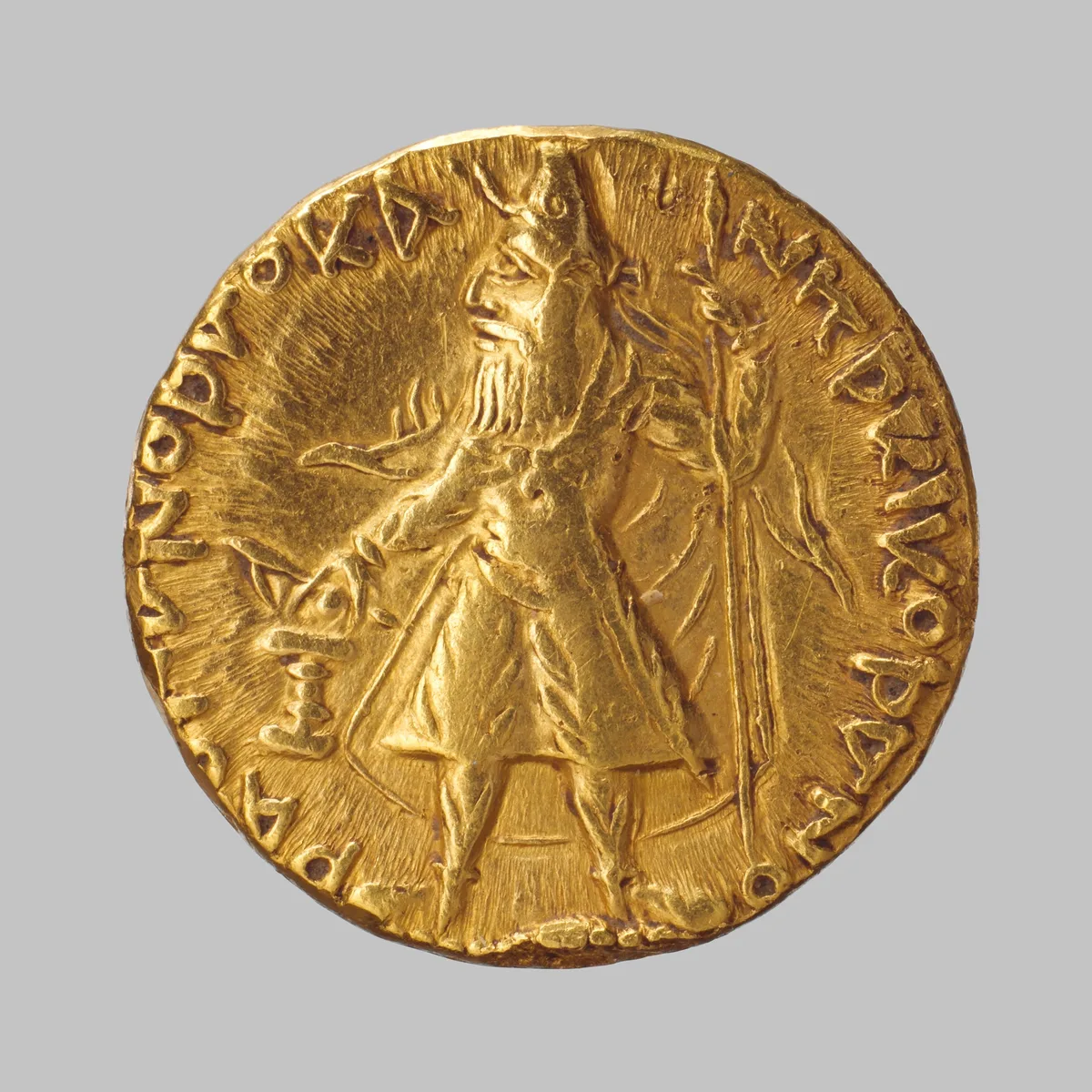
The Kushan Empire grew out of the Yuezhi principalities of Bactria. In the second half of the first century it extended over northern India. At the beginning of the second century it reached into the Tarim Basin as far as Khotan.[1] Its greatest king was Kanishka. Scholars have set the era of Kanishka in 78, in 127 and in 232. Numismatics, a newly found inscription and a reread text now point to 127.[1] In 232 the empire lost its lands north of the Hindu Kush to the Sasanians.[1]
The Kushan realm was a zone of stability and great wealth immediately south of Sogdiana. It probably never ruled Sogdiana. Buddhism spread from the realm to China, and in China the great merchants of the age were Kushan merchants.[2] The Sogdians began as pupils of these merchants. In the second century Sogdian trade was a marginal part of a commerce run by Indian and Bactrian merchants, both Kushan subjects. The invasions of the fourth century let the pupils overtake their masters.[3]
Guishuang in the Han histories
The Chinese histories do not know a Kushan Empire under that name. They know Guishuang, 貴霜. The Han Shu names it once, as the third of five xihou under the Great Yuezhi in Daxia, the Bactria of the modern literature. The seat of this xihou was the city of Huzao, 5,940 li from the Protector’s seat.[4] The Han Shu knows no realm of that name.[4]
The Hou Han Shu tells what followed. After a hundred and more years, the Guishuang xihou Qiujiuque, 丘就卻, attacked and destroyed the other four. He made himself king and called the realm Guishuang.[5] He invaded Anxi and took the land of Gaofu. He destroyed Puda and Jibin and controlled them all.[5] He died at over eighty. His son Yangaozhen, 閻膏珍, succeeded him.[5] Yangaozhen destroyed Tianzhu, the Chinese name for India. He set one general over it.[5] From then on the Yuezhi were at their richest and strongest. All the states called their king the king of Guishuang. The Han, however, kept to the old name and went on saying Great Yuezhi.[5]
The text dates the union only by the interval of a hundred and more years since the division of Daxia. It gives no year for Qiujiuque or for his son.[5] One reckoning takes the move of the Yuezhi to Daxia to have fallen in 133 to 129 BC. On that reckoning the union falls at about 20 BC.[6] The chronology of the kings that followed rests on coins and inscriptions. It lies outside what the Chinese texts can give.[1]
The realm as the Hou Han Shu describes it
The text places the seat of the Great Yuezhi at the city of Lanshi. Anxi lies west of it, at forty-nine days’ journey. The chapter measures the country at 6,537 li from the seat of the Han Chief Clerk and 16,370 li from Luoyang. It gives 100,000 households, 400,000 people and more than 100,000 men able to bear arms.[5] The figures are those of the Han Shu for the Great Yuezhi. The Hou Han Shu therefore repeats an old count and does not give a new one.[7]
The chapter also names the neighbours of the Yuezhi. Gaofu, a large state, good at trade and rich, lies to their south-west. Tianzhu, Jibin and Anxi each took Gaofu when they were strong and lost it when they were weak. According to the chapter, it never belonged to the Yuezhi until they broke Anxi.[5] Tianzhu lies some thousands of li to the south-east of the Yuezhi. At the time of the chapter it was wholly subject to them. The Yuezhi killed its king and put a general over its people.[5] The Great Yuezhi attacked Dong Li, more than three thousand li south-east of Tianzhu. Dong Li became their subject.[5]
The Yuezhi and the Han in the Tarim
The Yuezhi met the Han again in the Tarim. The Hou Han Shu tells it in the biography of Ban Chao, who held the western oases for the Han. The Yuezhi had once helped the Han against Cheshi. They sent pearls, fuba animals and lions as tribute, and asked at the same time for a Han princess. Ban Chao refused and sent their envoys back.[8] The Yuezhi resented it. They sent their deputy king Xie with seventy thousand men against Ban Chao.[8] Ban Chao’s men were few and afraid. He told them that the Yuezhi army was large, but that it had come over the Congling, the Pamirs, across thousands of li without supplies. If they gathered the grain and held out, the enemy would starve within a few tens of days.[8] Xie attacked and failed. He found nothing to plunder. Ban Chao reckoned that Xie would ask Kucha for help. He posted a few hundred men on the eastern border to cut the road. Xie sent horsemen with gold, silver and jewels to buy Kucha’s aid. Ban Chao’s men killed them and showed their heads to Xie. Xie sent to ask pardon and begged to go home alive. Ban Chao let him go. According to the chapter, the Yuezhi were greatly shaken and paid tribute every year after that.[8]
The Yuezhi also appear in the quarrels of the oasis kings. Zhong, the king of Shule, went over to Shache and held the city of Wuji against Ban Chao. Kangju sent picked troops to relieve it. Ban Chao could not take the city. The Yuezhi had lately married into the house of Kangju and were on close terms with it. He therefore sent rich gifts of brocade and silk to the Yuezhi king and asked him to explain matters to the king of Kangju. The king of Kangju then called off his troops. He seized Zhong and took him home, and Wuji surrendered.[8] In the Yuanchu years, under the emperor An, the Shule king Anguo sent his maternal uncle Chenpan to the Yuezhi for an offence. The Yuezhi king grew fond of him. Anguo died without a son, and his mother took over the government. Chenpan appealed to the Yuezhi king. The Yuezhi sent troops to take him back to Shule. The people respected him and feared the Yuezhi, and they made him king.[5] The road from Shache ran west through Puli and Wulei to the Great Yuezhi.[5]
The portraits on the coins
The coin portraits of the Kushan kings show no deformed skull. A reading of 1950 found one on the tetradrachms of Heraos, the predecessor and probably the father of Kujula Kadphises, the true founder of the dynasty, who lived in the last quarter of the first century BC. The reading then derived the steppe custom of binding the head from the Kushans. Neither those coins nor the coins of his successors bear this out.[9]
References
Sources
- Han Shu, juan 96 (after Shiji)
- Hou Han Shu, juan 47, 88
Literature
- Étienne de la Vaissière, Sogdian Traders: A History (2005)
- Peter B. Golden, An Introduction to the History of the Turkic Peoples (1992)
- Uchida Ginpū 内田吟風, 月氏のバクトリア遷移に關する地理的年代的考證(下) (1938)
- Joachim Werner, Beiträge zur Archäologie des Attila-Reiches (1956)
What links here3
- Persons
- Ban Chao
- Conflicts
- Göktürk–Persian war, 588–589
- Peoples
- Yuezhi
Cite this article
Yavuz, Emre-E. “Kushan Empire.” Turkic Atlas, revised 7 November 2026. https://turkicatlas.org/polities/kushan-empire/
Last revised: 7 November 2026

