
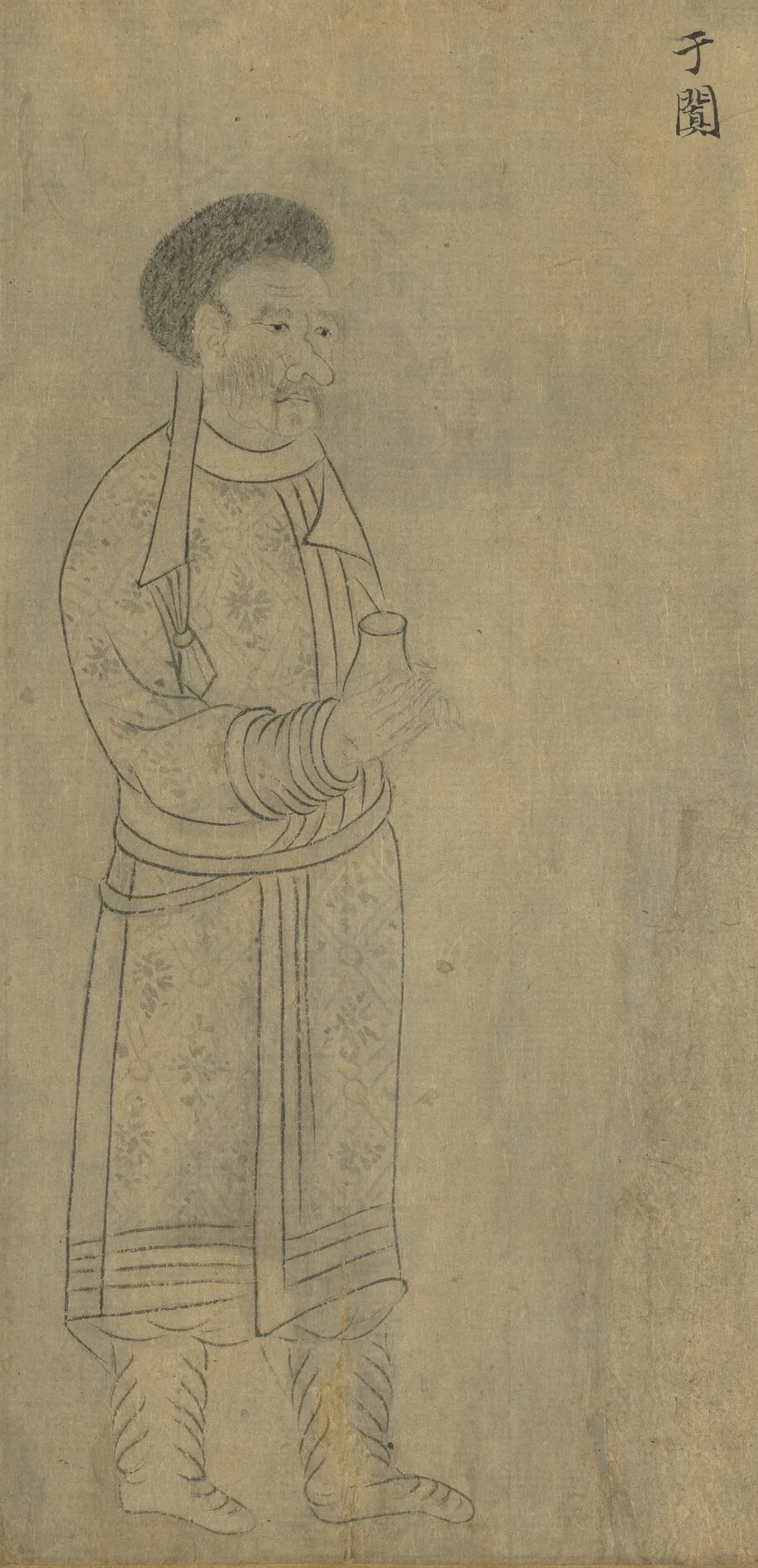
Khotan was a kingdom on the southern edge of the Tarim Basin. The Shiji records that the rivers west of Khotan flow west. East of it they flow east into the Salt Marsh.[1][2][3] Zhang Qian sent one of his deputies there.[1] Around 313 the merchants travelling from Central Asia to China crossed the Pamirs. They passed through Khotan and Loulan.[4]
In Han times
The Han Shu seats the king of Khotan at the West City. It counts 3,300 households, 19,300 people and 2,400 men fit to bear arms. It says that the country had much jade and that the source of the river came out there.[2] The Hou Han Shu counts 32,000 households, 83,000 people and more than 30,000 men.[5] The West City is identified with the ruins at Yotkan, some eight kilometres west of the modern town.[6] Khotan, Shanshan and Yarkand are the three lands of jade in the Han Shu.[2][7]
Han envoys traced the source of the Yellow River. They found that it rose in Khotan, in mountains rich in jade. They brought samples home. The emperor consulted old maps and books and named the mountain from which the river issues Kunlun.[1] The date is about 105 BC.[8]
Xuanzang’s Khotan
Xuanzang tells how Khotan, which had neither mulberry trees nor silkworms, obtained them. The king asked the ruler of the east for a Chinese princess as his wife. He let her know that his country had no silk. The princess hid mulberry seeds and silkworm eggs in the wadding of her cap. The frontier guards searched everything, but they did not dare to search the cap. In Khotan she had a decree cut in stone that forbade the killing of silkworms. She also built a monastery.[9]
At Pimo, east of Khotan, Xuanzang saw a standing statue of the Buddha in sandalwood, about twenty feet high. It gave off a light. The sick who stuck gold leaf on the part of the statue that matched their ailment were healed.[10] The local story has the statue made in the Buddha’s lifetime by King Udayana of Kausambi. It flew through the air to a city in the north of Khotan, Holaoluojia. The people there buried an arhat who had honoured the statue. Then a rain of sand buried the city. The statue came to Pimo with the one man who had been warned.[11] The story of the buried city may be a tale of the Indus lands that became a local legend of Turkestan only later.[12]
A century before Xuanzang, Song Yun travelled in 518 to 522 and saw the statue in a temple fifteen li south of a town he calls Hanmo.[13] Its silk banners and canopies numbered tens of thousands. The dates on the inscribed banners ran from 495 to 513. One banner went back to the Yao Qin, 384 to 417.[13] The two accounts are taken to describe the same statue, although the town is named differently.[14] Song Yun does not tell the story of Holaoluojia. It may be a later addition to the history of the statue.[15]
From the Jin period to the Karakhanids
A Chinese slip of the Jin period from the Lop Nor gives three sheng to an envoy of Khotan.[16] A contract for the sale of a camel from Endere, of the late third or early fourth century, is dated by the regnal years of a king of Khotan. It names a Sogdian, and it attests a Sogdian community at Khotan.[17] Khotan may for a time have belonged to the Kushan empire at the beginning of the second century.[18] In 1006 the Karakhanids took the town, where Muslim merchants and Buddhist pilgrims still met. Through it they supplied the Ghaznavids with musk and silk.[19]
References
- ^ a b c Shiji, juan 123
- ^ a b c Han Shu, juan 96
- ^ Herrmann 1910, p. 61
- ^ de la Vaissière 2005a, p. 46
- ^ Hou Han Shu, juan 88
- ^ Herrmann 1910, p. 93
- ^ Herrmann 1910, p. 122
- ^ Herrmann 1910, p. 66
- ^ Record of the Western Regions; Julien 1857–1858, p. 238–239
- ^ Record of the Western Regions; Julien 1857–1858, p. 243
- ^ Record of the Western Regions; Julien 1857–1858, p. 243–245
- ^ Lüders 1930, p. 59
- ^ a b Lüders 1930, p. 30
- ^ Lüders 1930, p. 30–31
- ^ Lüders 1930, p. 31
- ^ Chavannes 1913, p. 171
- ^ de la Vaissière 2005a, p. 58
- ^ de la Vaissière 2005a, p. 84
- ^ de la Vaissière 2005a, p. 321
Sources
- Shiji, juan 123
- Han Shu, juan 96 (after Shiji)
- Hou Han Shu, juan 88
- Record of the Western Regions
Literature
- Étienne de la Vaissière, Sogdian Traders: A History (2005)
- Édouard Chavannes, Les documents chinois découverts par Aurel Stein dans les sables du Turkestan oriental (1913)
- Albert Herrmann, Die alten Seidenstrassen zwischen China und Syrien. Beiträge zur alten Geographie Asiens, Bd. 1 (1910)
- Heinrich Lüders, Weitere Beiträge zur Geschichte und Geographie von Ostturkestan (1930)
- Stanislas Julien, Mémoires sur les contrées occidentales (1857–1858)
What links here11
- Persons
- Ban Chao · Rudan Tegin
- States
- Kushan Empire · Shanshan
- Places
- Jiuquan · Kucha · Tarim Basin · Xihai
- Institutions and Titles
- Raw Materials and Trade among the Turkic Peoples · Trade Routes of the Steppe
Cite this article
Yavuz, Emre-E. “Khotan.” Turkic Atlas, revised 8 November 2026. https://turkicatlas.org/places/khotan/
Last revised: 8 November 2026

