
- 400
- 500
- 600
- 700
- 800
- 900
- Rouran 400–554
- First Göktürk 552–630
- Tang rule 630–682
- Second Göktürk 682–744
- Uyghur 744–840
- Kirghiz 840–924
- Huns 370–469
- Western Göktürk 552–659
- Türgesh 699–766
- Karluk 766–800
- Khazar 650–969
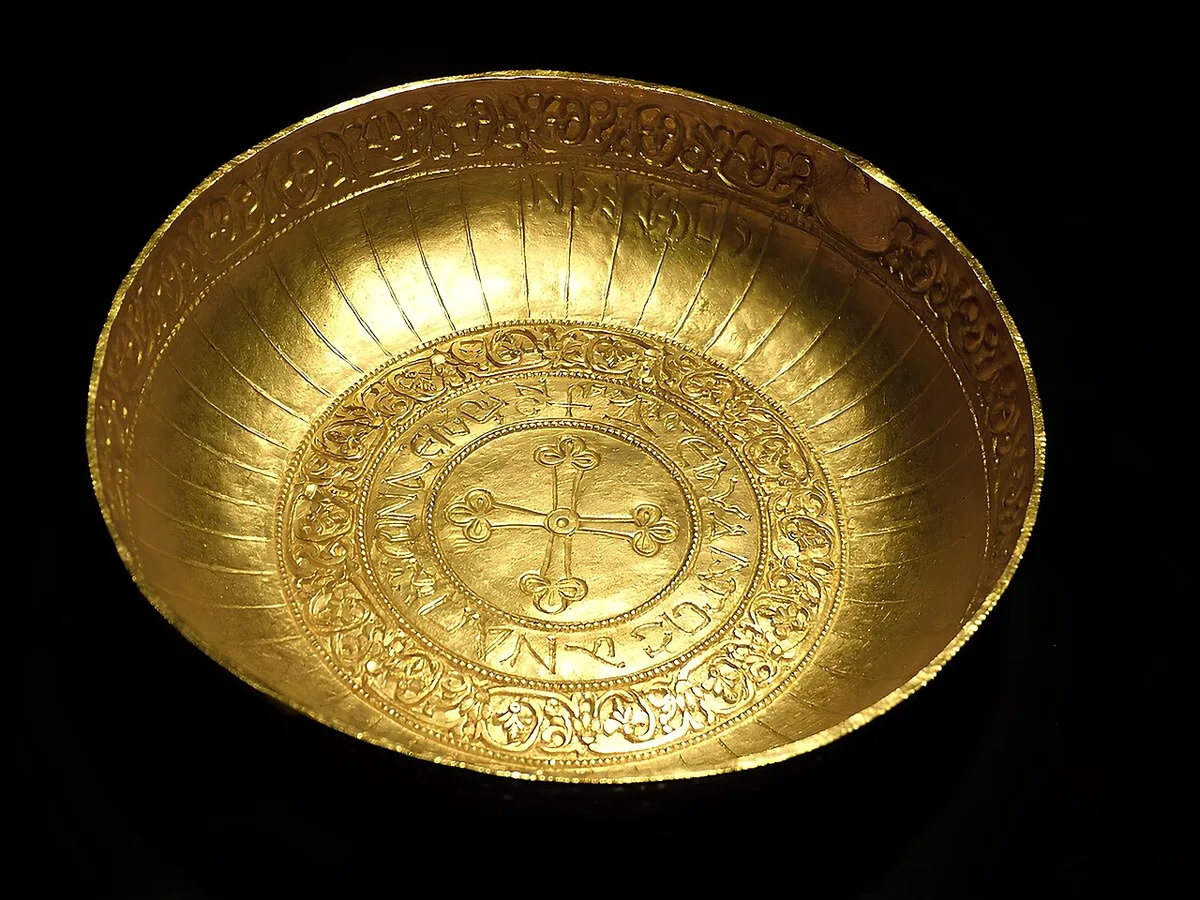
The treasure of Nagyszentmiklós is a hoard of gold vessels, known since 1799.[1] It was found south of the Maros river.[2] The style of the vessels places them in the eighth and ninth centuries.[2] Several of them carry inscriptions. Of nineteen, only five come with illustrations, and for the rest a study had to rely on the drawings of earlier editors.[3] The treasure has a place in the story of the Avars because it belongs to the Avar age in the Carpathian basin.[1]
The inscriptions
Two kinds of writing stand on the vessels. One is Greek: the nine words of the Buila inscription on a gold bowl, the longest text of the Avar period. Most scholars regard its language as an early Turkic variety.[4] The other is a set of runiform signs.
A Bulgarian study written in the two-hundredth year after the find states that one still cannot claim that the writing has been securely read.[5] Twenty-two signs with a sound value were counted. Half of them have a counterpart among the signs of Murfatlar.[6]
Date
Two dates are at issue, the date of the treasure and the date of its inscriptions.
One survey holds that the hoard was hidden in all likelihood after the fall of the khaganate in the early ninth century.[4] Another finds the runiform inscriptions probably later than the objects and not unambiguously legible.[7]
Archaeologists, by contrast, have put the treasure before the ninth century. It therefore has nothing to do with the Pechenegs, to whom one scholar had ascribed the runiform signs.[8] The two datings can be reconciled, since a vessel can be made early and buried late. They still differ over the inscriptions. One makes them later than the vessels. The other counts them to the late Avar script of the eighth century.
Attributions
The signs of Nagyszentmiklós and those of a bone needle case from a late Avar cemetery at Szarvas are grouped together as a late Avar script. Eight or nine of the signs have the same form as signs of the Székely script. One interpretation suspects a text in a language of Bulgar type and links it with the arrival of a new nomadic people in the Carpathian basin at the end of the seventh century.[1] For the second find, see the Szarvas needle case.
A study of the signs places those of Nagyszentmiklós nearer to the Old Turkic script and to the Székely runes than to the Cyrillic or Old Bulgar letters.[9] One scholar counts Nagyszentmiklós among the find-places of Bulgar dialect monuments.[10] None of these attributions rests on a reading. Runiform inscriptions found in the Khazar lands and further west have been ascribed to the Khazars, the Avars, the Pechenegs and the Bulgars, and no reading proposed for them has been satisfactory.[11]
References
Sources
Literature
- Svetlana Venelinova Kavrikova, Murfatlar ve Nad Sent Mikloş Yazıtlarının Paleografik Karakteristiği (2000)
- István Vásáry, Doğu Avrupa'nın Runik Alfabe Sistemleri Üzerine (1993)
- Denis Sinor (ed.), The Cambridge History of Early Inner Asia (1990)
- Alexander Savelyev; Choongwon Jeong, Early Nomads of the Eastern Steppe and Their Tentative Connections in the West (2020)
- Marcel Erdal, A Grammar of Old Turkic (2004)
- Lüdmila Dončeva-Petkova, Orta Çağ Bulgaristanı'ndan Runik İşaretler ve Birleşmeler (2000)
- Soslanbek Y. Bayçorov, Avrupa’nın Göktürk Harfli Eski Anıtları. Göktürk Harfli Eski Yazının Kuzey Kafkasya, Volga-Don ve Tuna Bölgeleriyle İlişkisi (1990)
Articles resting on this source 1
What links here8
- Institutions and Titles
- Avar Craftsmen
- Languages
- Oghur Turkic
Cite this article
Yavuz, Emre-E. “Treasure of Nagyszentmiklós.” Turkic Atlas, revised 8 November 2026. https://turkicatlas.org/sources/nagyszentmiklos-treasure/
Last revised: 8 November 2026


