
- 400
- 500
- 600
- 700
- 800
- 900
- Rouran 400–554
- First Göktürk 552–630
- Tang rule 630–682
- Second Göktürk 682–744
- Uyghur 744–840
- Kirghiz 840–924
- Huns 370–469
- Western Göktürk 552–659
- Türgesh 699–766
- Karluk 766–800
- Khazar 650–969
The Avars were the steppe people whose khagans ruled the Carpathian basin from 567 to 796.[1] Some twenty thousand of the nobility that had run the Rouran state rode west after Anagui’s death. The khagans of the Avars and their ruling nobility most likely came from them.[2][3][4] The Göktürk envoys at Constantinople in 568 counted the fugitive Avars at about that number.[5] The title khagan came to Europe with them.[2] The Rouran rulers had taken the title from the Xianbei and made it the title of the supreme ruler of the steppe. The rulers of the Avars were the first in Europe to bear it.[6][7] Istemi’s demand that the Romans not shelter them was one motive of the alliance. Setting out against the Hephthalites, Istemi said that the Avars were neither birds, to escape the Göktürk swords through the air, nor fish, to vanish under the sea. He said that he would fall on them when the Hephthalite war was over.[8] In 576 Türk-shad called them the Varchonitai, the Göktürks’ runaway slaves. He charged the Romans with making a treaty with them.[8] The Kül Tegin inscription names the Apar among the mourners of the founders. Whether the word means the Rouran, the European Avars or both is argued.
The Avars brought the stirrup to Europe a few years after 546. The Ashina Göktürks, who fought on horseback with spear and lance, most likely had the technology as well. No source names a Göktürk stirrup. Metal stirrups of iron and bronze came into central Europe with the Avars. The graves of the Hunnic period hold none.[9]
In Europe
They reached eastern Europe in the 550s and stayed several years in the northern Caucasus. In the winter of 557 and 558, they made their first contact with the Byzantines through the Alans. By 563 they were on the Danube.[1] In 567 they entered the Carpathian basin and destroyed the Gepids. A year later they took the neighbouring Lombard lands. On that ground, which had been Roman Pannonia and before that the seat of Attila, they founded their khaganate.[1] The cemeteries of the Avars in the Hungarian plain show no deformed skulls. The Avars did not bring this custom of the Hunnic age. By contrast, the bow stiffened with bone plates, which had gone out of use in central Europe after the Huns, came back with them.[10] By the 580s the khaganate had the military weight to be Byzantium’s chief rival in the north. In the early seventh century, it held much of the central and eastern European steppe.[1] The Franks of Charlemagne broke the khaganate in 796. The survivors were Slavicised quickly, and the Avars disappear from the map of Europe within a generation or two.[1]
The palaeoclimatologists set the Avars’ arrival north of the Black Sea about 550 within the Late Antique Little Ice Age that opened with the eruptions of 536 and 540. They see the movements out of the Asian steppe as, in part, a consequence of it. The climate article gives the argument and its authors’ own caution.
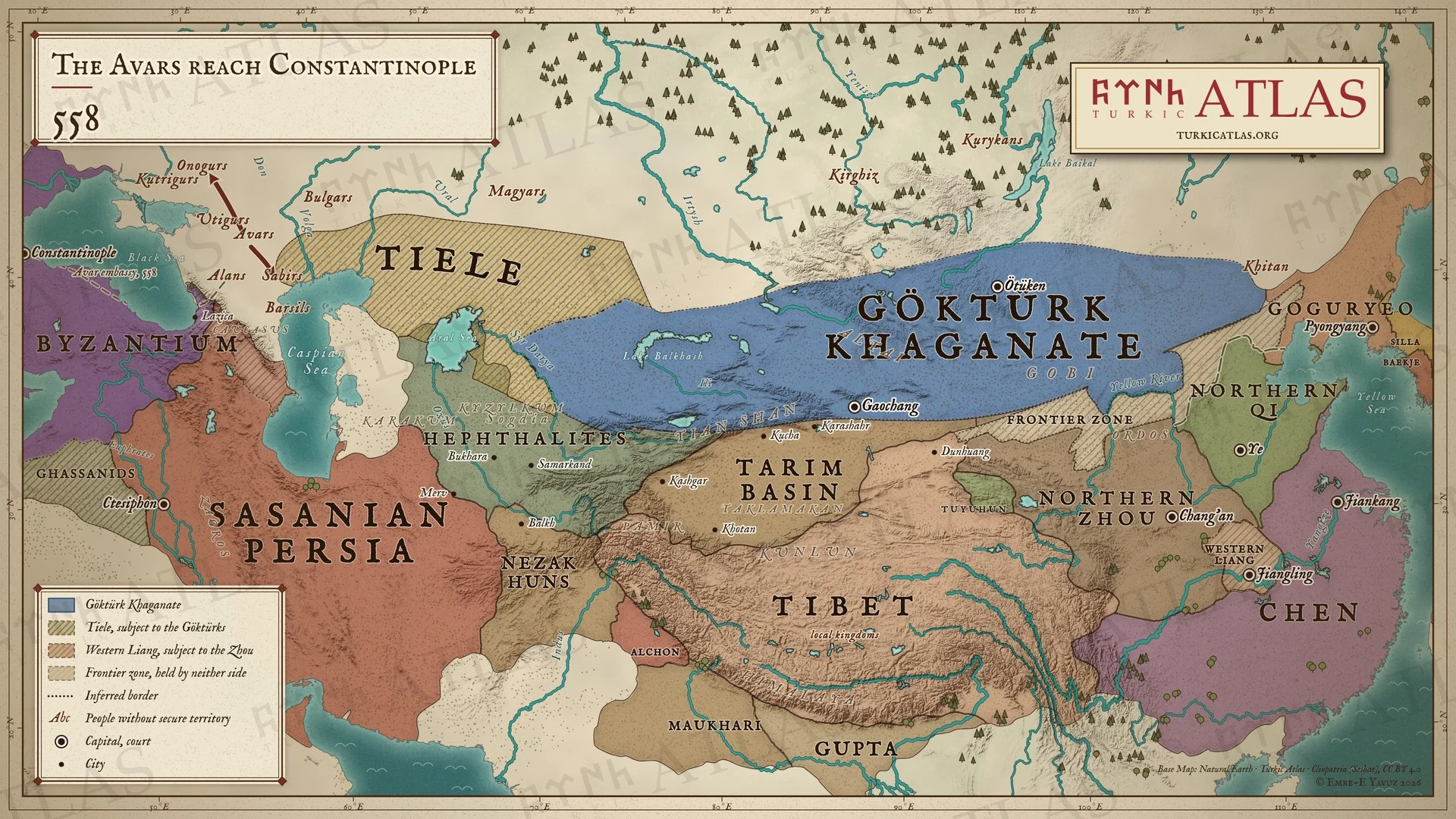
The khaganate on the Danube
The Avars of Europe are known from outside. Their history rests on Greek and Latin writers, with some Syriac, Armenian, Coptic, Arabic and Slavic ones. These writers saw the Avars from the Byzantine, Lombard or Frankish side. No Avar record of any weight survives.[11]
Menander Protector first names Bayan as khagan for the year 562, when he asked from the lower Danube for leave to settle inside the Roman frontier.[12] Justinian’s diplomacy gave him no large grant of land. Justin II stopped the yearly payments and presents on coming to the throne in 565.[12] Bayan turned west. In alliance with the Lombard king Alboin, he defeated the Gepids in 567, killed their king Kunimund and took their land. The Lombards left for Italy the next year. Bayan occupied the western part of the Carpathian basin as well, which completed the conquest of the middle Danube.[12]
From there the khaganate lived on Byzantine money and Byzantine weakness. Peace in 574 bound the empire to pay 80,000 gold pieces a year. The Göktürks held the Avars to be their runaway subjects, and in consequence they broke off relations with Byzantium.[13] After a blockade the empire surrendered Sirmium in the summer of 582, and the payment was renewed. About 585 it stood at 100,000.[14] While Byzantium fought Persia from 572 to 591, the Avars and the Slavs under their protection pushed into the Balkans. The Göktürks limited them. Their troops stood at Bosporus in the Crimea in 576 and near Cherson about 579. In 584 or 585, a report of a Göktürk attack on his own country made the khagan break off a successful campaign at Anchialus and withdraw to Sirmium.[15]
In 626, while Heraclius was campaigning in the East, an army of Avars, Slavs, Gepids and Bulgars besieged Constantinople for ten days. The imperial fleet decided the outcome. It kept the Persian commander Shahrbaraz on the Asian shore and destroyed the Slav boats in the Golden Horn.[16] The Avar ascendancy did not recover. The Slavic auxiliaries began to leave. The Bulgars claimed the khagan’s seat in 631 to 632 and lost the civil war that followed, with nine thousand of their families fleeing to Bavaria, where they were massacred. About 632 the Onoghur prince Kuvrat drove the khagan’s men out of Great Bulgharia.[17] By 678, when the Byzantine historians last mention an Avar embassy, it asked the emperor only for his benevolence.[18]
The state was not uniform. Bayan was followed by ten thousand Kutrigur warriors, whom he sent against Dalmatia in 568. Later a further ten thousand warriors of the Tarniakh, Kotzager and perhaps Zabender tribes fled the Göktürks and joined the Avars. Gepids stayed in the country, and the Bulgars were numerous enough in 631 to claim the khagan’s seat.[19] The Slavs nearest the centre, the Antes, Dulebs and Wends, bore the Avar yoke most heavily. A Wendic rising under Samo, whom the Fredegar chronicle calls a merchant from the land of the Franks, ended Avar influence between the Alps and the Elbe. Samo ruled until about 658 or 659.[20]
For the century from 680 to 780 the sources are few and doubtful. The river Enns became the western boundary of the khaganate, by most accounts between 680 and 700.[21] The end came from the Franks. Charlemagne negotiated with envoys of the khagan and of the yugurus from 782 and took the field in 791. By 794 a civil war was dividing the Avars. The khagan, the yugurus and the tudun each dealt with the Frankish court separately. The tudun was baptised at Aachen in 795, and the khagan and the yugurus fell in the quarrel.[22] In 795 and 796 Frankish armies broke into the heart of the country and destroyed the Ring, the khagan’s residence. Charlemagne gave part of the booty to his followers and to other rulers.[23]
The end of the state was not the end of the Avars. A baptised khagan, Abraham, was allowed in 805 to hold the supreme power over his people in the old manner. About the same time the Bulgar khan Krum destroyed the last remains of Avar statehood in the east.[24] A Salzburg memorial of 871 to 873 says that Christianised Avars were still living in Pannonia. Constantine Porphyrogenitus says that Avars still lived in Dalmatia in his time.[24]
The graves record a change about 670 to 680, which Byzantine coins date. Plain or stamped belt fittings give way to carved or glass-inlaid ones, and later to moulded ornaments with griffins and vines, the vine becoming dominant. Most Hungarian archaeologists connect the change with new groups arriving from the steppe.[25] Few graves in the major cemeteries are older than about 600. This suggests that until the age of Maurice the Avars and their federates had no permanent winter quarters. The later cemeteries, with hundreds and sometimes thousands of graves, point to a more settled life. Sickles and traces of poultry keeping appear beside the utensils of a pastoral one.[26]
Descent of the ruling elite
The Chinese histories end the Rouran khaganate between 552 and 555.[27][28] Anagui died in 552, and the Göktürks beat the remnant under his uncle Dengshuzi.[27] In 555 the Western Wei handed Dengshuzi and some three thousand of his people to the Göktürk envoys, who had them killed.[27][28] The Rouran chapter of the Bei Shi and the Tujue chapter of the Zhou Shu follow the survivors to the Northern Qi and the Western Wei. Neither names a flight to the west. The evidence for that flight is Byzantine.[2]
In 568 the Göktürk envoys at Constantinople said that some of the Avars still obeyed the Göktürks and that those who had fled numbered about twenty thousand.[5] In 576 Türk-shad called the Avars “our slaves who have fled their masters.”[29] The Göktürks thus claimed the Avars as subjects of the khaganate they had taken over, that is, the Rouran khaganate.[2] The dates agree. The first Avar envoys reached Constantinople in or around 558, before the Göktürk war against the Hephthalites was over. The fall of the Hephthalites therefore cannot have set the Avars in motion.[30][31] A flight from the Rouran collapse of 552 to 555 fits that sequence.[32]
The title points the same way. Shelun took the title khagan about 400.[33] The Hephthalites did not use it, and the ruler of the Avars did. Theophylact says that the Avars gave their leader the title of khagan, and Menander calls Bayan the khagan of the Avars.[2][34][35] The Göktürk envoys and the Byzantine writers insisted that the Avars of Europe were not the real Avars. That shows what the Avars claimed: to succeed the Rouran khaganate and so to be rightful khagans, on a par with the Göktürk khagans.[36] That claim would then be what enraged the Göktürk khagans against their fugitive slaves.[2][37]
The name points the same way. Rouran is a Chinese name, and outside the Chinese accounts the sources do not know it by that name.[38] The Rouran most likely called themselves Avars.[39][40][41] Priscus already names Avars about 463 as the people whose pressure set the Sabirs in motion. This is understood as the Rouran.[42] In Europe the name stayed with the ruling core while the groups beneath it changed.[39] The Liang Shu describes the Rouran with braided hair.[43] The first Avar envoys at Constantinople wore their hair long at the back, tied with ribbons and braided, and drew a crowd.[44] The braid, like the title and the organisation of the state, would then have come west with the Rouran core.[4]
The Avars in Europe were not Rouran alone. On the road west the Rouran nobility took in Ogur and Hunnic groups, and in numbers the following became largely Ogur.[4] The khagans, the title and the institutions came from the nobility.[4] A steppe polity kept its ruling core and its name while the groups beneath it changed in descent and in language.[39][45] The archaeology shows that mixture. In the early period there was no homogeneous Avar archaeological culture at all. Components of eastern steppe origin occur together with others that have close parallels in the Caucasus, the south Russian steppes and western Asia, and alongside local European, Mediterranean and Merovingian traditions. Objects and customs from the central Asian steppe do not even make up the bulk of the early Avar material.[1] The material changes after about 600.[1] The Avar material in the Carpathian basin becomes markedly more uniform, and grows more so through the remaining two centuries.[1] Whatever the Avars were when they arrived, they made themselves into one thing after they had arrived.
On the Asian side there is almost nothing to compare it with. Rouran archaeology is in its infancy, and a few individual finds that Mongolian archaeologists attribute to the Rouran are typologically comparable with Avar antiquities. No integrated Rouran archaeological tradition has been identified.[46] A single genome from the Rouran period has been published.[1] That individual has a broadly north-east Asian ancestry, distinct from the three published Xiongnu genomes. It falls between present-day Mongolic speakers and the Tungusic speakers of the lower Amur.[1] Studies of the maternal and paternal lines of the Avar elite find a substantial share of eastern Eurasian origin. The rest are western Eurasian.[1] The great majority of the eastern Y-chromosomes belong to one haplogroup, which suggests a fairly homogeneous eastern source on the paternal side.[1] Genome-wide data from the richest Avar burials of the seventh century then show north-east Asian ancestry that matches the earlier populations of the Mongolian steppe, and the Rouran-period genome in particular.[47] Many individuals of the early and middle elite fit that genome as a single source of ancestry. The models have little statistical power, however, because the genome is of low coverage.[48] The same elite also matches individuals of the Xiongnu and especially the Xianbei periods.[49] The later elite has a larger western Eurasian share, 20 to 30 per cent, mostly from a source that is not local to the Carpathian basin.[50] The authors take the result as support for the view that at least the Avar khagans and their core group descended from the Rouran.[3] What the uniparental markers cannot show is whether the mixture is an admixed population or a social order in which some individuals were wholly eastern and others wholly local.
Uchida Ginpū argues the case from the Chinese side most fully.[51] Uchida identified Theophylact’s Avars, who after their defeat fled partly to Taugast and partly to the Mukri, with Rouran who went to the Western Wei and to the Wuji of Manchuria.[52] He held that the Rouran destroyed in 555 were only one group of them. He regarded the Abo of the Sui histories, enemies of the Göktürks in the 580s, as Avars.[53] He also doubted that Apar in the Kül Tegin inscription means the Avars, and understood the name as Persia.[54] A second line of the same argument explains par from Middle Iranian pahr, a name for the whole Iranian land, and interprets apa urum as “Great Rome”, meaning Byzantium. The list of mourners would then name Persia and Byzantium and no Avars.[55]
The one weighty objection is linguistic. If the Rouran spoke a Mongolic language, as the reading of the Brāhmī inscriptions from central Mongolia suggests, and the Avars a Bulghar Turkic one, then continuity would require a language shift somewhere on the road.[1] No Mongolic substratum has been demonstrated in the language of the European Avars to show where.[1] Against that stands the dating of those inscriptions, which is the weak point of the Mongolic identification. Both were cut decades after the Rouran khaganate had been destroyed. The Rouran article discusses the problem.[1] A language shift during the migration is possible. The little that is known of the language of the European Avars is a weak basis for judging the language of the Rouran.[56]
Names and titles
- 𐰀𐰯𐰺Old Turkic
- ἌβαροιGreek
The one name that has carried most of the linguistic argument is that of Bayan, the first khagan, who ruled from 562 to 602.[1] It is understood as bayan, rich, a word used as a personal name among Bulghar Turkic and Mongolic speakers alike. It is of Turkic origin in Mongolic rather than the reverse.[1] A single name settles nothing by itself. The same Bulghar Turkic derivation can be assumed with some confidence for several other early Avar names, and no Mongolic trace appears among them.[1] Germanic and Alanic names stand there too.[1]
Of the titles, only khagan is attested among the Avars in the early period. The others, iugurrus, tudun, tarkhan and canizauci, enter the Avar political vocabulary at some point after 626. Their closest parallels are among the contemporary Bulghars and the Khazars. Tudun at least can be reconstructed as Proto-Turkic, and the spread of these words across the steppe belongs with the early Turkic migrations.[1] The article on the title gives what is known of khagan itself. It was the title of the Rouran khagans, and the rulers of the Avars bore it from the start.[57] Two of the later titles also stood at the Rouran court. The Wei Shu records the khatun, the consort of the Rouran khagan, and a modern account finds tarkhan borne by a brother of Anagui.[33][58] Among the Avars both titles are recorded only in a Frankish poem of 796.[59] That the ruler of the Avars in Hungary was called kaganus does not by itself make the Avars Turkic. The source of the title appears not to have been Turkic, and other nations of the steppe borrowed it too.[60] Other evidence may point to some form of Turkic among them.[60] One survey judges it probable, though it cannot be proved, that the principal titles of the later state continued the tradition set in Bayan’s time. These titles are khagan, khan, yugurus, kapkhan, tudun, tarkhan and katun. The survey notes that every one of them was used by one or more Altaic peoples. For the personal names it finds Altaic explanations in most cases, with different etymologies for some. It still leaves open whether the language stood nearer to Mongolic or to Turkic.[61]
The longest Avar-period text is the Buila inscription, nine words in Greek letters on a gold bowl from the treasure of Nagyszentmiklós.[1] The treasure was hidden in all likelihood after the fall of the khaganate in the early ninth century.[1] Most interpretations make it an early Turkic variety, and the most recent of them works from Bulghar Turkic material and from Chuvash, the one surviving Bulghar language. A Tungusic interpretation has been proposed and found incompatible with what is known of Tungusic historical phonology.[1] One caution applies to the inscription. A gold bowl can arrive as booty or as a gift, so its language need not be the language of the people who buried it.[1] The same survey found the runic marks on objects from Avar cemeteries uncertain in reading, possibly tamga-like property marks and not text. It held the runic inscriptions of the Nagyszentmiklós treasure to be probably later than the objects and not unambiguously legible.[62][63] The Nagyszentmiklós vessels are dated by their style to the eighth or ninth century, and only five of the nineteen inscriptions are published with pictures.[64] Another survey reports that archaeologists date the treasure before the ninth century. It also reports a bone needle case found in 1983 in a late Avar cemetery at Szarvas, of about the eighth century, which bears a runiform text of the same late Avar script. The survey thinks the language probably a Bulgar variety of Turkic, and it counts the script as undeciphered.[65] The surveys therefore differ on whether the runes are later than the objects. A different view identifies the signs on Avar graves of the Carpathian basin with the Orkhon and Yenisei script or one close to it.[66] It follows the script west with Karluk and Western Göktürk groups to the Urals, the Volga and the Oka, and from there with a late migration of the Avars to the Carpathian basin.[67] A tamga cut on a rock near Bol’šoe Mikuškino on the Sok has its nearest parallel on an iron strap end from an Avar grave at Keszthely-Csákberény in Hungary.[68]
Other theories
Other theories give the Rouran a smaller part or leave the origin open. For who argued each theory, and on what grounds, see the origin of the Avars.
The oldest is Theophylact’s. He writes that the Avars whom the Göktürks defeated fled partly to Taugast and partly to the Mukri, and that the people on the Danube were Var and Chunni, Ogurs who took the Avar name for its prestige.[69] The standard study of his text traces the distinction to a chronological error, since Theophylact placed the Göktürk victories under Maurice. It holds that his speculation about Avar origins is historically worthless.[70] Walter Pohl takes the pseudo-Avar line as a political interpretation rather than an ethnic one. On it the Avars of Europe were a mixed group of steppe warriors who chose a name of prestige, and the name Varchonites, which the Göktürks used for them, marks that mixture.[71] He doubts that the Rouran core, destroyed between 552 and 555, could have carried the migration.[72] He allows, however, that survivors of the ruling clan legitimized the title khagan for the new Avars. He holds it not unlikely that Bayan could claim descent from that clan.[37]
Another theory derives the core of the Avars from the Hephthalite realm and its Var and Hun peoples, a third from the Ogurs and the Töles.[73] A fourth identifies them with the Yueban, who lived west of the Rouran.[74] One survey leaves open whether the ancestors of the Danubian Avars were the Rouran or a nation of the Hephthalite realm. It allows that a combination of both may cover the historical reality. It observes that, whether or not Theophylact’s statement is discarded, the personal names of the Avars cannot be told apart from those of the Oghur peoples who joined them, both using an Altaic language.[75] A survey of the genetic data in 2020 found it neutral on the question. It showed only that at least some of the European Avars were of east Asian ancestry.[1]
The Göktürk claim to the Avars continued the Göktürk–Rouran Wars. The Avars matter here for three reasons. They are the reason the Göktürks and Byzantium spoke to each other at all. They are the westward continuation of the state the Göktürks destroyed. The Kül Tegin inscription names the Apar at the funeral of Bumin and Istemi.[76]
References
- ^ a b c d e f g h i j k l m n o p q r s t u v w x y Savelyev 2020
- ^ a b c d e f Golden 2013, p. 62–63
- ^ a b al. 2022, e6
- ^ a b c d Durmaz 2026, p. 59
- ^ a b Menander Protector; Blockley 1985, fr. 10.1, p. 117
- ^ Golden 2013, p. 54
- ^ Pohl 2018, p. 33, 217
- ^ a b Menander Protector
- ^ Werner 1956, p. 53
- ^ Werner 1956, p. 6, 15, 48
- ^ Sinor 1990, p. 206
- ^ a b c Sinor 1990, p. 207
- ^ Sinor 1990, p. 208
- ^ Sinor 1990, p. 208–209
- ^ Sinor 1990, p. 209
- ^ Sinor 1990, p. 213
- ^ Sinor 1990, p. 213–214
- ^ Sinor 1990, p. 215
- ^ Sinor 1990, p. 215, 222–223
- ^ Sinor 1990, p. 212–213, 224
- ^ Sinor 1990, p. 216
- ^ Sinor 1990, p. 217–218
- ^ Sinor 1990, p. 218–219
- ^ a b Sinor 1990, p. 220
- ^ Sinor 1990, p. 216, 226
- ^ Sinor 1990, p. 226–227
- ^ a b c Zhou Shu (Book of Zhou), juan 50
- ^ a b Bei Shi (History of the Northern Dynasties), juan 98
- ^ Menander Protector; Blockley 1985, fr. 19.1, p. 175
- ^ Pohl 2018, p. 20, 42
- ^ Whitby 1986, p. 188–189
- ^ Durmaz 2026, p. 58
- ^ a b Wei Shu, juan 103
- ^ Theophylact Simocatta; Whitby 1986, p. 189
- ^ Menander Protector; Blockley 1985, fr. 25.1, p. 219
- ^ Pohl 2018, p. 265
- ^ a b Pohl 2018, p. 46
- ^ Golden 2013, p. 45
- ^ a b c Golden 2013, p. 66
- ^ al. 2022, p. 2
- ^ Pohl 2018, p. 33
- ^ Golden 2013, p. 49–50
- ^ Liang Shu, juan 54
- ^ Pohl 2018, p. 20
- ^ Pohl 2018, p. 43–44
- ^ Kradin 2005, p. 150
- ^ al. 2022, p. 1, 7
- ^ al. 2022, p. 5
- ^ al. 2022, p. 7
- ^ al. 2022, p. 5, 7
- ^ 内田吟風 1962, p. 76,86
- ^ 内田吟風 1962, p. 78
- ^ 内田吟風 1962, p. 82-85
- ^ 内田吟風 1962, p. 87
- ^ Ercilasun 1990, p. 36–37
- ^ Golden 2013, p. 51–52
- ^ Pohl 2018, p. 270
- ^ Pohl 2018, p. 363
- ^ Pohl 2018, p. 363, 368
- ^ a b Erdal 2004, p. 3
- ^ Sinor 1990, p. 221–222
- ^ Sinor 1990, p. 225
- ^ Dončeva-Petkova 2000, p. 177
- ^ Kavrikova 2000, p. 241–242
- ^ Vásáry 1993, p. 58–59
- ^ Harmatta 1987 (Jahr after dem Dateinamen; ungarisches Original 1983), p. 57
- ^ Harmatta 1987 (Jahr after dem Dateinamen; ungarisches Original 1983), p. 73
- ^ Harmatta 1987 (Jahr after dem Dateinamen; ungarisches Original 1983), p. 67–71
- ^ Theophylact Simocatta; Whitby 1986, p. 188–190
- ^ Whitby 1988, p. 315, 317
- ^ Pohl 2018, p. 45–46
- ^ Pohl 2018, p. 36, 46
- ^ Durmaz 2026, p. 33–35
- ^ Pohl 2018, p. 41–42
- ^ Sinor 1990, p. 207, 222
- ^ Kül Tegin inscription
Sources
- Kül Tegin inscription
- Menander Protector
- Theophylact Simocatta
- Wei Shu, juan 103
- Zhou Shu (Book of Zhou), juan 50
- Bei Shi (History of the Northern Dynasties), juan 98 (after Wei Shu, Zhou Shu and Sui Shu)
- Liang Shu, juan 54
Literature
- Emre-E. Yavuz, The Gokturk Empire: 2nd Edition (2025)
- Ulf Büntgen; Vladimir S. Myglan; Fredrik Charpentier Ljungqvist; Michael McCormick; Nicola Di Cosmo et al., Cooling and societal change during the Late Antique Little Ice Age from 536 to around 660 AD (2016)
- Alexander Savelyev; Choongwon Jeong, Early Nomads of the Eastern Steppe and Their Tentative Connections in the West (2020)
- Uchida Ginpū 内田吟風, 柔然アヴァール同族論に關する諸問題 (1962)
- Marcel Erdal, A Grammar of Old Turkic (2004)
- Denis Sinor (ed.), The Cambridge History of Early Inner Asia (1990)
- Joachim Werner, Beiträge zur Archäologie des Attila-Reiches (1956)
- Peter B. Golden, Some Notes on the Avars and Rouran (2013)
- Walter Pohl, The Avars: A Steppe Empire in Central Europe, 567–822 (2018)
- Guido Alberto Gnecchi-Ruscone et al., Ancient Genomes Reveal Origin and Rapid Trans-Eurasian Migration of 7th Century Avar Elites (2022)
- Nikolay N. Kradin, From Tribal Confederation to Empire: The Evolution of the Rouran Society (2005)
- Batın Durmaz, Bozkırın Muamması: Avarların Köken Paradigması ve Yeni Bir Sentez Denemesi (2026)
- Batın Durmaz, Avar Etnogenezinin Oluşumunda Akhunların Etkisine Arkeogenetik Üzerinden Bir Bakış (2026)
- R. C. Blockley, The History of Menander the Guardsman: Introductory Essay, Text, Translation, and Historiographical Notes (1985)
- Michael Whitby, Mary Whitby (trans.), The History of Theophylact Simocatta (1986)
- Michael Whitby, The Emperor Maurice and His Historian (1988)
- János Harmatta (Turkish translation: Hicran Akın), Doğu Avrupa’da Türk Oyma Yazılı Kitabeler (1987 (Jahr after dem Dateinamen; ungarisches Original 1983))
- Ahmet Bican Ercilasun, Köl Tigin Yazıtı Bir Nutuk Metni midir? (1990)
- István Vásáry, Doğu Avrupa'nın Runik Alfabe Sistemleri Üzerine (1993)
- Lüdmila Dončeva-Petkova, Orta Çağ Bulgaristanı'ndan Runik İşaretler ve Birleşmeler (2000)
- Svetlana Venelinova Kavrikova, Murfatlar ve Nad Sent Mikloş Yazıtlarının Paleografik Karakteristiği (2000)
What links here44
- States
- Byzantium · Rouran Khaganate
- Battles & Events
- Embassy of Valentinos (576) · Flight of the Tarniach and Kotzager · Maniakh's embassy to Constantinople, 568 · Revolt of Turum · Siege of Bosporos, 576 · Subjugation of the Alans and Onogurs (before 576) · The Göktürk–Byzantine alliance · The khan's letter to Maurice
- Places
- Cherson
- Peoples
- Gepids · Kotzager · Kutrigurs · Rouran · Sabirs · Saragurs · Tarniach · Turkic Tribes in Europe · Utigurs · Zabender
- Lineages
- Yujiulü
- Institutions and Titles
- Avar Craftsmen · Khan (Khagan) · Skull Cup · The Göktürk Oath
- Religions
- Water Cult
- Languages
- The Turkic languages
- Sources
- Runiform inscriptions of the Khazar lands · Szarvas needle case inscription · Theophanes of Byzantium · Theophylact Simocatta · Treasure of Nagyszentmiklós
- Controversies
- Archaeogenetics of the Steppe Empires · The origin of the Avars
Cite this article
Yavuz, Emre-E. “Avars.” Turkic Atlas, revised 8 November 2026. https://turkicatlas.org/ethnicities/avars/
Last revised: 8 November 2026

